Results by title
15 books match the query 'Early Modern France'

An Errant Eye
Poetry and Topography in Early Modern FranceTom Conley
University of Minnesota Press, 2010
This tension, Conley demonstrates, cuts through literature and graphic matter of various shapes and forms-hybrid genres that include the comic novel, the emblem-book, the eclogue, sonnets, and the personal essay. An Errant Eye differs from historical treatments of spatial invention through Conley's argument that the topographic sensibility is one in which the ocular faculty, vital to the description of locale, is endowed with tact and touch.
Detailed close readings of Apian, Rabelais, Montaigne, and others empower the reader with a lively sense of the topographical impulse, deriving from Conley's own "errant eye," which is singularly discerning in attentiveness to the ambiguities of charted territory, the contours of woodcut images, and the complex combinations of word and figure in French Renaissance poetry, emblem, and politics.

Changing Identities in Early Modern France
Michael Wolfe, ed.
Duke University Press, 1997
After examining the interplay between competing ideologies and public institutions, from the monarchy to the Parlement of Paris to the aristocratic household, the volume explores the dynamics of deviance and dissent, particularly in regard to women’s roles in religious reform movements and such sensationalized phenomena as the witch hunts and infanticide trials. Concluding essays examine how regional and confessional identities reshaped French identity in response to the discovery of the New World and the spectacular spread of Calvinism.
Contributors. Charmarie Blaisdell, William Bouwsma, Lawrence M. Bryant, Denis Crouzet, Robert Descimon, Barbara B. Diefendorf, Richard M. Golden, Sarah Hanley, Mack P. Holt, Donald R. Kelley, Kristen B. Neuschel, J. H. M. Salmon, Zachary Sayre Schiffman, Silvia Shannon, Alfred Soman, Michael Wolfe
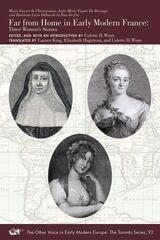
Far from Home in Early Modern France
Three Women’s StoriesMarie Guyart de l’Incarnation, Anne-Marie Fiquet du Boccage, and Henriette-Lucie Dillon de la Tour du Pin
Iter Press, 2022
This book showcases three Frenchwomen who ventured far from home at a time when such traveling was rare. In 1639, Marie de l’Incarnation embarked for New France where she founded the first Ursuline monastery in present-day Canada. In 1750, Madame du Boccage set out at the age of forty on her first “grand tour.” She visited England, the Netherlands, and Italy where she experienced firsthand the intellectual liberty offered there to educated women. As the Reign of Terror gripped France, the Marquise de la Tour du Pin fled to America with her husband and their two young children, where they ran a farm from 1794 to 1796. The writings these women left behind detailing their respective journeys abroad represent significant contributions to early modern travel literature. This book makes available to anglophone readers three texts that are rich in both historical and literary terms.
Involuntary Confessions of the Flesh in Early Modern France
Nora Martin Peterson
University of Delaware Press, 2017
Involuntary Confessions of the Flesh in Early Modern France was inspired by the observation that small slips of the flesh (involuntary confessions of the flesh) are omnipresent in early modern texts of many kinds. These slips (which bear similarities to what we would today call the Freudian slip) disrupt and destabilize readings of body, self, and text—three categories whose mutual boundaries this book seeks to soften—but also, in their very messiness, participate in defining them. Involuntary Confessions capitalizes on the uncertainty of such volatile moments, arguing that it is instability itself that provides the tools to navigate and understand the complexity of the early modern world. Rather than locate the body within any one discourse (Foucauldian, psychoanalytic), this book argues that slips of the flesh create a liminal space not exactly outside of discourse, but not necessarily subject to it, either. Involuntary confessions of the flesh reveal the perpetual and urgent challenge of early modern thinkers to textually confront and define the often tenuous relationship between the body and the self. By eluding and frustrating attempts to contain it, the early modern body reveals that truth is as much about surfaces as it is about interior depth, and that the self is fruitfully perpetuated by the conflict that proceeds from seemingly irreconcilable narratives.
Interdisciplinary in its scope, Involuntary Confessions of the Flesh in Early Modern France pairs major French literary works of the sixteenth and seventeenth centuries (by Marguerite de Navarre, Montaigne, Madame de Lafayette) with cultural documents (confession manuals, legal documents about the application of torture, and courtly handbooks). It is the first study of its kind to bring these discourses into thematic (rather than linear or chronological) dialog. In so doing, it emphasizes the shared struggle of many different early modern conversations to come to terms with the body’s volatility.
Published by University of Delaware Press. Distributed worldwide by Rutgers University Press.
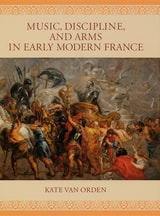
Music, Discipline, and Arms in Early Modern France
Kate van Orden
University of Chicago Press, 2005
The great pressure on French noblemen to take up the life of the warrior gave rise to bellicose art forms such as sword dances and equestrian ballets. Far from being construed as effeminizing, such combinations of music and the martial arts were at once refined and masculine-a perfect way to display military prowess. The incursion of music into riding schools and infantry drills contributed materially to disciplinary order, enabling the larger and more effective armies of the seventeenth century. This book is a history of the development of these musical spheres and how they brought forth new cultural priorities of civility, military discipline, and political harmony. Music, Discipline, and Arms in Early Modern France effectively illustrates the seminal role music played in mediating between the cultural spheres of letters and arms.
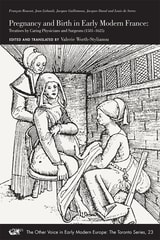
Pregnancy and Birth in Early Modern France
Treatises by Caring Physicians and Surgeons (1581–1625)François Rousset, Jean Liebault, Jacques Guillemeau, Jacques Duval, and Louis de Serres
Iter Press, 2013
—Gianna Pomata
Professor of the History of Medicine, Johns Hopkins University
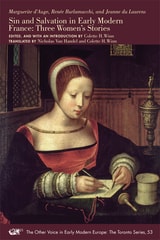
Sin and Salvation in Early Modern France
Three Women’s StoriesMarguerite d'Auge, Renée Burlamacchi, and Jeanne du Laurens
Iter Press, 2017
The texts available here in English for the first time open a window into the lives of three early modern Frenchwomen as they explore the common themes of family, memory, sin, and salvation. The Regrets of Marguerite d’Auge (1600), the Memoirs of Renée Burlamacchi (1623), and the Genealogy of Jeanne du Laurens (1631), taken from different genres of historical writings, raise important questions: Why and how did female authorship find its way into the historical record? How did these voices escape the censorship and prejudice against female publication? In a time of extreme religious conflict, how did these women convey their views on controversial issues such as primacy of grace, indulgences, and salvation without disrupting the gender expectations of the era?
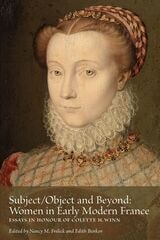
Subject/Object and Beyond
Women in Early Modern FranceEdited by Nancy M. Frelick and Edith Benkov
Iter Press, 2023
Subject/Object and Beyond brings together essays by established and emerging scholars to honor the exceptionally rich contributions and career of scholar Colette H. Winn. It also celebrates fifty years of sustained scholarship on early modern women, along with the foundation of Women’s Studies as a recognized academic discipline in North America. The collection comprises seventeen articles that explore multiple perspectives on early modern women, including their writings, translations, reception, and contributions to various fields, including literature, music, politics, religion, and science.
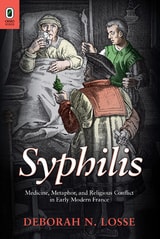
Syphilis
Medicine, Metaphor, and Religious Conflict in Early Modern FranceDeborah N. Losse
The Ohio State University Press, 2015
Losse provides close readings of a range of genres, moving between polemical poetry, satirical narratives, dialogical colloquies, travel literature, and the personal essay. With chapters featuring Erasmus, Rabelais, Montaigne, Léry, and Agrippa d’Aubigné, this study compares literary descriptions of syphilis with medical descriptions. In the first full-length study of Renaissance writers’ engagement with syphilis, Deborah Losse charts a history from the most vehement rhetoric of the pox to a tenuous resolution of France’s conflicts, when both sides called for a return to order.
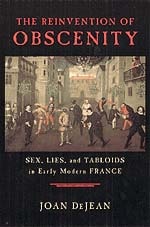
The Reinvention of Obscenity
Sex, Lies, and Tabloids in Early Modern FranceJoan DeJean
University of Chicago Press, 2002
The Reinvention of Obscenity casts a fresh light on the mythical link between sexual impropriety and things French. Exploring the complicity between censorship, print culture, and obscenity, DeJean argues that mass market printing and the first modern censorial machinery came into being at the very moment that obscenity was being reinvented—that is, transformed from a minor literary phenomenon into a threat to society. DeJean's principal case in this study is the career of Moliére, who cannily exploited the new link between indecency and female genitalia to found his career as a print author; the enormous scandal which followed his play L'école des femmes made him the first modern writer to have his sex life dissected in the press.
Keenly alert to parallels with the currency of obscenity in contemporary America, The Reinvention of Obscenity will concern not only scholars of French history, but anyone interested in the intertwined histories of sex, publishing, and censorship.
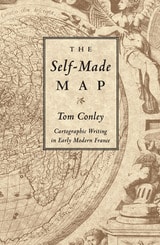
The Self-Made Map
Cartographic Writing in Early Modern FranceTom Conley
University of Minnesota Press, 2011
Conley traces the explosion of interest in mapmaking that occurred with the discovery of the New World, and discusses the commensurate rise of what he defines as cartographic writing-writing that "holds, penetrates, delineates, and explores space." Considering the works of such writers as Rabelais, Montaigne, and Descartes, Conley provides a "navigation" through the printed page, revealing the emerging values of Renaissance France. In his examination of the placing of words, letters, and graphic elements in books, he exposes the playful and sometimes enigmatic relation between spatial organization and text.
Conley also exposes the ideological exercise inherent in mapmaking, arguing that Renaissance cartography is inseparably bound up with the politics of the era. He undertakes close readings of maps and illustrations, discussing the necessity of viewing Renaissance maps in the context of their typographic layout, graphic reproduction, and literary and ideological import.
Richly illustrated throughout, The Self-Made Map combines studies of art, geography, history, literature, and printing to show a clear historical transformation, along the way linking geographical discoveries, printing processes, and political awareness. Conley's provocative analysis discloses how early modern printed literature and cartography worked together to crystallize broader issues engaging the then emergent status of cultural identity, nation, and individuality.
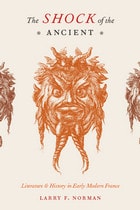
The Shock of the Ancient
Literature and History in Early Modern FranceLarry F. Norman
University of Chicago Press, 2011
The cultural battle known as the Quarrel of the Ancients and Moderns served as a sly cover for more deeply opposed views about the value of literature and the arts. One of the most public controversies of early modern Europe, the Quarrel has most often been depicted as pitting antiquarian conservatives against the insurgent critics of established authority. The Shock of the Ancient turns the canonical vision of those events on its head by demonstrating how the defenders of Greek literature—rather than clinging to an outmoded tradition—celebrated the radically different practices of the ancient world.
At a time when the constraints of decorum and the politics of French absolutism quashed the expression of cultural differences, the ancient world presented a disturbing face of otherness. Larry F. Norman explores how the authoritative status of ancient Greek texts allowed them to justify literary depictions of the scandalous. The Shock of the Ancient surveys the diverse array of aesthetic models presented in these ancient works and considers how they both helped to undermine the rigid codes of neoclassicism and paved the way for the innovative philosophies of the Enlightenment. Broadly appealing to students of European literature, art history, and philosophy, this book is an important contribution to early modern literary and cultural debates.

The Written World
Space, Literature, and the Chorological Imagination in Early Modern FranceJeffrey N. Peters
Northwestern University Press, 2018
In analyses of well-known authors such as Corneille, Molière, Racine, and Madame de Lafayette, Peters demonstrates that the apparent absence of physical space in seventeenth-century literary depiction indicates a subtle engagement with, rather than a rejection of, evolving principles of cosmological understanding. Space is not absent in these works so much as transformed in keeping with contemporaneous developments in early modern natural philosophy. The Written World will appeal to philosophers of literature and literary theorists as well as scholars of early modern Europe and historians of science and geography
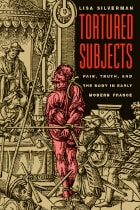
Tortured Subjects
Pain, Truth, and the Body in Early Modern FranceLisa Silverman
University of Chicago Press, 2001
Looking closely at the theory and practice of judicial torture in France from 1600 to 1788, the year in which it was formally abolished, Silverman revisits dossiers compiled in criminal cases, including transcripts of interrogations conducted under torture, as well as the writings of physicians and surgeons concerned with the problem of pain, records of religious confraternities, diaries and letters of witnesses to public executions, and the writings of torture's abolitionists and apologists. She contends that torture was at the center of an epistemological crisis that forced French jurists and intellectuals to reconsider the relationship between coercion and sincerity, or between free will and evidence. As the philosophical consensus on which torture rested broke down, and definitions of truth and pain shifted, so too did the foundation of torture, until by the eighteenth century, it became an indefensible practice.
Toward a Premodern Posthumanism
Anarchic Ontologies of Earthly Life in Early Modern FranceChad Córdova
Northwestern University Press, 2025
Drawing on early modern French thought to free nature and aesthetics from metaphysical humanism
What good is aesthetics in a time of ecological crisis? Toward a Premodern Posthumanism: Anarchic Ontologies of Earthly Life in Early Modern France shows that philosophical aesthetics contains unheeded potentialities for challenging the ontological subjection of nature to the human subject. Drawing on deconstructive, ecological, and biopolitical thought, Chad Córdova uncovers in aesthetics something irreducible to humanist metaphysics: an account of how beings emerge and are interrelated, responsive, and even response-able without reason or why.
This anarchic and atelic ontology, recovered from Kant, becomes the guiding thread for a new, premodern trajectory of posthumanism. Charting a path from Aristotle to Heidegger to today’s plant-thinking, with new readings of Montaigne, Pascal, Diderot, Rousseau, and others along the way, this capacious study reveals the untimely relevance of pre-1800 practices of writing, science, and art. Enacting a multitemporal mode of reading, Córdova offers a defense and illustration of the importance of returning to early modern texts as a way to rethink nature, art, ethics, and politics in a time when these concepts are in flux and more contentious than ever.