Results by title
11 books match the query 'Editors'
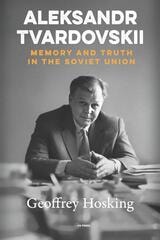
Aleksandr Tvardovskii
Memory and Truth in the Soviet UnionGeoffrey Hosking
Central European University Press, 2025
By giving a balanced account of his strengths and weaknesses, his achievements and failures, the author succeeds in giving the fullest picture available anywhere of a controversial man who turns out to be more complex than he has been portrayed so far. To understand him better is to understand why the Soviet intelligentsia changed so fundamentally in the USSR’s final decades, a change that helps to explain the rise of Gorbachev twenty years later. The study—which includes an in-depth analysis of Tvardovskii’s major works—also helps to better understand the fate of culture under an authoritarian regime and the intricacies of the struggle against censorship.
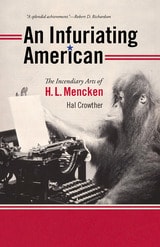
An Infuriating American
The Incendiary Arts of H. L. MenckenHal Crowther
University of Iowa Press, 2014
Nearly 60 years after his death, Mencken’s memory and monumental verbal legacy rest largely in the hands of literary scholars and historians, to whom he will always be a curious figure, unchecked and alien and not a little distasteful. No faculty would have voted him tenure. Hal Crowther, who followed in many of Mencken’s footsteps as a reporter, magazine editor, literary critic, and political columnist, focuses on Mencken the creator, the observer who turned his impressions and prejudices into an inimitable group portrait of America, painted in prose that charms and glowers and endures. Crowther, himself a working polemicist who was awarded the Baltimore Sun’s Mencken prize for truculent commentary, examines the origin of Mencken’s thunderbolts—where and how they were manufactured, rather than where and on whom they landed.
Mencken was such an outrageous original that contemporary writers have made him a political shuttlecock, defaming or defending him according to modern conventions he never encountered. Crowther argues that loving or hating him, admiring or despising him are scarcely relevant. Mencken can inspire and he can appall. The point is that he mattered, at one time enormously, and had a lasting effect on the national conversation. No writer can afford to ignore his craftsmanship or success, or fail to be fascinated by his strange mind and the world that produced it. This book is a tribute—though by no means a loving one—to a giant from one of his bastard sons.
Behind the Curtain of Scholarly Publishing
Editors in Writing StudiesGreg Giberson
Utah State University Press, 2022
Each chapter in the collection examines the unique experiences and individual contributions of its authors during their time as editors, offering advice to scholars and potential editors on how to navigate the publication process and understand editorial roles. The contributors provide multiple perspectives on the growth, transformation, and, in some cases, founding of some of the most influential publishing venues in writing studies.
The personal and historical narratives, along with the unique perspectives and insightful analyses of the individual authors in Behind the Curtain of Scholarly Publishing, offer needed transparency and context to what has historically been an opaque, yet inevitable and consequential, part of academic life. This volume will help researchers in the field understand the publishing process.
Contributors: Cheryl Ball, David Bartholomae, Charles Bazerman, Jean Ferguson Carr, Douglas Eyman, Muriel Harris, Byron Hawk, Alice Horning, Paul Kei Matsuda, Laura Micciche, Mike Palmquist, Michael Pemberton, Malea Powell, Kelly Ritter, Victor Villanueva, Victor Vitanza, Kathleen Blake Yancey
Between History And Poetry
H.D. And Norman Holmes PearsonDonna Krolik Hollenberg
University of Iowa Press, 1997
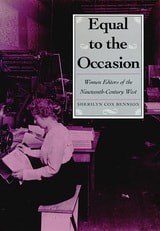
Equal To The Occasion
Women Editors On The Nineteenth-Century WestSherilyn Cox Bennion
University of Nevada Press, 1990
Bennion provides in-depth portraits of nineteenth-century women editors of the West and their diverse publications. The book's title takes its name from an 1898 editorial in the Wasatch Wave which described Piute Pioneer editor Candace Alice De Witt as a "maiden fair, fully equal to the occasion."Equal to the Occasion delves into the lives, publications, and historical contexts in which approximately thirty-five female editors of newspapers and other periodicals worked in the nineteenth-century West. The book covers the period from 1854, when the West's first woman editor began her work, through the turn of the century; it includes research gathered from thirteen western states. With its in-depth portraits of pioneering women editors and its appendix listing more than two hundred women and the major repositories where their extant publications are kept, Equal to the Occasion rescues from obscurity a whole panoply of nineteenth-century western women.
Gordon MacQuarrie
The Story of an Old Duck HunterKeith Crowley
Wisconsin Historical Society Press, 2003

Miss Kansas City
Joan Frank
University of Michigan Press, 2006
Friendless and reclusive, Alex Blue commutes two hours each way to a job that serves mainly as a place to bide time, until one day she meets the wealthy, worldly—and married—owner of a high-concept Bay Area lifestyle company. Meanwhile, the melancholy and closeted Morton Levi, yearning for a loving partner but stung by prior experience, lives a secret life outside the software information company he manages with a steady, efficient hand—the same company where Alex works.
As ominous rumors of mergers and layoffs swirl, and Alex and Mort are pushed to the emotional brink by the vagaries of love, they find themselves forging an unexpected alliance. Miss Kansas City is a moving exploration of the notion of possibility, and of a seasoned hope that can emerge on the other side of loneliness and loss.
O, How the Wheel Becomes It!
A NovelAnthony Powell
University of Chicago Press, 2015
Written at the peak of the late British master’s extraordinary literary career, this novel offers profound insight into the mind of a great artist whose unequaled style, ear for dialogue, and eye for irony will delight devotees and new readers alike.
Secretaries of the Moon
The Letters of Wallace Stevens and José Rodriguez FeoBeverly Coyle and Alan Filreis, eds.
Duke University Press, 1986
Coyle and Filreis present the entire extant correspondence between the two men. The fifty-one Rodriguez Feo letters and ten of the numerous Stevens letters are printed here for the first time, and the exchange between the two is unusually complete. The work includes a critical introduction and complete annotation of the letters.

The Last of His Mind
A Year in the Shadow of Alzheimer’sJohn Thorndike
Ohio University Press, 2011

William Maxwell
A Literary LifeBarbara A. Burkhardt
University of Illinois Press, 2004
Known as a beloved, longtime fiction editor at The New Yorker, William Maxwell worked closely with such legendary writers as Vladimir Nabokov, John Updike, Mary McCarthy, and John Cheever. His own novels include They Came Like Swallows and the American Book Award-winning So Long, See You Tomorrow, and many consider him to be one of the twentieth century's most important writers. Barbara Burkhardt's William Maxwell: A Literary Life represents the first major critical study of this Illinois writer's life and work.
Writing with an economy and elegance befitting her subject, Burkhardt addresses Maxwell's highly autobiographical fiction by skillfully interweaving his biography with her own critical interpretations. She contextualizes his fiction in terms of events including his mother's early death from influenza, his marriage, and the role of his psychoanalysis under the guidance of Theodor Reik. Drawing on a wide range of previously unavailable material, Burkhardt includes letters Maxwell received from authors such as Eudora Welty and Louise Bogan, excerpts from his unpublished manuscripts and correspondence, and her own interviews with Maxwell and key figures from his life, including John Updike, Roger Angell, New Yorker fiction editor Robert Henderson, and Maxwell's family and friends.