Results by title
9 books match the query 'Education, Bilingual'
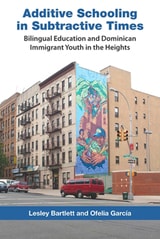
Additive Schooling in Subtractive Times
Bilingual Education and Dominican Immigrant Youth in the HeightsLesley Bartlett
Vanderbilt University Press, 2011
After offering a history of the school's formation, the authors detail the ways in which federal No Child Left Behind policies, New York State accountability measures, and New York City's educational reforms under Mayor Michael Bloomberg complicated the school's efforts. The book then describes the dynamic bilingual pedagogical approach adopted within the school to help students develop academic Spanish and English. Focusing on the lives of twenty immigrant youth, Bartlett and Garcia also show that, although the school achieves high completion rates, the graduating students nevertheless face difficult postsecondary educational and work environments that too often consign them to the ranks of the working poor.
American Conversations
Ellen Bigler
Temple University Press, 1999
The impassioned debate that erupted between long-time white ethnic residents and more recently arrived Puerto Rican citizens in the de-industrialized city the author calls "Arnhem" was initially sparked by one school board member's disparaging comments about Latinos. The conflict led to an investigation by the attempts to implement multicultural reforms in the city's schools. American Conversations follows the ensuing conflict, looks at the history of racial formation in the United States, and considers the specific economic and labor histories of the groups comprising the community in opposition. Including interviews with students, teachers, parents, and community leaders, as well as her own observations of exchanges among them inside and outside the classroom, Bigler's book explores the social positions, diverging constructions of history, and polarized understandings of contemporary racial/ethnic dynamics in Arnhem. Through her retelling of one community's crisis, Bigler illuminates the nature of racial politics in the United States and how both sides in the debate over multicultural education struggle to find a common language.
American Conversations will appeal to anyone invested in education and multiculturalism in the United States as well as those interested in anthropology, sociology, racial and ethnic studies, educational institutions, migration and settlement, the effects of industrial restructuring, and broad issues of community formation and conflict.
Change and Promise
Bilingual Deaf Education and Deaf Culture in Latin AmericaBarbara Gerner Gerner de Garcia
Gallaudet University Press, 2016
Change and Promise describes the historical, cultural, and political contexts for providing bilingual deaf education in Latin America. Bilingual deaf education uses students’ sign language, while simultaneously giving them access to and teaching them the majority spoken/written language. This book describes current bilingual deaf education programs in the region that have increased society’s understandings of Deaf culture and sign languages. This cause, as well as others, have been championed by successful social movements including the push for official recognition of Libras, the sign language of Brazil. Change and Promise covers this expanding empowerment of Deaf communities as they fight for bilingual deaf education, sign language rights, and deaf civil rights.
Despite the vast political and cultural differences throughout Latin America, an epistemological shift has occurred regarding how Deaf people are treated and their stories narrated, from labeling “deaf as handicapped” to being recognized as a linguistic minority. This panoramic study of these challenges and triumphs will provide an invaluable resource for improving outcomes in deaf education and help to secure the rights of deaf children and adults in all societies.
Communities of Practice
An Alaskan Native Model for Language Teaching and LearningEdited by Patrick E. Marlow and Sabine Siekmann
University of Arizona Press, 2013
In Alaska, the Second Language Acquisition Teacher Education (SLATE) project was designed to enable Indigenous communities and schools to improve the quality of native-language and English-language instruction and assessment by focusing on the elimination of barriers that have historically hindered degree completion for Indigenous and rural teachers. The Guided Research Collaborative (GRC) model, was employed to support the development of communities of practice through near-peer mentoring and mutual scaffolding. Through this important new model, teachers of both the heritage language, in this case Central Yup’ik, and English were able to situate their professional development into a larger global context based on current notions of multilingualism.
In Communities of Practice contributors show how the SLATE program was developed and implemented, providing an important model for improving second-language instruction and assessment. Through an in-depth analysis of the program, contributors show how this project can be successfully adapted in other communities via its commitment to local control in language programming and a model based on community-driven research.
Communities of Practice demonstrates how an initial cohort of Yup’ik- and English-language teachers collaborated to negotiate and ultimately completed the SLATE program. In so doing, these educators enhanced the program and their own effectiveness as teachers through a greater understanding of language learning. It is these understandings that will ultimately allow heritage- and English-language teachers to work together to foster their students’ success in any language.
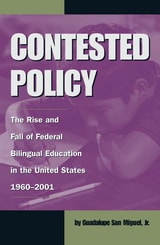
Contested Policy
The Rise and Fall of Federal Bilingual Education in the United States, 1960-2001Guadalupe San Miguel, Jr.
University of North Texas Press, 2004
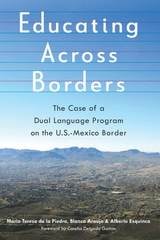
Educating Across Borders
The Case of a Dual Language Program on the U.S.-Mexico BorderMaría Teresa de la Piedra, Blanca Araujo, and Alberto Esquinca; Foreword by Concha Delgado Gaitan
University of Arizona Press, 2018
The authors, who themselves live and work on the border, question artificially created cultural and linguistic borders. To explore this issue, they employed participant-observation, focus groups, and individual interviews with teachers, administrators, and staff members to construct rich understandings of the experiences of transfronterizx students. These ethnographic accounts of their daily lives counter entrenched deficit perspectives about transnational learners.
Drawing on border theory, immigration and border studies, funds of knowledge, and multimodal literacies, Educating Across Borders is a critical contribution toward the formation of a theory of physical and metaphorical border crossings that ethnic minoritized students in U.S. schools must make as they traverse the educational system.
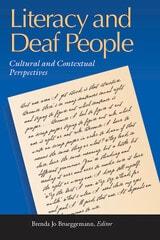
Literacy and Deaf People
Cultural and Contextual PerspectivesBrenda Jo Brueggemann
Gallaudet University Press, 2004
This compelling collection advocates for an alternative view of deaf people’s literacy, one that emphasizes recent shifts in Deaf cultural identity rather than a student’s past educational context as determined by the dominant hearing society. Divided into two parts, the book opens with four chapters by leading scholars Tom Humphries, Claire Ramsey, Susan Burch, and volume editor Brenda Jo Brueggemann. These scholars use diverse disciplines to reveal how schools where deaf children are taught are the product of ideologies about teaching, about how deaf children learn, and about the relationship of ASL and English.
Part Two features works by Elizabeth Engen and Trygg Engen; Tane Akamatsu and Ester Cole; Lillian Buffalo Tompkins; Sherman Wilcox and BoMee Corwin; and Kathleen M. Wood. The five chapters contributed by these noteworthy researchers offer various views on multicultural and bilingual literacy instruction for deaf students. Subjects range from a study of literacy in Norway, where Norwegian Sign Language recently became the first language of instruction for deaf pupils, to the difficulties faced by deaf immigrant and refugee children who confront institutional and cultural clashes. Other topics include the experiences of deaf adults who became bilingual in ASL and English, and the interaction of the pathological versus the cultural view of deafness. The final study examines literacy among Deaf college undergraduates as a way of determining how the current social institution of literacy translates for Deaf adults and how literacy can be extended to deaf people beyond the age of 20.
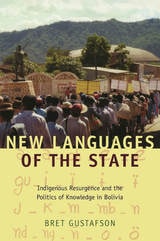
New Languages of the State
Indigenous Resurgence and the Politics of Knowledge in BoliviaBret Gustafson
Duke University Press, 2009
Gustafson shows that bilingual education is an issue that extends far beyond the classroom. Public schools are at the center of a broader battle over territory, power, and knowledge as indigenous movements across Latin America actively defend their languages and knowledge systems. In attempting to decolonize nation-states, the indigenous movements are challenging deep-rooted colonial racism and neoliberal reforms intended to mold public education to serve the market. Meanwhile, market reformers nominally embrace cultural pluralism while implementing political and economic policies that exacerbate inequality. Juxtaposing Guarani life, language, and activism with intimate portraits of reform politics among academics, bureaucrats, and others in and beyond La Paz, Gustafson illuminates the issues, strategic dilemmas, and imperfect alliances behind bilingual intercultural education.

Once Upon a Cuento
Bilingual Storytimes in English and SpanishJamie Campbell Naidoo
American Library Association, 2016