Results by title
34 books match the query 'Electronic surveillance'
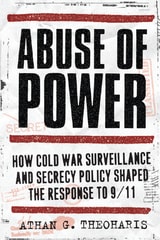
Abuse of Power
How Cold War Surveillance and Secrecy Policy Shaped the Response to 9/11Authored by Athan Theoharis
Temple University Press, 2011
Athan Theoharis, long a respected authority on surveillance and secrecy, established his reputation for meticulous scholarship with his work on the loyalty security program developed under Truman and McCarthy. In Abuse of Power, Theoharis continues his investigation of U.S. government surveillance and historicizes the 9/11 response.
Criticizing the U.S. government's secret activities and policies during periods of "unprecedented crisis," he recounts how presidents and FBI officials exploited concerns about foreign-based internal security threats.
Drawing on information sequestered until recently in FBI records, Theoharis shows how these secret activities in the World War II and Cold War eras expanded FBI surveillance powers and, in the process, eroded civil liberties without substantially advancing legitimate security interests.
Passionately argued, this timely book speaks to the costs and consequences of still-secret post-9/11 surveillance programs and counterintelligence failures. Ultimately, Abuse of Power makes the case that the abusive surveillance policies of the Cold War years were repeated in the government's responses to the September 11 attacks.
Age Factors in Biometric Processing
Michael Fairhurst
The Institution of Engineering and Technology, 2013
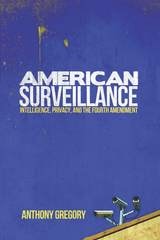
American Surveillance
Intelligence, Privacy, and the Fourth AmendmentAnthony Gregory
University of Wisconsin Press, 2016
Anthony Gregory challenges such simplifications, offering a nuanced history and analysis of these difficult issues. He highlights the complexity of the relationship between the gathering of intelligence for national security and countervailing efforts to safeguard individual privacy. The Fourth Amendment prohibiting unreasonable searches and seizures offers no panacea, he finds, in combating assaults on privacy—whether by the NSA, the FBI, local police, or more mundane administrative agencies. Given the growth of technology, together with the ambiguities and practical problems of enforcing the Fourth Amendment, advocates for privacy protections need to work on multiple policy fronts.
“This fascinating review of the shifts and accretions of American law and culture is filled with historical surprises and twenty-first-century shocks, so beneficial in an era of gross American ahistoricality and cultural acquiescence to the technological state. Every flag-waving patriot, every dissenter, every judge and police officer, every small-town mayor and every president should read America Surveillance. We have work to do!”—Lt. Col. Karen U. Kwiatkowski, (Ret.), former Senior Operations Staff Officer, Office of the Director, National Security Agency

Anonymity
Alison Macrina
American Library Association, 2019
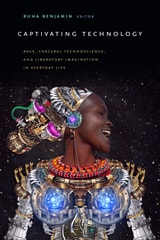
Captivating Technology
Race, Carceral Technoscience, and Liberatory Imagination in Everyday LifeRuha Benjamin, editor
Duke University Press, 2019

Computers, Surveillance, and Privacy
David Lyon and Elia Zureik, Editors
University of Minnesota Press, 1996
Computers, Surveillance, and Privacy was first published in 1996. Minnesota Archive Editions uses digital technology to make long-unavailable books once again accessible, and are published unaltered from the original University of Minnesota Press editions.
From computer networks to grocery store checkout scanners, it is easier and easier for governments, employers, advertisers, and individuals to gather detailed and sophisticated information about each of us. In this important new collection, the authors question the impact of these new technologies of surveillance on our privacy and our culture.
Although surveillance-literally some people "watching over" others-is as old as social relationships themselves, with the advent of the computer age this phenomenon has acquired new and distinctive meanings. Technological advances have made it possible for surveillance to become increasingly global and integrated-both commercial and government-related personal data flows more frequently across national boundaries, and the flow between private and public sectors has increased as well.
Addressing issues of the global integration of surveillance, social control, new information technologies, privacy violation and protection, and workplace surveillance, the contributors to Computers, Surveillance, and Privacy grapple with the ramifications of these concerns for society today. Timely and provocative, this collection will be of vital interest to anyone concerned with resistance to social control and incursions into privacy.
Contributors: Jonathan P. Allen, Colin J. Bennett, Simon G. Davies, Oscar H. Gandy Jr., Calvin C. Gotlieb, Rob Kling, Gary T. Marx, Abbe Mowshowitz, Judith A. Perrolle, Mark Poster, Priscilla M. Regan, James B. Rule.
David Lyon is professor of sociology at Queen's University, Canada. His previous books include The Electronic Eye: The Rise of Surveillance Society (Minnesota, 1994). Elia Zureik is also professor of sociology at Queen's University, Canada, and coedited (with Dianne Hartling) The Social Context of the New Information and Communication Technologies (1987).

Crisis Vision
Race and the Cultural Production of SurveillanceTom Monahan
Duke University Press, 2022

Dark Matters
On the Surveillance of BlacknessSimone Browne
Duke University Press, 2015
Digitize and Punish
Racial Criminalization in the Digital AgeBrian Jefferson
University of Minnesota Press, 2020
Tracing the rise of digital computing in policing and punishment and its harmful impact on criminalized communities of color
The U.S. Bureau of Justice Statistics estimates that law enforcement agencies have access to more than 100 million names stored in criminal history databases. In some cities, 80 percent of the black male population is registered in these databases. Digitize and Punish explores the long history of digital computing and criminal justice, revealing how big tech, computer scientists, university researchers, and state actors have digitized carceral governance over the past forty years—with devastating impact on poor communities of color.
Providing a comprehensive study of the use of digital technology in American criminal justice, Brian Jefferson shows how the technology has expanded the wars on crime and drugs, enabling our current state of mass incarceration and further entrenching the nation’s racialized policing and punishment. After examining how the criminal justice system conceptualized the benefits of computers to surveil criminalized populations, Jefferson focuses on New York City and Chicago to provide a grounded account of the deployment of digital computing in urban police departments.
By highlighting the intersection of policing and punishment with big data and web technology—resulting in the development of the criminal justice system’s latest tool, crime data centers—Digitize and Punish makes clear the extent to which digital technologies have transformed and intensified the nature of carceral power.
Discipline and Desire
Surveillance Technologies in PerformanceElise Morrison
University of Michigan Press, 2016
While the subject of surveillance continues to provoke fascination and debate in mainstream media and academia, opportunities to critically reflect upon and, more importantly, to imagine alternative, creative responses to living in a rapidly expanding surveillance society have been harder to find. Author Elise Morrison argues that such opportunities are being created through the growing genre of “surveillance art and performance,” defined as works that centrally employ technologies and techniques of surveillance to create theater, installation, and performance art. Introducing readers to a broad range of surveillance art works, including the work of artists and activists such as Surveillance Camera Players, Jill Magid, Steve Mann, Hasan Elahi, Wafaa Bilal, Blast Theory, Electronic Disturbance Theater, George Brant, Janet Cardiff, Mona Hatoum, and Zach Blas, Discipline and Desire provides a practical and analytical framework that can aid the diverse pursuits of new media-arts practitioners, performance scholars, activists, and hobbyists interested in critical and creative uses of surveillance technologies.

Disobedient Aesthetics
Surveillance, Bodies, ControlAnthony Stagliano
University of Alabama Press, 2024
A compelling inquiry into the rhetorical and aesthetic techniques that subvert contemporary regimes of digital surveillance, embodiment, and control.
The contemporary world bristles with tools of observation and manipulation. Security cameras, social media, data mining, biometric scans, and other instruments ensnare the individual in a web of surveillance. In Disobedient Aesthetics, Anthony Stagliano exposes the use of human lives as sites of data exploitation and outlines paths of resistance. From the thermal-vision systems used on military drones, which use human body heat itself as a media object, to facial recognition platforms that use human faces as data mines, and from law enforcement tools of DNA analysis to data-driven urban governance, the realm of algorithmic surveillance and control is wide and subtle.
Disobedient Aesthetics outlines interventions into the technical systems subtending data-driven surveillance and control. Stagliano maps not only the surveillant regimes afforded by recent networked technologies, but also the inventive, artistic research into ways of undermining, upending, or redirecting such technologies. The concluding chapter examines creative, critical, and collective efforts to democratize access to the technology that undergirds such scrutiny and enables ways to detect and contest its power.
In a fascinating epilogue, Stagliano revisits current theories of control and offers an alternative reading of Gilles Deleuze’s oft-cited thesis on control societies: namely that it is not a matter of “finding new weapons” to undermine control but developing new techniques, new designs, new prototypes, and new modes of creative escape.

Feminist Surveillance Studies
Rachel E. Dubrofsky and Soshana Amielle Magnet, eds.
Duke University Press, 2015
Contributors. Seantel Anaïs, Mark Andrejevic, Paisley Currah, Sayantani DasGupta, Shamita Das Dasgupta, Rachel E. Dubrofsky, Rachel Hall, Lisa Jean Moore, Yasmin Jiwani, Ummni Khan, Shoshana Amielle Magnet, Kelli Moore, Lisa Nakamura, Dorothy Roberts, Andrea Smith, Kevin Walby, Megan M. Wood, Laura Hyun Yi Kang

Going Stealth
Transgender Politics and U.S. Surveillance PracticesToby Beauchamp
Duke University Press, 2018
Intelligent Distributed Video Surveillance Systems
Sergio A. Velastin
The Institution of Engineering and Technology, 2006

John le Carré’s Post–Cold War Fiction
Robert Lance Snyder
University of Missouri Press, 2017
This is an analysis of the first 10 post—Cold War novels of one of the most significant ethicists in contemporary fiction.
This book challenges distinctions between “popular” and “serious” literature by recognizing le Carré as one of the most significant ethicists in contemporary fiction, contributing to an overdue reassessment of his literary stature. Le Carré’s ten post–Cold War novels constitute a distinctive subset of his espionage fiction in their response to the momentous changes in geopolitics that began in the 1990s. Through a close reading of these novels, Snyder traces how—amid the “War on Terror” and transnationalism—le Carré weighs what is at stake in this conflict of deeply invested ideologies.
Monitored
Business and Surveillance in a Time of Big DataPeter Bloom
Pluto Press, 2019
What does this technocratic ideology and surveillance-heavy culture reveal about the deeper reality of modern society? Monitored investigates the history and implications of this modern accountability paradox. Peter Bloom reveals pervasive monitoring practices which mask how at its heart, the elite remains socially and ethically out of control.
Challenging their exploitive 'accounting power', Bloom demands that the systems that administer our lives are oriented to social liberation and new ways of being in the world.
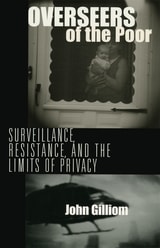
Overseers of the Poor
Surveillance, Resistance, and the Limits of PrivacyJohn Gilliom
University of Chicago Press, 2001
This powerful book lets us in on the conversations of low-income mothers from Appalachian Ohio as they talk about the welfare bureaucracy and its remarkably advanced surveillance system. In their struggle to care for their families, these women are monitored and assessed through a vast network of supercomputers, caseworkers, fraud control agents, and even grocers and neighbors.
In-depth interviews show that these women focus less on the right to privacy than on a critique of surveillance that lays bare the personal and political conflicts with which they live. And, while they have little interest in conventional forms of politics, we see widespread patterns of everyday resistance as they subvert the surveillance regime when they feel it prevents them from being good parents. Ultimately, Overseers of the Poor demonstrates the need to reconceive not just our understanding of the surveillance-privacy debate but also the broader realms of language, participation, and the politics of rights.
We all know that our lives are being watched more than ever before. As we struggle to understand and confront this new order, Gilliom argues, we need to spend less time talking about privacy rights, legislatures, and courts of law and more time talking about power, domination, and the ongoing struggles of everyday people.
Performance, Transparency, and the Cultures of Surveillance
James M. Harding
University of Michigan Press, 2018
Privacy Matters
Conversations about Surveillance within and beyond the ClassroomEstee Beck
Utah State University Press, 2020
This collection offers practical analyses of surveillance and privacy as they occur within classrooms and communities. Organized by themes—surveillance and classrooms, surveillance and bodies, surveillance and culture—Privacy Matters provides writing, rhetoric, and communication scholars and teachers with specific approaches, methods, inquiries, and examinations into the impact tracking and monitoring has upon people’s habits, bodies, and lived experiences.
While each chapter contributes a new perspective in the discipline and beyond, Privacy Matters affirms that these analyses remain inconclusive. This collection is a call for scholars, researchers, activists, and educators within rhetoric and composition to continue the scholarly conversation because privacy matters to all of us.
Contributors: Christina Cedillo, Jenae Cohn, Dànielle Nicole DeVoss, Dustin Edwards, Norah Fahim, Ann Hill Duin, Gavin P. Johnson, John Peterson, Santos Ramos, Colleen A. Reilly, Jennifer Roth Miller, Jason Tham, Stephanie Vie
Privacy at Risk
The New Government Surveillance and the Fourth AmendmentChristopher Slobogin
University of Chicago Press, 2007
Applying the Fourth Amendment’s prohibition on unreasonable searches and seizures, Slobogin argues that courts should prod legislatures into enacting more meaningful protection against government overreaching. In setting forth a comprehensive framework meant to preserve rights guaranteed by the Constitution without compromising the government’s ability to investigate criminal acts, Slobogin offers a balanced regulatory regime that should intrigue everyone concerned about privacy rights in the digital age.
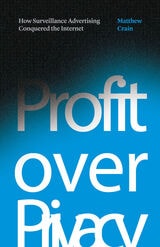
Profit over Privacy
How Surveillance Advertising Conquered the InternetMatthew Crain
University of Minnesota Press, 2021
A deep dive into the political roots of advertising on the internet
The contemporary internet’s de facto business model is one of surveillance. Browser cookies follow us around the web, Amazon targets us with eerily prescient ads, Facebook and Google read our messages and analyze our patterns, and apps record our every move. In Profit over Privacy, Matthew Crain gives internet surveillance a much-needed origin story by chronicling the development of its most important historical catalyst: web advertising.
The first institutional and political history of internet advertising, Profit over Privacy uses the 1990s as its backdrop to show how the massive data-collection infrastructure that undergirds the internet today is the result of twenty-five years of technical and political economic engineering. Crain considers the social causes and consequences of the internet’s rapid embrace of consumer monitoring, detailing how advertisers and marketers adapted to the existential threat of the internet and marshaled venture capital to develop the now-ubiquitous business model called “surveillance advertising.” He draws on a range of primary resources from government, industry, and the press and highlights the political roots of internet advertising to underscore the necessity of political solutions to reign in unaccountable commercial surveillance.
The dominant business model on the internet, surveillance advertising is the result of political choices—not the inevitable march of technology. Unlike many other countries, the United States has no internet privacy law. A fascinating prehistory of internet advertising giants like Google and Facebook, Profit over Privacy argues that the internet did not have to turn out this way and that it can be remade into something better.
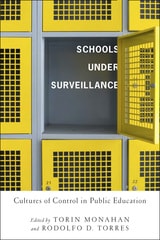
Schools Under Surveillance
Cultures of Control in Public EducationMonahan, Torin
Rutgers University Press, 2009
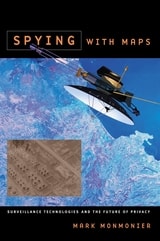
Spying with Maps
Surveillance Technologies and the Future of PrivacyMark Monmonier
University of Chicago Press, 2002
Despite our apprehension about surveillance technology, Spying with Maps is not a jeremiad, crammed with dire warnings about eyes in the sky and invasive tracking. Monmonier's approach encompasses both skepticism and the acknowledgment that geospatial technology brings with it unprecedented benefits to governments, institutions, and individuals, especially in an era of asymmetric warfare and bioterrorism. Monmonier frames his explanations of what this new technology is and how it works with the question of whether locational privacy is a fundamental right. Does the right to be left alone include not letting Big Brother (or a legion of Little Brothers) know where we are or where we've been? What sacrifices must we make for homeland security and open government?
With his usual wit and clarity, Monmonier offers readers an engaging, even-handed introduction to the dark side of the new technology that surrounds us—from traffic cameras and weather satellites to personal GPS devices and wireless communications.
SuperVision
An Introduction to the Surveillance SocietyJohn Gilliom and Torin Monahan
University of Chicago Press, 2012
We live in a surveillance society. Anyone who uses a credit card, cell phone, or even search engines to navigate the Web is being monitored and assessed—and often in ways that are imperceptible to us. The first general introduction to the growing field of surveillance studies, SuperVision uses examples drawn from everyday technologies to show how surveillance is used, who is using it, and how it affects our world.
Surveillance in the Time of Insecurity
Monahan, Torin
Rutgers University Press, 2010
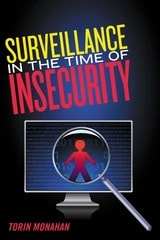
Surveillance in the Time of Insecurity fuses advanced theoretical accounts of state power and neoliberalism with original research from the social settings in which insecurity dynamics play out in the new century. Torin Monahan explores the counterterrorism-themed show 24, Rapture fiction, traffic control centers, security conferences, public housing, and gated communities, and examines how each manifests complex relationships of inequality, insecurity, and surveillance. Alleviating insecurity requires that we confront its mythic dimensions, the politics inherent in new configurations of security provision, and the structural obstacles to achieving equality in societies.
The American Surveillance State
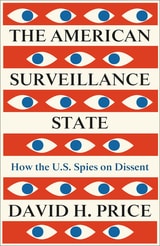
How the U.S. Spies on DissentDavid H. Price
Pluto Press, 2022
New evidence has come to light proving how far the FBI monitored its citizens throughout the Cold War and beyond
When the possibility of wiretapping first became known to Americans they were outraged. Now, in our post-9/11 world, it’s accepted that corporations are vested with human rights, and government agencies and corporations use computers to monitor our private lives. David H. Price pulls back the curtain to reveal how the FBI and other government agencies have always functioned as the secret police of American capitalism up to today, where they luxuriate in a near-limitless NSA surveillance of all.
Price looks through a roster of campaigns by law enforcement, intelligence agencies, and corporations to understand how we got here. Starting with J. Edgar Hoover and the early FBI’s alignment with business, his access to 15,000 pages of never-before-seen FBI files shines a light on the surveillance of Edward Said, Andre Gunder Frank and Alexander Cockburn, Native American communists, and progressive factory owners.
Price uncovers patterns of FBI monitoring and harassing of activists and public figures, providing the vital means for us to understand how these new frightening surveillance operations are weaponized by powerful governmental agencies that remain largely shrouded in secrecy.
The Cybernetic Border
Drones, Technology, and IntrusionIván Chaar López
Duke University Press, 2024
The Future of Digital Surveillance
Why Digital Monitoring Will Never Lose Its Appeal in a World of Algorithm-Driven AIYong Jin Park
University of Michigan Press, 2021
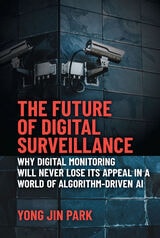
Are humans hard-wired to make good decisions about managing their privacy in an increasingly public world? Or are we helpless victims of surveillance through our use of invasive digital media? Exploring the chasm between the tyranny of surveillance and the ideal of privacy, this book traces the origins of personal data collection in digital technologies including artificial intelligence (AI) embedded in social network sites, search engines, mobile apps, the web, and email. The Future of Digital Surveillance argues against a technologically deterministic view—digital technologies by nature do not cause surveillance. Instead, the shaping of surveillance technologies is embedded in a complex set of individual psychology, institutional behaviors, and policy principles.

The Infrastructures of Security
Technologies of Risk Management in JohannesburgMartin J. Murray
University of Michigan Press, 2022
In The Infrastructures of Security, author Martin J. Murray concentrates on not only the turn toward technological solutions to managing the risk of crime through digital (and software-based) surveillance and automated information systems, but also the introduction of somewhat bizarre and fly-by-night experimental “answers” to perceived risk and danger. Digitalized surveillance is significant for two reasons: first, it enables monitoring to take place across wide "geographical distances with little time delay"; and second, it allows for the active sorting, identification, and "tracking of bodies, behaviors, and characteristics of subject populations on a continuous, real-time basis." These new software-based surveillance technologies represent monitoring, tracking, and information gathering without walls, towers, or guards.

The Intensification of Surveillance
Crime, Terrorism and Warfare in the Information AgeEdited by Kirstie Ball and Frank Webster
Pluto Press, 2003

The Seventies Now
Culture as SurveillanceStephen Paul Miller
Duke University Press, 1999
The concept of surveillance and its attendant social ramifications have been powerful agents in U.S. culture for many decades, but in describing how during the 1970s Americans learned to “survey” themselves, Miller shines surprising new light on such subjects as the women’s movement, voting rights enforcement, the Ford presidency, and environmental legislation. He illuminates the significance of what he terms “microperiods” and analyzes relevant themes in many of the decade’s major films—such as The Deer Hunter, Network, Jaws, Star Wars, and Apocalypse Now—and in the literature of writers including John Ashbery, Toni Morrison, Adrienne Rich, and Sam Shepard. In discussing the reverberations of the 1969 Stonewall riots, technological innovations, the philosophy of Michel Foucault, and a host of documents and incidents, Miller shows how the 1970s marked an important period of transition, indeed a time of many transitions, to the world we confront at the end of the millennium.
The Seventies Now will interest students and scholars of cultural studies, American history, theories of technology, film and literature, visual arts, and gay and lesbian studies.
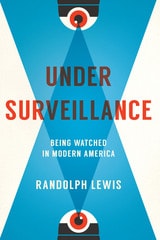
Under Surveillance
Being Watched in Modern AmericaBy Randolph Lewis
University of Texas Press, 2017
Never before has so much been known about so many. CCTV cameras, TSA scanners, NSA databases, big data marketers, predator drones, “stop and frisk” tactics, Facebook algorithms, hidden spyware, and even old-fashioned nosy neighbors—surveillance has become so ubiquitous that we take its presence for granted. While many types of surveillance are pitched as ways to make us safer, almost no one has examined the unintended consequences of living under constant scrutiny and how it changes the way we think and feel about the world. In Under Surveillance, Randolph Lewis offers a highly original look at the emotional, ethical, and aesthetic challenges of living with surveillance in America since 9/11.
Taking a broad and humanistic approach, Lewis explores the growth of surveillance in surprising places, such as childhood and nature. He traces the rise of businesses designed to provide surveillance and security, including those that cater to the Bible Belt’s houses of worship. And he peers into the dark side of playful surveillance, such as eBay’s online guide to “Fun with Surveillance Gadgets.” A worried but ultimately genial guide to this landscape, Lewis helps us see the hidden costs of living in a “control society” in which surveillance is deemed essential to governance and business alike. Written accessibly for a general audience, Under Surveillance prompts us to think deeply about what Lewis calls “the soft tissue damage” inflicted by the culture of surveillance.
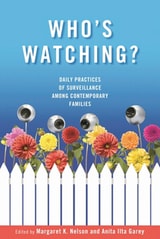
Who's Watching?
Daily Practices of Surveillance among Contemporary FamiliesMargaret K. Nelson
Vanderbilt University Press, 2009

Windows into the Soul
Surveillance and Society in an Age of High TechnologyGary T. Marx
University of Chicago Press, 2016
In this landmark book, Marx sums up a lifetime of work on issues of surveillance and social control by disentangling and parsing the empirical richness of watching and being watched. Using fictional narratives as well as the findings of social science, Marx draws on decades of studies of covert policing, computer profiling, location and work monitoring, drug testing, caller identification, and much more, Marx gives us a conceptual language to understand the new realities and his work clearly emphasizes the paradoxes, trade-offs, and confusion enveloping the field. Windows into the Soul shows how surveillance can penetrate our social and personal lives in profound, and sometimes harrowing, ways. Ultimately, Marx argues, recognizing complexity and asking the right questions is essential to bringing light and accountability to the darker, more iniquitous corners of our emerging surveillance society.
For more information, please see www.garymarx.net.