Results by title

6 books match the query 'Emperors'
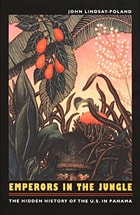
cover of Emperors in the Jungle: The Hidden History of the U.S. in Panama

Emperors in the Jungle

The Hidden History of the U.S. in Panama

John Lindsay-Poland

Duke University Press, 2003

Emperors in the Jungle is an exposé of key episodes in the military involvement of the United States in Panama. Investigative journalism at its best, this book reveals how U.S. ideas about taming tropical jungles and people, combined with commercial and military objectives, shaped more than a century of intervention and environmental engineering in a small, strategically located nation. Whether uncovering the U.S. Army’s decades-long program of chemical weapons tests in Panama or recounting the invasion in December 1989 which was the U.S. military’s twentieth intervention in Panama since 1856, John Lindsay-Poland vividly portrays the extent and costs of U.S. involvement.

Analyzing new evidence gathered through interviews, archival research, and Freedom of Information Act requests, Lindsay-Poland discloses the hidden history of U.S.–Panama relations, including the human and environmental toll of the massive canal building project from 1904 to 1914. In stunning detail he describes secret chemical weapons tests—of toxins including nerve agent and Agent Orange—as well as plans developed in the 1960s to use nuclear blasts to create a second canal in Panama.

He chronicles sustained efforts by Panamanians and international environmental groups to hold the United States responsible for the disposal of the tens of thousands of explosives it left undetonated on the land it turned over to Panama in 1999. In the context of a relationship increasingly driven by the U.S. antidrug campaigns, Lindsay-Poland reports on the myriad issues that surrounded Panama’s takeover of the canal in accordance with the 1977 Panama Canal Treaty, and he assesses the future prospects for the Panamanian people, land, and canal area. Bringing to light historical legacies unknown to most U.S. citizens or even to many Panamanians, Emperors in the Jungle is a major contribution toward a new, more open relationship between Panama and the United States.
[more]
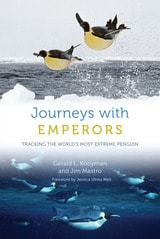
cover of Journeys with Emperors: Tracking the World's Most Extreme Penguin

Journeys with Emperors

Tracking the World's Most Extreme Penguin

Gerald L. Kooyman and Jim Mastro

University of Chicago Press, 2023

With stunning photographs from the ice edge, a firsthand account of a researcher’s time in Antarctica and of the perilous journeys of the world’s largest penguin species: the iconic emperor.
 
Nearly all emperor penguin colonies are extremely remote; of the sixty-six known, fewer than thirty have been visited by humans, and even fewer have been the subject of successful research programs. One of the largest known emperor penguin colonies is found on a narrow band of sea ice attached to the Antarctic continent. In Journeys with Emperors, Gerald L. Kooyman and Jim Mastro take us to this far-flung colony in the Ross Sea, showing us how scientists gained access to it, and what they learned while living among the penguins as they raised their chicks.
 
The primary mission was to record the birds’ activities at sea, and the data revealed important aspects of emperor penguin behavior and physiology: for instance, that in the course of hunting for food, some of the penguins dive to depths of greater than five hundred meters (a third of a mile, which is deeper than for any other diving bird). The researchers also discovered that, crucially, most of the emperor’s life is actually spent at sea, with fledged chicks and adults making separate, perilous journeys through icy water. When chick nurturing is complete, the fledglings abandon the colony in large groups, heading north to the Southern Ocean. The adults leave at the same time, traveling one thousand kilometers eastward across the Ross Sea to a sea-ice sanctuary for molting. During this journey, they must gain enough weight to survive the month-long molt, when every feather is replaced and the birds cannot enter the water to feed. After the molt, many if not most return to the colony to breed once again. For the males, this means another fast—this time for 120 days as they incubate their eggs. The nearness of the colony to the ice edge spared the penguins the long, energy-draining march for which other colonies are well-known. It also allowed researchers to observe the penguins’ departures to and arrivals from their foraging journeys, as well as their dangerous interactions with leopard seals and killer whales.
 
Featuring original color photographs and complemented with online videos, Journeys with Emperors is both an eye-opening overview of the emperor penguin’s life and a thrilling tale of scientific discovery in one of the most remote, harsh, and beautiful places on Earth.
[more]
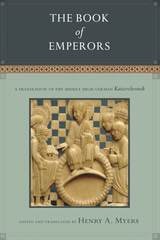
cover of The Book of Emperors: A Translation of the Middle High German Kaiserchronik

The Book of Emperors

A Translation of the Middle High German Kaiserchronik

Henry A. Myers

West Virginia University Press, 2013

The Kaiserchronik (c.1152–1165) is the first verse chronicle to have been written in a language other than Latin. This story recounts the exploits of the Roman, Byzantine, Carolingian, and Holy Roman kings and rulers, from the establishment of Rome to the start of the Second Crusade. As an early example of popular history, it was written for a non-monastic audience who would have preferred to read, or may only have been able to read, in German. As a rhymed chronicle, its combined use of the styles of language found within a vernacular epic and a factual treaty was a German innovation. The Book of Emperors is the first complete translation of the Kaiserchronik from Middle High German to English. It is a rich resource not only for medieval German scholars and students, but also for those working in early cultural studies. It brings together an understanding of the conception of kingship in the German Middle Ages, from the relationship between emperor and king, to the moral, theological, and legal foundations of claims and legitimacy and the medieval epistemological approaches to historiography. This translation includes a substantial introduction that discusses the historical and philological context of the work, as well as the themes of power and kingship. Each chapter begins with a brief introduction that distinguishes historical truths from the epic fiction found within the original text.
[more]
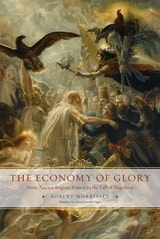
cover of The Economy of Glory: From Ancien Régime France to the Fall of Napoleon

The Economy of Glory

From Ancien Régime France to the Fall of Napoleon

Robert Morrissey

University of Chicago Press, 2013
From the outset of Napoleon’s career, the charismatic Corsican was compared to mythic heroes of antiquity like Achilles, and even today he remains the apotheosis of French glory, a value deeply embedded in the country’s history. From this angle, the Napoleonic era can be viewed as the final chapter in the battle of the Ancients and Moderns. In this book, Robert Morrissey presents a literary and cultural history of glory and its development in France and explores the “economy of glory” Napoleon sought to implement in an attempt to heal the divide between the Old Regime and the Revolution.
 
Examining how Napoleon saw glory as a means of escaping the impasse of Revolutionary ideas of radical egalitarianism, Morrissey illustrates the challenge the leader faced in reconciling the antagonistic values of virtue and self-interest, heroism and equality. He reveals that the economy of glory was both egalitarian, creating the possibility of an aristocracy based on merit rather than wealth, and traditional, being deeply embedded in the history of aristocratic chivalry and the monarchy—making it the heart of Napoleon’s politics of fusion. Going beyond Napoleon, Morrissey considers how figures of French romanticism such as Chateaubriand, Balzac, and Hugo constantly reevaluated this legacy of glory and its consequences for modernity. Available for the first time in English, The Economy of Glory is a sophisticated and beautifully written addition to French history.
[more]
cover of The Play of Allusion in the Historia Augusta

The Play of Allusion in the Historia Augusta

David Rohrbacher

University of Wisconsin Press, 2015
By turns outlandish, humorous, and scatological, the Historia Augusta is an eccentric compilation of biographies of the Roman emperors and usurpers of the second and third centuries. Historians of late antiquity have struggled to explain the fictional date and authorship of the work and its bizarre content (did the Emperor Carinus really swim in pools of floating apples and melons? did the usurper Proculus really deflower a hundred virgins in fifteen days?). David Rohrbacher offers, instead, a literary analysis of the work, focusing on its many playful allusions. Marshaling an array of interdisciplinary research and original analysis, he contends that the Historia Augusta originated in a circle of scholarly readers with an interest in biography, and that its allusions and parodies were meant as puzzles and jokes for a knowing and appreciative audience.
[more]
cover of Ushering in a New Republic: Theologies of Arrival at Rome in the First Century BCE

Ushering in a New Republic

Theologies of Arrival at Rome in the First Century BCE

Trevor S. Luke

University of Michigan Press, 2014

The ancient Romans are well known for their love of the pageantry of power. No single ceremony better attests to this characteristic than the triumph, which celebrated the victory of a Roman commander through a grand ceremonial entrance into the city that ended in rites performed to Rome’s chief tutelary deity, Jupiter Optimus Maximus, on the Capitoline hill. The triumph, however, was only one form of ceremonial arrival at the city, and Jupiter was not the only god to whom vows were made and subsequently fulfilled at the end of a successful assignment. Ushering in a New Republic expands our view beyond a narrow focus on the triumph to look at the creative ways in which the great figures of Rome in the first century BCE (men such as Sulla, Caesar, Augustus, and others) crafted theological performances and narratives both in and around their departures from Rome and then returned to cast themselves in the role of divinely supported saviors of a faltering Republic.

Trevor S. Luke tackles some of the major issues of the history of the Late Republic and the transition to the empire in a novel way. Taking the perspective that Roman elites, even at this late date, took their own religion seriously as a way to communicate meaning to their fellow Romans, the volume reinterprets some of the most famous events of that period in order to highlight what Sulla, Caesar, and figures of similar stature did to make a religious argument or defense for their actions. This exploration will be of interest to scholars of religion, political science, sociology, classics, and ancient history and to the general history enthusiast. While many people are aware of the important battles and major thinkers of this period of Roman history, the story of its theological discourse and competition is unfolded here for the first time.
[more]