Results by title

23 books match the query 'Ends'

cover of A Learned Faith: Principles, Problems, and Ends of Catholic Theology: Essays in Honor of Reinhard Huetter

A Learned Faith

Principles, Problems, and Ends of Catholic Theology: Essays in Honor of Reinhard Huetter

Thomas Pfau

Catholic University of America Press, 2026
One of the preeminent theologians of our time, Reinhard Hütter, has taught at the Catholic University of America, Duke University Divinity School, and Lutheran School of Theology at Chicago, has held prestigious visiting professorships at Providence College and Mundelein Seminary, and has published groundbreaking books engaging with Aquinas and Newman (among others). He has served as co-editor of Nova et Vetera and as editor of Pro Ecclesia, has been the president of the Academy of Catholic Theology, and has been a member of the International Theological Commission, the most important theological body in the Roman Catholic Church. This festschrift in honor of Reinhard Hütter contains twelve essays, with attention especially to theological method, the doctrine of the Triune God, faith and reason, the virtues, and ecclesiology, in light of Hütter’s own emphases. The Introduction explores Hütter’s distinctive contributions to Catholic theology, focusing on his constructive engagements with the theologies of Augustine, Aquinas, Newman, and Ratzinger. Contributors include Michael Root, Matthew Levering, Thomas Joseph White OP, Bruce D. Marshall, Peter Casarella, John R. Betz, Mats Wahlberg, Miguel J. Romero, Holly Taylor Coolman, Guy Mansini OSB, Edgardo A. Colón-Emeric, and Thomas Pfau.
[more]
cover of Architecture, Means and Ends

Architecture, Means and Ends

Vittorio Gregotti

University of Chicago Press, 2010

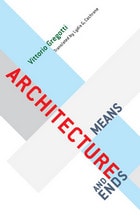
Vittorio Gregotti—the architect of Barcelona’s Olympic Stadium, Milan’s Arcimboldi Opera Theater, and Lisbon’s Centro Cultural de Belém, among many other noted constructions—is not only a designer of international repute but an acclaimed theorist and critic. Architecture, Means and Ends is his practical and imaginative reflection on the role of the technical aspects of architectural design, both as part of the larger process of innovation and in relation to the mythic opposition between vision and construction.

Interweaving the seemingly irreconcilable concerns of aesthetics, meaning, and construction,  Architecture, Means and Ends reflects Gregotti’s overarching claim that buildings always have a symbolic, cultural content. In this book, he argues that by making symbolic expression a primary objective in the design of a project, the designer will produce a practical aesthetic as well as an ethical solution. Architecture, Means and Ends embraces that philosophy and will appeal to those, like Gregotti, working at the intersections of the history of design, art criticism, and architectural theory.
[more]
cover of Ends Of Globalization

Ends Of Globalization

Mohammed A. Bamyeh

University of Minnesota Press, 2000

A uniquely broad perspective that challenges current ideas about worldwide cultural and political change.

Political and Social Theory/Cultural Studies

A uniquely broad perspective that challenges current ideas about worldwide cultural and political change. An intervention into current debates about globalization, nationalism, imperialism, and culture, this book offers a cogent critique of much of what is being said about globalization, by both the Right and the Left. In doing so, it charts the complex processes of globalization, drawing out their historical and philosophical roots and outlining the connections between cultural, political, and economic life that globalization has made, historically and in our day.The author’s orientation toward political theory and comparative civilizations-a rarity in globalization studies-allows him to detect in specific terms what is most dangerous and opportune in what is happening in the world today. Mohammed A. Bamyeh makes a compelling argument that we are witnessing a process typified by massive disjunctions between political, cultural, and economic logics on a world scale. Bamyeh demonstrates how the disruptions caused by globalization, while they blur our vision and block our rational approaches, also possess the potential to liberate the autonomous and convivial human possibilities and capabilities long shackled by such modernist institutions of governance as the nation-state.Translation Inquiries: University of Minnesota Press
[more]
cover of Ends in Sight: Marx/Fukuyama/Hobsbawm/Anderson

Ends in Sight

Marx/Fukuyama/Hobsbawm/Anderson

Gregory Elliott

Pluto Press, 2008

Following the disappearance of the Soviet Union, scholars across the political spectrum tackled the world-historical significance of the end of communism. This book addresses the balance-sheets of modern political history offered by three writers---Francis Fukuyama, Eric Hobsbawm and Perry Anderson---comparing them with the future projected by Marx in The Communist Manifesto.


Gregory Elliott argues that Marx is central to all three accounts and that, along with the Manifesto, they form a quartet of analyses of the results and prospects of capitalism and socialism, which are of enduring significance for the Left.


Senses of an Ending provides a readable survey of key historical and political thinkers that will appeal to anyone interested in modern political thought.
[more]
cover of Ends of Empire: Asian American Critique and the Cold War

Ends of Empire

Asian American Critique and the Cold War

Jodi Kim

University of Minnesota Press, 2010

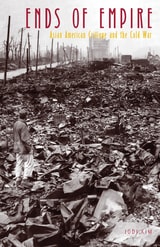
Ends of Empire examines Asian American cultural production and its challenge to the dominant understanding of American imperialism, Cold War dynamics, and race and gender formation.
 
Jodi Kim demonstrates the degree to which Asian American literature and film critique the record of U.S. imperial violence in Asia and provides a glimpse into the imperial and gendered racial logic of the Cold War. She unfolds this particularly entangled and enduring episode in the history of U.S. global hegemony—one that, contrary to leading interpretations of the Cold War as a simple bipolar rivalry, was significantly triangulated in Asia.
 
The Asian American works analyzed here constitute a crucial body of what Kim reveals as transnational “Cold War compositions,” which are at once a geopolitical structuring, an ideological writing, and a cultural imagining. Arguing that these works reframe the U.S. Cold War as a project of gendered racial formation and imperialism as well as a production of knowledge, Ends of Empire offers an interdisciplinary investigation into the transnational dimensions of Asian America and its critical relationship to Cold War history.
[more]
cover of Ends of the Earth: Poems

Ends of the Earth

Poems

Kate Partridge

University of Alaska Press, 2017

Ends of the Earth uses the landscape of Alaska as a testing ground for love and elegy. It is a poetry collection that contains both lyric responses to the urban Alaska environment and extended sequences that cycle between autobiography, mythic allusion, and the literary archive. In her work, Kate Partridge combines the fresh perspective of a newcomer with explorations of the landscape and lifestyles through allusions to classic literature.

While the poems turn an inquisitive, contemporary lens to the subject of Alaska, elements throughout the book are influenced by twentieth-century writers like Elizabeth Bishop and Marianne Moore. The manuscript also combines personal experience with collaged material from the Epic of Gilgamesh, Walt Whitman's notebooks, and other classic sources, to investigate the ideas of love, isolation, and location. Through humor and observation, Partridge takes a new look at what it means to live in urban Alaska and the world at large.

[more]
cover of Ever Faithful: Race, Loyalty, and the Ends of Empire in Spanish Cuba

Ever Faithful

Race, Loyalty, and the Ends of Empire in Spanish Cuba

David Sartorius

Duke University Press, 2013
Known for much of the nineteenth century as "the ever-faithful isle," Cuba did not earn its independence from Spain until 1898, long after most American colonies had achieved emancipation from European rule. In this groundbreaking history, David Sartorius explores the relationship between political allegiance and race in nineteenth-century Cuba. Challenging assumptions that loyalty to the Spanish empire was the exclusive province of the white Cuban elite, he examines the free and enslaved people of African descent who actively supported colonialism. By claiming loyalty, many black and mulatto Cubans attained some degree of social mobility, legal freedom, and political inclusion in a world where hierarchy and inequality were the fundamental lineaments of colonial subjectivity. Sartorius explores Cuba's battlefields, plantations, and meeting halls to consider the goals and limits of loyalty. In the process, he makes a bold call for fresh perspectives on imperial ideologies of race and on the rich political history of the African diaspora.
 
[more]
cover of Frank Miller's Daredevil and the Ends of Heroism

Frank Miller's Daredevil and the Ends of Heroism

Young, Paul

Rutgers University Press, 2016

2017 EISNER AWARD NOMINEE for Best Academic/Scholarly Work

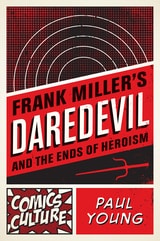
In the late 1970s and early 1980s, writer-artist Frank Miller turned Daredevil from a tepid-selling comic into an industry-wide success story, doubling its sales within three years. Lawyer by day and costumed vigilante by night, the character of Daredevil was the perfect vehicle for the explorations of heroic ideals and violence that would come to define Miller’s work.   
 
Frank Miller’s Daredevil and the Ends of Heroism is both a rigorous study of Miller’s artistic influences and innovations and a reflection on how his visionary work on Daredevil impacted generations of comics publishers, creators, and fans. Paul Young explores the accomplishments of Miller the writer, who fused hardboiled crime stories with superhero comics, while reimagining Kingpin (a classic Spider-Man nemesis), recuperating the half-baked villain Bullseye, and inventing a completely new kind of Daredevil villain in Elektra. Yet, he also offers a vivid appreciation of the indelible panels drawn by Miller the artist, taking a fresh look at his distinctive page layouts and lines.  
 
A childhood fan of Miller’s Daredevil, Young takes readers on a personal journey as he seeks to reconcile his love for the comic with his distaste for the fascistic overtones of Miller’s controversial later work. What he finds will resonate not only with Daredevil fans, but with anyone who has contemplated what it means to be a hero in a heartless world.   
 
Other titles in the Comics Culture series include Twelve-Cent Archie, Wonder Woman: Bondage and Feminism in the Marston/Peter Comics, 1941-1948, and Considering Watchmen: Poetics, Property, Politics.
 
[more]
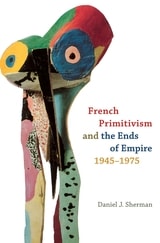
cover of French Primitivism and the Ends of Empire, 1945-1975

French Primitivism and the Ends of Empire, 1945-1975

Daniel J. Sherman

University of Chicago Press, 2011

 For over a century, the idea of primitivism has motivated artistic modernism. Focusing on the three decades after World War II, known in France as “les trentes glorieuses” despite the loss of most of the country’s colonial empire, this probing and expansive book argues that primitivism played a key role in a French society marked by both economic growth and political turmoil.
In a series of chapters that consider significant aspects of French culture—including the creation of new museums of French folklore and of African and Oceanic arts and the development of tourism against the backdrop of nuclear testing in French Polynesia—Daniel J. Sherman shows how primitivism, a collective fantasy born of the colonial encounter, proved adaptable to a postcolonial, inward-looking age of mass consumption. Following the likes of Claude Lévi-Strauss, Andrée Putman, and Jean Dubuffet through decorating magazines, museum galleries, and Tahiti’s pristine lagoons, this interdisciplinary study provides a new perspective on primitivism as a cultural phenomenon and offers fresh insights into the eccentric edges of contemporary French history.
[more]
cover of Kierkegaard And The Ends Of Language

Kierkegaard And The Ends Of Language

Geoffrey A. Hale

University of Minnesota Press, 2002

A timely and original intervention in our understanding of this major philosopher through the lens of his influence on others

What do we read when we read Kierkegaard? How do we know? Insisting that Kierkegaard remains a far more enigmatic and paradoxical writer than is often assumed, Geoffrey A. Hale argues that the best way to approach Kierkegaard’s work and understand its significance for our own thought is to retrace its formative influence on major intellectuals of the early twentieth century.

In mutually reflective readings of Kierkegaard’s foundational texts through the work of three pivotal authors—Franz Kafka, Theodor Adorno, and Rainer Maria Rilke—Hale shows how each of these writers draws attention to the unwavering sense of human finitude that pervades all of Kierkegaard’s work and, with it, the profoundly unsettling indeterminacy in which it results. It is the very limitations of language, Hale argues, that hold it open to meaning, to interpretation, and thus to freedom. Resisting clear circumscription in this way, Kierkegaard’s work becomes all the more fruitful to us—and all the more challenging—to the extent that it resists our understanding.

[more]
cover of Nostalgia: Origins and Ends of an Unenlightened Disease

Nostalgia

Origins and Ends of an Unenlightened Disease

Helmut Illbruck

Northwestern University Press, 2012
Helmut Illbruck traces the concept of nostalgia from the earliest uses of the term in the seventeenth century to today as it evolves with different meanings and intensities in the discourses of medicine, literature, philosophy, and aesthetics. Following nostalgia’s troubled relations to the philosophical project of the Enlightenment, Illbruck’s study builds a cumulative argument about nostalgia’s modern significance that often revises and thoroughly enriches our understanding of cultural, literary, and intellectual history. Illbruck concludes with an attempt at a reinterpretation and defense of nostalgia, which seduces us to read and think with, rather than against, nostalgia’s wistful yearning for the past. Nostalgia: Origins and Ends of an Unenlightened Disease is a comprehensive, insistent, and profound interdisciplinary investigation of the history of an idea. It should appeal to readers interested in the cultural makings of the Enlightenment and modernity or in the histories of medicine, literature, and philosophy.
[more]
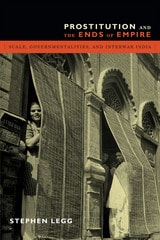
cover of Prostitution and the Ends of Empire: Scale, Governmentalities, and Interwar India

Prostitution and the Ends of Empire

Scale, Governmentalities, and Interwar India

Stephen Legg

Duke University Press, 2014
Officially confined to red-light districts, brothels in British India were tolerated until the 1920s. Yet, by this time, prostitution reform campaigns led by Indian, imperial, and international bodies were combining the social scientific insights of sexology and hygiene with the moral condemnations of sexual slavery and human trafficking. These reformers identified the brothel as exacerbating rather than containing "corrupting prostitutes" and the threat of venereal diseases, and therefore encouraged the suppression of brothels rather than their urban segregation. In this book, Stephen Legg tracks the complex spatial politics surrounding brothels in the interwar period at multiple scales, including the local, regional, national, imperial, and global. Campaigns and state policies against brothels did not just operate at different scales but made scales themselves, forging new urban, provincial, colonial, and international formations. In so doing, they also remade the boundary between the state and the social, through which the prostitute was, Legg concludes, "civilly abandoned."
[more]
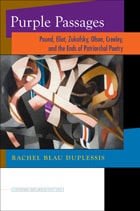
cover of Purple Passages: Pound, Eliot, Zukofsky, Olson, Creeley, and the Ends of Patriarchal Poetry

Purple Passages

Pound, Eliot, Zukofsky, Olson, Creeley, and the Ends of Patriarchal Poetry

Rachel Blau DuPlessis

University of Iowa Press, 2012
What is patriarchal poetry? How can it be both attractive and tempting and yet be so hegemonic that it is invisible? How does it combine various mixes of masculinity, femininity, effeminacy, and eroticism? At once passionate and dispassionate, Rachel Blau DuPlessis meticulously outlines key moments of choice and debate about masculinity among writers as disparate as Ezra Pound, T. S. Eliot, Louis Zukofsky, Charles Olson, Robert Creeley, and Allen Ginsberg, choices that construct consequential models for institutions of poetic practice.
As DuPlessis writes, “There are no genderless subjects in any relationship structuring literary culture: not in production, dissemination, or reception; not in objects, discourses, or practices; not in reading experiences or in interpretations.” And, as she reveals in careful and enthralling detail, for the poets at the center of this book, questions of masculinity loomed large and were continuously articulated in their self-creation as writers, in literary bonding, and in its deployment.
These gender-laden choices, debates, and contradictions all have a striking influence today. In this empathic yet critical historical polemic, DuPlessis reveals the outcomes of these many investments in the radical reconstruction of masculinity, in their strains, incompleteness, tensions—and failures. At the heart of modernist maleness and poetic practices are contradictions and urgencies, gender ideas both progressive and defensive.In a striking book on male behavior in poetic dyads, the third book in a feminist critical trilogy, DuPlessis tracks the poetic debates and arguments about gender that continuously affirm patriarchal poetry.
[more]
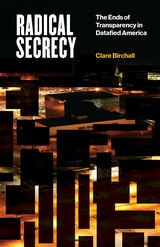
cover of Radical Secrecy: The Ends of Transparency in Datafied America

Radical Secrecy

The Ends of Transparency in Datafied America

Clare Birchall

University of Minnesota Press, 2021

Reimagining transparency and secrecy in the era of digital data

When total data surveillance delimits agency and revelations of political wrongdoing fail to have consequences, is transparency the social panacea liberal democracies purport it to be? This book sets forth the provocative argument that progressive social goals would be better served by a radical form of secrecy, at least while state and corporate forces hold an asymmetrical advantage over the less powerful in data control. Clare Birchall asks: How might transparency actually serve agendas that are far from transparent? Can we imagine a secrecy that could act in the service of, rather than against, a progressive politics? 

To move beyond atomizing calls for privacy and to interrupt the perennial tension between state security and the public’s right to know, Birchall adapts Édouard Glissant’s thinking to propose a digital “right to opacity.” As a crucial element of radical secrecy, she argues, this would eventually give rise to a “postsecret” society, offering an understanding and experience of the political that is free from the false choice between secrecy and transparency. She grounds her arresting story in case studies including the varied presidential styles of George W. Bush, Barack Obama, and Donald Trump; the Snowden revelations; conspiracy theories espoused or endorsed by Trump; WikiLeaks and guerrilla transparency; and the opening of the state through data portals.

Postsecrecy is the necessary condition for imagining, finally, an alternative vision of “the good,” of equality, as neither shaped by neoliberal incarnations of transparency nor undermined by secret state surveillance. Not least, postsecrecy reimagines collective resistance in the era of digital data.
[more]
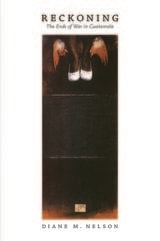
cover of Reckoning: The Ends of War in Guatemala

Reckoning

The Ends of War in Guatemala

Diane M. Nelson

Duke University Press, 2009

Following the 1996 treaty ending decades of civil war, how are Guatemalans reckoning with genocide, especially since almost everyone contributed in some way to the violence? Meaning “to count, figure up” and “to settle rewards and punishments,” reckoning promises accounting and accountability. Yet as Diane M. Nelson shows, the means by which the war was waged, especially as they related to race and gender, unsettled the very premises of knowing and being. Symptomatic are the stories of duplicity pervasive in postwar Guatemala, as the left, the Mayan people, and the state were each said to have “two faces.” Drawing on more than twenty years of research in Guatemala, Nelson explores how postwar struggles to reckon with traumatic experience illuminate the assumptions of identity more generally.

Nelson brings together stories of human rights activism, Mayan identity struggles, coerced participation in massacres, and popular entertainment—including traditional dances, horror films, and carnivals—with analyses of mass-grave exhumations, official apologies, and reparations. She discusses the stereotype of the Two-Faced Indian as colonial discourse revivified by anti-guerrilla counterinsurgency and by the claims of duplicity leveled against the Nobel laureate Rigoberta Menchú, and she explores how duplicity may in turn function as a survival strategy for some. Nelson examines suspicions that state power is also two-faced, from the left’s fears of a clandestine para-state behind the democratic façade, to the right’s conviction that NGOs threaten Guatemalan sovereignty. Her comparison of antimalaria and antisubversive campaigns suggests biopolitical ways that the state is two-faced, simultaneously giving and taking life. Reckoning is a view from the ground up of how Guatemalans are finding creative ways forward, turning ledger books, technoscience, and even gory horror movies into tools for making sense of violence, loss, and the future.
[more]
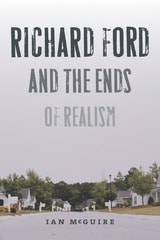
cover of Richard Ford and the Ends of Realism

Richard Ford and the Ends of Realism

Ian McGuire

University of Iowa Press, 2015

Richard Ford and the Ends of Realism examines the work of award-winning American novelist and short story writer Richard Ford, and places it firmly in the context of contemporary debates about the role and meaning of literary realism in a postmodern environment. In this fresh study of Ford’s oeuvre, Ian McGuire argues that Ford’s work is best understood as a form of pragmatic realism and thus positions him as part of a deeply rooted and ongoing American debate about the nature of realism and pragmatism. This debate, which reaches back to transcendentalist thinkers such as Ralph Waldo Emerson and continues on to today, questions the meaning of independence and the relationship between the self and history. In this context, McGuire explores Ford’s deep engagement with American literary and philosophical traditions and repositions his work in its appropriate intellectual and literary context.

McGuire also uses this idea of pragmatic realism to mount a larger defense of contemporary realist writing and uses Ford’s example to argue that realism itself remains a useful and necessary critical category. Contemporary realism, rather than being merely conventional or reactionary, as some of its critics have called it, can offer its proponents an aesthetically and philosophically sophisticated way of engaging with and contesting the particularities of contemporary, even postmodern, experience.

In offering this new reading of Richard Ford’s fiction, as well as a fresh understanding of the realist impulse in contemporary American fiction, both become richer, more resonant, and more immediate—reaching both backward into the past and forward to involve themselves in important contemporary debates about history, postmodernity, and moral relativism.
[more]
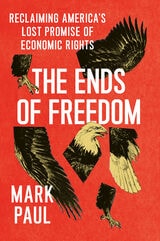
cover of The Ends of Freedom: Reclaiming America's Lost Promise of Economic Rights

The Ends of Freedom

Reclaiming America's Lost Promise of Economic Rights

Mark Paul

University of Chicago Press, 2023

An urgent and galvanizing argument for an Economic Bill of Rights—and its potential to confer true freedom on all Americans.

Since the Founding, Americans have debated the true meaning of freedom. For some, freedom meant the provision of life’s necessities, those basic conditions for the “pursuit of happiness.” For others, freedom meant the civil and political rights enumerated in the Bill of Rights and unfettered access to the marketplace—nothing more.  As Mark Paul explains, the latter interpretation—thanks in large part to a particularly influential cadre of economists—has all but won out among policymakers, with dire repercussions for American society: rampant inequality, endemic poverty, and an economy built to benefit the few at the expense of the many.

In this book, Paul shows how economic rights—rights to necessities like housing, employment, and health care—have been a part of the American conversation since the Revolutionary War and were a cornerstone of both the New Deal and the Civil Rights Movement. Their recuperation, he argues, would at long last make good on the promise of America’s founding documents. By drawing on FDR’s proposed Economic Bill of Rights, Paul outlines a comprehensive policy program to achieve a more capacious and enduring version of American freedom. Among the rights he enumerates are the right to a good job, the right to an education, the right to banking and financial services, and the right to a healthy environment.

Replete with discussions of some of today’s most influential policy ideas—from Medicare for All to a federal job guarantee to the Green New Deal—The Ends of Freedom is a timely and urgent call to reclaim the idea of freedom from its captors on the political right—to ground America’s next era in the country’s progressive history and carve a path toward a more economically dynamic and equitable nation.

 
[more]
cover of The Ends of Research: Indigenous and Settler Science after the War in the Woods

The Ends of Research

Indigenous and Settler Science after the War in the Woods

Tom Özden-Schilling

Duke University Press, 2023
In The Ends of Research Tom Özden-Schilling explores the afterlives of several research initiatives that emerged in the wake of the “War in the Woods,” a period of anti-logging blockades in Canada in the late twentieth century. Drawing on ethnographic fieldwork among neighboring communities of White environmental scientists and First Nations mapmakers in northwest British Columbia, Özden-Schilling examines these researchers’ lasting investments and the ways they struggle to continue their work long after the loss of government funding. He charts their use of planning documents, Indigenous territory maps, land use plots, reports, and other documents that help them not only to survive institutional restructuring but to hold on to the practices that they hope will enable future researchers to continue their work. He also shows how their lives and aspirations shape and are shaped by decades-long battles over resource extraction and Indigenous land claims. By focusing on researchers’ experiences and personal attachments, Özden-Schilling illustrates the complex relationships between researchers and rural histories of conservation, environmental conflict, resource extraction, and the long-term legacies of scientific research.
[more]
cover of The Ends of War, Volume 25

The Ends of War, Volume 25

Patrick Deer , ed.

Duke University Press, 0

This special issue of Social Text examines the self-perpetuating nature of postmodern war and war culture. It looks at the instrumental nature of war discourse as a political force and challenges its vision of endless warfare as the means to control both domestic and foreign populations in an era of globalization. Essays analyze the historical and material interests that war serves and challenge the seductive mythology of high-tech precision warfare, which allows the traumatic effects of war to be considered at a great distance. The issue also argues that the increasing tendency to discuss war metaphorically—as in the phrases “War on Drugs” and “War on Terror”—blurs the boundaries between civilian and soldier and between combatant and noncombatant and defers the human cost of permanent warfare.

The contributors to this special issue—drawing on cultural studies, anthropology, economics, psychoanalysis, gender studies, postcolonial studies, and war literature—target the blind spots in current debates about war. One essay examines the financing of war, challenging the myth that our military-industrial complex generates economic bounty. Another contributor addresses strategies of high-tech urban warfare now being developed by the U.S. military and warns of the historical limits of colonial policing techniques that build on practices of surveillance. Other essays discuss the eroticization of “consent” embodied in the practice of torture at Abu Ghraib; the paradoxes of paramilitary policing and popular resistance along the militarized Mexico-U.S. border; and the continuities between the permanent war economy that emerged in the United States during World War II and the current disastrous confluence of militarism, global outsourcing, and economic depletion.

Contributors. Ashley Dawson, Patrick Deer, Jonathan Michael Feldman, Kennan Ferguson, Jean Franco, Randy Martin, Leerom Medovoi, Rosalind C. Morris, Gilberto Rosas

[more]
cover of The Ends of the Earth

The Ends of the Earth

Roger Willemsen

Haus Publishing, 2010
An author, foreign correspondent, academic, and television personality, Roger Willemsen is a familiar figure in Germany, and The Ends of the Earth offers English-language readers a chance to engage with his uniquely astute take on the world. Consisting of twenty-two essays recounting and reflecting on a lifetime of travel to the far and forgotten corners of our planet, the book offers remarkable encounters and mysterious entanglements in locations as diverse as a Kamchatkan volcano, a Burmese railway station, an Arctic icebreaker, and a Minsk hospital ward. Willemsen is the perfect companion, reveling in the strange and unlovely, and tracing unexpected connections among places, times, and peoples.
[more]
cover of The News at the Ends of the Earth: The Print Culture of Polar Exploration

The News at the Ends of the Earth

The Print Culture of Polar Exploration

Hester Blum

Duke University Press, 2019
From Sir John Franklin's doomed 1845 search for the Northwest Passage to early twentieth-century sprints to the South Pole, polar expeditions produced an extravagant archive of documents that are as varied as they are engaging. As the polar ice sheets melt, fragments of this archive are newly emergent. In The News at the Ends of the Earth Hester Blum examines the rich, offbeat collection of printed ephemera created by polar explorers. Ranging from ship newspapers and messages left in bottles to menus and playbills, polar writing reveals the seamen wrestling with questions of time, space, community, and the environment. Whether chronicling weather patterns or satirically reporting on penguin mischief, this writing provided expedition members with a set of practices to help them survive the perpetual darkness and harshness of polar winters. The extreme climates these explorers experienced is continuous with climate change today. Polar exploration writing, Blum contends, offers strategies for confronting and reckoning with the extreme environment of the present.
[more]
cover of The Picture in Question: Mark Tansey and the Ends of Representation

The Picture in Question

Mark Tansey and the Ends of Representation

Mark C. Taylor

University of Chicago Press, 1999

A rich exploration of the possibilities of representation after Modernism, Mark Taylor's new study charts the logic and continuity of Mark Tansey's painting by considering the philosophical ideas behind Tansey's art. Taylor examines how Tansey uses structuralist and poststructuralist thought as well as catastrophe, chaos, and complexity theory to create paintings that please the eye while provoking the mind. Taylor's clear accounts of thinkers ranging from Plato, Kant, and Hegel to Merleau-Ponty, Derrida, and de Man will be an invaluable contribution to students and teachers of art.

[more]
cover of To the Ends of the Earth: The Necropolitics of the Acts of the Apostles

To the Ends of the Earth

The Necropolitics of the Acts of the Apostles

Eric C. Smith

SBL Press, 2026

In this book, Eric C. Smith uses the postcolonial theory of necropolitics to interpret the Acts of the Apostles. Necropolitics, a way to account for how power makes claims on the lives of persons especially in colonial or imperial circumstances, is particularly relevant for the study of Acts because of its attention to those specific imperial situations and the way coercion, violence, intimidation, imprisonment, and fear show up in the lives of its characters. Necropolitics reveals a useful perspective for understanding Acts and its account of the aftermath of Jesus’s death, the expansion of the Jesus movement across the Mediterranean basin, and the movement’s many encounters with representatives of cultural, religious, and political power.
[more]