Results by title
22 books match the query 'Epic poetry, Greek'
Approaches to Homer
Edited by Carl A. Rubino and Cynthia W. Shelmerdine
University of Texas Press, 1983
Modern Homeric scholarship is distinguished by a dazzling diversity of approaches. That diversity is brilliantly displayed in this volume, in which nine well-known classicists approach the Homeric poems from the various perspectives of archaeology, economic history, philosophy, literary criticism, linguistics, and Byzantine history.
Several essays are primarily concerned with what the Homeric poems teach us about the past. Richard Hope Simpson, for example, reviews the controversy sparked by his and John F. Lazenby's 1970 argument that the Catalogue of Ships in the Iliad accurately reflects the geography of Mycenean Greece. Using archaeology as just one of his starting points, Gregory Nagy reflects upon the death and funeral of Sarpedon as described in the Iliad. Our understanding of the word áté is enhanced by E. D. Francis, who closely examines its prehistory.
Norman Austin's elegant and original discussion of tone in the Odyssey's Cyclops tale is animated by both psychoanalytic theory and his work with two practitioners of optometric visual training. Writing of Odysseus, James M. Redfield dubs that hero "the economic man" and links certain tensions in the Odyssey to the actual economic concerns of Greece in the late eighth century BC. Both Ann L. T. Bergren and Mabel L. Lang concern themselves with problems of narrative in the Homeric epics.
Like Hope Simpson, C. J. Rowe updates a controversy—in this instance, the many objections raised to Arthur Adkins' influential 1960 study of moral values in Homer. Gareth Morgan provides a fascinating glimpse of the Homeric scholarship of another day by focusing on the work of the astonishing John Tzetzes in twelfth-century Byzantium.
Homer in Performance
Rhapsodes, Narrators, and CharactersEdited by Jonathan L. Ready and Christos C. Tsagalis
University of Texas Press, 2018
Before they were written down, the poems attributed to Homer were performed orally, usually by rhapsodes (singers/reciters) who might have traveled from city to city or enjoyed a position in a wealthy household. Even after the Iliad and the Odyssey were committed to writing, rhapsodes performed the poems at festivals, often competing against each other. As they recited the epics, the rhapsodes spoke as both the narrator and the characters. These different acts—performing the poem and narrating and speaking in character within it—are seldom studied in tandem. Homer in Performance breaks new ground by bringing together all of the speakers involved in the performance of Homeric poetry: rhapsodes, narrators, and characters.
The first part of the book presents a detailed history of the rhapsodic performance of Homeric epic from the Archaic to the Roman Imperial periods and explores how performers might have shaped the poems. The second part investigates the Homeric narrators and characters as speakers and illuminates their interactions. The contributors include scholars versed in epigraphy, the history of art, linguistics, and performance studies, as well as those capable of working with sources from the ancient Near East and from modern Russia. This interdisciplinary approach makes the volume useful to a spectrum of readers, from undergraduates to veteran professors, in disciplines ranging from classical studies to folklore.
Homer's Text and Language
Gregory Nagy
University of Illinois Press, 2004
In Homeric studies, there has been an ongoing debate centering on different ways to establish the text of Homer and the different ways to appreciate the poetry created in the language of Homer. Gregory Nagy, a lifelong Homer scholar, takes a stand in the midst of this debate. He presents an overview of millennia of scholarly engagement with Homer's poetry, shows the different editorial principles that have been applied to the texts, and evaluates their impact.
Homeric Questions
By Gregory Nagy
University of Texas Press, 1996
A Choice Outstanding Academic Book
The "Homeric Question" has vexed Classicists for generations. Was the author of the Iliad and the Odyssey a single individual who created the poems at a particular moment in history? Or does the name "Homer" hide the shaping influence of the epic tradition during a long period of oral composition and transmission?
In this innovative investigation, Gregory Nagy applies the insights of comparative linguistics and anthropology to offer a new historical model for understanding how, when, where, and why the Iliad and the Odyssey were ultimately preserved as written texts that could be handed down over two millennia. His model draws on the comparative evidence provided by living oral epic traditions, in which each performance of a song often involves a recomposition of the narrative.
This evidence suggests that the written texts emerged from an evolutionary process in which composition, performance, and diffusion interacted to create the epics we know as the Iliad and the Odyssey. Sure to challenge orthodox views and provoke lively debate, Nagy's book will be essential reading for all students of oral traditions.
Homeric Responses
By Gregory Nagy
University of Texas Press, 2003
The Homeric Iliad and Odyssey are among the world's foremost epics. Yet, millennia after their composition, basic questions remain about them. Who was Homer—a real or an ideal poet? When were the poems composed—at a single point in time, or over centuries of composition and performance? And how were the poems committed to writing? These uncertainties have been known as The Homeric Question, and many scholars, including Gregory Nagy, have sought to solve it.
In Homeric Responses, Nagy presents a series of essays that further elaborate his theories regarding the oral composition and evolution of the Homeric epics. Building on his previous work in Homeric Questions and Poetry as Performance: Homer and Beyond and responding to some of his critics, he examines such issues as the importance of performance and the interaction between audience and poet in shaping the poetry; the role of the rhapsode (the performer of the poems) in the composition and transmission of the poetry; the "irreversible mistakes" and cross-references in the Iliad and Odyssey as evidences of artistic creativity; and the Iliadic description of the shield of Achilles as a pointer to the world outside the poem, the polis of the audience.
Listening to Homer
Tradition, Narrative, and AudienceRuth Scodel
University of Michigan Press, 2002
---Greece & Rome
---Irene J.F. de Jong, Gnomon
Nature and Culture in the Iliad
The Tragedy of HectorJames M. Redfield
Duke University Press, 1994
Perfidy and Passion
Reintroducing the IliadMark Buchan
University of Wisconsin Press, 2012
Homer’s Iliad is often considered a poem of blunt truthfulness, his characters’ motivation pleasingly simple. A closer look, however, reveals a complex interplay of characters who engage in an awful lot of lies. Beginning with Achilles, who hatches a secret plot to destroy his own people, Mark Buchan traces motifs of deception and betrayal throughout the poem. Homer’s heroes offer bluster, their passion linked to and explained by their lack of authenticity. Buchan reads Homer’s characters between the lies, showing how the plot is structured individual denial and what cannot be said.
Sardonic Smile
Nonverbal Behavior in Homeric EpicDonald Lateiner
University of Michigan Press, 1998
Siren Songs
Gender, Audiences, and Narrators in the OdysseyLillian Eileen Doherty
University of Michigan Press, 1995
Siren Songs synthesizes audience-oriented and narratological approaches, and examines the relationships among three kinds of audiences: internal, implied, and actual. The author prefaces her own reading of the Odyssey with an analysis of the issues posed by the earlier feminist readings on which she builds. Should the Odyssey be read as a "closed" text, that is, as one whose meaning is highly determined, or as an "open" text whose contradictions and ambiguities undercut its overt meanings?
Siren Songs presents a feminist critique of the Odyssey in an accessible manner aimed at a more general audience. All Greek is translated, and critical terminology is clearly defined.
Lillian Eileen Doherty is Associate Professor of Classics, University of Maryland, College Park.
Taking Her Seriously
Penelope and the Plot of Homer's OdysseyRichard Heitman
University of Michigan Press, 2005
---Choice
---Bryn Mawr Classical Review
Tales of Dionysus
The Dionysiaca of Nonnus of PanopolisEdited by William Levitan and Stanley Lombardo
University of Michigan Press, 2022
Tales of Dionysus is the first English verse translation of one of the most extraordinary poems of the Greek literary tradition, the Dionysiaca of Nonnus of Panopolis. By any standard, the Dionysiaca is a formidable work. It is by far the longest poem surviving from the classical world, a massive mythological epic stretching to over 20,000 lines, written in the tradition of Homer, using Homer’s verse, Homer’s language, his narrative turns and motifs, and invoking his ancient Muses. But it is also the last ancient epic to follow a Homeric model, composed so late in fact that it stands as close in time to the Renaissance as it does to archaic Greece. Like its titular hero, Dionysus, with his fluidity of forms, names, and divine incarnations, the poem itself is continually shifting shape. Out of its formal epic frame spills a tumult of ancient literary types: tragedy, elegy, didactic, panegyric, pastoral idyll, and the novel are all parts of this gigantic enterprise, each genre coming to the fore one after the other.
Tales of Dionysus brings together forty-two translators from a wide range of backgrounds, with different experiences and different potential relationships to the text of Nonnus’ poem. All work in their own styles and with their own individual approaches to the poem, to translation, and to poetic form. This variety turns Tales of Dionysus into a showcase of the multiple possibilities open to classical translation in the contemporary world.
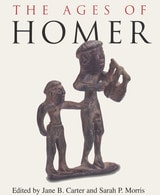
The Ages of Homer
A Tribute to Emily Townsend VermeuleEdited by Jane B. Carter and Sarah P. Morris
University of Texas Press, 1995
Homer’s Iliad and Odyssey have fascinated listeners and readers for over twenty-five centuries. In this volume of original essays, collected to honor the distinguished career of Emily T. Vermeule, thirty-four leading experts in Homeric studies and related fields provide up-to-date, multidisciplinary accounts of the most current issues in the study of Homer.
The book is divided into three sections. The first section treats the Bronze Age setting of the poems (around 1200 B.C.), using archaeological evidence to reveal how poetic memory preserves, distorts, and invents the past. The second section explores the early Iron Age, in which the poems were written (c. 800-500 B.C.), using the strategies of comparative philology and mythology, literary theory, historical linguistics, anthropology, and iconography to determine how the poems took shape. The final section traces the use of Homer for literary and artistic inspiration by classical Greece and Rome.
The Heart of Achilles
Characterization and Personal Ethics in the IliadGraham Zanker
University of Michigan Press, 1996
"[Zanker] investigates altruistic behavior in the epic with professional sophistication but in a way that makes his investigation available to a wide audience from undergraduates to advanced scholars. . . . [A] very useful interpretative study." --Choice
Graham Zanker is Senior Lecturer in Classics, University of Canterbury, New Zealand.
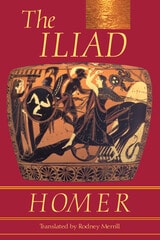
The Iliad
Homer
University of Michigan Press, 2007
nuances of English."
---Stephen G. Daitz, Professor Emeritus of Classics, City University of New York
Rodney Merrill's translation of Homer's Iliad offers a form of English poetry particularly relevant to the epic, producing a strong musical setting that brings many elements of the narrative truly to life. Most notable are the many battle scenes, in which Homer's strong dactylic hexameters make credible the "war-lust" in the deeds of the combatants.
The Iliad of Homer
Translated by Richmond Lattimore
University of Chicago Press, 1951
"Certainly the best modern verse translation."—Gilbert Highet
"This magnificent translation of Homer's epic poem . . . will appeal to admirers of Homer and the classics, and the multitude who always wanted to read the great Iliad but never got around to doing so."—The American Book Collector
"Perhaps closer to Homer in every way than any other version made in English."—Peter Green, The New Republic
"The feat is decisive that it is reasonable to foresee a century or so in which nobody will try again to put the Iliad in English verse."—Robert Fitzgerald
"Each new generation is bound to produce new translations. [Lattimore] has done better with nobility, as well as with accuracy, than any other modern verse translator. In our age we do not often find a fine scholar who is also a genuine poet and who takes the greatest pains over the work of translation."—Hugh Lloyd-Jones, New York Review of Books
"Over the long haul Lattimore's translation is more powerful because its effects are more subtle."—Booklist
"Richmond Lattimore is a fine translator of poetry because he has a poetic voice of his own, authentic and unmistakable and yet capable of remarkable range of modulation. His translations make the English reader aware of the poetry."—Moses Hadas, The New York Times
The Limits of Heroism
Homer and the Ethics of ReadingMark Buchan
University of Michigan Press, 2005
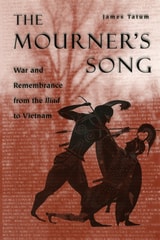
The Mourner's Song
War and Remembrance from the Iliad to VietnamJames Tatum
University of Chicago Press, 2002
Tatum's touchstone throughout is the Iliad, not just one of the earliest war poems, but also one of the most powerful examples of the way poetry can be a tribute to and consolation for what is lost in war. Reading the Iliad alongside later works inspired by war, Tatum reveals how the forms and processes of art convert mourning to memorial. He examines the role of remembrance and the distance from war it requires; the significance of landscape in memorialization; the artifacts of war that fire the imagination; the intimate relationship between war and love and its effects on the ferocity with which soldiers wage battle; and finally, the idea of memorialization itself. Because all survivors suffer the losses of war, Tatum's is a story of both victims and victors, commanders and soldiers, women and men. Photographs of war memorials in Vietnam, France, and the United States beautifully augment his testimonials.
Eloquent and deeply moving, The Mourner's Song will speak to anyone interested in the literature of war and the relevance of the classics to our most pressing contemporary needs.
The Odyssey
Homer, Translated by Rodney Merrill
University of Michigan Press, 2002
This epic began life as the music composed by a "singer of tales," not as words on a page. As such, its meter allows for pleasing variations with a strong basic "beat," thus providing a rhythmic impetus that carries the story swiftly forward. The resulting "music" has important repercussions for the reader's perception of the many repeated elements that provide structure for the poem and bring out significant themes, just as the repetitions in a piece of music do.
This edition of the Odyssey includes selections for further reading, a list of proper names (with a guide to pronunciation), and three maps. It also provides introductory discussions of how the work came into being and was transmitted until it became the work we read, how it is divided into six "performance sessions" of four books each, and how the poem's various themes are developed. Rodney Merrill's Odyssey is thus an ideal edition for students, teachers, and general readers.
The audiobook is available on twelve cassettes, and is read by Rodney Merrill. This version will bring Homer's epic masterpiece to life like never before. Perfect for the car or classroom!
Rodney Merrill is retired and an independent scholar. He has taught at Stanford University, the University of San Francisco, and the University of California, Berkeley.
Thomas R. Walsh, Senior Professor at Occidental College, has written articles on Homeric poetics, with a forthcoming book on anger in Homer.
The Odyssey
Homer
University of Chicago Press, 2025
The most accurate and poetic translation of the world's greatest epic, which is now a film by Academy Award winner Christopher Nolan!
“This may be the best translation of The Odyssey yet."—Edith Hall, The Telegraph
A magnificent feat of translation, hailed by classicists and poets alike as a “momentous achievement”: “thrilling,” “rich and rhythmical,” “superb,” “mesmerizing,” “searingly faithful—yet absolutely original.”
With this edition of Homer’s Odyssey, the celebrated author, critic, and classicist Daniel Mendelsohn brings the great epic to vividly poetic new life. Widely known for his essays on classical literature and culture in The New Yorker and many other publications, Mendelsohn gives us a line-for-line rendering of The Odyssey that is both engrossing as poetry and true to its source. Rejecting the streamlining and modernizing approach of many recent translations, he artfully reproduces the epic’s formal qualities—meter, enjambment, alliteration, assonance—and in so doing restores to Homer’s masterwork its archaic grandeur. Mendelsohn’s expansive six-beat line, far closer to the original than that of other recent translations, allows him to capture each of Homer’s dense verses without sacrificing the amplitude and shadings of the original.
The result is the richest, most ample, most precise, and most musical Odyssey in English, conveying the beauty of its poetry, the excitement of its hero’s adventures, and the profundity of its insights. Supported by an extensive introduction and the fullest notes and commentary currently available, Daniel Mendelsohn’s Odyssey is poised to become the authoritative version of this magnificent and enduringly influential masterpiece.
The Stranger's Welcome
Oral Theory and the Aesthetics of the Homeric Hospitality SceneSteve Reece
University of Michigan Press, 1993
War Music
An Account of Books 1-4 and 16-19 of Homer's IliadChristopher Logue
University of Chicago Press, 2003