Results by title
17 books match the query 'Faith and reason'
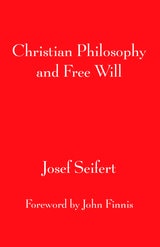
Christian Philosophy and Free Will
Josef Seifert
St. Augustine's Press, 2014
Following an ardent debate in the 1930s on the question over whether something like a “Christian philosophy” exists, as Etienne Gilson, Jacques Maritain, and others held, the term was used by many thinkers and rejected by many others, not only by Heidegger who called it a contradiction in terms, an “iron wood,” but also by Thomists who wanted to see philosophy and Christian faith strictly separated. Seifert analyses five understandings of the term “Christian philosophy” which have never been expounded with such clarity and which he rejects for different, partly for opposite, reasons. He presents these senses of Christian philosophy, and his reasons for rejecting them, in clear, straight-forward language. He presents for the first time a series of eleven wholly different and thoroughly positive and fruitful ways of understanding the (rather misleading) term “Christian philosophy.” Identifying and distinguishing these legitimate ways to speak of “Christian philosophy” shed light on the manifold fruitful relations between reason and faith. In a second part of the book, Seifert gives an example of Christian philosophy in the sense of a philosophy of religion that shows the absolute presupposedness and necessity of the existence of human, divine, and angelic free will to make any sense of divine revelation and of Christian (but also of Muslim and Jewish) religion. In a third part, he presents a penetrating analysis of seven indubitable evidences that demonstrate the nature and real existence of human free will (in a so-called “libertarian” sense that rejects the thesis of the compatibility between free will and determinism). The book is introduced by the eminent Thomist philosopher, John Finnis.
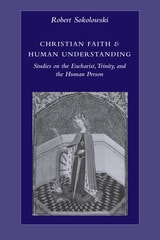
Christian faith & human understanding
studies on the Eucharist, Trinity, and the human personRobert Sokolowski
Catholic University of America Press, 2006
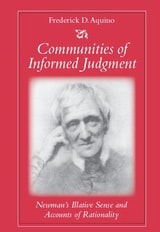
Communities of Informed Judgment
Newman's Illative Sense and Accounts of RationalityFrederick D. Aquino
Catholic University of America Press, 2004
Faith and Intellect
The Lives and Contributions of Latter-day Saint ThinkersLeonard J Arrington
Signature Books, 2019
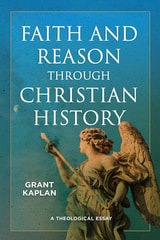
Faith and Reason through Christian History
A Theological EssayGrant Kaplan
Catholic University of America Press, 2022
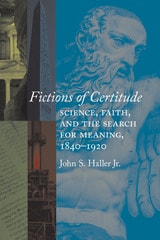
Fictions of Certitude
Science, Faith, and the Search for Meaning, 1840–1920John S. Haller Jr.
University of Alabama Press, 2020
The search for belief and meaning among nineteenth-century intellectuals
The nineteenth century’s explosion of scientific theories and new technologies undermined many deep-seated beliefs that had long formed the basis of Western society, making it impossible for many to retain the unconditional faith of their forebears. A myriad of discoveries—including Faraday’s electromagnetic induction, Joule’s law of conservation of energy, Pasteur’s germ theory, Darwin’s and Wallace’s theories of evolution by natural selection, and Planck’s work on quantum theory—shattered conventional understandings of the world that had been dictated by traditional religious teachings and philosophical systems for centuries.
Fictions of Certitude: Science, Faith, and the Search for Meaning, 1840–1920 investigates the fin de siècle search for truth and meaning in a world that had been radically transformed. John S. Haller Jr. examines the moral and philosophical journeys of nine European and American intellectuals who sought deeper understanding amid such paradigmatic upheaval. Auguste Comte, John Henry Newman, Herbert Spencer, Alfred Russel Wallace, Thomas Henry Huxley, John Fiske, William James, Lester Frank Ward, and Paul Carus all belonged to an age in which one world was passing while another world that was both astounding and threatening was rising to take its place.
For Haller, what makes the work of these nine thinkers worthy of examination is how they strove in different ways to find certitude and belief in the face of an epochal sea change. Some found ways to reconceptualize a world in which God and nature coexist. For others, the challenge was to discern meaning in a world in which no higher power or purpose can be found. As explained by D. H. Meyer, “The later Victorians were perhaps the last generation among English-speaking intellectuals able to believe that man was capable of understanding his universe, just as they were the first generation collectively to suspect that he never would.”
John of St. Thomas [Poinsot] on Sacred Science
Cursus Theologicus I, Question 1, Disputation 2John Of St. Thomas
St. Augustine's Press, 2012
This volume offers an English translation of John of St. Thomas’s Cursus theologicus I, question I, disputation 2. In this particular text, the Dominican master raises questions concerning the scientific status and nature of theology. At issue, here, are a number of factors: namely, Christianity’s continual coming to terms with the “Third Entry” of Aristotelian thought into Western Christian intellectual culture – specifically the Aristotelian notion of ‘science’ and sacra doctrina’s satisfaction of those requirements – the Thomistic-commentary tradition, and the larger backdrop of the Iberian Peninsula’s flourishing “Second Scholasticism.”
In this latter context, John of St. Thomas applies the theological principles of Thomas Aquinas to the Scholastic disputes preoccupying Thomist, Franciscan, and Jesuit theologians, such as Cajetan, Bañez, Luis de Molina, Vazquez, Suárez – to name only a few – in a tour de force of theological thinking throughout the entire period of Scholasticism. In the process – and not insignificantly – the status quaestionis of theology’s scientific character is clearly framed and answered according to John’s satisfaction.
Key to John of St. Thomas’s resolution of the question is his understanding of the continuity of the power of human reason with the super-intelligibility of divine revelation spelled out in terms of what he calls “virtual revelation.” This text presented in this volume is a quintessential example of the deep and abiding harmony that flourished between faith and reason as well as grace and nature within the golden era of Baroque Scholasticism.
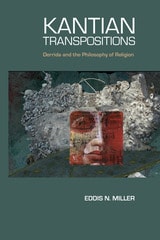
Kantian Transpositions
Derrida and the Philosophy of ReligionEddis N. Miller
Northwestern University Press, 2019
Kantian Transpositions presents an important new reading of Jacques Derrida’s writings on religion and ethics. Eddis Miller argues that Derrida’s late texts on religion constitute an interrogation of the meaning and possibility of a “philosophy of religion.” It is the first book to fully engage Derrida’s claim, in “Faith and Knowledge: The Two Sources of ‘Religion’ at the Limits of Reason Alone” to be transposing the Kantian gesture of thinking religion “within the limits of reason alone.”
Miller outlines the terms of this “transposition” and reads Derrida’s work as an attempt to enact such a transposition. Along the way, he stakes out new ground in the debate over deconstruction and ethics, showing—against recent interpretations of Derrida’s work—that there is an ethical moment in Derrida’s writings that cannot be understood properly without accounting for the decisive role played by Kant’s ethics. The result is the most sustained demonstration yet offered of Kant’s indispensible contribution to Derrida’s thought.
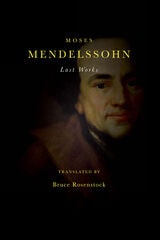
Last Works
Moses Mendelssohn. Translated by Bruce Rosenstock
University of Illinois Press, 2012
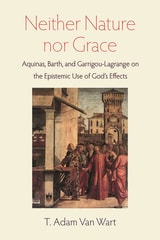
Neither Nature nor Grace
Aquinas, Barth, and Garrigou-Lagrance on the Epistemic Use of God's EffectsT. Adam Van Wart
Catholic University of America Press, 2021
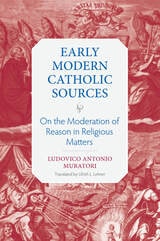
On the Moderation of Reason in Religious Matters
Ludovico Antonio Muratori
Catholic University of America Press, 2024
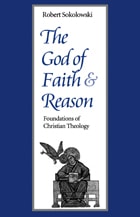
The God of Faith and Reason
Robert Sokolowski
Catholic University of America Press, 1995
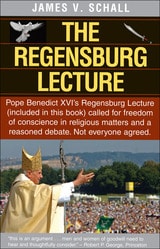
The Regensburg Lecture
James V. Schall, S.J.
St. Augustine's Press, 2007
The Two Wings of Catholic Thought
Essays on Fides et RatioDavid Ruel Foster
Catholic University of America Press, 2003
Theology Needs Philosophy
Matthew L. Lamb
Catholic University of America Press, 2016
Unity in Christ
Bishops, Synodality, and CommunionArchbishop Anthony Fisher, OP
Catholic University of America Press, 2023
Unsettling Obligations
Essays on Reason, Reality and the Ethics of BeliefAllen W. Wood
CSLI, 2002