Results by title
56 books match the query 'Fear' and 6 start with a
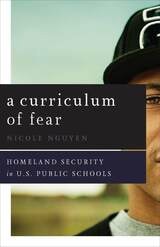
A Curriculum of Fear
Homeland Security in U.S. Public SchoolsNicole Nguyen
University of Minnesota Press, 2016
Welcome to Milton High School, where fear is a teacher’s best tool and every student is a soldier in the war on terror. A struggling public school outside the nation’s capital, Milton sat squarely at the center of two trends: growing fear of resurgent terrorism and mounting pressure to run schools as job training sites. In response, the school established a specialized Homeland Security program.
A Curriculum of Fear takes us into Milton for a day-to-day look at how such a program works, what it means to students and staff, and what it says about the militarization of U.S. public schools and, more broadly, the state of public education in this country. Nicole Nguyen guides us through a curriculum of national security–themed classes, electives, and internships designed through public-private partnerships with major defense contractors like Northrop Grumman and federal agencies like the NSA. She introduces us to students in the process of becoming a corps of “diverse workers” for the national security industry, learning to be “vigilant” citizens; and she shows us the everyday realities of a program intended to improve the school, revitalize the community, and eliminate the achievement gap.
With reference to critical work on school militarization, neoliberal school reform, the impact of the global war on terror on everyday life, and the political uses of fear, A Curriculum of Fear maps the contexts that gave rise to Milton’s Homeland Security program and its popularity. Ultimately, as the first ethnography of such a program, the book provides a disturbing close encounter with the new normal imposed by the global war on terror—a school at once under siege and actively preparing for the siege itself.
A Philosophy of Fear
Lars Svendsen
Reaktion Books, 2008
Svendsen delves into science, politics, sociology, and literature to explore the nature of fear. He examines the biology behind the emotion, from the neuroscience underlying our “fight or flight” instinct to how fear induces us to take irrational actions in our attempts to minimize risk. The book then turns to the political and social realms, investigating the role of fear in the philosophies of Machiavelli and Hobbes, the rise of the modern “risk society,” and how fear has eroded social trust. Entertainment such as the television show “Fear Factor,” competition in extreme sports, and the political use of fear in the ongoing “War on Terror” all come under Svendsen’s probing gaze, as he investigates whether we can ever disentangle ourselves from the continual state of alarm that defines our age.
Svendsen ultimately argues for the possibility of a brighter, less fearful future that is marked by a triumph of humanist optimism. An incisive and thought-provoking meditation, A Philosophy of Fear pulls back the curtain that shrouds dangers imagined and real, forcing us to confront our fears and why we hold to them.
An Ecology of Knowledges
Fear, Love, and Technoscience in Guatemalan Forest ConservationMicha Rahder
Duke University Press, 2020
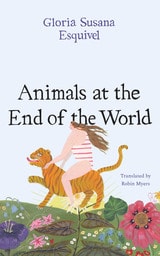
Animals at the End of the World
By Gloria Susana Esquivel, translated by Robin Myers
University of Texas Press, 2020
Animals at the End of the World begins with an explosion, which six-year-old Inés mistakes for the end of the world that she has long feared. In the midst of the chaos, she meets the maid’s granddaughter, Mariá, who becomes her best friend and with whom she navigates the adult world in her grandparents’ confined house. Together, they escape the house and confront the “animals” that populate Bogotá in the 1980s. But Inés soon realizes she cannot count on either María or her preoccupied and conflicted parents. Alone, she must learn to decipher her outer and inner worlds, confronting both armies of beasts and episodes of domestic chaos. In the process, she also learns what it means to test boundaries, break rules, and cope with the consequences.
The first novel by Colombian author Gloria Susana Esquivel, Animals at the End of the World is a poetic and moving coming-of-age story that lingers long after its final page.
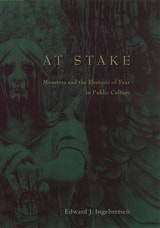
At Stake
Monsters and the Rhetoric of Fear in Public CultureEdward Ingebretsen
University of Chicago Press, 2001
In a study that is at once an analysis of popular culture, a polemic on religious and secular rhetoric, and an ethics of representation, Edward Ingebretsen searches for answers. At Stake explores the social construction of monstrousness in public discourse-tabloids, television, magazines, sermons, and popular fiction. Ingebretsen argues that the monster serves a moralizing function in our culture, demonstrating how not to be in order to enforce prevailing standards of behavior and personal conduct. The boys who shot up Columbine High School, for instance, personify teen rebellion taken perilously too far. Susan Smith, the South Carolinian who murdered her two children, embodies the hazards of maternal neglect. Andrew Cunanan, who killed Gianni Versace, among others, characterizes the menace of predatory sexuality. In a biblical sense, monsters are not unlike omens from the gods. The dreadful consequences of their actions inspire fear in our hearts, and warn us by example.
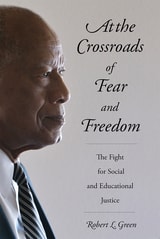
At the Crossroads of Fear and Freedom
The Fight for Social and Educational JusticeRobert L. Green
Michigan State University Press, 2016
This memoir relates previously untold stories about major Civil Rights campaigns that helped put an end to voting rights violations and Jim Crow education; explains how Green has helped urban school districts improve academic achievement levels; and explains why this history should inform our choices as we attempt to reform and improve American education. Green’s quest began when he helped the Kennedy Administration resolve a catastrophic education-related impasse and has continued through his service as one of the participants at an Obama administration summit on a current academic crisis.
It is commonly said that education is the new Civil Rights battlefield. Green’s memoir, At the Crossroads of Fear and Freedom: The Fight for Social and Educational Justice, helps us understand that educational equity has always been a central objective of the Civil Rights movement.