Results by title
49 books match the query 'Feminist criticism'
Abandoned Women and Poetic Tradition
Lawrence Lipking
University of Chicago Press, 1988

Ancient Sisterhood
The Lost Traditions of Hagar and SarahSavina J. Teubal
Ohio University Press, 1997
Ancient Sisterhood cites evidence that Hebrew women actually enjoyed the privileges and sanctity of their own religious practices. These practices, however, were gradually eroded and usurped by the establishment of patriarchal monarchies that were based on militaristic conquest and power. Teubal examines the figures of Hagar and Sarah from a feminist perspective that combines thorough scholarship with an informed and detailed understanding of the cultural and religious influences from which the mysterious biblical figure of Hagar emerged. She looks at Hagar's important role in the genesis of Hebrew culture, her role as mother of the Islamic nations, and her power as a matriarch as opposed to her apparent status as a concubine.
Teubal posits two distinct sources for the Hagar episodes: Hagar as companion to Sarah and an unknown woman whom she refers to as the desert matriarch. She explores whether Hagar was a slave to Abraham or Sarah, the differences between Hagar and the desert matriarch, and the obscurantism of these important elements in biblical texts. Teubal sheds considerable light on two central figures of these world religions and “the disassociation of woman from her own female religious experience.”
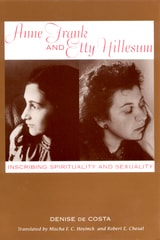
Anne Frank and Etty Hillesum
Inscribing Spirituality and Sexualityde Costa, Denise
Rutgers University Press, 1998
Studies of Nazi persecution and destruction of Jews have to date largely been based on the accounts of men. And yet gender difference in Western society is so profound that women and men seem to have divergent experiences, speak different languages, and see and hear in dissimilar ways. Denise de Costa's book explores the significance of sex and gender differences in the construction of history and society-specifically, the Nazi genocide of Jews in World War II-by focusing on the writing of two Jewish women, Anne Frank and Etty Hillesum.
De Costa argues that although both of these writers have received much attention, little has been done to understand how the significant difference occasioned by both gender and Jewishness helps to define cultural or personal identity in relation to the Holocaust. De Costa uses a variety of psychoanalytic and feminist theories to approach the writing of Frank and Hillesum. Critiquing as well as employing the concepts of Julia Kristeva, Hélène Cixous, Luce Irigaray, and Simone de Beauvoir among others, she presents a detailed and rich discussion of each writer.
De Costa approaches Anne Frank largely from a psychoanalytical perspective that emphasizes the function of writing itself in the development of self-identity. For Etty Hillesum, she is more concerned with how writing establishes a philosophy, and a faith, that can entertain and is indeed based in doubleness and paradox. Her assessment of these two writers makes a significant contribution to our understanding of the Holocaust as a cultural and historical phenomenon, of the role of writing in the production and expression of gendered identity, and of the complex relation between women, writing, and culture.
Applications Of Feminist Legal Theory
edited by D. Kelly Weisberg
Temple University Press, 1996

Bitter Milk
Women and TeachingMadeleine R. Grumet
University of Massachusetts Press, 1988
The first and last chapters address the familial relations that fall under the category of reproduction, a frame designed to emphasize the relations of reproduction and their importance to educational theory. The chapters closest to this margin are those that address women's work in schools, and the juxtaposition is chosen to accentuate the dialectical relation of our public and private meanings. The middle chapters are the ones most directly concerned with curriculum, that provisional ground that Grumet is naming as our mediating space, the place where we can heal. The fundamental argument of this text is that knowledge evolves in human relationships.

Body Drift
Butler, Hayles, HarawayArthur Kroker
University of Minnesota Press, 2012
As exemplary representatives of a form of critical feminism, the writings of Judith Butler, Katherine Hayles, and Donna Haraway offer entry into the great crises of contemporary society, politics, and culture. Butler leads readers to rethink the boundaries of the human in a time of perpetual war. Hayles turns herself into a “writing machine” in order to find a dwelling place for the digital humanities within the austere landscape of the culture of the code. Haraway is the one contemporary thinker to have begun the necessary ethical project of creating a new language of potential reconciliation among previously warring species.
According to Arthur Kroker, the postmodernism of Judith Butler, the posthumanism of Katherine Hayles, and the companionism of Donna Haraway are possible pathways to the posthuman future that is captured by the specter of body drift. Body drift refers to the fact that individuals no longer inhabit a body, in any meaningful sense of the term, but rather occupy a multiplicity of bodies: gendered, sexualized, laboring, disciplined, imagined, and technologically augmented.
Body drift is constituted by the blast of information culture envisioned by artists, communicated by social networking, and signified by its signs. It is lived daily by remixing, resplicing, and redesigning the codes: codes of gender, sexuality, class, ideology, and identity. The writings of Butler, Hayles, and Haraway, Kroker reveals, provide the critical vocabulary and political context for understanding the deep complexities of body drift and challenging the current emphasis on the material body.

Breaking the World
Black Insecurity and the Horizons of Speculative FictionJustin L. Mann
Duke University Press, 2026
Bringing Down the Temple House
Engendering Tractate YomaMarjorie Lehman
Brandeis University Press, 2022
While the use of feminist analysis as a methodological lens is not new to the study of Talmudic literature or to the study of individual tractates, this book demonstrates that such an intervention with the Babylonian Talmud reveals new perspectives on the rabbis’ relationship with the temple and its priesthood. More specifically, through the relationships most commonly associated with home, such as those of husband-wife, father-son, mother-son, and brother-brother, the rabbis destabilize the temple bayit (or temple house). Moving beyond the view that the temple was replaced by the rabbinic home, and that rabbinic rites reappropriate temple practices, a feminist approach highlights the inextricable link between kinship, gender, and the body, calling attention to the ways the rabbis deconstruct the priesthood so as to reconstruct themselves.
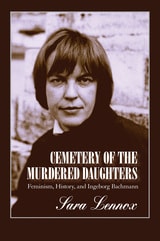
Cemetery of the Murdered Daughters
Feminism, History, and Ingeborg BachmannSara Lennox
University of Massachusetts Press, 2006
Although Austrian writer Ingeborg Bachmann (1926–1973) is widely regarded as one of the most important twentieth-century authors writing in German, her novels and stories have sometimes been viewed narrowly as portraits of women as victims. In this innovative study, Sara Lennox provides a much broader perspective on Bachmann's work, at the same time undertaking an experiment in feminist methodology. Lennox examines Bachmann's poetry and prose in historical context, arguing that the varied feminist interpretations of her writings are the result of shifts in theoretical emphases over a period of more than three decades. Lennox then places her own essays on Bachmann in similar perspective, showing how each piece reflects the historical moment in which it was written. Making use of recent interdisciplinary approaches—Foucauldian theories of sexuality, post-colonial theory, materialist feminism—she explores the extent to which each of her earlier readings was shaped by the methods employed, the questions asked, and the political issues that seemed most germane at the time. Out of this analysis comes a new understanding of the significance of Bachmann's work and new insight into the theory and practice of feminist criticism.
Contemporary Feminist Fiction and a Case for Expanding Rhetorical Narratology
Katherine J. Weese
The Ohio State University Press, 2025
Examining Ali Smith’s The Accidental and Hotel World, Barbara Kingsolver’s The Poisonwood Bible, Toni Morrison’s Beloved, Kate Atkinson’s A God in Ruins and Life After Life, and Ruth Ozeki’s A Tale for the Time Being, Weese demonstrates how various narratological theories inform rather than compete with one another. Through an expanded rhetorical poetics, including a refined version of James Phelan’s MTS (mimetic, thematic, synthetic) model, she reframes post-postmodern theorists’ concerns with communicative function through a narratological lens to make the case that exploring the rhetorical function of unnatural devices challenges and extends the claims of narrow metamodern readings.

Crip Genealogies
Mel Y. Chen, Alison Kafer, Eunjung Kim, and Julie A. Minich, editors
Duke University Press, 2023
Contributors. Suzanne Bost, Mel Y. Chen, Sony Coráñez Bolton, Natalia Duong, Lezlie Frye, Magda García, Alison Kafer, Eunjung Kim, Yoo-suk Kim, Kateřina Kolářová, James Kyung-Jin Lee, Stacey Park Milbern, Julie Avril Minich, Tari Young-Jung Na, Therí A. Pickens, Leah Lakshmi Piepzna-Samarasinha, Jasbir K. Puar, Sami Schalk, Faith Njahîra Wangarî
Dirshuni
Contemporary Women’s MidrashEdited by Tamar Biala
Brandeis University Press, 2022
Dirshuni: Contemporary Women’s Midrash, is the first-ever English edition of a historic collection of midrashim composed by Israeli women, which has been long-anticipated by multiple American audiences, including synagogues, rabbinical seminaries, adult learning programs, Jewish educators, and scholars of gender and religion. Using the classical forms developed by the ancient rabbis, the contributors express their religious and moral thought and experience through innovative interpretations of scripture. The women writers, from all denominations and beyond, of all political stripes and ethnic backgrounds, contribute their Torah to fill the missing half of the sacred Jewish bookshelf. This book reflects dramatic changes in the agency of women in the world of religious writings. The volume features a comprehensive introduction to Midrash for the uninitiated reader by the distinguished scholar Tamar Kadari and extensive annotation and commentary by Tamar Biala.
Early Jewish Writings
Eileen Schuller
SBL Press, 2017
New from the Bible and Women Series
This collection of essays deals with aspects of women and gender relations in early Judaism (during the Persian, Greek, and Roman empires). Some essays focus on specific writings: the Greek (Septuagint) version of Esther, Judith, Joseph and Aseneth, and the Letter of Jeremiah. Others explore how certain biblical texts are reinterpreted: Eve in the Life of Adam and Eve, the mixing of the sons of God with the daughters of men from Genesis 6:1–4, the Egyptian princess at the birth of Moses, and how Josephus retells biblical stories. The third group of essays explore specific social contexts: Philo's views of women in the Roman empire, the Sectarian Dead Sea Scrolls, and women philosophers of the Therapeutae in Egyptian Alexandria.
Features
- An International team of contributors from Europe and North America
- A breadth of materials covered, including many lesser-known early Jewish writings
- Focus is on a gendered perspective and gender specific questions
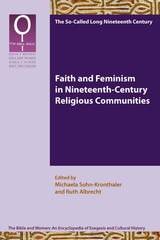
Faith and Feminism in Nineteenth-Century Religious Communities
Michaela Sohn-Kronthaler
SBL Press, 2019
Explore a diversity of feminist readings of the Bible
This latest volume in the Bible and Women series is concerned with documenting, through word and image, both well-known and largely unknown women and their relationship to the Bible from the period of the late eighteenth century up to the beginning of the twentieth century. The essays in this collection illustrate the broad range of treatment of the Holy Scripture. Paul Chilcote, Marion Ann Taylor, Christiana de Groot, Elizabeth M. Davis, and Pamela S. Nadell offer perspectives on the Anglo-American sphere during this period. Marina Cacchi, Adriano Valerio, Inmaculada Blasco Herranz, and Alexei Klutschewski and Eva Maria Synek illuminate the areas of southern and eastern Europe. Angela Berlis, Ruth Albrecht, Doris Brodbeck, Ute Gause, and Michaela Sohn-Kronthaler examine women from the German-speaking world and their texts. Bernhard Schneider, Magda Motté, Katharina Büttner-Kirschner, and Elfriede Wiltschnigg treat the subject area of religious literature and art.
Features
- Insight into how women participated in academic exegesis and applied biblical figures as models for structuring their own lives
- Exploration of genres used by women, including letters, diaries, autobiographical records, stories, novels, songs, poems, and specialized exegetical treatises and commentaries on individual books of the Bible
- Detailed analyses of women’s interpretations ranging from those that sought to confirm traditions to those that challenged them
Feminism Beyond Modernism
Elizabeth Flynn
Southern Illinois University Press, 2002
Misunderstanding and denigration of postmodern feminism are widespread. Elizabeth Flynn’s Feminism Beyond Modernism comes to its defense in a cogent and astute manner by first distinguishing between postmodern and antimodern feminisms and then reclaiming postmodern feminism by reconfiguring its relationship to modernism.
Too often postmodern feminism is unfairly identified as opposed to modernism and associated with subjectivism and relativism. Flynnaddresses these problems by provisionally defining postmodern feminism as problematizing and critiquing modernism without directly opposing it. Flynn also suggests that feminist traditions that reject modernism, such as radical and cultural feminisms, are antimodern rather than postmodern.
In this interdisciplinary study, Flynn defines feminist traditions broadly, situating her discussions within the contexts of literary studies and rhetoric and composition while simultaneously exploring the troubled relationship between these fields. Departing from accepted definitions of modernism, Flynn distinguishes between aesthetic modernism and Enlightenment modernism and uses the work of John Locke, Sigmund Freud, Charlotte Perkins Gilman, Michel Foucault, Donna Haraway, and others as benchmarks for historical placement. In addition, rereadings of works by Virginia Woolf, Adrienne Rich, Alice Walker, Louise Rosenblatt, and others demonstrate the complex ways in which they respond to modernist pressures and tendencies. From this context, Flynn’s Feminism Beyond Modernism reconfigures feminist traditions by defining postmodern feminism as a critique of modernism rather than as an antimodern opponent.
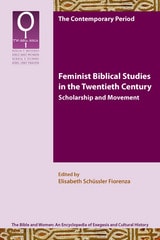
Feminist Biblical Studies in the Twentieth Century
Scholarship and MovementElisabeth Schüssler Fiorenza
SBL Press, 2014
Chart the development of feminist approaches and theories of interpretation during the period when women first joined the ranks of biblical scholars
This collection of essays on feminist biblical studies in the twentieth century seeks to explore four areas of inquiry demanding further investigation. In the first section, articles chart the beginnings and developments of feminist biblical studies as a conversation among feminists around the world. The second section introduces, reviews, and discusses the hermeneutic religious spaces created by feminist biblical studies. The third segment discusses academic methods of reading and interpretation that dismantle androcentric language and kyriarchal authority. The fourth section returns to the first with work that transgresses academic boundaries in order to exemplify the transforming, inspiring, and institutionalizing feminist work that has been and is being done to change religious mindsets of domination and to enable wo/men to engage in critical readings of the Bible.
Features:
- Essays examine the rupture or break in the malestream reception history of the Bible
- Exploration of the term feminism in different social-cultural and theoretical-religious locations
- Authors from around the world present research and future directions for research challenging the next generation of feminist interpreters
Feminist Theories for Dramatic Criticism
Gayle Austin
University of Michigan Press, 1990
Feminist Theories for Dramatic Criticism provides a number of useful approaches for analyzing works for the stage from a feminist perspective. Each chapter outlines key feminist theories in a specific field, covering literary criticisms, anthropology, psychology, and film, and then applies these theories in a detailed criticism of one or two plays. Plays by Eugene O'Neill, Arthur Miller, Lillian Hellman, Jane Bowles, Sam Shepard, and Alice Childress—all produced after World War II—are reexamined through the lenses of feminist theorist Judith Fetterley, Gayle Rubin, Nancy Chodorow, and Laura Mulvey, each a key figure in her respective field.
The introduction provides a framework for the discussion of feminist dramatic criticism by presenting the multiple political perspectives within feminism. The contributions of black and lesbian feminists to the question of theory are explored, as are the evolutionary stages of feminist criticism as they have been occurring in other fields. Theater has been slower than most fields to move through these stages, and its trajectory thus far is briefly traced. For the sake of clarity, each of the central chapters treats theories from a particular discipline, but the conclusion reminds us that in practice the theories are most often combined.
The book will appeal to theater scholars and practitioners interested in finding their way into feminist theory for the first time, or in expanding their knowledge of its insights for use in teaching, research, and production. Those in women's studies and other fields will find it shows ways to include plays among the texts they analyze.
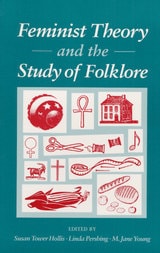
Feminist Theory and the Study of Folklore
Edited by Susan Tower Hollis, Linda Pershing, and M. Jane Young
University of Illinois Press, 1994

Fields of Play
Constructing an Academic LifeRichardson, Laurel
Rutgers University Press, 1997
Deeply engaging, movingly written with grace, elegance, and clarity, the book stimulates readers to situate their own writing in personal, social, and political contexts.
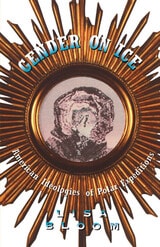
Gender On Ice
American Ideologies of Polar ExpeditionsLisa Bloom
University of Minnesota Press, 1993
Bloom focuses on the conquest of the North Pole as she reveals how popular print and visual media defined and shaped American national ideologies from the early twentieth century to the present.

Gender Studies
New Directions in Feminist CriticismJudith A. Spector
University of Wisconsin Press, 1986
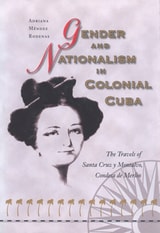
Gender and Nationalism in Colonial Cuba
The Travels of Santa Cruz y Montalvo, Condesa de MerlinAdriana Mendez Rodenas
Vanderbilt University Press, 1998
Born in colonial Havana to an aristocratic Creole family, the future countess of Merlin left Cuba for Spain at an early age. Later, her marriage to the French count Antoine Christophe Merlin and the invasion of French Napoleonic troops precipitated another move to France, where she became one of the belle dames of Paris and began her literary career. She returned only once to Cuba after the death of her husband in 1840, a journey that produced Viaje a la Habana. Upon her return to Paris, Merlin expanded this into La Havane, an ambitious three-volume account of the political, social, and economic organization of the island.
From the viewpoint of feminist and psychoanalytical theory, Gender and Nationalism in Colonial Cuba brilliantly explores the many ways in which issues of gender have contributed to Merlin's virtual absence from the canons of literature and from the discourses on Cuban national identity. Merlin's double identity as both Cuban and French is symbolic of the Cuban exiled condition, a fact taken up by contemporary exiled Cuban writers who see the countess as an alter-ego.
Mendez Rodenas seeks to restore Merlin as the first woman writer in Cuban literary history to articulate a sense of national identity, as well as being Cuba's first female historian. She focuses on Merlin's travel writings because they examine such issues as slavery, independence, nationhood, the role of women, education, and local literature. Together her writings construct an alternative, gendered history of nineteenth-century Cuba that must be acknowledged as both functional and authentic.
By situating Merlin at the intersection of the discourses of gender and nationalism, Mendez Rodenas reveals not only her pioneering role but also the need to expand current critical categories to account for the specificity of the Latin American literary tradition. In the process of restoring Merlin to her appropriate place in the canon of Latin American literature, she broadens our understanding of colonial Cuban history and expands our knowledge of the ways in which travel writing can influence a country's national literature .
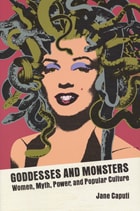
Goddesses and Monsters
Women, Myth, Power, and Popular CultureJane Caputi
University of Wisconsin Press, 2004
The essays in Goddesses and Monsters recognize popular culture as a primary repository of ancient mythic energies, images, narratives, personalities, icons, and archetypes. Together, they take on the patriarchal myth, where serial killers are heroes, where goddesses—in the form of great white sharks, femmes fatales, and aliens—are ritually slaughtered, and where pornography is the core story underlying militarism, environmental devastation, and racism. They also point to an alternative imagination of female power that still can be found behind the cult devotion given to Princess Diana and animating all the goddesses disguised as popular monsters, queen bitches, mammies, vamps, cyborgs, and sex bombs.
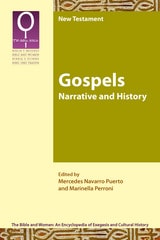
Gospels
Narrative and HistoryMercedes Navarro Puerto
SBL Press, 2015
An international collection of ecumenical, gender-sensitive interpretations
In this volume of the Bible and Women Series, contributors examine how biblical studies intersects with feminist interpretive methods with regard to the Gospels. Authors examine the lives of women in Roman Palestine, named and unnamed women in the Gospels, and the role of gender in the reception of the Hebrew scriptures in the New Testament.
Features:
- Essays by scholars from scholars from around the world
- An introduction and twenty essays focused on women and gender relations
- Coverage of power relations and ideologies within the texts and in current interpretations

Haunting Violations
Feminist Criticism and the Crisis of the "Real"Edited by Wendy S. Hesford and Wendy Kozol
University of Illinois Press, 2000
Feminist critics place a premium on the "real" stories told by the victimized and the oppressed. Haunting Violations offers a corrective to such uncritical acceptance of the "real" in confessional, testimonial, and ethnographic narratives. Through close readings of a wide variety of texts, contributors argue that depictions of the "real" are inherently performative, crafted within the limits and in the interests of specific personal, political, or social projects.
Haunting Violations explores the inseparability of discourse and politics in quasi-autobiographical works such as I, Rigoberta Menchú and When Heaven and Earth Changed Places. Contributors consider how the Sri Lankan Mother's Front movement exploits the sanctity of the maternal and how multiple political purposes on both sides bleed through government "documentary" photographs of Japanese-American concentration camp internees. This volume also investigates how South Asian feminists use the authority of their personal experience to critique the film Mississippi Masala and how realist narratives, such as Janet Campbell Hale's autobiographical Bloodlines, Margie Strosser's documentary film Rape Stories, and Shekur Kapur's film Bandit Queen, reexamine how assumptions about power and trauma are embedded in the promise of the real.
In a Field of Static
Missed Encounters with Black Feminist TheorizingJames Bliss
Duke University Press, 2026
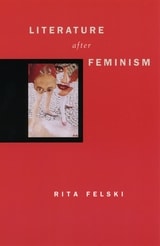
Literature after Feminism
Rita Felski
University of Chicago Press, 2003
Spelling out her main arguments clearly and succinctly, Rita Felski explains how feminism has changed the ways people read and think about literature. She organizes her book around four key questions: Do women and men read differently? How have feminist critics imagined the female author? What does plot have to do with gender? And what do feminists have to say about the relationship between literary and political value? Interweaving incisive commentary with literary examples, Felski advocates a double critical vision that can do justice to the social and political meanings of literature without dismissing or scanting the aesthetic.

Magical Habits
Monica Huerta
Duke University Press, 2021
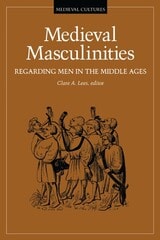
Medieval Masculinities
Regarding Men in the Middle AgesClare A. Lees
University of Minnesota Press, 1994
"Ranging from questions of epic violence and heroic embodiments of manhood to constructions of bachelorhood, husbandry, and sainthood, Medieval Masculinities is the first synthesis of medieval and gender studies to focus on masculinities."
Harry Brod, editor of The Making of Masculinities"We should not be working [exclusively] on the subjected sex any more than a historian of class can focus exclusively on peasants."-Natalie Zemon Davis, 1975 In the years since Natalie Davis made this remark, men's studies, and gender studies along with it, has earned its place in scholarship. What is often missing from such studies, however, is the insight that the concept of gender in general, and that of masculinity in particular, can be understood only in relation to individual societies, examined at specific historical and cultural moments. A brilliant application of this insight, Medieval Masculinities is the first full-length collection to explore the issues of men's studies and contemporary theories of gender within the context of the Middle Ages. Interdisciplinary and multicultural, the essays range from matrimony in medieval Italy to bachelorhood in Renaissance Venice, from friars and saints to the male animal in the fables of Marie de France, from manhood in Sir Gawain and the Green Knight, Beowulf, and the Roman d'Eneas to men as "other," whether Muslim or Jew, in medieval Castilian epic and ballad. The authors are especially concerned with cultural manifestations of masculinity that transcend this particular historical period-idealized gender roles, political and economic factors in structuring social institutions, and the impact of masculinist ideology in fostering and maintaining power. Together, their essays constitute an important reassessment of traditional assumptions within medieval studies as well as a major contribution to the evolving study of gender.ContributorsChristopher Baswell, Barnard CollegeVern L. Bullough, SUNY, BuffaloStanley Chojnacki, Michigan State UniversityJohn Coakley, New Brunswick Theological SeminaryThelma Fenster, Fordham UniversityClare Kinney, University of VirginiaClare A. Lees, University of PennsylvaniaJo Ann McNamara, Hunter CollegeLouise Mirrer, Fordham UniversityHarriet Spiegel, California State University, ChicoSusan Mosher Stuard, Haverford College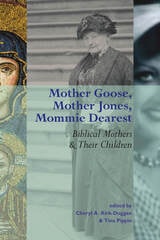
Mother Goose, Mother Jones, Mommie Dearest
Biblical Mothers and Their ChildrenCheryl A. Kirk-Duggan
SBL Press, 2009
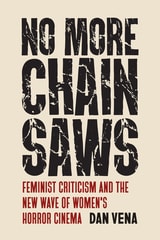
No More Chainsaws
Feminist Criticism and the New Wave of Women's Horror CinemaDan Vena
Rutgers University Press, 2026
“Welcome to the Golden Age of Women-Directed Horror.” Over the last fifteen years, there has been a sustained global influx of women artists working in mainstream and independent horror cinemas earning notable public and industry acclaim. As a result, now, for the first time in horror history, there is also a concentrated corpus of films that explicitly address topics of identity, sexuality, trauma, and monstrosity from women’s perspectives. No More Chainsaws offers an in-depth analysis of some of the earliest and underrated releases within this New Wave of women’s horror cinema: Catherine Hardwicke’s Twilight (2008), Karyn Kusama’s Jennifer’s Body (2009), Jennifer and Sylvia Soska’s American Mary (2012), and Kimberly Peirce’s Carrie (2013). No More Chainsaws articulates the ways in which these contemporary films attempt to liberate horror from an overdetermining gendered lexicon of violence and terror.
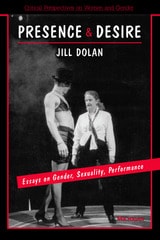
Presence and Desire
Essays on Gender, Sexuality, PerformanceJill Dolan
University of Michigan Press, 1993
This book critically bridges feminist theory and theatrical practice. Dolan examines how performance can subvert normative constructs of gender and sexuality. The collection evaluates mainstream theater, academic stages, subcultural venues, and performance in daily life. It centers sexuality as a primary analytical framework to explore queer visibility and cultural representation. It bridges contemporary feminist theory, poststructuralism, and theatrical practice and places sexuality at the center of its analytical framework to explore how theatrical representation can subvert normative constructs of gender and desire. Dolan evaluates a vast spectrum of performance spaces—ranging from mainstream professional and academic stages to subcultural venues, pornography, and everyday social interactions—to champion queer visibility and claim recognition for women's bodies. Ultimately, the volume functions as a foundational text in performance studies and LGBTQ+ cultural criticism, demonstrating how deliberate theatrical strategies can provoke American culture to actively dismantle and reimagine its traditional social relations
Reading The Social Body
Catherine B. Burroughs
University of Iowa Press, 1993
The overarching argument of Reading the Social Body is that the body is cultural rather than “natural.” Some of the essays treat the social construction of bodies that have actually existed in human history; others discuss the representation of bodies in artistic contexts; all recognize that everything visible to the human body—from posture and costume to the width of an eyebrow or a smile—is determined by and shaped in response to a particular culture.
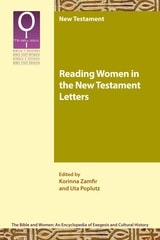
Reading Women in the New Testament Letters
Korinna Zamfir
SBL Press, 2024
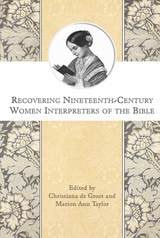
Recovering Nineteenth-Century Women Interpreters of the Bible
Christiana de Groot
SBL Press, 2007
Women have been thoughtful readers and interpreters of scripture throughout the ages, yet the usual history of biblical interpretation includes few women’s voices. To introduce readers to this untapped source for the history of biblical interpretation, this volume presents forgotten works from the nineteenth century written by women—including Grace Aguilar, Florence Nightingale, and Harriet Beecher Stowe, among others—from various faith backgrounds, countries, and social classes engaging contemporary biblical scholarship. Due to their exclusion from the academy, women’s interpretive writings addressed primarily a nonscholarly audience and were written in a variety of genres: novels and poetry, catechisms, manuals for Bible study, and commentaries on the books of the Bible. To recover these nineteenth-century women interpreters of the Bible, each essay in this volume locates a female author in her historical, ecclesiastical, and interpretive context, focusing on particular biblical passages to clarify an author’s contributions as well as to explore how her reading of the text was shaped by her experience as a woman.
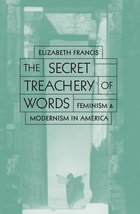
Secret Treachery Of Words
Feminism And Modernism In AmericaElizabeth Francis
University of Minnesota Press, 2002
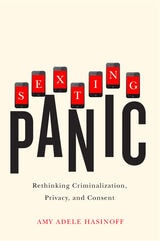
Sexting Panic
Rethinking Criminalization, Privacy, and ConsentAmy Adele Hasinoff
University of Illinois Press, 2015
Taboo Memories, Diasporic Voices
Ella Shohat
Duke University Press, 2006
Shohat’s critical method boldly transcends disciplinary and geographical boundaries. She explores such issues as the relations between ethnic studies and area studies, the paradoxical repercussions for audio-visual media of the “graven images” taboo, the allegorization of race through the refiguring of Cleopatra, the allure of imperial popular culture, and the gender politics of medical technologies. She also examines the resistant poetics of exile and displacement; the staging of historical memory through the commemorations of the two 1492s, the anomalies of the “national” in Zionist discourse, the implications of the hyphen in the concept “Arab-Jew,” and the translation of the debates on orientalism and postcolonialism across geographies. Taboo Memories, Diasporic Voices not only illuminates many of the concerns that have animated the study of cultural politics over the past two decades; it also points toward new scholarly possibilities.
The Early Middle Ages
Franca Ela Consolino
SBL Press, 2020
Examine the creative, profound dialogue between medieval women and biblical traditions
The latest volume in the Bible and Women series examines the relationship between women and the Bible’s reception during the early Middle Ages (500–1100 CE) in both the Greek East and the Latin West. Essays focus on interactions between women and the Bible through biblical precepts on women and for women, biblical women as the subjects of action or objects of discussion, and writings by women that refer to the Bible as a moral authority. The women discussed in the volume range from the well-known—including the nuns Kassia in Byzantium and Hrosvita in the West; the aristocrat Dhuoda, author of a moral guide for her son; Gisela, the sister of Charlemagne and abbess of Chelles; and her niece Rotrude—to those who remain anonymous. Contributions also explore how the Old and New Testaments exercised influence on emerging Islam.
Features:
- Analysis of images of the Virgin Mary as a means of tracing the spread of her cult and feast days from East to West
- Exploration of the significance of classical culture for medieval women who composed poems for a Christian audience
- Evaluation of art as a means of establishing devotional relationships not necessarily mediated by the voices of preachers or the reading of texts .
The Feminist Spectator as Critic
Jill Dolan
University of Michigan Press, 2012
The Feminist Spectator as Criticbroke new ground as one of the pioneering books on feminist spectatorship, encouraging resistant readings to generate feminist meanings in performance. Approaching live spectatorship through a range of interdisciplinary methods, the book has been foundational in theater studies, performance studies, and gender/sexuality/women's studies. This updated and enlarged second edition celebrates the book's twenty-fifth anniversary with a substantial new introduction and up-to-the-moment bibliography, detailing the progress to date in gender equity in theater and the arts, and suggesting how far we have yet to go.
The High Middle Ages
Kari Elisabeth Børresen
SBL Press, 2015
An international collection of ecumenical, gender-sensitive interpretations
The latest volume in the Bible and Women series examines the relationship between women and the Bible's reception in the centuries of the High and Late Middle Ages in Europe. Contributors bring a variety of new insights to questions of how women of the Bible were treated in literary, mystical, and doctrinal texts as well as in art and music. Though the Bible was used to legitimize the subordination of women to men and to exclude them from power, during this period women produced works of theology and biblical interpretation. Contributors include Gemma Avenoza, Marina Benedetti, Dinora Corsi, Maria Laura Giordano, Elisabeth Gössmann, Maria Leticia Sánchez Hernández, Hildegund Keul, Linda Maria Koldau, Martina Kreidler-Kos, Rita Librandi, Gary Macy, Constant J. Mews, Magda Motté, Rosa María Parrinello, María Isabel Toro Pascua, Claudia Poggi, Carmel Posa, Marina Santini, Valeria Ferrari Schiefer, Andrea Taschl-Erber, Adriana Valerio, and Paola Vitolo.
Features
- Essays on the treatment of women in commentaries and didactic moral literature written by men
- Close study of women as scholars and interpreters of the Bible from the twelfth through the fifteen centuries
- Twenty-one essays from twenty-three scholars from around the world
The Impossible Woman
Television, Feminism, and the FutureKristen Hoerl
Rutgers University Press, 2026
The Intercourse of Knowledge
On Gendering Desire and 'Sexuality' in the Hebrew BibleAthalya Brenner
SBL Press, 2016
Now in paperback!
This groundbreaking book, which builds on the author's earlier work in On Gendering Texts, studies how, by what means, and to what extent human love, desire and sex, and possibly even "sexuality"; are gendered in the Hebrew Bible. The investigation looks into the construction of male and female bodies in language and ideologies; the praxis and ideology of sex, procreation, and contraception; deviation from socio-sexual boundaries (e.g. incest, rape, adultery, homosexuality, prostitution); eroticism and "pornoprophetics."
Features:
- Paperback format of an essential Brill monograph
- A classification and gendering of the linguistic and semantic data
- Discussion of wider sociological and theological implications
The Politics of Women's Biology
Hubbard, Ruth
Rutgers University Press, 1990
The Tenets of Cognitive Existentialism
Dimitri Ginev
Ohio University Press, 2011
In The Tenets of Cognitive Existentialism, Dimitri Ginev draws on developments in hermeneutic phenomenology and other programs in hermeneutic philosophy to inform an interpretative approach to scientific practices. At stake is the question of whether it is possible to integrate forms of reflection upon the ontological difference in the cognitive structure of scientific research. A positive answer would have implied a proof that (pace Heidegger) “science is able to think.” This book is an extended version of such a proof. Against those who claim that modern science is doomed to be exclusively committed to the nexus of objectivism and instrumental rationality, the interpretative theory of scientific practices reveals science’s potentiality of hermeneutic self-reflection. Scientific research that takes into consideration the ontological difference has resources to enter into a dialogue with Nature.
Ginev offers a critique of postmodern tendencies in the philosophy of science, and sets out arguments for a feminist hermeneutics of scientific research.
Virtual Gender
Fantasies of Subjectivity and EmbodimentMary Ann O'Farrell and Lynne Vallone, Editors
University of Michigan Press, 1999

Wendy Wasserstein
Jill Dolan
University of Michigan Press, 2017
Wendy Wasserstein provides a critical introduction and a feminist reappraisal of the significant plays of one of the most famous contemporary American women playwrights. Following a biographical introduction, chapters address each of her important plays, situating Wasserstein’s work in the history of the US feminist movement and in a historical moment in which women artists continue to struggle for recognition.
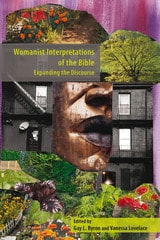
Womanist Interpretations of the Bible
Expanding the DiscourseGay L. Byron
SBL Press, 2016
Expand the discourse and open the spheres of engagement to include new voices of scholars and bold, innovative interpretive approaches
This edited volume brings together cross-generational and cross-cultural readings of the Bible and other sacred sources by including scholars from the Caribbean, India, and Africa who have not traditionally fit into the narrow U.S., African American paradigm for understanding womanist biblical interpretation. The volume engages the reader in a wide range of interdisciplinary methods and perspectives, such as gender and feminist criticism, social-scientific methods, post-colonial and psychoanalytical theory that emphasize the inherently intersectional dynamics of race, ethnicity, and class at work in womanist thought and analysis.
Features
- Topics include the Black Lives Matter movement, domestic violence, and AIDS, while at the same time uncovering the roles of children, women, and other marginalized persons in biblical narratives
- Coverage of Hebrew Bible and New Testament texts, as well as Ifa spiritual narratives, Hindu scripture, and Ethiopic texts
- Responses from four respected womanist and feminist critics: Katherine Doob Sakenfeld, Emilie Townes, Layli (Phillips) Maparyan, and Sarojini Nadar
Women in Hollywood's Dream Factory
Tales of Inequality, Abuse, and ResistanceEdited by Karen McNally
University of Illinois Press, 2026
The #MeToo revelations put a twenty-first-century stamp on the age-old story of women’s mistreatment in Hollywood. Karen McNally edits a collection focused on examining and revising film history in the aftermath of the women’s stories, past and present, that have come to light.
The collection begins with essays on the interplay between reality and imagination in narratives and representations of women’s experiences of unequal treatment. In Part 2, contributors discuss how the gendered attitudes of the media’s stories enable inequality in Hollywood and look at the forces that arise whenever women resist these media assaults. The next section addresses the structures that built the inequalities and mistreatment while Part 4 revisits established narratives to challenge, renew, and expand upon our understanding of film history through women’s stories. Essays in the final section address the combination of inequality and resistance that defines women’s experiences in Hollywood.
Piercing and astute, Women in Hollywood’s Dream Factory confronts our perception of Hollywood as a mythological land of dreams.
Contributors: Alicia Byrnes, Anna M. Dempsey, Harriet Fletcher, Amanda Konkle, Tamar Jeffers McDonald, Kerry McElroy, Adrienne L. McLean, Karen McNally, Donna Peberdy, Melanie Piper, Victoria K. Pistivsek, Sarah Polley, Ina C. Seethaler, Gabrielle Stecher, and Jennifer Voss