Results by title
80 books match the query 'Football' and 6 start with a
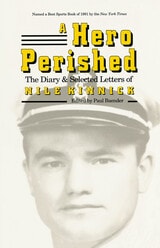
A Hero Perished
The Diary and Selected Letters of Nile KinnickPaul Baender
University of Iowa Press, 1992
A Hero Perished tells Nile Kinnick's story. This grandson of an Iowa governor, the son of parents who disciplined him to strive for his measure of greatness, became a Heisman Trophy winner and national celebrity through a combination of talent and circumstance. Following his college successes, Kinnick began legal study to prepare for a political career, but with the approach of war he entered the Navy Air Corps to refashion himself as a fighter pilot. Assigned to the carrier USS Lexington on its premier cruise, he took off in a defective plane—and his death shocked a nation grown almost used to tragic loss.
For the first time, Kinnick tells his own tale through his engaging letters—all but one previously unpublished—and his diary, printed in its entirety for the first time. The result is a human, intimate look at the true person behind the myth, revealing both his foibles and his essential principles. A Hero Perished also includes a definitive text of Kinnick's moving Heisman Award acceptance speech and his impassioned commencement supper address, calling on the new Iowa graduates to achieve moral courage in a time of depression and war.
An illuminating comment on a time and attitude that have passed, A Hero Perished is of and about a football player, but it is not a football book—it is far more. This volume displays Kinnick—who was, despite his great gifts and achievements, a vulnerable and decent young man—in a time of great change and peril when a phase of our culture was passing away.
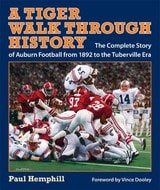
A Tiger Walk through History
The Complete Story of Auburn Football from 1892 to the Tuberville EraPaul Hemphill
University of Alabama Press, 2008
In this lively and fascinating book, noted writer and Auburn alum Paul Hemphill tells the story of the progress of Auburn from that first game coached by Auburn legend George Petrie through the team’s growth and development into the national force it is today. Hemphill records the many highs and occasional lows, and the heartbreak and jubilation each caused, noting the standouts great and small on the way.
A Tiger Walk through History contains 172 photographs, many of them rare and surprising. The text and photos capture the many great players and coaches in the Auburn football experience: Auburn’s first bowl appearance in 1936; coaching eras of innovative football genius John Heisman, after whom the Heisman trophy is named; “Iron Mike” Donahue; Ralph “Shug” Jordan, who brought Auburn its first national championship in 1957; Pat Dye, Terry Bowden, and present coach Tommy Tuberville; Auburn’s two Heisman trophy winners Pat Sullivan and Bo Jackson; and victories over rivals Alabama and Georgia. The 2007-2008 season is highlighted, including the sixth straight win over Alabama and a bowl victory over Clemson. As the game has grown, Auburn and its team have grown with it, and Auburn now ranks as a perennial power both in its conference and in the nation.
Vince Dooley states in his foreword that “beyond the famous coaches and players and their heroics on behalf of the Orange and Blue, A Tiger Walk through History is also about time-honored traditions—rallying cries like ‘Sullivan-to-Beasley’ and ‘Punt Bama Punt’ and ‘Rolling Toomer’s Corner’—that echo in resounding fashion from the pages of Paul Hemphill’s remarkable book.”
No fan, whether casual or devoted, can afford to miss this riveting account of the Plainsmen’s journey from the very beginning to today, which is the record of a great university as well as the story of the development of a great football team.
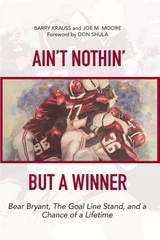
Ain't Nothin' But a Winner
Bear Bryant, The Goal Line Stand, and a Chance of a LifetimeBarry Krauss and Joe M. Moore With a Foreword by Don Shula
University of Alabama Press, 2006
No university has won more football championships than Alabama, and Barry Krauss played a key role in one of them. The linebacker’s fourth down stop of Penn State’s Mike Guman in the Sugar Bowl on January 1, 1979, was recently named by ESPN as one of the ten most important plays of the 20th century.
The Goal Line Stand, as the play became known, immortalized Krauss among legions of fans. More than twenty-five years later, people still tell him exactly what they were doing and how they felt when he collided in mid-air with Guman that New Year’s Day—and almost never mention his twelve-year career in the NFL.
In this entertaining and well-illustrated memoir, Krauss tells of scrimmaging on front lawns with friends as a kid in Pompano Beach, Florida, and of his childhood dream to play for Don Shula. He acknowledges how Coach Bear Bryant tamed his free spirit and shaped him into the football player—and the man—he became. In addition, he emphasizes the importance of team, weaving together the personal stories of his Alabama teammates on the field during the Goal Line Stand, and acknowledges their significant roles in winning the game and the championship.
Ain’t Nothin’ But a Winner offers an insider’s look at how a team is built, tested, and becomes a national champion—and how that process sometimes calls upon an individual to rise to the challenge presented by his own personal gut check.
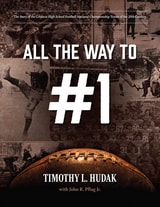
All the Way to #1
The Story of the Greatest High School Football National Championship Teams of the 20th CenturyTimothy L. Hudak
Ohio University Press, 2015
But which of these teams was the greatest?
All the Way to #1 is the first book to thoroughly document the nation’s top high school football teams from the 20th century. Identifying seventeen legendary programs, football historian Timothy Hudak tells the exciting and entertaining stories of how these teams came to prominence on the national stage. Fans will be particularly interested in Hudak’s conclusion about which of these teams was the best.
Filled with 330 black and white photos, statistics, and the most comprehensive listing of the 20th century’s high school football champions found anywhere, All the Way to #1 is a one-of-a-kind book that will be perfect for fans across the country.
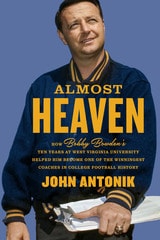
Almost Heaven
How Bobby Bowden's Ten Years at West Virginia University Helped Him Become One of the Winningest Coaches in College Football HistoryJohn Antonik
West Virginia University Press, 2025
Sports journalist John Antonik covers Bowden’s entire WVU tenure from 1966–75 and the circumstances, issues, difficulties, and obstacles that he had to overcome that were unique to this period in Mountaineer sports history. Additionally, Almost Heaven examines what transpired on WVU’s campus and in its athletic programs as well as nationally during the Vietnam War, campus protests, desegregation, and the complexities of the shifting NCAA landscape. Antonik paints a vivid picture of how Bowden’s time at WVU enriched him personally and professionally while putting athletics on a path toward the much greater successes that it enjoyed in the 1980s when Don Nehlen arrived. By the time he left Morgantown in the winter of 1976, following the Mountaineers’ 13–10 Peach Bowl victory over North Carolina State, which culminated in an outstanding 9–3 season, he was a far wiser and much better-prepared football coach. Those difficult lessons that Bowden learned at West Virginia led him down a path to greatness at Florida State.
Almost Heaven draws from an impressive array of primary sources, including newspaper articles; football team rosters; internal documents on recruiting; and interviews with former players, assistants, staffers, sports reporters, Bowden’s sons Tommy and Terry, and Bowden himself, prior to his passing in 2021. The year 2025 represents the 50th anniversary of his final season coaching the Mountaineers, and many of his players are now entering their golden years, making this the optimal time to tell this story.
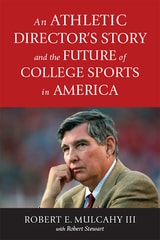
An Athletic Director’s Story and the Future of College Sports in America
Robert E. Mulcahy
Rutgers University Press, 2020
His words and actions were prominent during a nationally-reported incident involving student athletes. When the Rutgers Women’s Basketball team players were slandered by racist remarks from a popular radio talk show host, Mulcahy met it head on. With the coach and players, he set an inspiring example for defending character and values.
Though Mr. Mulcahy left Rutgers in 2009, his memoir reflects continued devotion to intercollegiate athletics and student athletes. His insights for addressing several leading issues confronting Division I sports today offer guidelines for present and future athletic directors to follow.