Results by title
9 books match the query 'French drama'
Challenges to Traditional Authority
Plays by French Women Authors, 1650-1700Françoise Pascal, Mary-Catherine Desjardins, Antoinette Deshoulières, and Catherine Durand
Iter Press, 2015
Mormons in Paris
Polygamy on the French Stage, 1874-1892Corry Cropper
Bucknell University Press, 2021
In the late nineteenth century, numerous French plays, novels, cartoons, and works of art focused on Mormons. Unlike American authors who portrayed Mormons as malevolent “others,” however, French dramatists used Mormonism to point out hypocrisy in their own culture. Aren't Mormon women, because of their numbers in a household, more liberated than French women who can't divorce? What is polygamy but another name for multiple mistresses? This new critical edition presents translations of four musical comedies staged or published in France in the late 1800s: Mormons in Paris (1874), Berthelier Meets the Mormons (1875), Japheth’s Twelve Wives (1890), and Stephana’s Jewel (1892). Each is accompanied by a short contextualizing introduction with details about the music, playwrights, and staging. Humorous and largely unknown, these plays use Mormonism to explore and mock changing French mentalities during the Third Republic, lampooning shifting attitudes and evolving laws about marriage, divorce, and gender roles.
Published by Bucknell University Press. Distributed worldwide by Rutgers University Press.
Plays by French and Francophone Women
A Critical AnthologyChristiane P. Makward and Judith G. Miller, Editors
University of Michigan Press, 1994
Plays by French and Francophone Women presents eight recent plays by contemporary French and francophone women writers. The plays vary in style and form from the satirical to the poetic, from the comedic one-woman show to the potential multi-media esoteric production, and have been written by French, Qué becois, Acadian, and Caribbean francophone writers. The editors have provided informative headnotes to introduce each play, then faithful translations rendered with an ear toward production in English. A general introduction to the volume situates each work within the broader context of contemporary French-language theater by women. The volume also includes an annotated bibliography by Cynthia Running-Johnson of thirty-one additional plays by women in French.
Featured plays and playwrights are The Scent of Sulphur by S. Corinna Bille; When Fairies Thirst by Denise Boucher; Island Memories by Ina Césaire; Warmth: A Bloodsong by Chantal Chawaf; The Goddess Lar or Centuries of Women by Andrée Chedid; The Name of Oedipus: Song of the Forbidden Body by Hélène Cixous; The Table: Womenspeak by Michèle Foucher; and The Rabble by Antonine Maillet.
Queer Velocities
Time, Sex, and Biopower on the Early Modern StageJennifer Eun-Jung Row
Northwestern University Press, 2022
The twin innovations of precise, portable timepieces and the development of the theater as a state institution together ignited new types of embodiments, orderly and disorderly pleasures, and normative and wayward rhythms of life. Row leverages a painstakingly formalist and rhetorical analysis of tragedies by Jean Racine and Pierre Corneille to show how the staging of delay or haste can critically interrupt the normative temporalities of marriage, motherhood, mourning, or sovereignty—the quotidian rhythms and paradigms so necessary for the biopolitical management of life. Row’s approach builds on the queer turn to temporality and Elizabeth Freeman’s notion of the chronobiopolitical to wager that queerness can also be fostered by the sensations of disruptive speed and slowness. Ultimately, Row suggests that the theater not only contributed to the glitter of Louis XIV’s absolutist spectacle but also ignited new forms of knowing and feeling time, as well as new modes of loving, living, and being together.
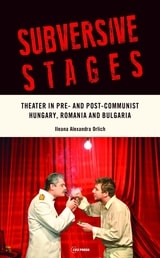
Subversive Stages
Theater in Pre- and Post-Communist Hungary, Romania and BulgariaIleana Alexandra Orlich
Central European University Press, 2017
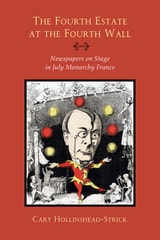
The Fourth Estate at the Fourth Wall
Newspapers on Stage in July Monarchy FranceCary Hollinshead-Strick
Northwestern University Press, 2019
July Monarchy plays, which provided affordable entertainment to a broad section of the public, constitute a large, nearly untapped reservoir of commentary on the arrival of the forty-franc press. Vaudevilles and comedies ask whether journalism that benefits from advertisement can be unbiased. Dramas explore whether threatening to spread false news is an acceptable way for journalists to exercise their influence. Hollinshead-Strick uses both plays and novels to show that despite their claims to enlighten their readers, newspapers were often accused of obscuring public access to information. Balzac’s interventions in this media sphere reveal his utopian views on print technology. Nerval’s and Pyat’s demonstrate the nefarious impact that corrupt theater critics could have on authors and on the public alike.
Scholars of press and media studies, French literature, theater, and nineteenth-century literature more generally will find this book a valuable introduction to a cross-genre debate about press publicity that remains surprisingly resonant today.
Theater, War, and Memory in Crisis
Vichy, Algeria, the AftermathJohn Ireland
University of Michigan Press, 2025
Tragedy and the Return of the Dead
John D. Lyons
Northwestern University Press, 2018
Early modernity rediscovered tragedy in the dramas and the theoretical writings of the ancient Greeks and Romans. Attempting to make new tragic fictions, writers like Shakespeare, Webster, Hardy, Corneille, and Racine created a dramatic form that would probably have been unrecognizable to the ancient Athenians. Tragedy and the Return of the Dead recovers a model of the tragic that fits ancient tragedies, early modern tragedies, as well as contemporary narratives and films no longer called “tragic” but which perpetuate the same elements.
Authoritative, wide-ranging, and thought provoking, Tragedy and the Return of the Dead uncovers a set of interlocking plots of family violence that stretch from Greek antiquity up to the popular culture of today. Casting aside the elite, idealist view that tragedy manifests the conflict between two equal goods or the human struggle against the divine, John D. Lyons looks closely at tragedy’s staging of gory and painful deaths, ignominious burials, and the haunting return of ghosts. Through this adjusted lens Le Cid, Hamlet, Frankenstein, The Spanish Tragedy, Romeo and Juliet, Phèdre, Macbeth, and other early modern works appear in a striking new light. These works are at the center of a panorama that stretches from Aeschylus’s Agamemnon to Hitchcock’s Psycho and are placed against the background of the Gothic novel, Freud’s “uncanny,” and Burke’s “sublime.”
Lyons demonstrates how tragedy under other names, such as “Gothic fiction” and “thrillers,” is far from dead and continues as a vital part of popular culture.
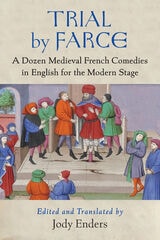
Trial by Farce
A Dozen Medieval French Comedies in English for the Modern StageEdited and Translated by Jody Enders
University of Michigan Press, 2023
Was there more to comedy than Chaucer, the Second Shepherds’ Play, or Shakespeare? Of course! But, for a real taste of medieval and Renaissance humor and in-your-face slapstick, one must cross the Channel to France, where over two hundred extant farces regularly dazzled crowds with blistering satires. Dwarfing all other contemporaneous theatrical repertoires, the boisterous French corpus is populated by lawyers, lawyers everywhere. No surprise there. The lion’s share of mostly anonymous farces was written by barristers, law students, and legal apprentices. Famous for skewering unjust judges and irreligious ecclesiastics, they belonged to a 10,000-member legal society known as the Basoche, which flourished between 1450 and 1550. What is more, their dramatic send-ups of real and fictional court cases were still going strong on the eve of Molière, resilient against those who sought to censor and repress them. The suspenseful wait to see justice done has always made for high drama or, in this case, low drama. But, for centuries, the scripts for these outrageous shows were available only in French editions gathered from scattered print and manuscript sources.
In Trial by Farce, prize-winning theater historian Jody Enders brings twelve of the funniest legal farces to English-speaking audiences in a refreshingly uncensored but philologically faithful vernacular. Newly conceived as much for scholars as for students and theater practitioners, this repertoire and its familiar stock characters come vividly to life as they struggle to negotiate the limits of power, politics, class, gender, and, above all, justice. Through the distinctive blend of wit, social critique, and breathless boisterousness that is farce, we gain a new understanding of comedy itself as form of political correction. In ways presciently modern and even postmodern, farce paints a different cultural picture of the notoriously authoritarian Middle Ages with its own vision of liberty and justice for all. Theater eternally offers ways for new generations to raise their voices and act.