Results by title
16 books match the query 'French language'

Call Me Henri
Lorraine López
Northwestern University Press, 2006
Lorraine López (author of Soy la Avon Lady and Other Stories) has created a vivid picture of barrio life, filled with honesty, insight, and humor for young adults. She paints a balanced and detailed landscape of Enrique's world. Although Enrique is confused and angered by his mother's refusal to stand up for him against the abuse of his stepfather, he also draws strength from the supportive and loving family of his friend Francisco. While some of his teachers are uncaring or inept, others provide help and encouragement at critical moments in his life.
When Enrique witnesses his friend Horacio gunned down in a drive-by shooting and is seen by the assailants, gang members set out to kill him. As the novel reaches its climax, Enrique must make some agonizing decisions.
Although specifically about barrio life, this novel is universal in its themes—the drive for success, the desire for love and family support, and the need for true friendship. López's fully delineated characters provide a rich and credible mural of our human comedy.

Contemporary French and Francophone Narratology
Edited by John Pier
The Ohio State University Press, 2020
The essays included in this collection seek to take the pulse of recent developments in narratological research in the French-speaking countries. Theorists in these countries heavily participated in and shaped narratology, an outgrowth of the structuralist movement during the 1960s and 1970s. While US, German, and Scandinavian theorists took the forefront in the 1990s, narratology in France faded into the background. It was not until the turn of the century that a new interest in narratological issues among French researchers emerged. Activity in the field has since intensified, spurred on, in part, by the realization that narratology cannot be summed up by its formalist and structuralist origins.
Well-versed in French narrative theory, both classical and more recent, the authors in this collection also draw on scholarship coming from other research traditions. The result is that these contributions offer a number of syntheses and perspectives representative of recent French-language scholarship in the field that readers may not be familiar with or that provide them with further insight into subjects they may have encountered in other contexts. This volume will leave readers with a greater awareness of the directions taken by present-day French-language narratology as well as new and developing themes in narrative theory generally.
Contributors
Raphaël Baroni, Denis Bertrand, Olivier Caïra, Claude Calame, Benoît Hennaut, Françoise Lavocat, Sylvie Patron, John Pier, Françoise Revaz, and Richard Saint-Gelais
Culture and Content in French
Frameworks for Innovative CurriculaAurélie Chevant-Aksoy
Lever Press, 2022
Descartes and the Resilience of Rhetoric
Varieties of Cartesian Rhetorical TheoryThomas M. Carr, Jr.
Southern Illinois University Press, 2009
A careful analysis of the rhetorical thought of René Descartes and of a distinguished group of post-Cartesians. Covering a unique range of authors, including Bernard Lamy and Nicolas Malebranche, Carr attacks the idea, which has become commonplace in contemporary criticism, that the Cartesian system is incompatible with rhetoric.
Carr analyzes the writings of Balzac, the Port-Royalists Arnauld and Nicole, Malebranche, and Lamy, exploring the evolution of Descartes’ thought into their different theories of rhetoric. He constructs his arguments, probing each author’s writings on rhetoric, persuasion, and attention, to demonstrate the basis for rhetorical thought present in Descartes’ theory of persuasion when it is combined with his psychophysiology of attention.

French Verbs Made Simple(r)
By David Brodsky
University of Texas Press, 2006
It's time for a new approach to learning French verbs. Unlike popular verb guides that require the rote memorization of hundreds of verb forms, this book clearly explains the rules that govern the conjugation of all classes of French verbs—especially the irregular ones that give second-language learners the most trouble. These straightforward, easy-to-understand rules for conjugating French verbs are effective learning tools for both beginning students and more advanced speakers who want to perfect their usage of French verb forms.
French Verbs Made Simple(r) has many helpful features that you won't find in any other verb guide:
- Clear explanations of all verb tenses and forms.
- The simple patterns and rules that govern the conjugation of all verbs—including those verbs whose irregularities follow patterns that can be easily learned.
- A detailed discussion of how each verb form is used, with numerous examples.
- A full explanation of whether a verb should be conjugated with avoir or être, and the conditions under which the past participle is variable—two of the thorniest problems for students of French.
- An extended treatment of the subjunctive that will help you understand why it is used in some situations but not others.
- Complete conjugations for 57 basic model verbs (along with 27 "variants") and a comprehensive listing of some 6,200 verbs that indicates which of the models each verb follows.
Going well beyond any other guide in the clarity and detail of its explanations—as well as the innovative manner in which individual verbs are linked to model conjugations—French Verbs Made Simple(r) is the only guide to French verbs a learner needs.
Fulfulde (Maasina) - English - French Lexicon
A Root-Based Compilation Drawn from Extant SourcesDonald W. Osborn
Michigan State University Press, 1993
The Lexicon brings together lexical material from a wide range of published and non-published sources to create an extensive compilation of the vocabulary of Fulfulde as it is spoken in that part of central Mali known as Masina (in Fulfulde, Maasina). The Lexicon is intended primarily for non-Fulfulde speakers who are learning the language at the intermediate or advanced levels and who need access to a comprehensive reference source on Fulfulde vocabulary. Scholars, development workers, and others whose research or fieldwork involves use of the Fulfulde of Masina may find it helpful as well in clarifying nuances of meaning and standardized spelling for the less familiar terms they might encounter. It is also intended that the present work, beyond the matter of organizing vocabulary, will contribute significantly to the expanding lexicographical and linguistic investigations of Fulfulde.

Handbook of French Semantics
Edited by Francis Corblin and Henriëtte de Swart
CSLI, 2003

Insiders' French
Beyond the DictionaryEleanor Levieux and Michel Levieux
University of Chicago Press, 1999
This "new France" is a country poised to experience the European single currency but uncertain about being part of Europe. It is hooked on fast food but ambivalent about the country where it originated. France today has record unemployment and an increasingly controversial immigrant population. Clearly, given the rapidly changing conditions and lifestyles, conventional French dictionaries alone cannot completely inform readers and visitors. Insiders' French offers a solution to the incomprehension, a unique handbook in which you'll find the language of European union, the space program, abortion and women's rights, high-tech industries, and health care, among other topics. Entries proceed by association of ideas and related terms, with extensive cross-referencing, while still being alphabetized for easy reference like a standard dictionary. Cartoons from major French journals add to your understanding and enjoyment.
Insiders' French opens up the secret territory of French politics and culture that is often not understood by visitors or students, and it does so with wit and verve—qualities that remain in the French language despite its recent changes.

Masked Inversion in French
Paul M. Postal
University of Chicago Press, 1989
This analysis has significant consequences for contemporary syntactic theories. First, the arguments support the view that a sentence's superficial structure cannot be identified with its syntactic structure, even though such an identification is a fundamental assumption of several currently influential grammatical frameworks. Second, even certain theories that do posit abstract aspects of grammatical form fail to allow for the needed Inversion structures. Postal's study supports theories based on the notion of arc and stratification into levels which provide a natural treatment consistent with the factual requirements.
Masked Inversion in French is the first systematic account of this puzzling French syntactic anomaly, and its findings will stimulate research in many areas of natural language grammatical structure.
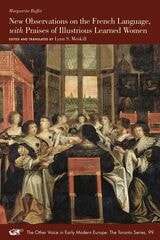
New Observations on the French Language, with Praises of Illustrious Learned Women
Marguerite Buffet
Iter Press, 2023
According to the few historical records that mention Marguerite Buffet, she lived her entire life in seventeenth-century Paris where she taught French to aristocratic women. Buffet’s vivid example of proper language use in New Observations on the French Language offers a rare glimpse into the life, habits, and culture of seventeenth-century France. She describes common errors in contemporary language use and gives examples of correct expressions for speaking and writing all the while encouraging women to aspire to higher levels of intellectual achievement.
In addition, her Praises of Illustrious Learned Women, a catalog of biographies of women who displayed exemplary intellect, wit, and conversation, includes a number of the author’s contemporaries such as Anna Maria van Schurman and Madeleine de Scudéry. Buffet’s collected praises of these women, many of whom were connected to the court of Louis XIV, show her unique position as both a participant in and historian of the intellectual and social world of the French salon.
This volume presents Buffet’s work in its near entirety for the first time in English, bringing to light Buffet’s unique contribution to the centuries-long debate concerning the status of women known as the querelle des femmes.

Poetics of Relation
Édouard Glissant
University of Michigan Press, 1997
In Poetics of Relation, Glissant turns the concrete particulars of Caribbean reality into a complex, energetic vision of a world in transformation. He sees the Antilles as enduring suffering imposed by history, yet as a place whose unique interactions will one day produce an emerging global consensus. Arguing that the writer alone can tap the unconscious of a people and apprehend its multiform culture to provide forms of memory capable of transcending "nonhistory," Glissant defines his "poetics of relation"--both aesthetic and political--as a transformative mode of history, capable of enunciating and making concrete a French-Caribbean reality with a self-defined past and future. Glissant's notions of identity as constructed in relation and not in isolation are germane not only to discussions of Caribbean creolization but also to our understanding of U.S. multiculturalism. In Glissant's view, we come to see that relation in all its senses--telling, listening, connecting, and the parallel consciousness of self and surroundings--is the key to transforming mentalities and reshaping societies.
This translation of Glissant's work preserves the resonating quality of his prose and makes the richness and ambiguities of his voice accessible to readers in English.
"The most important theoretician from the Caribbean writing today. . . . He is central not only to the burgeoning field of Caribbean studies, but also to the newly flourishing literary scene in the French West Indies." --Judith Graves Miller, University of Wisconsin, Madison
Édouard Glissant is Distinguished Professor of French at City University of New York, Graduate Center. Betsy Wing's recent translations include Lucie Aubrac's Outwitting the Gestapo (with Konrad Bieber), Didier Eribon's Michel Foucault and Hélêne Cixous's The Book of Promethea.

Spatial Prepositions
A Case Study from FrenchClaude Vandeloise
University of Chicago Press, 1991
Most previous analyses of spatial prepositions have assumed that their semantic properties can be adequately explained by familiar logical and geometrical concepts. Thus, the standard view of the preposition "in" as it appears in the sentence "the ball is in the bag" postulates that it refers to the geometrical relation of inclusion. This paradigm, however, falters when faced with the contrast in acceptability between sentences such as "the bulb is in the socket" and "the bottle is in the cap." The force exerted by the "landmark" (a conceptually fixed object) on the "target" (a moveable object) is crucial in this difference: the functional notion of containment seems more operational in the use of the preposition "in" than inclusion. That is, what are taken to be the landmark and the target depend greatly on the functions these objects serve in the human scheme. This offers important clues to otherwise problematic linguistic quirks, such as why one sleeps in one's bed, while one is said to lie on one's deathbed.
While many of the examples apply in English as well as French, there are some noteworthy differences—in French one sits on a chair, but in a couch. Vandeloise convincingly argues that it is precisely this subjective element which makes a standard geometrical account unfeasible.

Terror And Its Discontents
Suspect Words In Revolutionary FranceCaroline Weber
University of Minnesota Press, 2003
A timely exploration of the political uses of language and rhetoric
Camille Desmoulins, a journalist writing under the Montagnard regime of 1793-94, remarked that France’s government had replaced “the language of democracy” with “the cold poison of fear, which paralyzed thought in the bottom of people’s souls, and prevented it from pouring forth at the tribunal, or in writing.” How this happened, how the Reign of Terror reached even into the realms of thought and language, is the subject of Caroline Weber’s book, a revealing look into the paradoxical embargo on free expression that underpinned the Robespierrists’s self-proclaimed “despotism of liberty” during the French Revolution.
Weber examines Jean-Jacques Rousseau’s and the Robespierrists’s articulation of a series of initiatives designed to curtail and control the dissemination of alternative political and philosophical messages in the republic. Here Weber underscores the internal contradictions and limitations of an enterprise that promised universal freedom while oppressing particularism, and that railed against the very language that it was compelled to adopt as a principal political tool. The book then focuses on two eloquent contemporary critics of this phenomenon, Desmoulins and the Marquis de Sade, the infamous libertine author. Weber demonstrates how Desmoulins reconfigured the Montagnard regime’s rhetoric to conjure up a political system based on tolerance, not terror, and how Sade deftly parodied the Robespierrists’s brutality and hypocrisy, proposing a republic based on the ruthless elimination of dissident voices and on the unabashed celebration of despotism and bloodshed.A balanced account of how the “discourse of totality” actually restricted particular freedoms in the wake of the French Revolution, this book provides a highly original—and timely—exposition of the political uses of rhetoric and of the links between language and power.
The Orient of Style
Modernist Allegories of ConversionBeryl Schlossman
Duke University Press, 1991
Toward the end of Remembrance of Things Past, the narrator describes the act of creating a work of art as a conversion of sensation into a spiritual equivalent. By means of such allegories of “conversion,” Schlossman shows, the modernist artist disappeared within the work of art and left behind the trace of his sublime vocation, a vocation in which he was transformed, in Schlossman’s words, “into a kind of priest kneeling at the altar of beauty before the masked divinity of representation.”
The author shows how allegory—the representation of the symbolic as something real—was adapted by modernist writers to reflect subjectivity while masking an authorial origin. She reveals how modernist allegory arose, as Walter Benjamin suggests, at the crossroads of history, sociology, economics, urban architecture, and art—providing a kind of map of capitalism—and was produced through the eyes of a melancholic gazing at a “monument of absence.”
The Reconquest Of Montreal
Language Policy and Social Change in a Bilingual CityMarc V. Levine
Temple University Press, 1991
Although Montreal has been a bilingual city since 1760 and demographically dominated by French-speakers for well over a century and a quarter, it was not until the late 1960s that full-fledged challenges to the city’s English character emerged. Since then. two decades of agitation over la question linguistique as well as the enactment of three language laws have altered the places of French and English in Montreal‘s schools, public administration, economy. and even commercial signs. In this book, Marc Levine examines the nature of this stunning transformation and, in particular, the role of public policy in promoting it.
The reconquest of Montreal by the French-speaking majority makes for interesting history. It includes episodes of intense conflict and occasional violence and tells the fascinating story of how an economically disadvantaged and culturally threatened linguistic community mobilized politically and used the state to redistribute group power in Canada’s second largest city. In addition, the history of Montreal’s language question offers analysts of urban politics and public policy an excellent case study of some of the central issues facing cities containing more than one major linguistic community.
After tracing the politicization of the language question in the 1960s and 1970s, Levine analyzes the impact of the three controversial language laws penacted by the Quebec provincial government between 1969 and 1977. Exhaustively researched, The Reconquest of Montreal is the definitive study of the most explosive issue in Quebec political life.
In the series Conflicts in Urban and Regional Development, edited by John R. Logan and Todd Swanstrom.
The Regional Dynamics of Language Differentiation in Belgium
A Study in Cultural-Political GeographyAlexander B. Murphy
University of Chicago Press, 1988