Results by title
8 books match the query 'Freshwater Fishes'
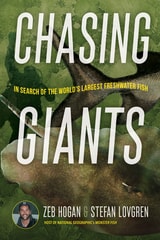
Chasing Giants
In Search of the World's Largest Freshwater FishZeb Hogan
University of Nevada Press, 2023
On May 1, 2005, a Thai fisherman caught a truly monstrous Mekong giant catfish. At 646 pounds, it captured the world’s attention, and with awe and wonder, it was deemed the largest freshwater fish on record. There was no denying its size, but when biologist and research associate professor Hogan saw a photo of the fish, he wondered if it really was the biggest in the world. To his surprise, no one had systematically sought to answer the question: Which of the giant freshwater species really was the largest?
Seeking to answer that question has brought Hogan face to face with massive arapaima and piranha in the Amazon, alligator gar in Texas, pigeon-eating wels catfish in France, stingrays in Cambodia, and the gnarled-toothed sawfish in Australia. Part of his scientific adventure has been captured on Monster Fish, and Hogan now tells the full story of his 25-year quest to understand the mysteries of some of the oldest, largest, most bizarre creatures on Earth.
The fate of these giant fish motivates Hogan to understand the various species he studies. The megafish’s numbers are dwindling, and the majority of them face extinction. In this book, he teams up with award-winning journalist Stefan Lovgren to tell, for the first time, the remarkable and troubling story of the world’s largest freshwater fish. It is a story that stretches across the globe, chronicling a race against the clock to find and protect these ancient leviathans before they disappear forever.
Chasing Giants: In Search of the World’s Largest Freshwater Fish combines science, adventure, and wonder to provide insights into the key role the massive fish of our lakes and rivers play in our past, present, and future.
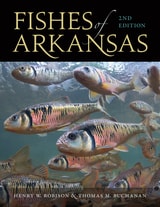
Fishes of Arkansas
Henry W. Robison
University of Arkansas Press, 2019
An invaluable reference for anyone interested in the state’s fish population—from professional ichthyologists, fisheries biologists, and managers of aquatic resources, to amateur naturalists and anglers—this new edition provides updated taxonomic keys as well as detailed descriptions, photographs, and line drawings to aid identification of the state’s 243 fish species. There is also much information on the distribution and biology of each species, including descriptions of habitat, foods eaten, reproductive biology, and conservation status.
This project and the preparation of this publication was funded in part by a grant from the Arkansas Game and Fish Commission.
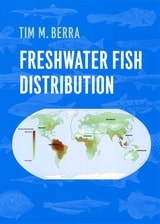
Freshwater Fish Distribution
Tim M. Berra
University of Chicago Press, 2007
Tim Berra’s seminal resource, Freshwater Fish Distribution,maps the 169 fish families that swim in fresh water around the world. Each family account includes the class, subclass, and order; a pronunciation guide to the family name; life cycle information; and interesting natural history facts. Each account is illustrated, many with historical nineteenth-century woodcuts.
Now available in paperback, this heavily cited work in ichthyology and biogeography will serve as a reference for students, a research support for professors, and a helpful guide to tropical fish hobbyists and anglers.
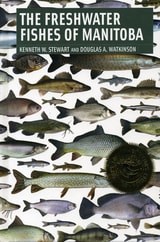
Freshwater Fishes of Manitoba
Kenneth Stewart
University of Manitoba Press, 2004
Freshwater Fishes of Mexico
Robert Rush Miller, W. L. Minckley, and Steven Mark Norris
University of Chicago Press, 2006
No one knew these Mexican freshwaters or the fish that inhabit them better than the late world-renowned ichthyologist Robert Rush Miller. A pioneer of the field, Miller undertook his first field excursion more than fifty years ago and, in the decades following, amassed the information necessary to write the first encyclopedia of Mexican inland ichthyology. Providing keys to more than 500 native species—accompanied by detailed distribution maps and illustrations—Freshwater Fishes of México offers a historical overview of the country's ichthyology, as well as syntheses of the unique biogeography of Mexican fishes and their current conservation status. Organized by family, the species accounts are supplemented with color galleries containing photographs of live fishes in their native environments and natural habitats. Exploring ecological, biological, and taxonomic issues, the book also considers the evolutionary history of the ichthyofauna itself and the human history of the scientists who researched it during the last several centuries.
The life's work of Robert Rush Miller, the long-awaited Freshwater Fishes of México will be welcomed not only by students of Mexican fishes, but by all ichthyologists working in Central and North America. This book will also find an audience among home aquarium hobbyists, fishery managers, conservation biologists, and environmental planners and managers.
Inland Fishes of the Greater Southwest
Chronicle of a Vanishing BiotaW. L. Minckley and Paul C. Marsh
University of Arizona Press, 2009
Many native fish species are unique to the Southwest. They possess interesting and unusual adaptations to the challenges of the region, able to survive silt-laden floods as well as extreme water temperatures and highly fluctuating water flows ranging from very low levels to flash floods. However, in spite of being well-adapted, many of the fish described here are threatened or endangered, often due to the acts of humans who have altered the natural habitat. For that reason, Inland Fishes of the Greater Southwest presents a vast amount of information about the ecological relationships between the fishes it describes and their environments, paying particular attention to the ways in which human interactions have modified aquatic ecosystems—and to how humans might work to ensure the survival of rapidly disappearing native species.
Net Results
Great Fishing Spots in Southern WisconsinBob Riepenhoff
University of Wisconsin Press, 2004
Includes contour maps of 54 lakes.
Rivers, Fish, and the People
Tradition, Science, and Historical Ecology of Fisheries in the American WestPei-Lin Yu
University of Utah Press, 2015
America’s western rivers are under assault from development, pollution, invasive species, and climate change. Returning these eco- systems to the time of European contact is often the stated goal for restoration efforts, yet neither the influence of indigenous societ- ies on rivers at the time of contact nor the deeper evolutionary relationships are yet understood by the scientific world. This volume presents a unique synthesis of scientific discoveries and traditional knowledge about the ecology of iconic river species in the American West.
Building from a foundation in fisheries biology and life history data about key species, the book reveals ancient human relationships with those species and describes time-tested Native resource management techniques, drawing from the archaeological record and original ethnographic sources. It evaluates current research trends, summarizes the conceptual foundations for the cultural and evolutionary significance of sustainable use of fish, and seeks pathways for future research. Geographic areas described include the Columbia Plateau, Idaho’s Snake River Plain, the Sacramento River Delta, and the mid-Fraser River of British Columbia. Previously unpublished information is included with the express permission and approval of tribal communities. This approach broadens and deepens the available body of data and establishes a basis for future collaboration between scientists and Native stakeholders toward mutual goals of river ecosystem health.