Results by title
11 books match the query 'Gay men's writings, American'

A Queer Sort of Materialism
Recontextualizing American TheaterDavid Savran
University of Michigan Press, 2003
The selections presented here are by turns entertaining, informative, sophisticated, and polemical, reflecting the author's dual citizenship as rigorous scholar and engaging theater critic. This book also provides a model for a kind of queer historical materialism that will prove useful to a wide range of disciplines, including theater and performance, gender and sexuality, queer/gay/lesbian/transgender studies, American studies, and popular culture.
David Savran is Professor of Theater, the Graduate Center, the City University of New York, and author of Cowboys, Communists, and Queers and Taking It Like a Man.
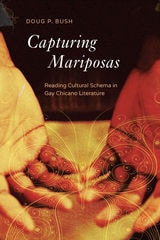
Capturing Mariposas
Reading Cultural Schema in Gay Chicano LiteratureDoug P. Bush
The Ohio State University Press, 2019
In Capturing Mariposas: Reading Cultural Schema in Gay Chicano Literature, Doug P. Bush looks at the book as only the beginning, considering how this literature has the power to bring understanding to disparate groups, speak truth about repressed sexuality and repressive communities, and recast traditional spaces as ones of inclusion, all through the idea of the cultural schema. Integrating elements of narratology and cognitive studies of literature, the cultural schema speaks to how these authors challenge, reaffirm, and transform commonly held experiences of gay Chicanos—or potentially any audience who reads their works. Focusing on twenty-first-century writers such as Manuel Muñoz, Rigoberto González, and Alex Espinoza, Bush examines the cultural schema of their works and then moves toward a more holistic discussion of the publishing and political implications of this genre. In addition to Bush’s important scholarship, the book includes extensive interviews with the authors themselves.
Homosexual Tradition in American Poetry
Robert K. Martin
University of Iowa Press, 1998
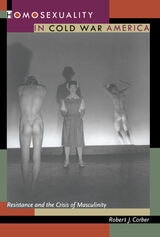
Homosexuality in Cold War America
Resistance and the Crisis of MasculinityRobert J. Corber
Duke University Press, 1997
By exploring the representation of gay men in film noir, Corber suggests that even as this Hollywood genre reinforced homophobic stereotypes, it legitimized the gay male "gaze." He emphasizes how film noir’s introduction of homosexual characters countered the national "project" to render gay men invisible, and marked a deep subversion of the Cold War mentality. Corber then considers the work of gay male writers Tennessee Williams, Gore Vidal, and James Baldwin, demonstrating how these authors declined to represent homosexuality as a discrete subculture and instead promoted a model of political solidarity rooted in the shared experience of oppression. Homosexuality in Cold War America reveals that the ideological critique of the dominant culture made by gay male authors of the 1950s laid the foundation for the gay liberation movement of the following decade.
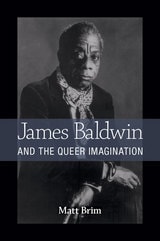
James Baldwin and the Queer Imagination
Matt Brim
University of Michigan Press, 2014
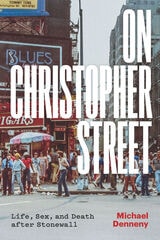
On Christopher Street
Life, Sex, and Death after StonewallMichael Denneny
University of Chicago Press, 2023
The Stonewall Riots of 1969 and the AIDS crisis of the 1980s have been captured in minute detail, and rightly memorialized in books, on tv, and in film as pivotal and powerful moments in queer history. Yet what about the moments in between—the tumultuous decade post-Stonewall when the queer community’s vitality and creativity exploded across the country, even as the AIDS crisis emerged?
Michael Denneny was there for it all. As a founder and editor of the wildly influential magazine Christopher Street and later as the first openly gay editor at a major publishing house, Denneny critically shaped publishing around gay subjects in the 1970s and beyond. At St. Martin’s Press, he acquired a slew of landmark titles by gay authors—many for his groundbreaking Stonewall Inn Editions—propelling queer voices into the mainstream cultural conversation. On Christopher Street is Denneny’s time machine, going back to that heady period to lay out the unfolding geographies and storylines of gay lives and capturing the raw immediacy of his and his contemporaries’ daily lives as gay people in America. Through forty-one micro-chapters, he uses his journal writings, articles, interviews, and more from the 1970s and ‘80s to illuminate the twists and turns of a period of incomparable cultural ferment.
One of the few surviving voices of his generation, Denneny transports us back in time to share those vibrant in-between moments in gay lives—the joy, sorrow, ecstasy, and energy—across three decades of queer history.
Our Deep Gossip
Conversations with Gay Writers on Poetry and DesireChristopher Hennessy; Foreword by Christopher Bram
University of Wisconsin Press, 2013
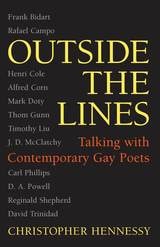
Outside the Lines
Talking with Contemporary Gay PoetsChristopher Hennessy, Editor
University of Michigan Press, 2005
---Bernard Cooper, author of Maps to Anywhere
Editor Christopher Hennessy gathers interviews with some of the most significant figures in contemporary American poetry. While each poet is gay, these encompassing, craft-centered interviews reflect the diversity of their respective arts and serve as a testament to the impact gay poets have had and will continue to have on contemporary poetics.
The book includes twelve frank, intense interviews with some of America's best-known and loved poets, who have not only enjoyed wide critical acclaim but who have had lasting impact on both the gay tradition and the contemporary canon writ large, for example, Frank Bidart, the late Thom Gunn, and J. D. McClatchy. Some of the most honored and respected poets, still in the middle of their careers, are also included, for example, Mark Doty, Carl Phillips, and Reginald Shepherd. Each interview explores the poet's complete work to date, often illuminating the poet's technical evolution and emotional growth, probing shifts in theme, and even investigating links between verse and sexuality.
In addition to a selected bibliography of works by established poets, the book also includes a list of works by newer and emerging poets who are well on their way to becoming important voices of the new millennium.

Queer Optimism
Lyric Personhood and Other Felicitous PersuasionsMichael D. Snediker
University of Minnesota Press, 2008
A new paradigm for queer theory
Michael Snediker offers a much-needed counterpoint to queer theoretical discourse, which has long privileged melancholy, self-shattering, incoherence, shame, and the death drive. Recovering the forms of positive affect that queer theory has jettisoned, Snediker insists that optimism must itself be taken beyond conventional tropes of hope and futurity and reimagined as necessary for critical engagement.
Through fresh, perceptive, and sensitive readings of the poetry of Emily Dickinson, Hart Crane, Jack Spicer, and Elizabeth Bishop, Snediker reveals that each of these poets demonstrated an interest in the durability of positive affects. Dickinson, Snediker argues, expresses joy and grace as much as pain and loss, and the myriad cryptic smiles in Hart Crane’s White Building contradict prevailing narratives of Crane’s apocryphal literary failures and eventual suicide. Snediker’s ambitious and sophisticated study, informed by thinkers such as Winnicott, Deleuze, and de Man, both supplements and challenges the work of queer theory’s leading figures, including Judith Butler, Leo Bersani, Eve Kosofsky Sedgwick, and Lee Edelman. Queer Optimism revises our understanding of queer love and affiliation, examining Spicer’s serial collusion with matinee idol Billy the Kid as well as the critically neglected force of Bishop’s epistolary and poetic reparations of the drowned figure of Hart Crane. In doing so, Snediker persuasively reconceives a theoretical field of optimism that was previously unavailable to scrupulous critical inquiry and provides a groundbreaking approach to modern American poetry and poetics.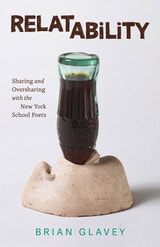
Relatability
Sharing and Oversharing with the New York School PoetsBrian Glavey
University of Chicago Press, 2026
An engaging account of how the New York School poets used art to imagine their queerness as something that might be shared with other people.
How did Frank O’Hara and other New York School poets—a small coterie associated with experimental art and gay culture —become fixtures in today’s culture, quoted on prestige television shows, in teen romances, and at the wedding ceremonies of straight celebrities? How, in other words, did these poets become so relatable? Brian Glavey’s Relatability tells the story of an aesthetic as it traveled from a cluster of mostly queer poets in the middle of the twentieth century to become increasingly central to everyday life in the early twenty-first century.
That the New York School poets are more relatable now than they were during their own lifetime speaks in part to the growing acceptance of same-sex desire in American culture. But Glavey argues that this transformation also tells the story of a shift in the way that aesthetic experience is understood to work. Moving away from forms of modernist impersonality, O’Hara, John Ashbery, James Schuyler, and Joe Brainard made sociability central to the experience of art and literature. Attempting to share their experience of works of art, they were willing to risk the reader’s judgment that they had, perhaps, overshared. Glavey advances an idea of aesthetic judgment that takes seriously its missed connections as well as its successes. Relatability adds a fresh perspective to current conversations around attachment and affect in literary studies.
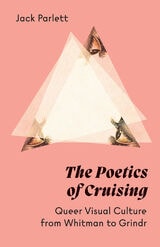
The Poetics of Cruising
Queer Visual Culture from Whitman to GrindrJack Parlett
University of Minnesota Press, 2022
The Poetics of Cruising explores the relationship between cruising, photography, and the visual in the work of leading poets, from Walt Whitman in the nineteenth century to Eileen Myles in the twenty-first. What is it that happens, asks Jack Parlett, and what is it that is sought, in this often transient moment of perception we call cruising, this perceptual arena where acts of looking between strangers are intensified and eroticized? Parlett believes that this moment is not only optical in nature but visual: a mode of looking that warrants comparison with the ways in which we behold still and moving images.
Whether it’s Whitman’s fixation with daguerreotypes, Langston Hughes’s hybrid photographic works, or Frank O’Hara’s love of Hollywood movie stars, argues Parlett, the history of poets cruising abounds with this intermingling between the verbal and the visual, the passing and the fixed. To look at someone in the act of cruising, this history suggests, is to capture, consider, and aestheticize, amid the flux and instantaneity of urban time. But it is also to reveal the ambivalence at the heart of this erotic search, where power may be unevenly distributed across glances, and gendered and racialized bodies are marked. Thus, in identifying for the first time this confluence of cruising, poetry, and visual culture, Parlett concludes that the visual erotic economy associated with gay cruising today, exemplified by the photographic grid of an app like Grindr, is not a uniquely contemporary phenomenon.
Innovative, astute, and highly readable, and drawing on compelling archival material, The Poetics of Cruising is a must for scholars of queer and LGBTQ literature and culture, modern and contemporary poetry, visual studies, and the history of sexuality.