Results by title
28 books match the query 'Geographical perception'
A Deeper Sense of Place
Stories and Journeys of Collaboration in Indigenous ResearchJay T. Johnson and Soren C. Larsen
Oregon State University Press, 2013
These first-person narratives offer insight into the challenges faced by Native and non-Native scholars to their academic and personal approaches during research with Indigenous communities. By addressing the ethical, political, intellectual, and practical meanings of collaboration with Indigenous peoples, A Deeper Sense of Place highlights the ways in which collaborative research can help Indigenous and settler communities find common ground through a shared commitment to land, people, and place.
A Deeper Sense of Place will inform students and academics engaged in research with Indigenous communities, as well as those interested in the challenges of employing critical, qualitative methodologies.
An American Provence
Thomas P. Huber
University Press of Colorado, 2011
-From An American Provence
In this poetic personal narrative, Thomas P. Huber reflects on two seemingly unrelated places-the North Fork Valley in western Colorado and the Coulon River Valley in Provence, France-and finds a shared landscape and sense of place. What began as a simple comparison of two like places in distant locations turned into a more complex, interesting, and personal task. Much is similar-the light, the valleys, the climate, the agriculture. And much is less so-the history, the geology, the physical makeup of villages. Using a geographer's eye and passion for the land and people, Huber examines the regions' similarities and differences to explore the common emotional impact of each region. Part intimate travelogue and part case study of geography in the real world, An American Provence illuminates the importance sense of place plays in who we are.
Ancestral Places
Understanding Kanaka GeographiesKatrina-Ann R. Kapa'anaokalaokeola Nakoa Oliveira
Oregon State University Press, 2014
Katrina-Ann R. Kapa‘anaokalaokeola Nakoa Oliveira elucidates a Kanaka geography and provides contemporary scholars with insights regarding traditional culture—including the ways in which Kanaka utilize cartographic performances to map our ancestral places and retain our mo‘olelo, such as reciting creation accounts, utilizing nuances embedded in language, and dancing hula.
A Kanaka by birth, a kumu ‘olelo Hawai‘i (language teacher) by profession, and a geographer by training, Oliveira’s interests intersect at the boundary where words and place-making meet her ancestral land. Thus, Ancestral Places imbues the theoretical with sensual practice. The book’s language moves fluidly between Hawaiian and English, terms are nimbly defined, and the work of the field is embodied: geographic layers are enacted within the text, new understandings created—not just among lexica, but amidst illustrations, charts, terms, and poetry.
In Ancestral Places, Oliveira reasserts both the validity of ancestral knowledge systems and their impact in modernity. Her discussion of Kanaka geographies encompasses the entire archipelago, offering a new framework in Kanaka epistemology.
Becoming French
Mapping the Geographies of French Identity, 1871-1914Dana Kristofor Lindaman
Northwestern University Press, 2016
Beyond Settler Time
Temporal Sovereignty and Indigenous Self-DeterminationMark Rifkin
Duke University Press, 2017
Buried Indians
Digging Up the Past in a Midwestern TownLaurie Hovell McMillin
University of Wisconsin Press, 2006
In Buried Indians, Laurie Hovell McMillin presents the struggle of her hometown, Trempealeau, Wisconsin, to determine whether platform mounds atop Trempealeau Mountain constitute authentic Indian mounds. This dispute, as McMillin subtly demonstrates, reveals much about the attitude and interaction-past and present-between the white and Indian inhabitants of this Midwestern town.
McMillin's account, rich in detail and sensitive to current political issues of American Indian interactions with the dominant European American culture, locates two opposing views: one that denies a Native American presence outright and one that asserts its long history and ruthless destruction. The highly reflective oral histories McMillin includes turn Buried Indians into an accessible, readable portrait of a uniquely American culture clash and a dramatic narrative grounded in people's genuine perceptions of what the platform mounds mean.
Cartographic Mexico
A History of State Fixations and Fugitive LandscapesRaymond B. Craib
Duke University Press, 2004
Crossing through Chueca
Lesbian Literary Culture in Queer MadridJill Robbins
University of Minnesota Press, 2010
Jill Robbins traverses the various literary spaces of the city associated with queer culture, in particular the gay barrio of Chueca, revealing how it is a product of interrelations—a site crisscrossed by a multiplicity of subjects who constitute it as a queer space through the negotiation of their sexual, racial, gender, and class identities. Robbins recognizes Chueca as a political space as well, a refuge from homophobia. She also shows how the spatial and literary practices of Chueca relate to economic issues.
In examining how women’s sexual identities have become visible in and through the Chueca phenomenon, this work is a revealing example of transnational queer studies within the broader Western discussion on gender and sexuality.
Culture, Power, Place
Explorations in Critical AnthropologyAkhil Gupta and James Ferguson, eds.
Duke University Press, 1997
This collection of both new and well-known essays begins by critically exploring the concepts of locality and community; first, as they have had an impact on contemporary global understandings of displacement and mobility, and, second, as they have had a part in defining identity and subjectivity itself. With sites of discussion ranging from a democratic Spain to a Puerto Rican barrio in North Philadelphia, from Burundian Hutu refugees in Tanzania to Asian landscapes in rural California, from the silk factories of Hangzhou to the long-sought-after home of the Palestinians, these essays examine the interplay between changing schemes of categorization and the discourses of difference on which these concepts are based. The effect of the placeless mass media on our understanding of place—and the forces that make certain identities viable in the world and others not—are also discussed, as are the intertwining of place-making, identity, and resistance as they interact with the meaning and consumption of signs. Finally, this volume offers a self-reflective look at the social and political location of anthropologists in relation to the questions of culture, power, and place—the effect of their participation in what was once seen as their descriptions of these constructions. Contesting the classical idea of culture as the shared, the agreed upon, and the orderly, Culture, Power, Place is an important intervention in the disciplines of anthropology and cultural studies.
Contributors. George E. Bisharat, John Borneman, Rosemary J. Coombe, Mary M. Crain, James Ferguson, Akhil Gupta, Kristin Koptiuch, Karen Leonard, Richard Maddox, Lisa H. Malkki, John Durham Peters, Lisa Rofel

Environmental Perception and Behavior
An Inventory and ProspectEdited by Thomas F. Saarinen, David Seamon, and James L. Sell
University of Chicago Press, 1984
Highland Sanctuary
Environmental History in Tanzania’s Usambara MountainsChristopher A. Conte
Ohio University Press, 2004
Imagining Serengeti
A History of Landscape Memory in Tanzania from Earliest Times to the PresentJan Bender Shetler
Ohio University Press, 2007
Many students come to African history with a host of stereotypes that are not always easy to dislodge. One of the most common is that of Africa as safari grounds—as the land of expansive, unpopulated game reserves untouched by civilization and preserved in their original pristine state by the tireless efforts of contemporary conservationists. With prose that is elegant in its simplicity and analysis that is forceful and compelling, Jan Bender Shetler brings the landscape memory of the Serengeti to life. She demonstrates how the social identities of western Serengeti peoples are embedded in specific spaces and in their collective memories of those spaces. Using a new methodology to analyze precolonial oral traditions, Shetler identifies core spatial images and reevaluates them in their historical context through the use of archaeological, linguistic, ethnographic, ecological, and archival evidence. Imagining Serengeti is a lively environmental history that will ensure that we never look at images of the African landscape in quite the same way.
Kiowa Ethnogeography
By William C. Meadows
University of Texas Press, 2008
Examining the place names, geographical knowledge, and cultural associations of the Kiowa from the earliest recorded sources to the present, Kiowa Ethnogeography is the most in-depth study of its kind in the realm of Plains Indian tribal analysis. Linking geography to political and social changes, William Meadows applies a chronological approach that demonstrates a cultural evolution within the Kiowa community.
Preserved in both linguistic and cartographic forms, the concepts of place, homeland, intertribal sharing of land, religious practice, and other aspects of Kiowa life are clarified in detail. Native religious relationships to land (termed "geosacred" by the author) are carefully documented as well. Meadows also provides analysis of the only known extant Kiowa map of Black Goose, its unique pictographic place labels, and its relationship to reservation-era land policies. Additional coverage of rivers, lakes, and military forts makes this a remarkably comprehensive and illuminating guide.

Landscape, Memory and History
Anthropological PerspectivesEdited by Pamela J. Stewart and Andrew Strathern
Pluto Press, 2003
Contributors from North America, Australia, New Zealand, Taiwan, and Europe explore a wide variety of case studies that includes seascapes in Jamaica; the Solomon Islands; the forests of Madagascar; Aboriginal and European notions of landscape in Australia; place and identity in 19th century maps and the bogs of Ireland; contemporary concerns over changing landscapes in Papua New Guinea; and representations of landscape and history in the poetry of the Scottish Borders.
Landscapes of Devils
Tensions of Place and Memory in the Argentinean ChacoGastón R. Gordillo
Duke University Press, 2004
As Gordillo explains, the bush is the result of social, cultural, and political processes that intertwine this place with other geographies. Labor exploitation, state violence, encroachment by settlers, and the demands of Anglican missionaries all transformed this land. The Toba’s lives have been torn between alienating work in sugar plantations and relative freedom in the bush, between moments of domination and autonomy, abundance and poverty, terror and healing. Part of this contradictory experience is culturally expressed in devils, evil spirits that acquire different features in different places. The devils are sources of death and disease in the plantations, but in the bush they are entities that connect with humans as providers of bush food and healing power. Enacted through memory, the experiences of the Toba have produced a tense and shifting geography. Combining extensive fieldwork conducted over a decade, historical research, and critical theory, Gordillo offers a nuanced analysis of the Toba’s social memory and a powerful argument that geographic places are not only objective entities but also the subjective outcome of historical forces.

Little Saigons
Staying Vietnamese in AmericaKarin Aguilar–San Juan
University of Minnesota Press, 2009
Karin Aguilar-San Juan examines the contradictions of Vietnamese American community and identity in two emblematic yet different locales: Little Saigon in suburban Orange County, California (widely described as the capital of Vietnamese America) and the urban "Vietnamese town" of Fields Corner in Boston, Massachusetts. Their distinctive qualities challenge assumptions about identity and space, growth amid globalization, and processes of Americanization.
With a comparative and race-cognizant approach, Aguilar-San Juan shows how places like Little Saigon and Fields Corner are sites for the simultaneous preservation and redefinition of Vietnamese identity. Intervening in debates about race, ethnicity, multiculturalism, and suburbanization as a form of assimilation, this work elaborates on the significance of place as an integral element of community building and its role in defining Vietnamese American-ness.
Staying Vietnamese, according to Aguilar-San Juan, is not about replicating life in Viet Nam. Rather, it involves moving toward a state of equilibrium that, though always in flux, allows refugees, immigrants, and their U.S.-born offspring to recalibrate their sense of self in order to become Vietnamese anew in places far from their presumed geographic home.
Making Worlds
Gender, Metaphor, MaterialityEdited by Susan Hardy Aiken, Ann Brigham, Sallie A. Marston, and Penny Waterstone
University of Arizona Press, 1997
In recent years these questions have occasioned intensifying debates, but they have seldom extended beyond the boundaries of individual academic disciplines or crossed the divide that has traditionally separated the academy from the "outside" world. Making Worlds both questions and traverses those divisions by combining personal essays, activist political rhetoric, oral history, poetry, iconography, and performance art with interdisciplinary academic discourses.
Representing a wide range of perspectives, Making Worlds develops a provocative conversation about gender and spatiality in the interwoven symbolic and material environments we create. The contributors engage such issues as the body as site of symbolic action, fabrication, and desire; the place and play of sexualities; the cultural implications of everyday life—home, travel, work, childbirth, food, disease, and death; technology and mass media; surveillance, confinement, and the law; the dynamics of race and ethnicity; imperialism, oppression, and resistance; the politics of urban spaces; landscape and cultural memory; the experience of time; and the nature of "Nature." For students and scholars in cultural studies, geography, literary criticism, anthropology, history, and women's studies, it offers new ways of thinking about space, place, and the spatial contexts of social thought and action.
Mapping Tourism
Stephen P. Hanna
University of Minnesota Press, 2003
Looks at tourism maps to offer new insights into the social construction of place
At first glance, the relationships among tourists, tourism maps, and the spaces of tourism seem straightforward enough: tourists use maps to find their way to and through the sites of history, culture, nature, or recreation represented there. Less apparent is how tourism maps and those using them construct such spaces and identities. As the essays in Mapping Tourism clearly demonstrate, the extraordinary interactions of work with leisure and the everyday with the exotic make tourism maps ideal sites for exploring the contested construction of place and identity.
Construction sites in the “New Berlin,” Alabama’s civil rights trail, Québec City, a California ghost town, and Bangkok’s sex trade are among the spaces the essays examine. Taken together, these essays allow us to see tourist space as it truly is: contested, ever changing, and replete with issues of power.Contributors: Mary Curran, Eastern Connecticut State U; Dydia DeLyser, Louisiana State U; Owen J. Dwyer, Indiana U; John R. Gold, Oxford Brookes U; Margaret M. Gold, U of North London; Rob Shields; Karen E. Till, U of Minnesota.
Mapping the Invisible Landscape
Folklore, Writing, and the Sense of PlaceKent C. Ryden
University of Iowa Press, 1993
Any landscape has an unseen component: a subjective component of experience, memory, and narrative which people familiar with the place understand to be an integral part of its geography but which outsiders may not suspect the existence of—unless they listen and read carefully. This invisible landscape is make visible though stories, and these stories are the focus of this engrossing book.
Traveling across the invisible landscape in which we imaginatively dwell, Kent Ryden—himself a most careful listener and reader—asks the following questions. What categories of meaning do we read into our surroundings? What forms of expression serve as the most reliable maps to understanding those meanings? Our sense of any place, he argues, consists of a deeply ingrained experiential knowledge of its physical makeup; an awareness of its communal and personal history; a sense of our identity as being inextricably bound up with its events and ways of life; and an emotional reaction, positive or negative, to its meanings and memories.
Ryden demonstrates that both folk and literary narratives about place bear a striking thematic and stylistic resemblance. Accordingly, Mapping the Invisible Landscape examines both kinds of narratives. For his oral materials, Ryden provides an in-depth analysis of narratives collected in the Coeur d'Alene mining district in the Idaho panhandle; for his consideration of written works, he explores the “essay of place,” the personal essay which takes as its subject a particular place and a writer's relationship to that place.
Drawing on methods and materials from geography, folklore, and literature, Mapping the Invisible Landscape offers a broadly interdisciplinary analysis of the way we situate ourselves imaginatively in the landscape, the way we inscribe its surface with stories. Written in an extremely engaging style, this book will lead its readers to an awareness of the vital role that a sense of place plays in the formation of local cultures, to an understanding of the many-layered ways in which place interacts with individual lives, and to renewed appreciation of the places in their own lives and landscapes.
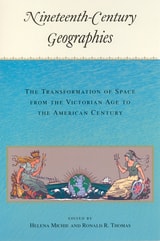
Nineteenth-Century Geographies
The Transformation of Space from the Victorian Age to the American CenturyThomas, Ronald R
Rutgers University Press, 2002
The nineteenth century was a time of unprecedented discovery and exploration throughout the globe, a period when the “blank spaces” of the earth were systematically investigated, occupied, and exploited by the major imperial powers of Western Europe and the United States. The lived experience of space was also changing in dramatic ways for people as a result of new developments in technology, communication, and transportation. As a result, the century was characterized by a new and intense interest in place, both local and global.
The collection is comprised of seventeen essays from various disciplines organized into four areas of geographic concern. The first, “Time Zones,” examines several ways that place gets expressed as time during the period, how geography becomes history. A second grouping, “Commodities and Exchanges,” explores the role of geographic origin as it was embodied in particular objects, from the souvenir map to imported tea. The set of essays on “Domestic Fronts” moves the discussion from the public to the private sphere by looking at how domestic space became defined in terms of its boundary with the foreign. The final section, “Orientations,” takes up the changing relations of bodies, identities, and the spaces they inhabit and through which they moved. The collection as a whole also traces the development of the discipline of geography with its different institutional and political trajectories in the United States and Great Britain.
Seeking Spatial Justice
Edward W. Soja
University of Minnesota Press, 2010
Space and Place in Jewish Studies
Mann, Barbara E
Rutgers University Press, 2012
Scholars in the humanities have become increasingly interested in questions of how space is produced and perceived—and they have found that this consideration of human geography greatly enriches our understanding of cultural history. This “spatial turn” equally has the potential to revolutionize Jewish Studies, complicating familiar notions of Jews as “people of the Book,” displaced persons with only a common religious tradition and history to unite them.
Space and Place in Jewish Studies embraces these exciting critical developments by investigating what “space” has meant within Jewish culture and tradition—and how notions of “Jewish space,” diaspora, and home continue to resonate within contemporary discourse, bringing space to the foreground as a practical and analytical category. Barbara Mann takes us on a journey from medieval Levantine trade routes to the Eastern European shtetl to the streets of contemporary New York, introducing readers to the variety of ways in which Jews have historically formed communities and created a sense of place for themselves. Combining cutting-edge theory with rabbinics, anthropology, and literary analysis, Mann offers a fresh take on the Jewish experience.
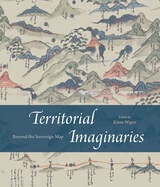
Territorial Imaginaries
Beyond the Sovereign MapEdited by Kären Wigen
University of Chicago Press, 2025
This strikingly colorful volume contends that modern mapping has never been sufficient to illustrate the complex reality of territory and political sovereignty, whether past or present. For Territorial Imaginaries, editor Kären Wigen has assembled an impressive slate of experts, spanning disciplines from political science to art history, to contribute perspectives and case studies covering three main themes: mapping before the nation-state, rethinking and critiquing mapping practices, and robust traditions of counter-cartography.
Each contributor proposes alternative ways to think about mapping, and the essays are supported with rich archival documentation. Among the far-reaching case studies are Barbara Mundy’s cartographic history of Indigenous dispossession in the Americas, Peter Bol’s examination of two Chinese maps created five hundred years apart, and Ali Yaycıoğlu’s exploration of tensions between top-down and bottom-up mapping of Habsburg and Ottoman border claims.
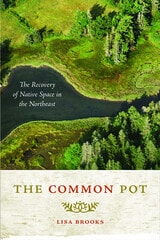
The Common Pot
The Recovery of Native Space in the NortheastLisa Brooks
University of Minnesota Press, 2008
Illuminates the significance of writing to colonial-era Native American resistance
Literary critics frequently portray early Native American writers either as individuals caught between two worlds or as subjects who, even as they defied the colonial world, struggled to exist within it. In striking counterpoint to these analyses, Lisa Brooks demonstrates the ways in which Native leaders—including Samson Occom, Joseph Brant, Hendrick Aupaumut, and William Apess—adopted writing as a tool to reclaim rights and land in the Native networks of what is now the northeastern United States.
“The Common Pot,” a metaphor that appears in Native writings during the eighteenth and nineteenth centuries, embodies land, community, and the shared space of sustenance among relations. Far from being corrupted by forms of writing introduced by European colonizers, Brooks contends, Native people frequently rejected the roles intended for them by their missionary teachers and used the skills they acquired to compose petitions, political tracts, and speeches; to record community councils and histories; and most important, to imagine collectively the routes through which the Common Pot could survive.Reframing the historical landscape of the region, Brooks constructs a provocative new picture of Native space before and after colonization. By recovering and reexamining Algonquian and Iroquoian texts, she shows that writing was not a foreign technology but rather a crucial weapon in the Native Americans’ arsenal as they resisted—and today continue to oppose—colonial domination.
The Visual Elements Landscapes
John A. Jakle
University of Massachusetts Press, 1987
The Worldmakers
Global Imagining in Early Modern EuropeAyesha Ramachandran
University of Chicago Press, 2015
The Worldmakers moves beyond histories of globalization to explore how “the world” itself—variously understood as an object of inquiry, a comprehensive category, and a system of order—was self-consciously shaped by human agents. Gathering an international cast of characters, from Dutch cartographers and French philosophers to Portuguese and English poets, Ramachandran describes a history of firsts: the first world atlas, the first global epic, the first modern attempt to develop a systematic natural philosophy—all part of an effort by early modern thinkers to capture “the world” on the page.
Transatlantic Topographies
Islands, Highlands, JunglesIleana Rodriguez
University of Minnesota Press, 2004
Explores the construction of the Americas by and through European eyes
Transatlantic Topographies was first published in 2004. Minnesota Archive Editions uses digital technology to make long-unavailable books once again accessible, and are published unaltered from the original University of Minnesota Press editions.
Transatlantic Topographies studies the representation of American space during the initial confrontation between Europeans and Amerindians and during the eighteenth, nineteenth, and twentieth centuries. Starting from topographical descriptions of land, islands, highlands, and jungles, Ileana Rodríguez shows how existing systems of knowledge broke down with the discovery of the Americas and had to be reinvented through the interpretation of signs, the accumulation of evidence, material exchange, and, finally, through the learning, teaching, and “kidnapping” of language. Proceeding from the period of exploration to the modern creation of a “twentieth-century frontier,” Rodríguez charts the path that led from island paradise to jungle chaos, from representations of natural beauty to the racialization of the islands. Drawing attention to cross-cultural miscommunication and the riddles of meaning and message it produces, Transatlantic Topographies develops a highly nuanced understanding of the evolving forces of imperialism as they gave way to postcolonialism and then to transnationalism—and newly re-inscribed notions of imperial economic practices.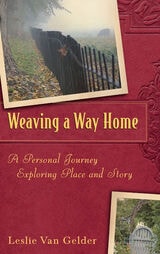
Weaving a Way Home
A Personal Journey Exploring Place and StoryLeslie Van Gelder
University of Michigan Press, 2008
An inquiry into how we engage with the world, and how solutions to environmental challenges can be found in the heart of our emotional relationships with places
"No one with a working heart will fail to be moved by Van Gelder. With passion and intelligence, she explores the way we story places and places story all life."
---Patrick Curry, Lecturer in Religious Studies, University of Kent, and author of Ecological Ethics: An Introduction and Defending Middle-Earth
"With grace and passion Leslie Van Gelder weaves together stories of her own encounters with an amazing variety of places---riverside meadows of Oxford, racially sundered Cyprus, fly-tormented Canadian muskeg, caves stroked by Paleolithic fingertips, derelict Coney Island, grasslands through which lion cubs follow the black tip of their mother’s tail---to show us how Place and Story are the warp and weft of our being as earth-dwellers."
---Tim Robinson, Folding Landscapes, and author of Connemara: Listening to the Wind
"Travel narrative, memoir, literary criticism, and anthropology fuse in this highly original and moving exploration of place and home."
---John Elder, author of Reading the Mountains of Home and Pilgrimage to Vallombrosa
"Van Gelder offers her most deeply personal stories as microcosmic examples of universal human experience, thus creating an empathic bond with her reader that conveys power and understanding simultaneously, and stimulates the reader's imagination toward reflection upon similarly personal stories of place. Van Gelder has modeled the relationship between story and place by telling placeful stories, and so has licensed the reader to do the same. Her writing throughout is rich and metaphoric. She is a gifted storyteller and a competent scholar, a combination to be treasured."
---Joseph W. Meeker, Professor Emeritus, College of Arts/Science, Union Institute and University, and author of The Spheres of Life, The Comedy of Survival, and Minding the Earth
Weaving a Way Home is an inquiry into the complex relationship between people, place, and story. In our memories and connections to a place, we are given one of the few opportunities to have deep relationships with place---relationships that cannot be described in words. Place can embody powerful emotions for us, and Leslie Van Gelder argues that we ourselves are places---geographical points possessing unique perspectives---that can feel displaced, replaced, or immovable. While the places of the external world can be accessed through maps and a good GPS system, our emotional landscapes are best reached through the sharing of stories.
In the tradition of writers Lewis Hyde, Barry Lopez, Peter Matthiessen, Joseph Meeker, Steven Mithen, Paul Shepard, Gary Snyder, and Terry Tempest Williams, Van Gelder uses both creative nonfiction narrative and evolutionary biological theory to explore complex terrain. Following Van Gelder's own travels, the book moves from the caves of the Dordogne lit only by the small beam of a flashlight, to an acacia thicket in Mozambique, to a black fly–infested bay inappropriately named Baie de Ha Ha in the inlands of Quebec, to the green line wrapped in barbed wire separating northern and southern Cyprus, to Abu Simbel's empty stone eyes in the Egyptian desert, and finally to the high road above Pelorus Sound on the rocky coasts of New Zealand. The author takes the reader to each place to create a storied landscape and explore new intellectual terrain. Van Gelder shows us that our collections of experiences, unique to us, can only be shared through the articulation of narrative.Weaving a Way Home will appeal to those deeply interested in knowing how we forge relationships with places and how that shapes who we are.
Jacket photographs: Garden gate: © iStockphoto.com/Richard Goerg. Iron fence: Christ Church Meadow in Oxford, Leslie Van Gelder.
Author photograph: Kevin Sharpe