Results by title
218 books match the query 'Handbooks, manuals, etc' and 15 start with a
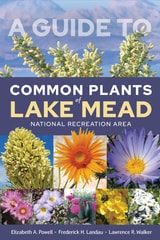
A Guide to Common Plants of Lake Mead National Recreation Area
Elizabeth A. Powell
University of Nevada Press, 2023
A Guide to Common Plants of Lake Mead National Recreation Area is the definitive book for weekend explorers and botanists alike who venture into LMNRA ready to discover the many wonders of the local flora. The authors highlight 183 plants that hikers are most likely to encounter along popular trails, washes, and surrounding hot springs, helping the area’s millions of annual visitors identify and enjoy these common plants. This guide includes photos and descriptions of each plant, along with a map of LMNRA.
The authors also provide a primer on plant ecology, including a guide to plant structures, desert adaptations and life forms, plant-to-plant interactions, and plant-animal interactions. Plants are grouped by life forms, such as tree, shrub, cactus, or grass, and by flower color within the wildflower section. The guide will encourage readers to pause and look carefully at each plant they encounter, giving them an enriched experience during their exploration.
A Handbook for EMC Testing and Measurement
David Morgan
The Institution of Engineering and Technology, 1994

A History of ALA Policy on Intellectual Freedom
A Supplement to the Intellectual Freedom ManualTrina Magi
American Library Association, 2015
Collecting several key documents and policy statements, this supplement to the tenth edition of the Intellectual Freedom Manual traces a history of ALA's commitment to fighting censorship. Beginning with an introductory essay that chronicles ALA policy making on intellectual freedom, this important resource includes sections discussing such foundational issues as
- library advocacy on social and political issues, from post-World War I disarmament, to Vietnam-era protests, to the call to revisit the field’s rhetoric concerning neutrality;
- the evolution of the Library Bill of Rights, such as the 1978 revision that eliminated its use of sex-linked pronouns and ALA Council actions rescinding the 2018 interpretation on meeting rooms;
- protecting the freedom to read;
- diverse collections and equity, diversity, and inclusion, new to this edition;
- ALA’s complicated history on race, including a 1936 statement opposing discrimination, inaction amidst litigation to desegregate libraries in the 1950s and 1960s, and protests over Florida’s Stand Your Ground Law;
- ALA's Code of Ethics;
- how to respond to challenges and concerns about library resources;
- internet filtering, minors and online activity, and education and information literacy;
- programs and displays;
- policy on governmental intimidation;
- copyright; and
- privacy and confidentiality, including the retention of library usage records.
A Manual for Writers of Research Papers, Theses, and Dissertations, Eighth Edition
Chicago Style for Students and ResearchersKate L. Turabian
University of Chicago Press, 2013
The Manual retains its familiar three-part structure, beginning with an overview of the steps in the research and writing process, including formulating questions, reading critically, building arguments, and revising drafts. Part II provides an overview of citation practices with detailed information on the two main scholarly citation styles (notes-bibliography and author-date), an array of source types with contemporary examples, and detailed guidance on citing online resources.
The final section treats all matters of editorial style, with advice on punctuation, capitalization, spelling, abbreviations, table formatting, and the use of quotations. Style and citation recommendations have been revised throughout to reflect the sixteenth edition of The Chicago Manual of Style. With an appendix on paper format and submission that has been vetted by dissertation officials from across the country and a bibliography with the most up-to-date listing of critical resources available, A Manual for Writers remains the essential resource for students and their teachers.
A Manual for Writers of Research Papers, Theses, and Dissertations, Ninth Edition
Chicago Style for Students and ResearchersKate L. Turabian
University of Chicago Press, 2018
This new edition filters decades of expertise into modern standards. While previous editions incorporated digital forms of research and writing, this edition goes even further to build information literacy, recognizing that most students will be doing their work largely or entirely online and on screens. Chapters include updated advice on finding, evaluating, and citing a wide range of digital sources and also recognize the evolving use of software for citation management, graphics, and paper format and submission. The ninth edition is fully aligned with the recently released Chicago Manual of Style, 17th edition, as well as with the latest edition of The Craft of Research.
Teachers and users of the previous editions will recognize the familiar three-part structure. Part 1 covers every step of the research and writing process, including drafting and revising. Part 2 offers a comprehensive guide to Chicago’s two methods of source citation: notes-bibliography and author-date. Part 3 gets into matters of editorial style and the correct way to present quotations and visual material. A Manual for Writers also covers an issue familiar to writers of all levels: how to conquer the fear of tackling a major writing project.
Through eight decades and millions of copies, A Manual for Writers has helped generations shape their ideas into compelling research papers. This new edition will continue to be the gold standard for college and graduate students in virtually all academic disciplines.
- Bestselling, trusted, and time-tested advice for writing research papers
- The best interpretation of Chicago style for higher education students and researchers
- Definitive, clear, and easy to read, with plenty of examples
- Shows how to compose a strong research question, construct an evidence-based argument, cite sources, and structure work in a logical way
- Essential for anyone interested in learning about research
- Everything any student or teacher needs to know concerning paper writing
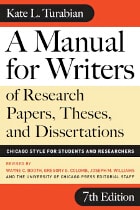
A Manual for Writers of Research Papers, Theses, and Dissertations, Seventh Edition
Chicago Style for Students and ResearchersKate L. Turabian
University of Chicago Press, 2007
Now, with this seventh edition, Turabian’s Manual has undergone its most extensive revision, ensuring that it will remain the most valuable handbook for writers at every level—from first-year undergraduates, to dissertation writers apprehensively submitting final manuscripts, to senior scholars who may be old hands at research and writing but less familiar with new media citation styles. Gregory G. Colomb, Joseph M. Williams, and the late Wayne C. Booth—the gifted team behind The Craft of Research—and the University of Chicago Press Editorial Staff combined their wide-ranging expertise to remake this classic resource. They preserve Turabian’s clear and practical advice while fully embracing the new modes of research, writing, and source citation brought about by the age of the Internet.
Booth, Colomb, and Williams significantly expand the scope of previous editions by creating a guide, generous in length and tone, to the art of research and writing. Growing out of the authors’ best-selling Craft of Research, this new section provides students with an overview of every step of the research and writing process, from formulating the right questions to reading critically to building arguments and revising drafts. This leads naturally to the second part of the Manual for Writers, which offers an authoritative overview of citation practices in scholarly writing, as well as detailed information on the two main citation styles (“notes-bibliography” and “author-date”). This section has been fully revised to reflect the recommendations of the fifteenth edition of The Chicago Manual of Style and to present an expanded array of source types and updated examples, including guidance on citing electronic sources.
The final section of the book treats issues of style—the details that go into making a strong paper. Here writers will find advice on a wide range of topics, including punctuation, table formatting, and use of quotations. The appendix draws together everything writers need to know about formatting research papers, theses, and dissertations and preparing them for submission. This material has been thoroughly vetted by dissertation officials at colleges and universities across the country.
This seventh edition of Turabian’s Manual for Writers of Research Papers, Theses, and Dissertations is a classic reference revised for a new age. It is tailored to a new generation of writers using tools its original author could not have imagined—while retaining the clarity and authority that generations of scholars have come to associate with the name Turabian.
A Manual for Writers of Term Papers, Theses, and Dissertations
Kate L. Turabian evised by John Grossman and Alice Bennett
University of Chicago Press, 1996
The familiar organization of this popular book remains largely unchanged. Chapter 1 describes the parts of a long formal paper. Chapters 2-5 introduce the mechanics of writing style, from abbreviations to quotations. Chapters 6 and 7 show how to prepare and refer to tables and illustrations. The section on documentation, chapters 8-12, describes two of the most commonly used systems of citation; these chapters provide many examples including guidance on how to cite electronic documents. Chapter 13, on manuscript preparation, shows how to take advantage of word processing software to present the elements of a paper clearly and effectively. Chapter 14 offers more than two dozen sample pages illustrating ways of formatting some of the complex features found in many research papers.
Authoritative, comprehensive, easy to use, and filled with good sense, this new edition will be the standard for yet another generation of students and their teachers.
Kate Turabian (1893-1987) was dissertation secretary at the University of Chicago from 1930 to 1958. This manual and her Student's Guide for Writing College Papers made her name so well known that she has become "part of the folklore of American higher education" (Quill and Scroll).
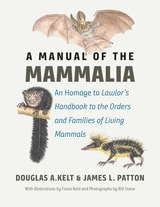
A Manual of the Mammalia
An Homage to Lawlor’s “Handbook to the Orders and Families of Living Mammals”Douglas A. Kelt and James L. Patton
University of Chicago Press, 2020
The taxonomy of recent mammals has lately undergone tremendous revision, but it has been decades since the last update to Timothy E. Lawlor’s acclaimed identification guide the Handbook to the Orders and Families of Living Mammals. Integrating the latest advances in research, Douglas A. Kelt and James L. Patton provide this long-overdue update in their new, wholly original work, A Manual of the Mammalia.
Complemented by global range maps, high-resolution photographs of skulls and mandibles by Bill Stone, and the outstanding artwork of Fiona Reid, this book provides an overview of biological attributes of each higher taxon while highlighting key and diagnostic characters needed to identify skulls and skins of all recent mammalian orders and most families. Kelt and Patton also place taxa in their currently understood supra-familial clades, and discuss current challenges in higher mammal taxonomy. Including a comprehensive review of mammalian anatomy to provide a foundation for understanding all characters employed throughout, A Manual of the Mammalia is both a user-friendly handbook for students learning to identify higher mammal taxa and a uniquely comprehensive, up-to-date reference for mammalogists and mammal-lovers from across the globe.
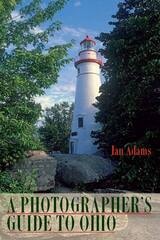
A Photographer’s Guide to Ohio
Ian Adams
Ohio University Press, 2011
A Primer for Teaching African History
Ten Design PrinciplesTrevor R. Getz
Duke University Press, 2018
A Reader's Guide to the Novels of Louise Erdrich
Peter G. Beidler & Gay Barton
University of Missouri Press, 2006
A Trauma-Informed Approach to Library Services
Rebecca Tolley
American Library Association, 2014
We are only now coming to terms with how common trauma really is; a landmark Kaiser study that surveyed patients receiving physicals found that almost two-thirds had experienced at least one form of abuse, neglect, or other trauma as a child. Though originating in the fields of health and social services, trauma-informed care is a framework that holds great promise for application to library work. Empathetic service, positive patron encounters, and a more trusting workplace are only a few of the benefits that this approach offers. In this important book Tolley, experienced in both academic and public libraries, brings these ideas into the library context. Library administrators, directors, and reference and user services staff will all benefit from learning
- the six key principles of trauma-informed care;
- characteristics of a trusting and transparent library organization, plus discussion questions to promote a sense of psychological safety among library workers;
- how certain language and labels can undermine mutuality, with suggested phrases that will help library staff demonstrate neutrality to patron ideas and views during information requests;
- delivery models that empower patrons;
- advice on balancing free speech on campus with students’ need for safety;
- how appropriate furniture arrangement can help people suffering from PTSD feel safe;
- guidance on creating safe zones for LGBTQIA+ children, teens, and adults; and
- self-assessment tools to support change toward trauma-responsive library services.
Alzheimer's and Dementia
A Practical and Legal Guide for Nevada Caregivers, Revised and UpdatedKim Boyer
University of Nevada Press, 2025
The book, specific to Nevada, covers state laws including Medicaid planning, asset protection, guardianship, probate, advance directives, and patient rights. It also addresses estate and financial planning, and provides a detailed list of resources available to assist caregivers. Written by an elder law attorney and a gerontologist, Alzheimer’s and Dementiaoffers insights from two professionals who provide practical solutions to common obstacles faced by caregivers, helping them support the needs and overcome the challenges facing those coping with these diseases.
Boyer and Shapiro coauthored The Essential Eldercare Handbook for Nevada also available from the University of Nevada Press.

Arranging and Describing Archives and Manuscripts
Dennis Meissner
Society of American Archivists, 2019
Arranging and Describing Archives and Manuscripts
Dennis Meissner
American Library Association, 2019