Results by title
10 books match the query 'Hard Times'

Families and Food in Hard Times
European Comparative ResearchRebecca O'Connell and Julia Brannen
University College London, 2021
Food is fundamental, yet food poverty has increased in the Global North. Adopting a comparative case approach, Food and Families in Hard Times addresses the global problem of economic retrenchment and the burden it places on the most vulnerable. This timely book examines food poverty in the United Kingdom, Portugal, and Norway following the 2008 financial crisis, examining the resources available to families in relation to the intersection of public policies, local institutions, and kinship networks. The book explores the ways that low income impacts household food provisioning, formal and informal support for struggling families, the provision and role of school meals, and constraints upon families’ social participation. Drawing upon extensive and intensive knowledge on the conditions and experiences of low-income families, the book also draws upon current research in European social science literature to shed light on the causes and consequences of food poverty in austerity-era Europe.
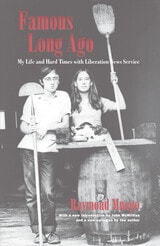
Famous Long Ago
My Life and Hard Times with Liberation News ServiceRaymond Mungo
University of Massachusetts Press, 2012
Originally published in 1970, Raymond Mungo's picaresque account of his adventures with Liberation News Service in the wild years of 1967 and 1968 has been variously described as youthful, passionate, lyrical, demented, and an iconic symbol of the sixties counterculture. A review in The Nation described it as “hip Huck Finn.”
A college editor at the height of the Vietnam War, Mungo found himself smack in the middle of a mad swirl of activism and dissent, vigorously protesting everything from the draft to abortion laws to the university itself. Then he connected with Marshall Bloom to cofound LNS in Washington, D.C., as a news service catering to the burgeoning underground press. One thing led to another, until LNS, like so many other radical organizations, eventually disintegrated into violently warring factions. Mungo's memoir tracks its development and destruction with wicked humor and literary panache.
In an introduction to this new edition, John McMillian discusses the enduring appeal of Famous Long Ago and situates it within its broader historical context, while the author provides his own retrospective take in a new afterword.
Good Medicine, Hard Times
Memoir of a Combat Physician in IraqEdward P. Horvath, MD
The Ohio State University Press, 2022
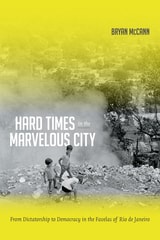
Hard Times in the Marvelous City
From Dictatorship to Democracy in the Favelas of Rio de JaneiroBryan McCann
Duke University Press, 2013
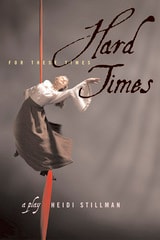
Hard Times
For These TimesHeidi Stillman
Northwestern University Press, 2003
The citizens of Charles Dickens's Coketown have moved readers for over a century. Now, Heidi Stillman's stunning adaptation brings these iconic characters to life on the stage, revealing the universality of their hopes and suffering in their times and in ours. The world premiere of Hard Times was presented by the Lookingglass Theatre Company of Chicago in 2001. The Play won five Joseph Jefferson Awards, for best production of a play, best director, best adaptation, best choreography, and best lighting design.
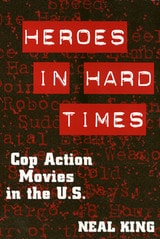
Heroes In Hard Times
Neal King
Temple University Press, 1999
King studies how, in the cop action genre, working-class police officers weigh in on such topics as racial justice, homosexuality, misogyny, unemployment, worker resistance, affirmative action, drug use, poverty, divorce, and the use of violence to deal with social problems. Facing their enemies with wisecracks and firepower, these men prove themselves at once complicitous in a system of violence and corruption and worthy to "blow away," with neither hesitation nor remorse, their -- society's -- menacing threats. The central male figures in these stories are heroes in their fight against criminals, but, as individuals, they fell undervalued by women, unappreciated by their bosses, and out of place in a society where fat cats and liberals have all the power. Such "hard times," King's study reveals, position them to simultaneously long for, disdain, and heroically -- if violently -- stake their frustrated claim to white male privilege.
Discussing such topics as white male guilt and the rage of the oppressed and examining such films as Lethal Weapon, Die Hard, and Silence of the Lambs, King's book notes the socially-charged roles given to American culture's fictional police heroes. The last artisan in a culture that has become increasingly corporate and bureaucratized, the movie cop is the last 'real man' in a world that has emasculated men and the last non-conforming patriot in a world that pays more attention to rules than what is morally right.
A book that shows how modern mythology makes sense of rampant corruption (and provides entertainment in its punishment), Heroes in Hard Times will educate and provoke those interested in American popular culture, film, and gender studies.
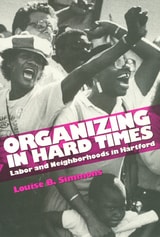
Organizing In Hard Times
Labor and Neighborhoods In HartfordLouise B. Simmons
Temple University Press, 1994
In 1990, Hartford, Connecticut, ranked as the eight poorest city in the country by the census; the real estate market was severely depressed; downtown insurance companies were laying off and the retail department stores were closing; public services were strained; and demolition sites abandoned for lack of funds pockmarked the streets. Hartford's problems are typical of those experienced in numerous U.S. cities affected by a lingering recession.
The harsh economic times felt throughout the city's workplaces and neighborhoods precipitated the formation of grassroots alliances between labor and community organizations. Coming together to create new techniques, their work has national implications for the development of alternative strategies for stimulating economic recovery.
Louise B. Simmons, a former Hartford City Councilperson, offers an insider's view of these coalitions, focusing on three activist unions—rhe New England Health Care Employees Union, the Hotel and Restaurant Employees, and the United Auto Workers—and three community groups—Hartford Areas Rally Together, Organized North Easterners-Clay Hill and North End, and Asylum Hill Organizing Project. Her in-depth analysis illustrates these groups' successes and difficulties in working together toward a new vision of urban politics.
In the series Labor and Social Change, edited by Paula Rayman and Carmen Sirianni.
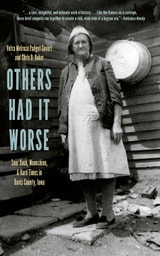
Others Had It Worse
Sour Dock, Moonshine, and Hard Times in Davis County, IowaVetra Melrose Padget Covert and Chris D. Baker
University of Iowa Press, 2013

State Employment Policy in Hard Times
Michael Barker, ed.
Duke University Press, 1983
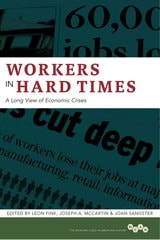
Workers in Hard Times
A Long View of Economic CrisesEdited by Leon Fink, Joseph A. McCartin, and Joan Sangster
University of Illinois Press, 2020
Since the Industrial Revolution, contributors argue, factors such as race, sex, and state intervention have mediated both the effect of economic depressions on workers' lives and workers' responses to those depressions. Contributors also posit a varying dynamic between political upheaval and economic crises, and between workers and the welfare state.
The volume ends with an examination of today's "Great Recession": its historical distinctiveness, its connection to neoliberalism, and its attendant expressions of worker status and agency around the world. A sobering conclusion lays out a likely future for workers--one not far removed from the instability and privation of the nineteenth century.
The essays in this volume offer up no easy solutions to the challenges facing today's workers. Nevertheless, they make clear that cogent historical thinking is crucial to understanding those challenges, and they push us toward a rethinking of the relationship between capital and labor, the waged and unwaged, and the employed and jobless.
Contributors are Sven Beckert, Sean Cadigan, Leon Fink, Alvin Finkel, Wendy Goldman, Gaetan Heroux, Joseph A. McCartin, David Montgomery, Edward Montgomery, Scott Reynolds Nelson, Melanie Nolan, Bryan D. Palmer, Joan Sangster, Judith Stein, Hilary Wainright, and Lu Zhang.