Results by title

12 books match the query 'Heads of state'
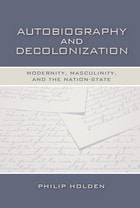
cover of Autobiography and Decolonization: Modernity, Masculinity, and the Nation-State

Autobiography and Decolonization

Modernity, Masculinity, and the Nation-State

Philip Holden

University of Wisconsin Press, 2008
Philip Holden reveals deeply gendered connections between the writing of individual lives and of the narratives of nations emerging from colonialism. Autobiography and Decolonization is the first book to give serious academic attention to autobiographies of nationalist leaders in the process of decolonization, attending to them not simply as partial historical documents, but as texts involved in remaking the world views of their readers.
            Holden examines Mohandas K. Gandhi’s An Autobiography: The Story of My Experiments with Truth, Marcus Garvey’s fragmentary Autobiography,Joseph Ephraim Casely Hayford’s Ethiopia Unbound, Lee Kuan Yew’s The Singapore Story, Nelson Mandela’s Long Walk to Freedom, Jawaharlal Nehru’s An Autobiography, and Kwame Nkrumah’s Ghana:The Autobiography of Kwame Nkrumah.
            Holden argues that these examples of life writing have had significant influence on the formation of new, and often profoundly gendered, national identities. These narratives constitute the nation less as an imagined community than as an imagined individual. Moving from the past to the promise of the future, they mediate relationships between public and private, and between individual and collective stories. Ultimately, they show how the construction of modern selfhood is inextricably linked to the construction of a postcolonial polity.
[more]
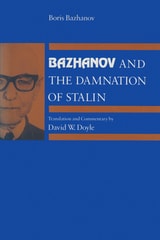
cover of Bazhanov and the Damnation of Stalin

Bazhanov and the Damnation of Stalin

Boris Bazhanov

Ohio University Press, 1990
On January 1, 1928, Bazhanov escaped from the Soviet Union and became for many years the most important member of a new breed—the Soviet defector. At the age of 28, he had become an invaluable aid to Stalin and the Politburo, and had he stayed in Stalin’s service, Bazhanov might well have enjoyed the same meteoric careers as the man who replaced him when he left, Georgy Malenkov. However, Bazhanov came to despise the unethical and brutal regime he served. One he decided to become anti–communist, he sought to bring down the regime. Planning his departure carefully, he brought with him documentation which revealed some of the innermost secrets of the Kremlin. Despite being pursued by the OGPU (an earlier incarnation of the KGB), he arrived eventually in Paris, and Bazhanov set to work writing his message to the West. While Bazhanov did successfully escape to the West, Stalin had Bazhanov watched and several attempts were made to assassinate him. Bazhanov may have been fearful for his life much of the time, but he was a man of courage and conviction, and he damned Stalin as often and as publicly as he could. In this riveting and illuminating book, Bazhanov provides an eyewitness account of the inner workings and personalities of the Soviet Central Committee and the Politburo in the 1920s. Bazhanov clearly details how Stalin invaded the communications of his opponents, rigged votes, built up his own constituency, and maneuvered to achieve his coup d’etat despite formidable odds. he also provides a better understanding of the curiously vapid way in which he other revolutionary leaders, most notably Trotsky, failed to appreciate the threat and let Stalin override them. He reveals how those Soviets with a sense of fairness, justice, and ethics were extinguished by Stalin and his minions, and how the self–centered, protective bureaucratic machine was first built. Bazhanov’s view, at the right hand of Stalin, is unique and chilling. Bazhanov’s post–defection prediction of Stalin’s continuing and fatal danger to Trotsky shows how well Bazhanov understood the dictator. His formation, in 1940, of an armed force recruited from Soviet Army prisoners to help Mannerheim defend Finland from Stalin’s forces and his 1941 decision to decline the position of Hitler’s Gauleiter of German–occupied Russia are fascinating. But perhaps the most interesting facet to Bazhanov’s tale is the fact that almost no Soviets—even today—know the real story of the Communist party’s criminal acquiescence in Stalin’s rise to, and abuse of, power.
[more]
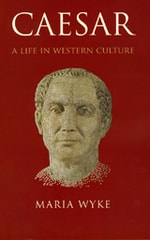
cover of Caesar: A Life in Western Culture

Caesar

A Life in Western Culture

Maria Wyke

University of Chicago Press, 2008
More than two millennia have passed since Brutus and his companions murdered Julius Caesar—and inaugurated his legend. Though the assassins succeeded in ending Caesar’s dictatorship, they could never have imagined that his power and influence would only grow after his death, reaching mythic proportions and establishing him as one of the central icons of Western culture, fascinating armchair historians and specialists alike.
 
With Caesar, Maria Wyke takes up the question of just why Julius Caesar has become such an exalted figure when most of his fellow Romans have long been forgotten. Focusing on key events in Caesar’s life, she begins with accounts from ancient sources, then traces the ways in which his legend has been adapted and employed by everyone from Machiavelli to Madison Avenue, Shakespeare to George Bernard Shaw. Napoleon and Mussolini, for example, cited Caesar’s crossing of the Rubicon in defense of their own dictatorial aims, while John Wilkes Booth fancied himself a new Brutus, ridding America of an imperial scourge. Caesar’s personal life, too, has long been fair game—but the lessons we draw from it have changed: Suetonius derided Caesar for his lustfulness and his love of luxury, but these days he and his lover Cleopatra serve as the very embodiment of glamour, enticingly invoked everywhere from Caesars Palace in Las Vegas to the hit HBO series Rome.
 
Caesar is the witty and perceptive work of a writer who is as comfortable with the implications of Xena: Warrior Princess as with the long shadow cast by the Annals of Tacitus. Wyke gives us a Caesar for our own time: complicated, hotly contested, and perpetually, fascinatingly renewed.
 
[more]
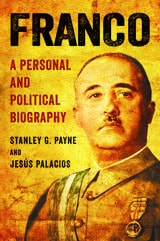
cover of Franco: A Personal and Political Biography

Franco

A Personal and Political Biography

Stanley G. Payne and Jesús Palacios

University of Wisconsin Press, 2018

General Francisco Franco ruled Spain for nearly forty years, as one of the most powerful and controversial leaders in that nation's long history. He has been the subject of many biographies, several of them more than a thousand pages in length, but all the preceding works have tended toward one extreme of interpretation or the other. This is the first comprehensive scholarly biography of Franco in English that is objective and balanced in its coverage, treating all three major aspects of his life—personal, military, and political. The coauthors, both renowned historians of Spain, present a deeply researched account that has made extensive use of the Franco Archive (long inaccessible to historians). They have also conducted in-depth interviews with his only daughter to explain better his family background, personal life, and marital environment, as well as his military and political career.
            Franco: A Personal and Political Biography depicts his early life, explains his career and rise to prominence as an army officer who became Europe's youngest interwar brigadier general in 1926, and then discusses his role in the affairs of the troubled Second Spanish Republic (1931–36). Stanley G. Payne and Jesús Palacios examine in detail how Franco became dictator and how his leadership led to victory in the Spanish Civil War that consolidated his regime. They also explore Franco's role in the great repression that accompanied the Civil War—resulting in tens of thousands of executions—and examine at length his controversial role in World War II. This masterful biography highlights Franco's metamorphoses and adaptations to retain power as politics, culture, and economics shifted in the four decades of his dictatorship.

Best Books for General Audiences, selected by the American Association of School Librarians

Best Books for General Audiences, selected by the Public Library Reviewers

“An important book, destined to elicit a heated academic debate surrounding the man who ruled Spain for forty years and whose figure still casts a long shadow four decades after his death.”—Journal of Modern History
[more]
cover of Hitler in History

Hitler in History

Eberhard Jäckel

Brandeis University Press, 2000
A leading interpreter of the Nazi period addresses crucial issues in modern European and contemporary history.
[more]
cover of Mao Zedong and China in the Twentieth-Century World: A Concise History

Mao Zedong and China in the Twentieth-Century World

A Concise History

Rebecca E. Karl

Duke University Press, 2010
Throughout this lively and concise historical account of Mao Zedong’s life and thought, Rebecca E. Karl places the revolutionary leader’s personal experiences, social visions and theory, military strategies, and developmental and foreign policies in a dynamic narrative of the Chinese revolution. She situates Mao and the revolution in a global setting informed by imperialism, decolonization, and third worldism, and discusses worldwide trends in politics, the economy, military power, and territorial sovereignty. Karl begins with Mao’s early life in a small village in Hunan province, documenting his relationships with his parents, passion for education, and political awakening during the fall of the Qing dynasty in late 1911. She traces his transition from liberal to Communist over the course of the next decade, his early critiques of the subjugation of women, and the gathering force of the May 4th movement for reform and radical change. Describing Mao’s rise to power, she delves into the dynamics of Communist organizing in an overwhelmingly agrarian society, and Mao’s confrontations with Chiang Kaishek and other nationalist conservatives. She also considers his marriages and romantic liaisons and their relation to Mao as the revolutionary founder of Communism in China. After analyzing Mao’s stormy tenure as chairman of the People’s Republic of China, Karl concludes by examining his legacy in China from his death in 1976 through the Beijing Olympics in 2008.
[more]
cover of Stalin: An Unknown Portrait

Stalin

An Unknown Portrait

Miklós Kun

Central European University Press, 2003

This exceptional volume contains exciting new information about Stalin's actual and political "family", the Kremlin Mafia and the clans around him. The author has interviewed key politicians who survived the Stalin era, including officials of the KGB and the Party, as well as people who had personal contact with the dictator as secretaries or interpreters. Kun's special expertise and his access to archival sources in Russia have resulted in a work revealing jealously guarded secrets. In addition to the interviews and hitherto unpublished correspondence between Stalin, Molotov, Voroshilov, Mikoyan, Zhdanov and others, the book also contains a fascinating collection of over 300 photos of Stalin, his family members, and various political actors of the period. Extensive notes, a bibliography, and an index of names add to the value of the volume.
[more]
cover of Succession to High Office in Botswana: Three Case Studies

Succession to High Office in Botswana

Three Case Studies

Jack Parson

Ohio University Press, 1990
This book examines the process through which the mantle of leadership passed from one leader to another in Botswana. It concerns the succession to high office in Botswana over the course of more than half a century from the colonial time to the present. Three case studies explore the relationship between the British colonial authorities and the tribal leaders in affirming the legitimacy of the tribal chiefs of the Bangwato tribe in the former Bechuanaland protectorate. The studies examine the succession crises of the Bangwato first in 1925 and again between 1948 to 1953 and the political changes from the Botswana National Archives contained in the appendices fully support the text.
[more]
cover of The Last Days of Hitler

The Last Days of Hitler

Hugh Trevor-Roper

University of Chicago Press, 1992

Late in 1945, Trevor-Roper was appointed by British Intelligence in Germany to investigate conflicting evidence surrounding Hitler's final days and to produce a definitive report on his death. The author, who had access to American counterintelligence files and to German prisoners, focuses on the last ten days of Hitler's life, April 20-29, 1945, in the underground bunker in Berlin—a bizarre and gripping episode punctuated by power play and competition among Hitler's potential successors.

"From exhaustive research [Trevor-Roper] has put together a carefully documented, irrefutable, and unforgettable reconstruction of the last days in April, 1945."—New Republic

"A book sound in its scholarship, brilliant in its presentation, a delight for historians and laymen alike."—A. J. P. Taylor, New Statesman
[more]
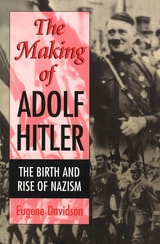
cover of The Making of Adolf Hitler: The Birth and Rise of Nazism

The Making of Adolf Hitler

The Birth and Rise of Nazism

Eugene Davidson

University of Missouri Press, 1997

The harsh Armistice terms of 1918, the short-lived Weimar Republic, Hindenburg's senile vacillations, and behind-the-scene power plays form the backbone of this excellent study covering German history during the first three-and-a-half decades of the century.
[more]
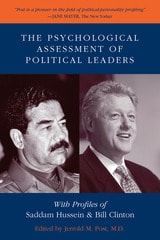
cover of The Psychological Assessment of Political Leaders: With Profiles of Saddam Hussein and Bill Clinton

The Psychological Assessment of Political Leaders

With Profiles of Saddam Hussein and Bill Clinton

Jerrold M. Post, Editor

University of Michigan Press, 2005

In an age when world affairs are powerfully driven by personality, politics require an understanding of what motivates political leaders such as Hussein, Bush, Blair, and bin Laden. Through exacting case studies and the careful sifting of evidence, Jerrold Post and his team of contributors lay out an effective system of at-a-distance evaluation. Observations from political psychology, psycholinguistics and a range of other disciplines join forces to produce comprehensive political and psychological profiles, and a deeper understanding of the volatile influences of personality on global affairs.

Even in this age of free-flowing global information, capital, and people, sovereign states and boundaries remain the hallmark of the international order -- a fact which is especially clear from the events of September 11th and the War on Terrorism.

Jerrold M. Post, M.D., is Professor of Psychiatry, Political Psychology, and International Affairs, and Director of the Political Psychology Program at George Washington University. He is the founder of the CIA's Center for the Analysis of Personality and Political Behavior.
[more]
cover of Ukraine's Patronal Democracy and the Russian Invasion: The Russia-Ukraine War, Volume One

Ukraine's Patronal Democracy and the Russian Invasion

The Russia-Ukraine War, Volume One

Bálint Madlovics

Central European University Press, 2023

The Russian invasion of Ukraine in 2022 jeopardizes the country's independence and its chances for Western-style development. However, the heroic attitude of the Ukrainian people, combined with a solidifying national identity, makes the domestic foundations for a western turn stronger than ever. After the invasion, building strong foundations of liberal democracy will be a top priority. In addition to alleviating immediate problems, the country must also address its post-communist legacy and address the constraints of patronalism.

The authors of this edited volume, leading Ukrainian scholars supplemented by colleagues from Hungary, examine the chances of an anti-patronal transformation after the war. The book provides an overview of the development of Ukraine's political-economic system: color revolutions in 2004 and 2014 brought democratic transformation, but no change in the patronage system The result was patronal regime cycles instead of the emergence of a Western-type liberal democracy in the country. Building on the conceptual framework of the editors' The Anatomy of Post-Communist Regimes (CEU Press, 2020), the 12 chapters examine the impact of the war on patronal democracy, the relational economy, clientelist society, and the international environment in which Ukraine operates.

This collection is complemented by the book entitled Russia. Imperial Endeavor and Geopolitical Consequences.

[more]