Results by title
21 books match the query 'History & Philosophy'

A Brief Quadrivium
Peter Ulrickson
Catholic University of America Press, 2023
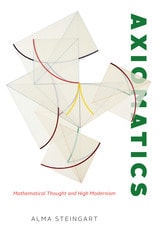
Axiomatics
Mathematical Thought and High ModernismAlma Steingart
University of Chicago Press, 2023
Why did abstraction dominate American art, social science, and natural science in the mid-twentieth century? Why, despite opposition, did abstraction and theoretical knowledge flourish across a diverse set of intellectual pursuits during the Cold War? In recovering the centrality of abstraction across a range of modernist projects in the United States, Alma Steingart brings mathematics back into the conversation about midcentury American intellectual thought. The expansion of mathematics in the aftermath of World War II, she demonstrates, was characterized by two opposing tendencies: research in pure mathematics became increasingly abstract and rarified, while research in applied mathematics and mathematical applications grew in prominence as new fields like operations research and game theory brought mathematical knowledge to bear on more domains of knowledge. Both were predicated on the same abstractionist conception of mathematics and were rooted in the same approach: modern axiomatics.
For American mathematicians, the humanities and the sciences did not compete with one another, but instead were two complementary sides of the same epistemological commitment. Steingart further reveals how this mathematical epistemology influenced the sciences and humanities, particularly the postwar social sciences. As mathematics changed, so did the meaning of mathematization.
Axiomatics focuses on American mathematicians during a transformative time, following a series of controversies among mathematicians about the nature of mathematics as a field of study and as a body of knowledge. The ensuing debates offer a window onto the postwar development of mathematics band Cold War epistemology writ large. As Steingart’s history ably demonstrates, mathematics is the social activity in which styles of truth—here, abstraction—become synonymous with ways of knowing.
Before Voltaire
The French Origins of “Newtonian” Mechanics, 1680-1715J.B. Shank
University of Chicago Press, 2017
Before Voltaire explores how Newton’s ideas made their way not just through the realm of French science, but into the larger world of society and culture of which Principia was an intertwined part. Shank also details a history of the beginnings of calculus-based mathematical physics that integrates it into the larger intellectual currents in France at the time, including the Battle of the Ancients and the Moderns, the emergence of wider audiences for science, and the role of the newly reorganized Royal Academy of Sciences. The resulting book offers an unprecedented cultural history of one the most important and influential elements of Enlightenment science.
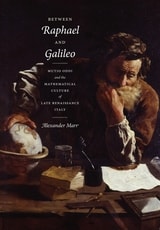
Between Raphael and Galileo
Mutio Oddi and the Mathematical Culture of Late Renaissance ItalyAlexander Marr
University of Chicago Press, 2011
Although largely unknown today, during his lifetime Mutio Oddi of Urbino (1569–1639) was a highly esteemed scholar, teacher, and practitioner of a wide range of disciplines related to mathematics. A prime example of the artisan-scholar so prevalent in the late Renaissance, Oddi was also accomplished in the fields of civil and military architecture and the design and retail of mathematical instruments, as well as writing and publishing.
In Between Raphael and Galileo, Alexander Marr resurrects the career and achievements of Oddi in order to examine the ways in which mathematics, material culture, and the book shaped knowledge, society, and the visual arts in late Renaissance Italy. Marr scrutinizes the extensive archive of Oddi papers, documenting Oddi’s collaboration with prominent intellectuals and officials and shedding new light on the practice of science and art during his day. What becomes clear is that Oddi, precisely because he was not spectacularly innovative and did not attain the status of a hero in modern science, is characteristic of the majority of scientific practitioners and educators active in this formative age, particularly those whose energetic popularization of mathematics laid the foundations for the Scientific Revolution. Marr also demonstrates that scientific change in this era was multivalent and contested, governed as much by friendship as by principle and determined as much by places as by purpose.
Plunging the reader into Oddi’s world, Between Raphael and Galileo is a finely wrought and meticulously researched tale of science, art, commerce, and society in the late sixteenth and early seventeenth century. It will become required reading for any scholar interested in the history of science, visual art, and print culture of the Early Modern period.
Casanova's Lottery
The History of a Revolutionary Game of ChanceStephen M. Stigler
University of Chicago Press, 2022
In the 1750s, at the urging of famed adventurer Giacomo Casanova, the French state began to embrace risk in adopting a new Loterie. The prize amounts paid varied, depending on the number of tickets bought and the amount of the bet, as determined by each individual bettor. The state could lose money on any individual Loterie drawing while being statistically guaranteed to come out on top in the long run. In adopting this framework, the French state took on risk in a way no other has, before or after. At each drawing the state was at risk of losing a large amount; what is more, that risk was precisely calculable, generally well understood, and yet taken on by the state with little more than a mathematical theory to protect it.
Stephen M. Stigler follows the Loterie from its curious inception through its hiatus during the French Revolution, its renewal and expansion in 1797, and finally to its suppression in 1836, examining throughout the wider question of how members of the public came to trust in new financial technologies and believe in their value. Drawing from an extensive collection of rare ephemera, Stigler pieces together the Loterie’s remarkable inner workings, as well as its implications for the nature of risk and the role of lotteries in social life over the period 1700–1950.
Both a fun read and fodder for many fields, Casanova's Lottery shines new light on the conscious introduction of risk into the management of a nation-state and the rationality of playing unfair games.
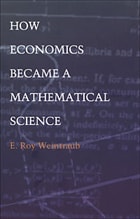
How Economics Became a Mathematical Science
E. Roy Weintraub
Duke University Press, 2002
Whereas others have viewed economics as autonomous, Weintraub presents a different picture, one in which changes in mathematics—both within the body of knowledge that constitutes mathematics and in how it is thought of as a discipline and as a type of knowledge—have been intertwined with the evolution of economic thought. Weintraub begins his account with Cambridge University, the intellectual birthplace of modern economics, and examines specifically Alfred Marshall and the Mathematical Tripos examinations—tests in mathematics that were required of all who wished to study economics at Cambridge. He proceeds to interrogate the idea of a rigorous mathematical economics through the connections between particular mathematical economists and mathematicians in each of the decades of the first half of the twentieth century, and thus describes how the mathematical issues of formalism and axiomatization have shaped economics. Finally, How Economics Became a Mathematical Science reconstructs the career of the economist Sidney Weintraub, whose relationship to mathematics is viewed through his relationships with his mathematician brother, Hal, and his mathematician-economist son, the book’s author.
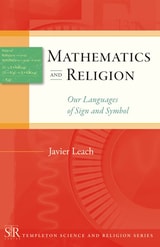
Mathematics and Religion
Our Languages of Sign and SymbolJavier Leach
Templeton Press, 2010
Mathematics and Religion: Our Languages of Sign and Symbol is the sixth title published in the Templeton Science and Religion Series, in which scientists from a wide range of fields distill their experience and knowledge into brief tours of their respective specialties. In this volume, Javier Leach, a mathematician and Jesuit priest, leads a fascinating study of the historical development of mathematical language and its influence on the evolution of metaphysical and theological languages.
Leach traces three historical moments of change in this evolution: the introduction of the deductive method in Greece, the use of mathematics as a language of science in modern times, and the formalization of mathematical languages in the nineteenth and twentieth centuries. As he unfolds this fascinating history, Leach notes the striking differences and interrelations between the two languages of science and religion. Until now there has been little reflection on these similarities and differences, or about how both languages can complement and enrich each other.
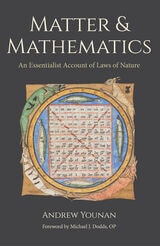
Matter and Mathematics
An Essential Account of Laws of NatureAndrew Younan
Catholic University of America Press, 2022
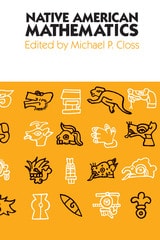
Native American Mathematics
By Michael P. Closs
University of Texas Press, 1996
There is no question that native cultures in the New World exhibit many forms of mathematical development. This Native American mathematics can best be described by considering the nature of the concepts found in a variety of individual New World cultures. Unlike modern mathematics in which numbers and concepts are expressed in a universal mathematical notation, the numbers and concepts found in native cultures occur and are expressed in many distinctive ways. Native American Mathematics, edited by Michael P. Closs, is the first book to focus on mathematical development indigenous to the New World.
Spanning time from the prehistoric to the present, the thirteen essays in this volume attest to the variety of mathematical development present in the Americas. The data are drawn from cultures as diverse as the Ojibway, the Inuit (Eskimo), and the Nootka in the north; the Chumash of Southern California; the Aztec and the Maya in Mesoamerica; and the Inca and Jibaro of South America. Among the strengths of this collection are this diversity and the multidisciplinary approaches employed to extract different kinds of information. The distinguished contributors include mathematicians, linguists, psychologists, anthropologists, and archaeologists.

Number and Time
Reflections Leading Toward a Unification of Depth Psychology and PhysicsMarie-Louise von Franz
Northwestern University Press, 1986
A classic on mind, matter, and the unified world model
C. G. Jung's work in his later years suggested that the seemingly divergent sciences of psychology and modern physics might, in fact, be approaching a unified world model in which the dualism of matter and psyche would be resolved into “one world” or Unus Mundus. Jung believed that the natural integers are the archetypal patterns that regulate the unitary realm of psyche and matter, and that number serves as a special instrument for man's becoming conscious of this unity.
Written in a clear style and replete with illustrations which help make the mathematical ideas visible, Number and Time is a piece of original scholarship which introduces a view of how "mind" connects with "matter" at the most fundamental level.
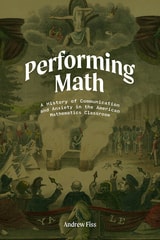
Performing Math
A History of Communication and Anxiety in the American Mathematics ClassroomAndrew Fiss
Rutgers University Press, 2021
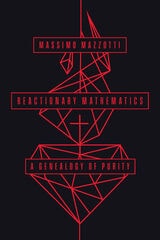
Reactionary Mathematics
A Genealogy of PurityMassimo Mazzotti
University of Chicago Press, 2023
The nineteenth century opened with a major shift in European mathematics, and in the Kingdom of Naples, this occurred earlier than elsewhere. Between 1790 and 1830 its leading scientific institutions rejected as untrustworthy the “very modern mathematics” of French analysis and in its place consolidated, legitimated, and put to work a different mathematical culture. The Neapolitan mathematical resistance was a complete reorientation of mathematical practice. Over the unrestricted manipulation and application of algebraic algorithms, Neapolitan mathematicians called for a return to Greek-style geometry and the preeminence of pure mathematics.
For all their apparent backwardness, Massimo Mazzotti explains, they were arguing for what would become crucial features of modern mathematics: its voluntary restriction through a new kind of rigor and discipline, and the complete disconnection of mathematical truth from the empirical world—in other words, its purity. The Neapolitans, Mazzotti argues, were reacting to the widespread use of mathematical analysis in social and political arguments: theirs was a reactionary mathematics that aimed to technically refute the revolutionary mathematics of the Jacobins. During the Restoration, the expert groups in the service of the modern administrative state reaffirmed the role of pure mathematics as the foundation of a newly rigorous mathematics, which was now conceived as a neutral tool for modernization. What Mazzotti’s penetrating history shows us in vivid detail is that producing mathematical knowledge was equally about producing certain forms of social, political, and economic order.
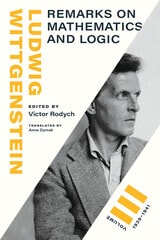
Remarks on Mathematics and Logic
Volume III, 1939–1941Ludwig Wittgenstein
University of Chicago Press, 0
The second of five planned volumes, this book collects Wittgenstein’s unabridged writings on mathematics and logic composed between 1939 and 1941.
In 1956, a significant but abridged portion of Ludwig Wittgenstein’s 1937–1944 writings for a continuation of what became Philosophical Investigations was published as Remarks on the Foundations of Mathematics. Now, in these five German-English facing-page volumes, the writings of Remarks on Mathematics and Logic are presented in full as Wittgenstein wrote them: in chronological order, without editorial omissions, selections, or rearrangements.
Volume III contains materials from 1939 to 1941, including previously unpublished—one manuscript and four manuscript parts—and one manuscript from which selections were made for previous abridgements.
The topics covered in this volume include surveyability and perspicuity in mathematics; Cantor and Gödel; Russellian logicism; geometrical cogency of proofs; consensus as part of the phenomenon of our calculating; rule-following and unwinding; consistency proofs; calculation as invention rather than discovery; superstitious fear of contradictions; why mathematicians cannot philosophize about mathematics; mathematical propositions are overdetermined; the idea of a mathematical reality; the connection between the sense of a mathematical proposition and its use; positioning a proposition in a system; an unproved mathematical proposition as the expression of a problem; the role of mathematical propositions in descriptions (of reality).
This edition will be the authoritative source for Wittgenstein’s writings in their original context.
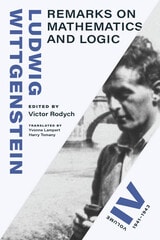
Remarks on Mathematics and Logic
Volume IV, 1941–1943Ludwig Wittgenstein
University of Chicago Press, 0
In 1956, a significant but abridged portion of Ludwig Wittgenstein’s 1937–1944 writings for a continuation of what became Philosophical Investigations was published as Remarks on the Foundations of Mathematics. Now, in the five German-English facing pages volumes of Remarks on Mathematics and Logic, these writings are presented in full as Wittgenstein wrote them: in chronological order, without editorial omissions, selections, or rearrangements.
Volume IV contains materials from 1941 to 1943, including one previously unpublished manuscript and three manuscripts from which selections were made for the previous abridgment. The topics covered in this volume include the philosophy of mathematics, mathematical foundationalism, surveyability in mathematics, language-games and proof-networks, Gödelian undecidability, pictures in mathematics, Cantorian diagonal proofs, applied mathematics without pure mathematics, and mathematics and chess, among others.
This German-English facing pages edition presents Wittgenstein’s writings in their original context—as Wittgenstein wrote them, in chronological order, and without editorial omissions, selections, or rearrangements.
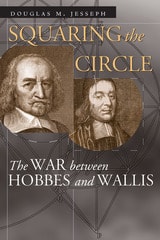
Squaring the Circle
The War between Hobbes and WallisDouglas M. Jesseph
University of Chicago Press, 1999
Hobbes believed that by recasting geometry in a materialist mold, he could solve any geometric problem and thereby demonstrate the power of his materialist metaphysics. Wallis, a prominent Presbyterian divine as well as an eminent mathematician, refuted Hobbes's geometry as a means of discrediting his philosophy, which Wallis saw as a dangerous mix of atheism and pernicious political theory.
Hobbes and Wallis's "battle of the books" illuminates the intimate relationship between science and crucial seventeenth-century debates over the limits of sovereign power and the existence of God.
Teaching the Quadrivium
A Guide for InstructorsPeter Ulrickson
Catholic University of America Press, 2023
The Math Mafia
How a Persistent Group of Reformers Standardized American EducationEmily T. Hamilton
University of Alabama Press, 2026
How Cold War urgency, academic ambition, and federal power converged to make math the cornerstone of American education policy.
The Math Mafia by Emily T. Hamilton is a historical account of mathematics education reform in twentieth-century America and how that movement played a role in shaping the broader contours of national education policy. Hamilton contends that a cohesive and well-organized community of advocates was instrumental in the rise of standardized testing and curriculum reforms, as well as federal involvement in classrooms, especially during the Cold War. By positioning mathematics as central to national strength and security, these reformers established math education as a key area of federal focus.
The “mafia” at the center of Hamilton’s story includes mathematicians, educators, and researchers from universities, as well as members of government-funded organizations such as the National Science Foundation and various educational psychology circles. Prominent figures such as Edward Begle, who led the School Mathematics Study Group during the “new math” movement, played key roles. Other influential participants include federal education officials, advocates from professional organizations such as the National Council of Teachers of Mathematics, and cognitive scientists, who contributed both research and theoretical frameworks that informed curriculum design and assessment methods.
The Math Mafia offers historians, educators, policymakers, and other interested readers a compelling perspective on the legacy of the math education reforms on federal education policy in the United States and is a welcome contribution to ongoing discourse around “teaching toward the test,” educational equity, school performance, and other hot-button issues in US education today.

The Optics of Ibn al-Haytham Books IV–V
On Reflection and Images Seen by ReflectionAbdelhamid I. Sabra
University of London Press, 2023
Ibn al-Haytham was perhaps the greatest mathematician and physicist of the medieval Arabic/Islamic world. The most famous book in which he applied his scientific method is his Optics, through which he dealt with both the mathematics of rays of light and the physical aspects of the eye in seven comprehensive books. His rethinking of the entire science of optics set the scene for the whole of the subsequent development of the subject, influencing figures such as William of Ockham, Kepler, Descartes, and Christaan Huygens. The immense work of editing, translating into English, and commenting on this work was undertaken by Abdelhamid I. Sabra. This English translation of Books IV–V was completed by Sabra just before his death in 2013 with an introduction and critical analysis. It has been extensively revised by Jan Hogendijk.

Truth, Reference and Realism
Zsolt Novak
Central European University Press, 2011
Uncountable
A Philosophical History of Number and Humanity from Antiquity to the PresentDavid Nirenberg and Ricardo L. Nirenberg
University of Chicago Press, 2021
Our knowledge of mathematics has structured much of what we think we know about ourselves as individuals and communities, shaping our psychologies, sociologies, and economies. In pursuit of a more predictable and more controllable cosmos, we have extended mathematical insights and methods to more and more aspects of the world. Today those powers are greater than ever, as computation is applied to virtually every aspect of human activity. Yet, in the process, are we losing sight of the human? When we apply mathematics so broadly, what do we gain and what do we lose, and at what risk to humanity?
These are the questions that David and Ricardo L. Nirenberg ask in Uncountable, a provocative account of how numerical relations became the cornerstone of human claims to knowledge, truth, and certainty. There is a limit to these number-based claims, they argue, which they set out to explore. The Nirenbergs, father and son, bring together their backgrounds in math, history, literature, religion, and philosophy, interweaving scientific experiments with readings of poems, setting crises in mathematics alongside world wars, and putting medieval Muslim and Buddhist philosophers in conversation with Einstein, Schrödinger, and other giants of modern physics. The result is a powerful lesson in what counts as knowledge and its deepest implications for how we live our lives.
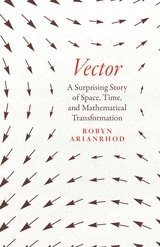
Vector
A Surprising Story of Space, Time, and Mathematical TransformationRobyn Arianrhod
University of Chicago Press, 2024
The stars of this book, vectors and tensors, are unlikely celebrities. If you ever took a physics course, the word “vector” might remind you of the mathematics needed to determine forces on an amusement park ride, a turbine, or a projectile. You might also remember that a vector is a quantity that has magnitude and (this is the key) direction. In fact, vectors are examples of tensors, which can represent even more data. It sounds simple enough—and yet, as award-winning science writer Robyn Arianrhod shows in this riveting story, the idea of a single symbol expressing more than one thing at once was millennia in the making. And without that idea, we wouldn’t have such a deep understanding of our world.
Vector and tensor calculus offers an elegant language for expressing the way things behave in space and time, and Arianrhod shows how this enabled physicists and mathematicians to think in a brand-new way. These include James Clerk Maxwell when he ushered in the wireless electromagnetic age; Einstein when he predicted the curving of space-time and the existence of gravitational waves; Paul Dirac, when he created quantum field theory; and Emmy Noether, when she connected mathematical symmetry and the conservation of energy. For it turned out that it’s not just physical quantities and dimensions that vectors and tensors can represent, but other dimensions and other kinds of information, too. This is why physicists and mathematicians can speak of four-dimensional space-time and other higher-dimensional “spaces,” and why you’re likely relying on vectors or tensors whenever you use digital applications such as search engines, GPS, or your mobile phone.
In exploring the evolution of vectors and tensors—and introducing the fascinating people who gave them to us—Arianrhod takes readers on an extraordinary, five-thousand-year journey through the human imagination. She shows the genius required to reimagine the world—and how a clever mathematical construct can dramatically change discovery’s direction.