Results by title
14 books match the query 'Identity (Philosophical concept) in literature'
Displacement and the Somatics of Postcolonial Culture
Douglas Robinson
The Ohio State University Press, 2013
Identities
Edited by Kwame Anthony Appiah and Henry Louis Gates Jr.
University of Chicago Press, 1995
Leading scholars in literary criticism, anthropology, sociology, and philosophy explore such topics as "Gypsies" in the Western imagination, the mobilization of the West in Chinese television, the lesbian identity and the woman's gaze in fashion photography, and the regulation of black women's bodies in early 20th-century urban areas. This collection of twenty articles brings together the special issue of Critical Inquiry entitled "Identities" (Summer 1992), two other previously published essays, and five previously published critical responses and rejoinders, all of which is interrogated in two new essays by Michael Gorra and Judith Butler.
Contributors include Elizabeth Abel, Kwame Anthony Appiah, Akeel Bilgrami, Daniel Boyarin, Jonathan Boyarin, Judith Butler, Hazel V. Carby, Xiaomei Chen, Diana Fuss, Henry Louis Gates, Jr., Avery Gordon, Michael Gorra, Cheryl Herr, Saree S. Makdisi, Walter Benn Michaels, Christopher Newfield, Gananath Obeyesekere, Molly Anne Rothenberg, Gayatri Chakravorty Spivak, Sara Suleri, Katie Trumpener, and Joseph Valente.
Inhuman Citizenship
Traumatic Enjoyment and Asian American LiteratureJuliana Chang
University of Minnesota Press, 2012
In Inhuman Citizenship, Juliana Chang claims that literary representations of Asian American domesticity may be understood as symptoms of America’s relationship to its national fantasies and to the “jouissance”—a Lacanian term signifying a violent yet euphoric shattering of the self—that both overhangs and underlies those fantasies. In the national imaginary, according to Chang, racial subjects are often perceived as the source of jouissance, which they supposedly embody through their excesses of violence, sexuality, anger, and ecstasy—excesses that threaten to overwhelm the social order.
To examine her argument that racism ascribes too much, rather than a lack of, humanity, Chang analyzes domestic accounts by Asian American writers, including Fae Myenne Ng’s Bone, Brian Ascalon Roley’s American Son, Chang-rae Lee’s Native Speaker, and Suki Kim’s The Interpreter. Employing careful reading and Lacanian psychoanalysis, Chang finds sites of excess and shock: they are not just narratives of trauma; they produce trauma as well. They render Asian Americans as not only the objects but also the vehicles and agents of inhuman suffering. And, claims Chang, these novels disturb yet strangely exhilarate the reader through characters who are objects of racism and yet inhumanly enjoy their suffering and the suffering of others.
Through a detailed investigation of “family business” in works of Asian American life, Chang shows that by identifying with the nation’s psychic disturbance, Asian American characters ethically assume responsibility for a national unconscious that is all too often disclaimed.

Israel in Exile
Jewish Writing and the DesertRanen Omer-Sherman
University of Illinois Press, 2006
In contrast to other ethnic and national representations, Jewish writers since antiquity have not constructed a neat antithesis between the desert and the city or nation; rather, the desert becomes a symbol against which the values of the city or nation can be tested, measured, and sometimes found wanting. This book examines how the ethical tension between the clashing Mosaic and Davidic paradigms of the desert still reverberate in secular Jewish literature and produce fascinating literary rewards. Omer-Sherman ultimately argues that the ancient encounter with the desert acquires a renewed urgency in response to the crisis brought about by national identities and territorial conflicts.

Migration and Identity in Nordic Literature
Edited by Martin Humpál and Helena Brezinová
Karolinum Press, 2022
Migration is a frequent topic of many debates nowadays, whether it concerns refugees from war-torn areas or the economic pros and cons of the mobility of multinational corporations and their employees. Yet such migration has always been a part of the human experience, and its dimensions—with its shifting nature, manifestations, and consequences—were often greater than we can imagine today.
In this book, ten scholars from Czechia, Denmark, the Netherlands, Norway, Poland, and Sweden focus on how migration has manifested itself in literature and culture through the nineteenth, twentieth, and early twenty-first centuries in Denmark, Norway, Sweden, Finland, and Iceland. Examining the theme of migration as it relates to questions of identity, both national and individual, the authors argue that migration almost always leads to a disturbance of identity and creates a potential for conflicts between individuals and larger groups. The book digs deep into such cases of disturbance, disruption, and hybridization of identity as they are represented in three centuries of literary works from the European North.

Private Lives, Proper Relations
Regulating Black IntimacyCandice M. Jenkins
University of Minnesota Press, 2007
Private Lives, Proper Relations begins with the question of why contemporary African American literature—particularly that produced by black women—is continually concerned with issues of respectability and propriety. Candice M. Jenkins argues that this preoccupation has its origins in recurrent ideologies about African American sexuality, and that it expresses a fundamental aspect of the racial self—an often unarticulated link between the intimate and the political in black culture.
In a counterpoint to her paradigmatic reading of Nella Larsen’s Passing, Jenkins’s analysis of black women’s narratives—including Ann Petry’s The Street, Toni Morrison’s Sula and Paradise, Alice Walker’s The Color Purple, and Gayl Jones’s Eva’s Man—offers a theory of black subjectivity. Here Jenkins describes middle-class attempts to rescue the black community from accusations of sexual and domestic deviance by embracing bourgeois respectability, and asserts that behind those efforts there is the “doubled vulnerability” of the black intimate subject. Rather than reflecting a DuBoisian tension between race and nation, to Jenkins this vulnerability signifies for the African American an opposition between two poles of potential exposure: racial scrutiny and the proximity of human intimacy.
Scholars of African American culture acknowledge that intimacy and sexuality are taboo subjects among African Americans precisely because black intimate character has been pathologized. Private Lives, Proper Relations is a powerful contribution to the crucial effort to end the distortion still surrounding black intimacy in the United States.
Candice M. Jenkins is associate professor of English at Hunter College, City University o
Racial Beings
Experiments in Asian American New MaterialismsMichelle N. Huang
Duke University Press, 2026

THE NOVEL AND THE MENAGERIE
TOTALITY, ENGLISHNESS, AND EMPIREKURT KOENIGSBERGER
The Ohio State University Press, 2007

The Literatures of the U.S.-Mexican War
Narrative, Time, and IdentityBy Jaime Javier Rodríguez
University of Texas Press, 2010
The literary archive of the U.S.-Mexican War (1846–1848) opens to view the conflicts and relationships across one of the most contested borders in the Americas. Most studies of this literature focus on the war's nineteenth-century moment of national expansion. In The Literatures of the U.S.-Mexican War, Jaime Javier Rodríguez brings the discussion forward to our own moment by charting a new path into the legacies of a military conflict embedded in the cultural cores of both nations.
Rodríguez's groundbreaking study moves beyond the terms of Manifest Destiny to ask a fundamental question: How do the war's literary expressions shape contemporary tensions and exchanges among Anglo Americans, Mexicans, and Mexican Americans. By probing the war's traumas, anxieties, and consequences with a fresh attention to narrative, Rodríguez shows us the relevance of the U.S.-Mexican War to our own era of demographic and cultural change. Reading across dime novels, frontline battle accounts, Mexican American writings and a wide range of other popular discourse about the war, Rodríguez reveals how historical awareness itself lies at the center of contemporary cultural fears of a Mexican "invasion," and how the displacements caused by the war set key terms for the ways Mexican Americans in subsequent generations would come to understand their own identities. Further, this is also the first major comparative study that analyzes key Mexican war texts and their impact on Mexico's national identity.
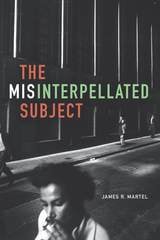
The Misinterpellated Subject
James R. Martel
Duke University Press, 2017
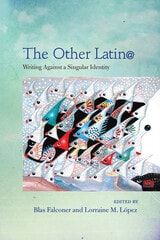
The Other Latin@
Writing Against a Singular IdentityEdited by Blas Falconer and Lorraine M. López
University of Arizona Press, 2011
The sheer number of different ethnic groups and cultures in the United States makes it tempting to classify them according to broad stereotypes, ignoring their unique and changing identities. Because of their growing diversity within the United States, Latinas and Latinos face this problem in their everyday lives. With cultural roots in Mexico, Puerto Rico, Cuba, the Dominican Republic, or a variety of other locales, Hispanic-origin people in the United States are too often consigned to a single category. With this book Blas Falconer and Lorraine M. López set out to change this.
The Other Latin@ is a diverse collection of essays written by some of the best emerging and established contemporary writers of Latin origin to help answer the question: How can we treat U.S. Latina and Latino literature as a definable whole while acknowledging the many shifting identities within their cultures? By telling their own stories, these authors illuminate the richness of their cultural backgrounds while adding a unique perspective to Latina and Latino literature.
This book sheds light on the dangers of abandoning identity by accepting cultural stereotypes and ignoring diversity within diversity. These contributors caution against judging literature based on the race of the author and lament the use of the term Hispanic to erase individuality. Honestly addressing difficult issues, this book will greatly contribute to a better understanding of Latina and Latino literature and identity.
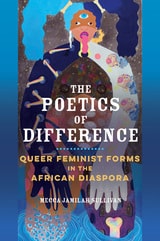
The Poetics of Difference
Queer Feminist Forms in the African DiasporaMecca Jamilah Sullivan
University of Illinois Press, 2021
From Audre Lorde, Ntozake Shange, and Bessie Head, to Zanele Muholi, Suzan-Lori Parks, and Missy Elliott, Black women writers and artists across the African Diaspora have developed nuanced and complex creative forms. Mecca Jamilah Sullivan ventures into the unexplored spaces of black women’s queer creative theorizing to learn its languages and read the textures of its forms. Moving beyond fixed notions, Sullivan points to a space of queer imagination where black women invent new languages, spaces, and genres to speak the many names of difference. Black women’s literary cultures have long theorized the complexities surrounding nation and class, the indeterminacy of gender and race, and the multiple meanings of sexuality. Yet their ideas and work remain obscure in the face of indifference from Western scholarship.
Innovative and timely, The Poetics of Difference illuminates understudied queer contours of black women’s writing.
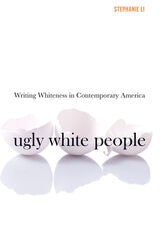
Ugly White People
Writing Whiteness in Contemporary AmericaStephanie Li
University of Minnesota Press, 2023
Whiteness revealed: an analysis of the destructive complacency of white self-consciousness
White Americans are confronting their whiteness more than ever before, with political and social shifts ushering in a newfound racial awareness. And with white people increasingly seeing themselves as distinctly racialized (not simply as American or human), white writers are exposing a self-awareness of white racialized behavior—from staunch antiracism to virulent forms of xenophobic nationalism. Ugly White People explores representations of whiteness from twenty-first-century white American authors, revealing white recognition of the ugly forms whiteness can take.
Stephanie Li argues that much of the twenty-first century has been defined by this rising consciousness of whiteness because of the imminent shift to a “majority minority” population and the growing diversification of America’s political, social, and cultural institutions. The result is literature that more directly grapples with whiteness as its own construct rather than a wrongly assumed norm. Li contextualizes a series of literary novels as collectively influenced by changes in racial and political attitudes. Turning to works by Dave Eggers, Sarah Smarsh, J. D. Vance, Claire Messud, Ben Lerner, and others, she traces the responses to white consciousness that breed shared manifestations of ugliness. The tension between acknowledging whiteness as an identity built on domination and the failure to remedy inequalities that have proliferated from this founding injustice is often the source of the ugly whiteness portrayed through these narratives.
The questions posed in Ugly White People about the nature and future of whiteness are vital to understanding contemporary race relations in America. From the election of Trump and the rise of white nationalism to Karen memes and the war against critical race theory to the pervasive pattern of behavior among largely liberal-leaning whites, Li elucidates truths about whiteness that challenge any hope of national unity and, most devastatingly, the basic humanity of others.
Retail e-book files for this title are screen-reader friendly.
Virtuous Citizens
Counterpublics and Sociopolitical Agency in Transatlantic LiteratureKendall McClellan
University of Alabama Press, 2021
Transatlantic Perspectives on Civic Identity and Political Participation.
The rise of the bourgeois public sphere and the contemporaneous appearance of counterpublics in the eighteenth century deeply influenced not only how politicians and philosophers understood the relationships among citizens, disenfranchised subjects, and the state but also how members of the polity understood themselves. In Virtuous Citizens: Counterpublics and Sociopolitical Agency in Transatlantic Literature, Kendall McClellan uncovers a fundamental and still redolent transformation in conceptions of civic identity that occurred over the course of the eighteenth and nineteenth centuries. Literature of this period exposes an emotional investment in questions of civic selfhood born out of concern for national stability and power, which were considered products of both economic strength and a nation’s moral fiber. McClellan shows how these debates traversed the Atlantic to become a prominent component of early American literature, evident in works by James Fenimore Cooper, Catharine Maria Sedgwick, Sarah Josepha Hale, and Harriet Beecher Stowe, among others.
Underlying popular opinion about who could participate in the political public, McClellan argues, was an impassioned rhetorical wrestling match over the right and wrong ways to demonstrate civic virtue. Relying on long-established tropes of republican virtue that lauded self-sacrifice and disregard for personal safety, abolitionist writers represented loyalty to an ideals-based community as the surest safeguard of both private and public virtue. This evolution in civic virtue sanctioned acts of protest against the state, offered disenfranchised citizens a role in politics, and helped usher in the modern transnational public sphere.
Virtuous Citizens shows that the modern public sphere has always constituted a vital and powerful space for those invested in addressing injustice and expanding democracy. To illuminate some of the fundamental issues underlying today’s sociopolitical unrest, McClellan traces the transatlantic origins of questions still central to the representation of movements like Black Lives Matter, the Women’s March, and the Alt-Right: What is the primary loyalty of a virtuous citizen? Are patriots those who defend the current government against attacks, external and internal, or those who challenge the government to fulfill sociopolitical ideals?