Results by title
22 books match the query 'Immigrants in literature'
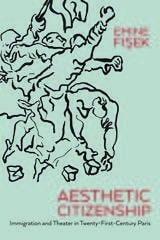
Aesthetic Citizenship
Immigration and Theater in Twenty-First-Century ParisEmine Fisek
Northwestern University Press, 2017
From neighborhood associations and humanitarian alliances to arts organizations both large and small, Fisek traces how theater has emerged as a practice with the perceived capacity to address questions regarding immigrant rights, integration, and experience. In Aesthetic Citizenship, she explores how the stage, one of France’s most evocative cultural spaces, has come to play a role in contemporary questions about immigration, citizenship and national identity. Yet Fişek’s insightful research also illuminates Paris’s broader historical, political, and cultural through-lines that continue to shape the relationship between theater and migration in France.
By focusing on how French public discourses on immigration are not only rendered meaningful but also inhabited and modified in the context of activist and arts practice, Aesthetic Citizenship seeks to answer the fundamental question: is theater a representational act or can it also be a transformative one?
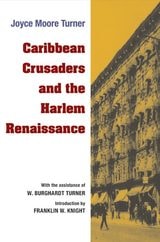
Caribbean Crusaders and the Harlem Renaissance
Joyce Moore Turner
University of Illinois Press, 2005
To explore the roots of the Caribbean emigres' radical ideology and the strategies used to extend agitation from Harlem to national and international platforms, the study draws on the papers and writings of Hermina Huiswoud, Cyril Briggs, the Reverend E. Ethelred Brown, Langston Hughes, and Richard B. Moore, as well as from interviews and biographies of related contemporary figures. It also incorporates census records, FBI files, and hundreds of documents from the recently opened Russian Archive.
Through a focus on Otto Huiswoud, the sole African American charter member of the Communist Party, and his wife, Hermina, Turner exposes the complex developments within the socialist and communist parties on the question of race. The account ranges beyond Harlem to Europe, Africa, and the Soviet Union to reveal the breadth, depth, and nearly global reach of the Afro-Caribbean activists' activities.
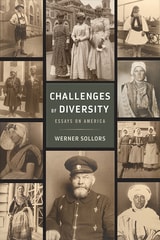
Challenges of Diversity
Essays on AmericaSollors, Werner
Rutgers University Press, 2017
What unites and what divides Americans as a nation? Who are we, and can we strike a balance between an emphasis on our divergent ethnic origins and what we have in common? Opening with a survey of American literature through the vantage point of ethnicity, Werner Sollors examines our evolving understanding of ourselves as an Anglo-American nation to a multicultural one and the key role writing has played in that process.
Challenges of Diversity contains stories of American myths of arrival (pilgrims at Plymouth Rock, slave ships at Jamestown, steerage passengers at Ellis Island), the powerful rhetoric of egalitarian promise in the Declaration of Independence and the heterogeneous ends to which it has been put, and the recurring tropes of multiculturalism over time (e pluribus unum, melting pot, cultural pluralism). Sollors suggests that although the transformation of this settler country into a polyethnic and self-consciously multicultural nation may appear as a story of great progress toward the fulfillment of egalitarian ideals, deepening economic inequality actually exacerbates the divisions among Americans today.

Dance Between Two Cultures
Latino Caribbean Literature Written in the United StatesWilliam Luis
Vanderbilt University Press, 1997
In this groundbreaking study, William Luis analyzes the most salient and representative narrative and poetic works of the newest literary movement to emerge in Spanish American and U.S. literatures. The book is divided into three sections, each focused on representative Puerto Rican American, Cuban American, and Dominican American authors. Luis traces the writers' origins and influences from the nineteenth century to the present, focusing especially on the contemporary works of Oscar Hijuelos, Julia Alvarez, Cristina Garcia, and Piri Thomas, among others. While engaging in close readings of the texts, Luis places them in a broader social, historical, political, and racial perspective to expose the tension between text and context.
As a group, Latino Caribbeans write an ethnic literature in English that is born of their struggle to forge an identity separate from both the influences of their parents' culture and those of the United States. For these writers, their parents' country of origin is a distant memory. They have developed a culture of resistance and a language that mediates between their parents' identity and the culture that they themselves live in.
Latino Caribbeans are engaged in a metaphorical dance with Anglo Americans as the dominant culture. Just as that dance represents a coming together of separate influences to make a unique art form, so do both Hispanic and North American cultures combine to bring a new literature into being. This new body of literature helps us to understand not only the adjustments Latino Caribbean cultures have had to make within the larger U.S. environment but also how the dominant culture has been affected by their presence.
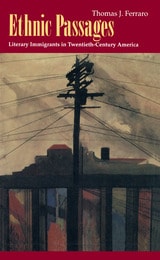
Ethnic Passages
Literary Immigrants in Twentieth-Century AmericaThomas J. Ferraro
University of Chicago Press, 1993
Ferraro engages the literature of immigration and mobility by asking what motivates its authors and what their work actually accomplishes. He concentrates on five diverse examples of the "up-from-the-ghetto" narrative: Mario Puzo's The Godfather, Anzia Yezierska's Bread Givers, Henry Roth's Call It Sleep, Henry Miller's "The Tailor Shop," and Maxine Hong Kingston's The Woman Warrior. To Ferraro the unsuspected value of these works is that they recast the conventions of ethnic representation, illustrating the power of ethnic writing to capture and redirect the national literary imagination.
Ferraro's sharply observed reading of these five works shows how such reenactments of immigrant mobility test the ideology of assimilation against the writer's experience. Ethnic Passages will refocus discussion of how literature addresses the American conflict between ethnic heritage and the greater opportunities of "mainstream" society.

Hanif Kureishi
Postcolonial StorytellerBy Kenneth C. Kaleta
University of Texas Press, 1997
"Hanif Kureishi is a proper Englishman. Almost." So observes biographer Kenneth Kaleta. Well known for his films My Beautiful Laundrette and Sammy and Rosie Get Laid, the Anglo-Asian screenwriter, essayist, and novelist has become one of the leading portrayers of Britain's multicultural society. His work raises important questions of personal and national identity as it probes the experience of growing up in one culture with roots in another, very different one.
This book is the first critical biography of Hanif Kureishi. Kenneth Kaleta interviewed Kureishi over several years and enjoyed unlimited access to all of his working papers, journals, and personal files. From this rich cache of material, he opens a fascinating window onto Kureishi's creative process, tracing such works as My Beautiful Laundrette, Sammy and Rosie Get Laid, The Buddha of Suburbia, London Kills Me, The Black Album, and Love in a Blue Time from their genesis to their public reception. Writing for Kureishi fans as well as film and cultural studies scholars, Kaleta pieces together a vivid mosaic of the postcolonial, hybrid British culture that has nourished Kureishi and his work.
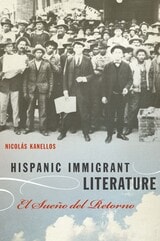
Hispanic Immigrant Literature
El Sueño del RetornoBy Nicolás Kanellos
University of Texas Press, 2011
Immigration has been one of the basic realities of life for Latino communities in the United States since the nineteenth century. It is one of the most important themes in Hispanic literature, and it has given rise to a specific type of literature while also defining what it means to be Hispanic in the United States. Immigrant literature uses predominantly the language of the homeland; it serves a population united by that language, irrespective of national origin; and it solidifies and furthers national identity. The literature of immigration reflects the reasons for emigrating, records—both orally and in writing—the trials and tribulations of immigration, and facilitates adjustment to the new society while maintaining links with the old society.
Based on an archive assembled over the past two decades by author Nicolás Kanellos's Recovering the U. S. Hispanic Literary Heritage project, this comprehensive study is one of the first to define this body of work. Written and recorded by people from Mexico, Cuba, Puerto Rico, the Caribbean, and Central and South America, the texts presented here reflect the dualities that have characterized the Hispanic immigrant experience in the United States since the mid-nineteenth century, set always against a longing for homeland.
Imitations of Life
Fannie Hurst’s Gaslight SonatasAbe C. Ravitz
Southern Illinois University Press, 2009
In the early 1920s, Fannie Hurst’s enormous popularity made her the highest-paid writer in America. She conquered the literary scene at the same time the silent movie industry began to emerge as a tremendously profitable and popular form of entertainment. Abe C. Ravitz parallels Hurst’s growing acclaim with the evolution of silent films, from which she borrowed ideas and techniques that furthered her career. Ravitz notes that Hurst was amazingly adept at anticipating what the public wanted. Sensing that the national interest was shifting from rural to urban subjects, Hurst set her immigrant tales and her "woiking goil" tales in urban America. In her early stories, she tried to bridge the gap between Old World and New World citizens, each somewhat fearful and suspicious of the other. She wrote of love and ethnicity—bringing the Jewish Mother to prominence—of race relations and prejudice, of the woman alone in her quest for selfhood. Ravitz argues, in fact, that her socially oriented tales and her portraits of women in the city clearly identify her as a forerunner of contemporary feminism.
Ravitz brings to life the popular culture from 1910 through the 1920s, tracing the meteoric rise of Hurst and depicting the colorful cast of characters surrounding her. He reproduces for the first time the Hurst correspondence with Theodore Dreiser, Charles and Kathleen Norris, and Gertrude Atherton. Fellow writers Rex Beach and Vachel Lindsay also play important roles in Ravitz’s portrait of Hurst, as does Zora Neale Hurston, who awakened Hurst’s interest in the Harlem Renaissance and in race relations, as shown in Hurst’s novel Imitation of Life.
Immigrant Acts
On Asian American Cultural PoliticsLisa Lowe
Duke University Press, 1996
Lowe argues that a national memory haunts the conception of Asian American, persisting beyond the repeal of individual laws and sustained by U.S. wars in Asia, in which the Asian is seen as the perpetual immigrant, as the “foreigner-within.” In Immigrant Acts, she argues that rather than attesting to the absorption of cultural difference into the universality of the national political sphere, the Asian immigrant—at odds with the cultural, racial, and linguistic forms of the nation—displaces the temporality of assimilation. Distance from the American national culture constitutes Asian American culture as an alternative site that produces cultural forms materially and aesthetically in contradiction with the institutions of citizenship and national identity. Rather than a sign of a “failed” integration of Asians into the American cultural sphere, this critique preserves and opens up different possibilities for political practice and coalition across racial and national borders.
In this uniquely interdisciplinary study, Lowe examines the historical, political, cultural, and aesthetic meanings of immigration in relation to Asian Americans. Extending the range of Asian American critique, Immigrant Acts will interest readers concerned with race and ethnicity in the United States, American cultures, immigration, and transnationalism.

Migrant Sites
America, Place, and Diaspora LiteraturesDalia Kandiyoti
Dartmouth College Press, 2009
Mongrel Nation
Diasporic Culture and the Making of Postcolonial BritainAshley Dawson
University of Michigan Press, 2007
Mongrel Nation surveys the history of the United Kingdom’s African, Asian, and Caribbean populations from 1948 to the present, working at the juncture of cultural studies, literary criticism, and postcolonial theory. Ashley Dawson argues that during the past fifty years Asian and black intellectuals from Sam Selvon to Zadie Smith have continually challenged the United Kingdom’s exclusionary definitions of citizenship, using innovative forms of cultural expression to reconfigure definitions of belonging in the postcolonial age. By examining popular culture and exploring topics such as the nexus of race and gender, the growth of transnational politics, and the clash between first- and second-generation immigrants, Dawson broadens and enlivens the field of postcolonial studies.
Mongrel Nation gives readers a broad landscape from which to view the shifting currents of politics, literature, and culture in postcolonial Britain. At a time when the contradictions of expansionist braggadocio again dominate the world stage, Mongrel Nation usefully illuminates the legacy of imperialism and suggests that creative voices of resistance can never be silenced.Dawson
“Elegant, eloquent, and full of imaginative insight, Mongrel Nation is a refreshing, engaged, and informative addition to post-colonial and diasporic literary scholarship.”
—Hazel V. Carby, Yale University
“Eloquent and strong, insightful and historically precise, lively and engaging, Mongrel Nation is an expansive history of twentieth-century internationalist encounters that provides a broader landscape from which to understand currents, shifts, and historical junctures that shaped the international postcolonial imagination.”
—May Joseph, Pratt Institute
Ashley Dawson is Associate Professor of English at the City University of New York’s Graduate Center and the College of Staten Island. He is coeditor of the forthcoming Exceptional State: Contemporary U.S. Culture and the New Imperialism.

Planetarity from Below
Decolonial Ecopoetics of Migration and DiasporaEmily Yu Zong
University of Michigan Press, 2026
Through short stories, memoirs, speculative fiction, poetry, and documentary films, Zong unpacks a decolonial migrant ecopoetics, revealing a pluralist method of worldmaking—from Australia’s oceanic refugee camps, Indigenous Canadian land, and Chinese migrant worker sweatshops, to climate futures. These migrant ecologies imagine freedom “from below” not simply as individual survival or assimilation but as an unruly and contingent process of shared creativity with animals, waters, minerals, waste, and technology.
Shifting environmental ethics from individual morality to a political ecology of sustaining life in precarity, Zong introduces decolonial knowledges, imaginations, and praxes that help us expand justice and freedom beyond the human, asking how borderland subjectivities can open new possibilities for multispecies flourishing.
Precarious Crossings
Immigration, Neoliberalism, and the AtlanticAlexandra Perisic
The Ohio State University Press, 2019
Perisic argues that in traveling beyond the postcolonial route that connects former colonizer and former colonized, these authors also shift their focus from cultural difference and national belonging to precarity—a condition characterized by a lack of economic and social stability and protection—as a shared characteristic under global neoliberalization. She demonstrates how contemporary Atlantic narratives reveal the contradictions inherent in neoliberalism as an ideology—thereby showing how they further participate in Atlantic literary and cultural dialogues and push against literary conventions of various genre as they explore the complexities of a globalized Atlantic.
Slumming in New York
From the Waterfront to Mythic HarlemRobert M. Dowling
University of Illinois Press, 2006
Using the methods of ethnicity theory, black studies, regional studies, literary studies, and popular culture, Robert M. Dowling reveals the way in which "outsider" authors helped alleviate New York's mounting social anxieties by popularizing "insider" voices from neighborhoods as distinctive as the East Side waterfront, the Bowery, the Tenderloin's "black Bohemia," the Jewish Lower East Side, and mythic Harlem.
The Necropolitical Theater
Race and Immigration on the Contemporary Spanish StageJeffrey K. Coleman
Northwestern University Press, 2020
Coleman identifies an inherent racial hierarchy informed by the legacies of colonization and religious intolerance.
Drawing on theatrical texts, performances, legal documents, interviews, and critical reviews, this book challenges Spanish theater to develop a new theatrical space. Jeffrey K. Coleman proposes a “convivial theater” that portrays immigrants as contributors to the Spanish state and better represents the multicultural reality of the nation today.
The Tenement Saga
The Lower East Side and Early Jewish American WritersSanford Sternlicht
University of Wisconsin Press, 2004
Sternlicht discusses the role of women, the Yiddish Theater, secular values, the struggle between generations, street crime, politics, labor unions, and the importance of newspapers and periodicals. He documents the decline of Yiddish culture as these immigrants blended into what they called "The Golden Land."
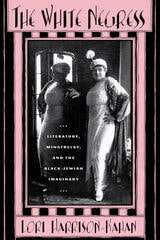
The White Negress
Literature, Minstrelsy, and the Black-Jewish ImaginaryHarrison-Kahan, Lori
Rutgers University Press, 2010
Lori Harrison-Kahan examines writings by Edna Ferber, Fannie Hurst, and Zora Neale Hurston, as well as the blackface performances of vaudevillian Sophie Tucker and controversies over the musical and film adaptations of Show Boat and Imitation of Life. Moving between literature and popular culture, she illuminates how the dynamics of interethnic exchange have at once produced and undermined the binary of black and white.
Traitors and True Poles
Narrating a Polish-American Identity, 1880–1939Karen Majewski
Ohio University Press, 2003
During Poland’s century-long partition and in the interwar period of Poland’s reemergence as a state, Polish writers on both sides of the ocean shared a preoccupation with national identity. Polish-American immigrant writers revealed their persistent, passionate engagement with these issues, as they used their work to define and consolidate an essentially transnational ethnic identity that was both tied to Poland and independent of it.
By introducing these varied and forgotten works into the scholarly discussion, Traitors and True Poles recasts the literary landscape to include the immigrant community’s own competing visions of itself. The conversation between Polonia’s creative voices illustrates how immigrants manipulated often difficult economic, social, and political realities to provide a place for and a sense of themselves. What emerges is a fuller picture of American literature, one vital to the creation of an ethnic consciousness.
This is the first extended look at Polish-language fiction written by turn-of-the-century immigrants, a forgotten body of American ethnic literature. Addressing a blind spot in our understanding of immigrant and ethnic identity and culture, Traitors and True Poles challenges perceptions of a silent and passive Polish immigration by giving back its literary voice.
Transatlantic Subjects
Acts of Migration and Cultures of Transnationalism between Greece and AmericaIoanna Laliotou
University of Chicago Press, 2004
According to Ioanna Laliotou, cultural institutions and practices played an important role in the formation of migrant subjectivities. Reconstructing the cultural history of migration, her book points out the relationship between subjectivity formation and cultural practices and performances, such as publishing, reading, acting, storytelling, consuming, imitating, parading, and traveling. Transatlantic Subjects then locates the development of these practices within key sites and institutions of cultural formation, such as migrant and fraternal associations, educational institutions, state agencies and nongovernmental organizations, mental institutions, coffee shops, the church, steamship companies, banks, migration services, and chambers of commerce.
Ultimately, Laliotou explores the complex and situational entanglements of migrancy, cultural nationalism, and the politics of self. Reading against the grain of hegemonic narratives of cultural and migration histories, she reveals how migrancy produced distinctive forms of sociality during the first half of the twentieth century.
Transnational Asian American Literature
Sites and Transitsedited by Shirley Geok-lin Lim, John Blair Gamber, Stephen Hong Sohn and Gina Valentino
Temple University Press, 2005
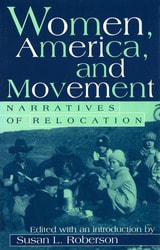
Women, America, and Movement
Narratives of RelocationEdited & Intro by Susan L. Roberson
University of Missouri Press, 1998
Since the colonial days, American women have traveled, migrated, and relocated, always faced with the challenge of reconstructing their homes for themselves and their families. Women, America, and Movement offers a journey through largely unexplored territory—the experiences of migrating American women. These narratives, both real and imagined, represent a range of personal and critical perspectives; some of the women describe their travels as expansive and freeing, while others relate the dreadful costs and sacrifices of relocating.
Despite the range of essays featured in this study, the writings all coalesce around the issues of politics, poetry, and self- identity described by Adrienne Rich as the elements of the "politics of location," treated here as the politics of relocation. The narratives featured in this book explore the impact of race, class, and sexual economics on migratory women, their self-identity, and their roles in family and social life. These issues demonstrate that in addition to geographic place, ideology is itself a space to be traversed.
By examining the writings of such women as Louise Erdrich, Zora Neale Hurston, and Gertrude Stein, the essayists included in this volume offer a variety of experiences. The book confronts such issues as racist politicking against Native Americans, African Americans, and Asian immigrants; sexist attitudes that limit women to the roles of wife, mother, and sexual object; and exploitation of migrants from Appalachia and of women newly arrived in America.
These essays also delve into the writings themselves by looking at what happens to narrative structure as authors or their characters cross geographic boundaries. The reader sees how women writers negotiate relocation in their texts and how the written word becomes a place where one finds oneself.
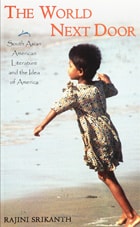
World Next Door
South Asian American LiteratureRajini Srikanth
Temple University Press, 2004
South Asian American literature, with its focus on the multiple geographies and histories of the global dispersal of South Asians, pulls back from a close-up view of the United States to reveal a wider landscape of many nations and peoples.
South Asian American poets, novelists, and playwrights depict the nation as simultaneously discrete and entwined with the urgencies of places as diverse as Bangladesh, Sri Lanka, India, Burma, Pakistan, and Trinidad. Drawing on the cosmopolitan sensibility of scholars like Anthony Appiah, Vinay Dharwadker, Martha Nussbaum, Bruce Robbins, and Amartya Sen, this book exhorts North American residents to envision connectedness with inhabitants of other lands. The world out there arrives next door.