Results by title
29 books match the query 'Interpretation and construction'
Against the Law
Paul F. Campos, Pierre Schlag, and Steven D. Smith
Duke University Press, 1996
Linked by a persistent inquiry into the nature and identity of “the law,” these essays are informed by the conviction that the conventional representations of law, both in law schools and the courts, cannot be taken at face value—that the law, as commonly conceived, makes no sense. The authors argue that the relentlessly normative prescriptions of American legal thinkers are frequently futile and, indeed, often pernicious. They also argue that the failure to recognize the role that authorship must play in the production of legal thought plagues both the teaching and the practice of American law. Ranging from the institutional to the psychological and metaphysical deficiencies of the American legal system, the depth of criticism offered by Against the Law is unprecedented.
In a departure from the nearly universal legitimating and reformist tendencies of American legal thought, this book will be of interest not only to the legal academics under attack in the book, but also to sociologists, historians, and social theorists. More particularly, it will engage all the American lawyers who suspect that there is something very wrong with the nature and direction of their profession, law students who anticipate becoming part of that profession, and those readers concerned with the status of the American legal system.
An Introduction to Legal Reasoning
Edward H. Levi
University of Chicago Press, 1962
An Introduction to Legal Reasoning
Edward H. Levi
University of Chicago Press, 2013
For this edition, the book includes a substantial new foreword by leading contemporary legal scholar Frederick Schauer that helpfully places this foundational book into its historical and legal contexts, explaining its continuing value and relevance to understanding the role of analogical reasoning in the law. This volume will continue to be of great value to students of logic, ethics, and political philosophy, as well as to members of the legal profession and everyone concerned with problems of government and jurisprudence.
Congress and the Constitution
Neal Devins and Keith E. Whittington, eds.
Duke University Press, 2005
Several contributors offer wide-ranging accounts of the workings of Congress. They look at lawmakers’ attitudes toward Congress’s role as a constitutional interpreter, the offices within Congress that help lawmakers learn about constitutional issues, Congress’s willingness to use its confirmation power to shape constitutional decisions by both the executive and the courts, and the frequency with which congressional committees take constitutional questions into account. Other contributors address congressional deliberation, paying particular attention to whether Congress’s constitutional interpretations are sound. Still others examine how Congress and the courts should respond to one another’s decisions, suggesting how the courts should evaluate Congress’s work and considering how lawmakers respond to Court decisions that strike down federal legislation. While some essayists are inclined to evaluate Congress’s constitutional interpretation positively, others argue that it could be improved and suggest institutional and procedural reforms toward that end. Whatever their conclusions, all of the essays underscore the pervasive and crucial role that Congress plays in shaping the meaning of the Constitution.
Contributors. David P. Currie, Neal Devins, William N. Eskridge Jr.. John Ferejohn, Louis Fisher, Elizabeth Garrett, Michael J. Gerhardt, Michael J. Klarman, Bruce G. Peabody, J. Mitchell Pickerill, Barbara Sinclair, Mark Tushnet, Adrian Vermeule, Keith E. Whittington, John C. Yoo

Fallout
Nuclear Diplomacy in an Age of Global FractureGrégoire Mallard
University of Chicago Press, 2014
In Fallout, Grégoire Mallard seeks to understand why some nations agreed to these limitations of their sovereign will—and why others decidedly did not. He builds his investigation around the 1968 signing of the Nuclear Nonproliferation Treaty (NPT), which, though binding in nature, wasn’t adhered to consistently by all signatory nations. Mallard looks at Europe’s observance of treaty rules in contrast to the three holdouts in the global nonproliferation regime: Israel, India, and Pakistan. He seeks to find reasons for these discrepancies, and makes the compelling case that who wrote the treaty and how the rules were written—whether transparently, ambiguously, or opaquely—had major significance in how the rules were interpreted and whether they were then followed or dismissed as regimes changed. In honing in on this important piece of the story, Mallard not only provides a new perspective on our diplomatic history, but, more significantly, draws important conclusions about potential conditions that could facilitate the inclusion of the remaining NPT holdouts. Fallout is an important and timely book sure to be of interest to policy makers, activists, and concerned citizens alike.
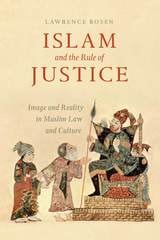
Islam and the Rule of Justice
Image and Reality in Muslim Law and CultureLawrence Rosen
University of Chicago Press, 2018
With Islam and the Rule of Justice, Lawrence Rosen analyzes a number of these misperceptions. Drawing on specific cases, he explores the application of Islamic law to the treatment of women (who win most of their cases), the relations between Muslims and Jews (which frequently involve close personal and financial ties), and the structure of widespread corruption (which played a key role in prompting the Arab Spring). From these case studie the role of informal mechanisms in the resolution of local disputes. The author also provides a close reading of the trial of Zacarias Moussaoui, who was charged in an American court with helping to carry out the 9/11 attacks, using insights into how Islamic justice works to explain the defendant’s actions during the trial. The book closes with an examination of how Islamic cultural concepts may come to bear on the constitutional structure and legal reforms many Muslim countries have been undertaking.
Islamic Legal Orthodoxy
Devin J Stewart
University of Utah Press, 2007
One of the most far-reaching developments in the history of Islam was the rise of the four classic Sunni schools of law between the ninth and eleventh centuries CE. Consolidation of these schools went hand in hand with the establishment of jurists’ dominance over religious discourse and social institutions. Orthodoxy came to be defined as the consensus (ijma’) of the Sunni jurists. Devin Stewart argues that it is to the margins of the emerging system that investigators must look to understand its historical dynamics. The development of Twelve Shi’ite jurisprudence in relation and reaction to the Sunni schools is particularly informative.
In Islamic Legal Orthodoxy, Stewart explores the process by which Shi’ite jurists participated in the mainstream of Islamic jurisprudence and were influenced by Sunni legal doctrines. He identifies three main reactions to Sunni legal definitions of othodoxy and the concept of consensus on which it was based. The Akhbaris rejected Sunni legal consensus and juristic authority for a scripture-based system; many Shi’ite outwardly accepted the ground rules of Sunni legal consensus and joined the Shafi’i school of jurisprudence; a third option was to adopt the concept of consensus to create a “fifth,” Shi’ite, legal system.
The development of the Sunni legal system effectively set the ground rules for the marginal sect’s negotiation of their identity with respect to Islamic legal orthodoxy. Accordingly, Shi’ite jurists developed a legal institution that is structurally similar to the four Sunni madhhabs and even today serves as means to position themselves in the Muslim world. Stewart points to an underlying tension in Shi’ite intellectual history between assimilationist and nativist impulses in the debate over consensus, dissmulation (taqiyyah) and the lives of certain Shi’ite scholars who lived and studies among Sunnis.
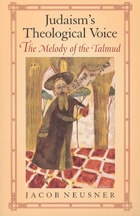
Judaism's Theological Voice
The Melody of the TalmudJacob Neusner
University of Chicago Press, 1995
In his attempt to answer these questions, Neusner sets forth the character and the form of the Torah as sung theology. Israel, the holy community, meets God in the synagogue, while at prayer, and in the yeshiva, when studying the Torah—at the moment in each setting when the Torah is received. In both circumstances people do not read but sing out its words. With the written part of the Torah sung in the synagogue, and the oral part declaimed in centers of sacred learning, music provides the medium for Judaism's theological voice.
Neusner identifies a reciprocal exchange between the holy community Israel and God: Israel sings to God when the Torah is studied, and God sings to Israel when the Torah is declaimed. Through the metaphor of music, Neusner offers an account of how he believes those faithful to the Torah meet God in the Torah, and how they should listen to the melody of God's self-revelation. The result is an original theological reflection that will interest all students of Judaism.

Judges and the Cities
Interpreting Local AutonomyGordon L. Clark
University of Chicago Press, 1985
As concrete examples, Clark analyzes four court disputes in depth, showing that the concept of local autonomy has very different meanings and implications in each of them. These cases—Boston's defense of resident-preference hiring policies, conflict over urban land-use zoning in Toronto, a Chicago's suburb's fight against a sewage treatment plant, and the evolution of the City of Denver's power since 1900—demonstrate that legal reasoning is not impervious to other kinds of reasoning, and the solutions provided by the courts are not unique. To ground his explorations, Clark investigates both liberalism and structuralism, showing that both are inadequate bases for determining social policy. He mounts provocative critiques of the works of de Tocqueville, Nozick, Tiebout, and Posner on the one hand and Castells and Poulantzas on the other.
This ambitious and important work will command the interest of geographers, political scientists, economists, sociologists, and legal scholars.
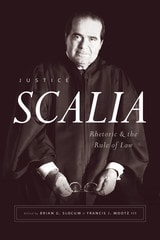
Justice Scalia
Rhetoric and the Rule of LawEdited by Brian G. Slocum and Francis J. Mootz III
University of Chicago Press, 2019
In this edited collection, leading scholars from law, political science, philosophy, rhetoric, and linguistics look at the ways Scalia framed and stated his arguments. Focusing on rhetorical strategies rather than the logic or validity of Scalia’s legal arguments, the contributors collectively reveal that Scalia enacted his rigidly conservative vision of the law through his rhetorical framing.
Legal Language
Peter M. Tiersma
University of Chicago Press, 1999
"Legal Language will resonate with lawyers . . . and any non-lawyer who has waded through legal documents, or has tuned in to the latest trial on Court TV."—Carmie D. Boccuzzi, Jr., Boston Book Review
"[A] masterful, highly readable, and enjoyable book. . . . Legal Language is truly a fun book to read."—David Schultz, Law and Politics Book Review
MacArthur's Japanese Constitution
Kyoko Inoue
University of Chicago Press, 1991
"This is an important book. . . . This is the most significant work on postwar Japanese constitutional history to appear in the West. It is highly instructive about the century-long process of cultural conflict in the evolution of government and society in modern Japan."—Thomas W. Burkman, Monumenta Nipponica
Managing Legal Uncertainty
Elite Lawyers in the New DealRonen Shamir
Duke University Press, 1995
Applying the insights of Weber and Bourdieu to the sociology of the legal profession, Shamir shows that elite members of the bar had a keen self-interest in blocking the expansion of administrative law. He dismisses as oversimplified the view that elite lawyers were "hired guns" who argued that New Deal legislation was unconstitutional solely because of their duty to represent their capitalist clients. Instead, Shamir suggests, their alignment with the capitalist class was an incidental result of their attempt to articulate their vision of the law as scientific, apolitical, and judicially oriented—and thereby to defend their own position within the law profession. The academic legal realists on the other side of the constitutional debates criticized the rigidity of the traditional judicial process and insisted that flexibility of interpretation and the uncertainty of legal outcomes was at the heart of the legal system. The author argues that many legal realists, encouraged by the experimental nature of the New Deal, seized an opportunity to improve on their marginal status within the legal profession by moving their discussions from academic circles to the national policy agenda.
Negotiating in Civil Conflict
Constitutional Construction and Imperfect Bargaining in IraqHaider Ala Hamoudi
University of Chicago Press, 2013
Ordinary Meaning
A Theory of the Most Fundamental Principle of Legal InterpretationBrian G. Slocum
University of Chicago Press, 2015
Legal interpretation is built around one key question: by what standard should legal texts be interpreted? The traditional doctrine is that words should be given their “ordinary meaning”: words in legal texts should be interpreted in light of accepted standards of communication. Yet often, courts fail to properly consider context, refer to unsuitable dictionary definitions, or otherwise misconceive how the ordinary meaning of words should be determined. In this book, Brian Slocum builds his argument for a new method of interpretation by asking glaring, yet largely ignored, questions. What makes one particular meaning the “ordinary” one, and how exactly do courts conceptualize the elements of ordinary meaning? Ordinary Meaning provides a much-needed, revised framework, boldly instructing those involved with the law in how the components of ordinary meaning should properly be identified and developed in our modern legal system.
Reason in Law, Tenth Edition
Lief H. Carter, Thomas F. Burke and Jessica Silbey
University of Chicago Press, 2026
An indispensable introduction to legal reasoning, updated for today’s political and legal environment.
Since it was first published nearly five decades ago, Reason in Law has become the starting point for understanding legal reasoning, a critical component of the rule of law. The editors show how judges can integrate all the elements of a case to persuasively explain their rulings—and, even more importantly, why they sometimes fail to do so. Drawing on cases old and new, Reason in Law enables readers to become sophisticated “judges of judging.”
Now in its tenth edition, Reason in Law includes a new chapter on the increasingly contentious and politically consequential field of administrative law and addresses recent developments in the American legal landscape, including growing conservatism in the federal judiciary and the flood of lawsuits brought against the second Trump administration. It also analyzes new cases on the First Amendment rights of high schoolers, transgender civil rights, the responsibilities universities have for student safety, Donald Trump’s sweeping claims of executive power, and historic Supreme Court decisions expanding the rights of gun owners and allowing states to criminalize abortion. As always, Reason in Law connects legal theory with empirical research on the American judicial system, showing how trustworthy legal reasoning helps preserve social peace and the rule of law.
Reason in Law
Ninth EditionLief H. Carter and Thomas F. Burke
University of Chicago Press, 2016
Regulatory Rights
Supreme Court Activism, the Public Interest, and the Making of Constitutional LawLarry Yackle
University of Chicago Press, 2007
Traversing a wide range of Supreme Court decisions that established crucial precedents about racial discrimination, the death penalty, and sexual freedom, Yackle contends that the rights we enjoy are neither more nor less than what the justices choose to make of them. Regulatory Rights is a bracing read that will be heatedly debated by all those interested in constitutional law and the judiciary.
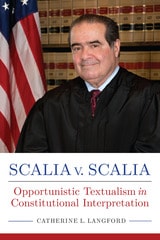
Scalia v. Scalia
Opportunistic Textualism in Constitutional InterpretationCatherine L. Langford
University of Alabama Press, 2018
Antonin Scalia is considered one of the most controversial justices to have been on the United States Supreme Court. A vocal advocate of textualist interpretation, Justice Scalia argued that the Constitution means only what it says and that interpretations of the document should be confined strictly to the directives supplied therein. This narrow form of constitutional interpretation, which limits constitutional meaning to the written text of the Constitution, is known as textualism.
Scalia v. Scalia:Opportunistic Textualism in Constitutional Interpretation examines Scalia’s discussions of textualism in his speeches, extrajudicial writings, and judicial opinions. Throughout his writings, Scalia argues textualism is the only acceptable form of constitutional interpretation. Yet Scalia does not clearly define his textualism, nor does he always rely upon textualism to the exclusion of other interpretive means.
Scalia is seen as the standard bearer for textualism. But when textualism fails to support his ideological aims (as in cases that pertain to states’ rights or separation of powers), Scalia reverts to other forms of argumentation. Langford analyzes Scalia’s opinions in a clear area of law, the cruel and unusual punishment clause; a contested area of law, the free exercise and establishment cases; and a silent area of law, abortion. Through her analysis, Langford shows that Scalia uses rhetorical strategies beyond those of a textualist approach, concluding that Scalia is an opportunistic textualist and that textualism is as rhetorical as any other form of judicial interpretation.
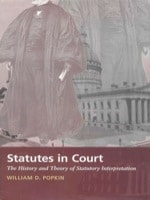
Statutes in Court
The History and Theory of Statutory InterpretationWilliam D. Popkin
Duke University Press, 1999
Popkin begins by discussing the British origins of statutory interpretation in this country. He then maps the evolving conceptions of the judicial role in the United States from Revolutionary times through the twentieth century before presenting his “ordinary judging” theory—one that asks the judge to use modest judicial discretion to assist the legislature in implementing good government. Claiming that theory cannot account for everything a judge does when determining statutory meaning or writing an opinion, Popkin shows how judges who strive to be conscientious in interpreting the law are often hampered by the lack of both a framework in which to fit their approach and a well-understood common vocabulary to explain what they do. Statutes in Court fills that gap.
This work will be valuable to anyone concerned about the judicial role in the interpretation of laws—from judiciary officials and law professors to legal historians and political scientists.
The Birth of Doubt
Confronting Uncertainty in Early Rabbinic LiteratureMoshe Halbertal
SBL Press, 2020
A systematic attempt to understand the rabbinic world through its approach to confronting uncertainty
In the history of halakhah, the treatment of uncertainty became one of the most complex fields of intense study. In his latest book, Moshe Halbertal focuses on examining the point of origin of the study of uncertainty in early rabbinic literature, including the Mishnah, Tosefta, and halakhic midrashim. Halbertal explores instructions concerning how to behave in situations of uncertainty ranging from matters of ritual purity, to lineage and marriage, to monetary law, and to the laws of forbidden foods. This examination of the rules of uncertainty introduced in early rabbinic literature reveals that these rules were not aimed at avoiding but rather at dwelling in the midst of uncertainty, thus rejecting the sectarian isolationism that sought to minimize a community’s experience of and friction with uncertainty.
Features:
- A thorough investigation of the principles concerning how to behave in cases of uncertainty
- An examination of two distinct modes for coping with uncertainty
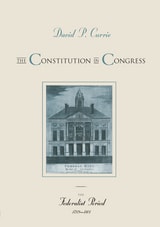
The Constitution in Congress
The Federalist Period, 1789-1801David P. Currie
University of Chicago Press, 1997
"A joy to read."—Appellate Practive Journal and Update
"[A] patient and exemplary analysis of the work of the first six Congresses."—Geoffrey Marshall, Times Literary Supplement
The Enchantment Of Reason
Pierre Schlag
Duke University Press, 1998
In examining the fierce resistance to questioning reason’s primacy, this renowned critic and professor of American law demonstrates how those who use and study the law perpetuate their own methodological blind spots. Claiming that reason has been endowed with a virtually mystical power to organize social life, Schlag unravels the seemingly rational world of judicial opinions, statutes, doctrines, and legal principles. In the process, he paints a shocking—and sure to be controversial—picture of the chaos and, indeed, violence of the American legal tradition.
This bold commentary on the irrationality of reason in American law and legal studies will interest not only legal scholars and philosophers but also serious thinkers across a broad disciplinary spectrum.
The Justice of the Greeks
Raphael Sealey
University of Michigan Press, 1994
The Language of Statutes
Laws and Their InterpretationLawrence M. Solan
University of Chicago Press, 2010
Pulling the rug out from debates about interpretation, The Language of Statutes joins together learning from law, linguistics, and cognitive science to illuminate the fundamental issues and problems in this highly contested area. Here, Lawrence M. Solan argues that statutory interpretation is alive, well, and not in need of the major overhaul that many have suggested. Rather, he suggests, the majority of people understand their rights and obligations most of the time, with difficult cases occurring in circumstances that we can predict from understanding when our minds do not work in a lawlike way.
Solan explains that these cases arise because of the gap between our inability to write crisp yet flexible laws on one hand and the ways in which our cognitive and linguistic faculties are structured on the other. Making our lives easier and more efficient, we’re predisposed to absorb new situations into categories we have previously formed—but in the legislative and judicial realms this can present major difficulties. Solan provides an excellent introduction to statutory interpretation, rejecting the extreme arguments that judges have either too much or too little leeway, and explaining how and why a certain number of interpretive problems are simply inevitable.
The Nature of Legal Interpretation
What Jurists Can Learn about Legal Interpretation from Linguistics and PhilosophyEdited by Brian G. Slocum
University of Chicago Press, 2017
To fully engage and probe these questions of interpretation, this volume draws upon a variety of experts from several fields, who collectively examine the interpretation of legal texts. In The Nature of Legal Interpretation, the contributors argue that the meaning of language is crucial to the interpretation of legal texts, such as statutes, constitutions, and contracts. Accordingly, expert analysis of language from linguists, philosophers, and legal scholars should influence how courts interpret legal texts. Offering insightful new interdisciplinary perspectives on originalism and legal interpretation, these essays put forth a significant and provocative discussion of how best to characterize the nature of language in legal texts.
The Search for God's Law
Islamic Jurisprudence in the Writings of Sayf al-Din al-AmidiBernard G Weiss
University of Utah Press, 2011
Weiss’s new introduction provides an overview of Amidi’s jurisprudence that facilitates deeper comprehension of the challenging dialectic of the text. This edition includes an in-depth analysis of the nature of language and the ways in which it mediates the law, while shaping it at the same time. An updated index has been added.
The search for God's law
Islamic jurisprudence in the writings of Sayf al-Din al-AmidiBernard G Weiss
University of Utah Press, 1992
Why the Law Is So Perverse
Leo Katz
University of Chicago Press, 2011
Conundrums, puzzles, and perversities: these are Leo Katz’s stock-in-trade, and in Why the Law Is So Perverse, he focuses on four fundamental features of our legal system, all of which seem to not make sense on some level and to demand explanation. First, legal decisions are essentially made in an either/or fashion—guilty or not guilty, liable or not liable, either it’s a contract or it’s not—but reality is rarely as clear-cut. Why aren’t there any in-between verdicts? Second, the law is full of loopholes. No one seems to like them, but somehow they cannot be made to disappear. Why? Third, legal systems are loath to punish certain kinds of highly immoral conduct while prosecuting other far less pernicious behaviors. What makes a villainy a felony? Finally, why does the law often prohibit what are sometimes called win-win transactions, such as organ sales or surrogacy contracts?
Katz asserts that these perversions arise out of a cluster of logical difficulties related to multicriterial decision making. The discovery of these difficulties dates back to Condorcet’s eighteenth-century exploration of voting rules, which marked the beginning of what we know today as social choice theory. Condorcet’s voting cycles, Arrow’s Theorem, Sen’s Libertarian Paradox—every seeming perversity of the law turns out to be the counterpart of one of the many voting paradoxes that lie at the heart of social choice. Katz’s lucid explanations and apt examples show why they resist any easy resolutions.
The New York Times Book Review called Katz’s first book “a fascinating romp through the philosophical side of the law.” Why the Law Is So Perverse is sure to provide its readers a similar experience.