Results by title
9 books match the query 'Investments, American'

Americans in the Treasure House
Travel to Porfirian Mexico and the Cultural Politics of EmpireBy Jason Ruiz
University of Texas Press, 2014
When railroads connected the United States and Mexico in 1884 and overland travel between the two countries became easier and cheaper, Americans developed an intense curiosity about Mexico, its people, and its opportunities for business and pleasure. Indeed, so many Americans visited Mexico during the Porfiriato (the long dictatorship of Porfirio Díaz, 1876–1911) that observers on both sides of the border called the hordes of tourists and business speculators a “foreign invasion,” an apt phrase for a historical moment when the United States was expanding its territory and influence.
Americans in the Treasure House examines travel to Mexico during the Porfiriato, concentrating on the role of travelers in shaping ideas of Mexico as a logical place for Americans to extend their economic and cultural influence in the hemisphere. Analyzing a wealth of evidence ranging from travelogues and literary representations to picture postcards and snapshots, Jason Ruiz demonstrates that American travelers constructed Mexico as a nation at the cusp of modernity, but one requiring foreign intervention to reach its full potential. He shows how they rationalized this supposed need for intervention in a variety of ways, including by representing Mexico as a nation that deviated too dramatically from American ideals of progress, whiteness, and sexual self-control to become a modern “sister republic” on its own. Most importantly, Ruiz relates the rapid rise in travel and travel discourse to complex questions about national identity, state power, and economic relations across the U.S.–Mexico border.
Foreign Direct Investment
Edited by Kenneth A. Froot
University of Chicago Press, 1993
Chapters cover such topics as theoretical accounts of FDI patterns, the growth of multinational enterprises, and the FDI experiences of Japan, the United States, and selected developing countries. This volume will interest economists, government officials, and business people concerned with FDI today.
Spiritual Investments
Wall Street Wisdom From Sir JohnGary Moore
Templeton Press, 1998
Gathered here are seventeen sound investment principles that will help people make sensible choices for financial security. What is surprising, however, is how applicable these principles are to life.
The Diplomacy of Trade and Investment
American Economic Expansion in the Hemisphere, 1865-1900David M. Pletcher
University of Missouri Press, 1998
The move to encourage trade with Canada and Mexico during the 1990s, culminating with the negotiation of the North American Free Trade Agreement (NAFTA), has had a long background extending as far back as the late eighteenth century. American trade with both Canada and Latin America rapidly increased during the last third of the nineteenth century as a result of burgeoning industry and agriculture in the United States. The Diplomacy of Trade and Investment is the first detailed examination of the economic and political forces behind this rapid growth and their effect on government policy.
Based on a thorough examination of government documents, congressional debates and reports, private papers of government and business leaders, and newspapers, David M. Pletcher begins this monumental study with a comprehensive survey of U.S. trade following the Civil War. He goes on to outline the problems of building a coherent trade policy toward Canada, Mexico, Central America, the Caribbean, and South America. The study concludes by analyzing a series of abortive trade reform efforts and examining the effects of the Spanish-American War.
Pletcher rejects the long-held belief that American business and government engaged in a deliberate, consistent drive for economic hegemony in the hemisphere during the late 1800s. Instead he finds that the American government improvised and experimented with ways to further trade expansion. But American businessmen were often more interested in domestic trade than in trade with foreign markets. In fact, many of them resisted efforts to lower the American tariff or otherwise encourage American trade abroad.
The combination of traditionalist and revisionist insight with Pletcher's own deep knowledge and research provides the reader with a comprehensive new interpretation of hemispheric trade expansion at the end of the nineteenth century.
The Effects of U.S. Trade Protection and Promotion Policies
Edited by Robert C. Feenstra
University of Chicago Press, 1997
The volume concludes that some policies can act to both protect imports and promote exports, that the threat of protectionist policies can often have effects that are as pronounced as their implementation, and that regulatory policy has as great an impact on trade and investment patterns as does trade policy itself. It will be of crucial interest to international trade economists, policy specialists, and political scientists.

The People of Sonora and Yankee Capitalists
Ramón Eduardo Ruiz
University of Arizona Press, 1988
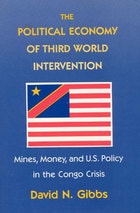
The Political Economy of Third World Intervention
Mines, Money, and U.S. Policy in the Congo CrisisDavid N. Gibbs
University of Chicago Press, 1991
In The Political Economy of Third World Intervention, David Gibbs explores the factors that motivate intervention, especially the influence of business interests. He challenges conventional views of international relations, eschewing both the popular "realist" view that the state is influenced by diverse national interests and the "dependency" approach that stresses conflicts between industrialized countries and the Third World. Instead, Gibbs proposes a new theoretical model of "business conflict" which stresses divisions between different business interests and shows how such divisions can influence foreign policy and interventionism. Moreover, he focuses on the conflicts among the core countries, highlighting friction among private interests within these countries.
Drawing on U.S. government documents—including a wealth of newly declassified materials—he applies his new model to a detailed case study of the Congo Crisis of the 1960s. Gibbs demonstrates that the Crisis is more accurately characterized by competition among Western interests for access to the Congo's mineral wealth, than by Cold War competition, as has been previously argued.
Offering a fresh perspective for understanding the roots of any international conflict, this remarkably accessible volume will be of special interest to students of international political economy, comparative politics, and business-government relations.
"This book is an extremely important contribution to the study of international relations theory; Gibbs' treatment of the Congo case is superb. He effectively takes the "statists" to task and presents a compelling new way of analyzing external interventions in the Third World."—Michael G. Schatzberg, University of Wisconsin
"David Gibbs makes an original and important contribution to our understanding of the influence of business interests in the making of U.S. foreign policy. His business conflict model provides a synthetic theoretical framework for the analysis of business-government relations, one which yields fresh insights, overcomes inconsistencies in other approaches, and opens new ground for important research. . . . [Gibbs] provides a sophisticated analysis of the conflicts within the U.S. business community and identifies the complex ways in which they interacted with agencies within the government to form U.S. foreign policy toward the Congo. . . . This is a well-crafted analysis of a critical case of U.S. postwar intervention which should be of general interest to scholars and others concerned with the domestic bases of foreign policy."—Thomas J. Biersteker, Director, School of International Relations, University of Southern California
The United States in the World Economy
Edited by Martin Feldstein
University of Chicago Press, 1988
Trade Policies for International Competitiveness
Edited by Robert C. Feenstra
University of Chicago Press, 1989
In Trade Policies for International Competitiveness, Robert C. Feenstra collects seven papers from the conference, each accompanied by discussants' comments, and adds a helpful introduction. Some of the issues considered by contributors are effects of macroeconomic and strategic foreign policies on competitiveness; the recent influx of foreign direct investment in the United States, primarily from Japan; the extent to which Japanese trade patterns are a reflection of underlying factor and endowments rather than trade barriers; and the market structure of Canadian industries, including applications for ongoing U.S.-Canadian free trade negotiations. Topical and provocative, these papers will be of value to economists, policymakers, and those in the business world.