Results by title

21 books match the query 'Japanese language'
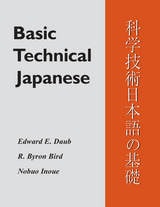
cover of Basic Technical Japanese

Basic Technical Japanese

Edward E. Daub

University of Wisconsin Press, 2011

Even if you have had no Japanese-language training, you can learn how to translate technical manuals, research publications, and reference works. Basic Technical Japanese takes you step by step from an introduction to the Japanese writing system through a mastery of grammar and scientific vocabulary to reading actual texts in Japanese. You can use the book to study independently or in formal classes.
    This book places special emphasis on the kanji (characters) that occur most often in technical writing. There are special chapters on the language of mathematics and chemistry, and vocabulary building and reading exercises in physics, chemistry, biology, and biochemistry. With extensive character charts and vocabulary lists, Basic Technical Japanese is entirely self-contained; no dictionaries or other reference works are needed.
[more]
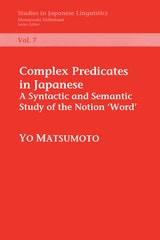
cover of Complex Predicates in Japanese: A Syntactic and Semantic Study of the Notion 'Word'

Complex Predicates in Japanese

A Syntactic and Semantic Study of the Notion 'Word'

Yo Matsumoto

CSLI, 1996

In this thoroughly revised version of 1992 Stanford dissertation, the author presents an extensive discussion of Japanese complex predicates. A broad range of constructions and predicates are discussed, which include predicative complement constructions, light verbs, causative predicates, desiderative predicates, syntactic and lexical compound verbs, and complex motion predicates. A number of new interesting facts are uncovered, and a detailed syntactic and semantic analyses are presented. On the basis of the analyses, the author argues that the notion 'word' must be relativized to at least three different senses: morphological, grammatical (functional), and semantic; and that this observation can be insightfully captured in the theory of Lexical-Functional Grammar. Previous proposals for each type of predicate that involve such mechanisms as argument transfer, incorporation, restructuring, etc. are thoroughly reviewed. Concrete proposals on the constraints on semantic wordhood are also made (an issue rarely discussed in the literature), drawing insights from cognitive linguistics.
[more]
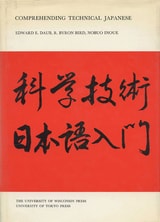
cover of Comprehending Technical Japanese

Comprehending Technical Japanese

Edward E. Daub

University of Wisconsin Press, 1975

Used for self-study or in the classroom, this text shows the reader how to read and translate technical Japanese texts by providing graded readings, explanatory notes, and translation aids.
 

[more]
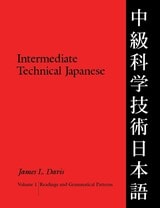
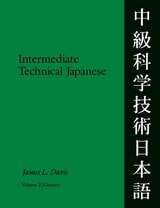
cover of Intermediate Technical Japanese, Volume 1: Readings and Grammatical Patterns

Intermediate Technical Japanese, Volume 1

Readings and Grammatical Patterns

James L. Davis

University of Wisconsin Press, 2002

     Learn how to read and translate technical manuals, research publications, and reference works. This two-volume set is designed to help the intermediate-level learner of Japanese build a technical vocabulary, reinforce understanding of frequently used grammatical patterns, improve reading comprehension, and practice translating technical passages. The glossary in volume 2 clarifies words and phrases that often puzzle beginning readers.
     The sample readings on technical topics are drawn from a broad range of specialties, from mathematics and computer science to electronics and polymer science. The initial grammar lesson and the first nine field-specific lessons constitute the common core to be used by all instructors or students. Topics of interest from the remaining thirty-one field-specific lessons may be selected to produce a customized course of study. Intermediate Technical Japanese is designed to fulfill a typical two-semester sequence.

Volume 1 contains:
o  information about 600 key kanji
o  explanations of 100 important grammatical patterns
o  more than 700 scientific or technical essays
o  an index of the grammatical patterns.

Volume 2 contains:
o  a complete glossary
[more]
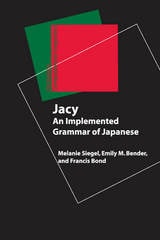
cover of Intermediate Technical Japanese, Volume 2: Glossary

Intermediate Technical Japanese, Volume 2

Glossary

James L. Davis

University of Wisconsin Press, 2002

     Learn how to read and translate technical manuals, research publications, and reference works. This two-volume set is designed to help the intermediate-level learner of Japanese build a technical vocabulary, reinforce understanding of frequently used grammatical patterns, improve reading comprehension, and practice translating technical passages. The glossary in volume 2 clarifies words and phrases that often puzzle beginning readers.
     The sample readings on technical topics are drawn from a broad range of specialties, from mathematics and computer science to electronics and polymer science. The initial grammar lesson and the first nine field-specific lessons constitute the common core to be used by all instructors or students. Topics of interest from the remaining thirty-one field-specific lessons may be selected to produce a customized course of study. Intermediate Technical Japanese is designed to fulfill a typical two-semester sequence.

Volume 1 contains:
o  information about 600 key kanji
o  explanations of 100 important grammatical patterns
o  more than 700 scientific or technical essays
o  an index of the grammatical patterns.

Volume 2 contains:
o  a complete glossary
[more]
cover of Jacy: An Implemented Grammar of Japanese

Jacy

An Implemented Grammar of Japanese

Melanie Siegel, Emily M. Bender, and Francis Bond

CSLI, 2017
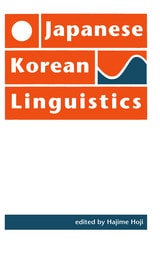
This book describes the fundamentals of Jacy, an implementation of a Japanese head-driven phrase structure grammar with many useful linguistic implications. Jacy presents sound information about the Japanese language (syntax, semantics, and pragmatics) based on implementation and tested on large quantities of data. As the grammar development was done in a multilingual environment, Jacy also showcases both multilingual concepts and differences among the languages and demonstrates the usefulness of semantic analysis in language technology applications.
[more]
cover of Japanese/Korean Linguistics, Volume 1

Japanese/Korean Linguistics, Volume 1

Edited by Hajime Hoji

CSLI, 1990
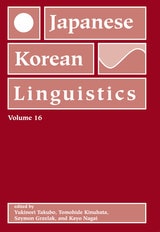
Japanese and Korean are typographically quite similiar, so a linguistic phenomenon in one language often has a counterpart in the other. The papers in this volume are intended to further collective and collaborative research into both languages. The contributors discuss aspects of language acquisition, sociolinguistics, pragmatics, phonology, syntax, morphologyu, and semantics. Most of the papers were presented at the Southern Californai Japanese/Korean Linguistics Conference in 1989. Hajime Hoji is a professor of linguistics at the University of Southern California. Distributed for the Center for the Study of Language and Inforamtion
[more]
cover of Japanese/Korean Linguistics, Volume 16

Japanese/Korean Linguistics, Volume 16

Edited by Yukinori Takubo, Tomohide Kinuhata, Szymon Grzelak, and Kayo Nagai

CSLI, 2009

The annual Japanese/Korean Linguistics Conference provides a forum for presenting research that will broaden the understanding of these two languages, especially through comparative study. The sixteenth Japanese/Korean Linguistics Conference, held in October of 2006 at Kyoto University, was the first in the history of the conference to be held outside of the United States. The thirty-six papers in this volume encompass a variety of areas, such as phonetics; phonology; morphology; syntax; semantics; pragmatics; discourse analysis; and the geographical and historical factors that influence the development of languages, sociolinguistics, and psycholinguistics.
[more]
cover of Japanese/Korean Linguistics, Volume 17

Japanese/Korean Linguistics, Volume 17

Edited by Shoishi Iwasaki, Haejime Hoji, Patricia M. Clancy, and Sung-Ock Sohn

CSLI, 2009

The papers in this volume are from the seventeenth Japanese/Korean Linguistics Conference, which was held at the University of California, Los Angeles in November of 2007. The articles cover a broad range of topics in Japanese and Korean linguistics, including phonology, morphology, syntax, semantics, historical linguistics, discourse analysis, prosody, psycholinguistics, sociolinguistics, acquisition, and grammaticalization.
[more]
cover of Japanese/Korean Linguistics, Volume 18

Japanese/Korean Linguistics, Volume 18

Edited by William McClure and Marcel den Dikken

CSLI, 2011

Because Japanese and Korean are typologically quite similar, a linguistic phenomenon in one language often has a counterpart in the other. The annual Japanese/Korean Linguistics Conference provides a forum for presenting research that will deepen our understanding of these two languages, especially through comparative study. The papers in this volume are from the eighteenth Japanese/Korean Linguistics Conference, which was held at the Graduate Center of the City University of New York in 2008. The papers cover a broad range of topics in Japanese/Korean linguistics, including phonology, morphology, syntax, semantics, historical linguistics, discourse analysis, prosody, and psycholinguistics.
[more]
cover of Japanese/Korean Linguistics, Volume 19

Japanese/Korean Linguistics, Volume 19

Edited by Ho-Min Sohn, Haruko Minegishi Cook, William O'Grady, Leon A. Serafim, and Sang Yee Cheon

CSLI, 2011
Japanese and Korean are typologically similar languages, and a linguistic phenomenon in the former often has a counterpart in the latter. The papers in this volume are from the nineteenth Japanese/Korean Linguistics Conference, which was held at the University of Hawai’i at Manoa. The collections in this volume include essays on the phonology, morphology, syntax, semantics, historical linguistics, discourse analysis, prosody, and psycholinguistics of both languages. Such comparative studies deepen our understanding of both languages and will be a useful reference for students and scholars in either field.
[more]
cover of Japanese/Korean Linguistics, Volume 2

Japanese/Korean Linguistics, Volume 2

Edited by Patricia Clancy

CSLI, 1993
Japanese and Korean are typologically quite similar, so a linguitic phenomenon in one language often has a counterpart in the other. The papers in this voulme are intended to further collective and collaborative research in both languages. The contributors discuss aspects of language acquisition, discourse, syntax, semantics, pragmatics, phonology, morphology, typology, sociolinguistics, and psycholinguistics. The papers were presented at the Southern California Japanese/Korean Linguistics Conference in September 1991. Contributors to this volume are Patricia M. Clancy, SeikoYamaguchi Fujii, Shoichi Iwasaki, Kyu-hyun Kim, Yoshiko Matsumoto, Shigeko Okamoto, Sung-Ock S. Sohn, Kyung- Hee Suh, Eunjoo Han, Jongho Jun, Ongmi Kang, David James Silva, Noriko Akasuka, Shoji Azuma, Sooja Choi, Bruce L. Derwing, Yeo Bom Yoon, Sook Whan Cho, Tsuyoshi Ono, Hiroko Yamashita, Laurie Stowe, Mineharu Nakayama, Ruriko Kawashima, Masanori Nakamaura, Shin Watanbe, Dong-In Cho, Stanley Dubinsky, Hiroto Hoshi, Yasua Ishii, Hisatsugu Kitahara, Masatoshi Koizumi, Jae Hong Lee, Sookhee Lee, Young-Suk Lee, and Shigeo Tonoike. Patricia Clancy is associate profressor in the Department of Linguistics at the University of California at Santa Barbara. She is the author of The Acquisition of Japanese.
[more]
cover of Japanese/Korean Linguistics, Volume 20

Japanese/Korean Linguistics, Volume 20

Peter Sells

CSLI, 2013
Japanese and Korean are typologically similar, with linguistic phenomena in one often having counterparts in the other. The Japanese/Korean Linguistics Conference provides a forum for research, particularly through comparative study, of both languages. This volume includes essays on the phonology, morphology, syntax, semantics, historical linguistics, discourse analysis, prosody, and psycholinguistics of both languages. This volume will be a useful tool for any researcher or student in either field.
[more]
cover of Japanese/Korean Linguistics, Volume 21

Japanese/Korean Linguistics, Volume 21

Seungho Nam, Heejeong Ko, and Jongho Jun

CSLI, 2015
Japanese and Korean are typologically similar languages, and a linguistic phenomenon in the former often has a counterpart in the latter. The papers in this volume are from the twenty-first Japanese/Korean Linguistics Conference, which was held at the Seoul National University in October 2011. The collections in this volume include essays on the phonology, morphology, syntax, semantics, historical linguistics, discourse analysis, prosody, and psycholinguistics of both languages. Such comparative studies deepen our understanding of both languages and will be a useful reference for students and scholars in either field.
[more]
cover of Japanese/Korean Linguistics, Volume 22

Japanese/Korean Linguistics, Volume 22

Edited by Mikio Griko, Naonori Nagaya, Akiko Takemura, and Timothy J. Vance

CSLI, 2014
Japanese and Korean are typologically similar, with linguistic phenomena in one often having counterparts in the other. The Japanese/Korean Linguistics Conference provides a forum for research, particularly through comparative study, of both languages. The papers in this volume are from the twenty-second conference, which was held at the National Institute for Japanese Language and Linguistics. They include essays on the phonology, morphology, syntax, semantics, historical linguistics, discourse analysis, prosody, and psycholinguistics of both languages. Such comparative studies deepen our understanding of both languages and will be a useful reference for students and scholars in either field.
[more]
cover of Japanese/Korean Linguistics, Volume 23

Japanese/Korean Linguistics, Volume 23

Edited by Theodore Levin, Ryo Masuda, and Michael Kenstowicz

CSLI, 2014
Japanese and Korean are typologically similar, with linguistic phenomena in one often having counterparts in the other. The Japanese/Korean Linguistics Conference provides a forum for research, particularly through comparative study, of both languages. The papers in this volume are from the twenty-third conference, which was held at the Massachusetts Institute of Technology. They include essays on the phonology, morphology, syntax, semantics, historical linguistics, discourse analysis, prosody, and psycholinguistics of both languages. Such comparative studies deepen our understanding of both languages and will be a useful reference for students and scholars in either field.
[more]
cover of Japanese/Korean Linguistics, Volume 24

Japanese/Korean Linguistics, Volume 24

Edited by Kenshi Funakoshi, et al.

CSLI, 2017
Japanese and Korean are typologically similar, with linguistic phenomena in one often having counterparts in the other. The Japanese/Korean Linguistics Conference provides a forum for research, particularly through comparative study, on both languages. The papers in this volume are from the twenty-fourth conference, which was held at the National Institute for Japanese Language and Linguistics. They include essays on the phonology, morphology, syntax, semantics, historical linguistics, discourse analysis, prosody, and psycholinguistics of both languages. Such comparative studies deepen our understanding of both languages and will be a useful reference for students and scholars in either field.
[more]
cover of Japanese/Korean Linguistics, Volume 25

Japanese/Korean Linguistics, Volume 25

Edited by Shinichiro Fukuda et al.

CSLI, 2018

Japanese and Korean are typologically similar, with linguistic phenomena in one often having counterparts in the other. The Japanese/Korean Linguistics Conference provides a forum for research, particularly through comparative study, on both languages. The papers in this volume are from the twenty-fifth conference, which was held at the University of Hawai’i at Mānoa. They include essays on the phonology, morphology, syntax, semantics, historical linguistics, discourse analysis, prosody, and psycholinguistics of both languages. Such comparative studies deepen our understanding of both languages and will be a useful reference for students and scholars in either field.

[more]
cover of Japanese/Korean Linguistics, Volume 26

Japanese/Korean Linguistics, Volume 26

Edited by Shoichi Iwasaki, Susan Strauss, Shin Fukuda, and Sun-Ah Jun

CSLI, 2020
Japanese and Korean are typologically similar, with linguistic phenomena in one often having counterparts in the other. The Japanese/Korean Linguistics Conference provides a forum for research, particularly through comparative study, of both languages. This volume includes essays on the phonology, morphology, syntax, semantics, historical linguistics, discourse analysis, prosody, and psycholinguistics of both languages. This volume will be a useful tool for any researcher or student in either field.
[more]
cover of Readings in Japanese Natural Language Processing

Readings in Japanese Natural Language Processing

Edited by Francis Bond, et al.

CSLI, 2014
Readings in Japanese Natural Language Processing surveys a wide range of texts that explore Japanese morphology and syntactic analysis, discourse, and natural language process applications. Presenting such techniques in a manner accessible to those with little or no familiarity with Japanese, these carefully selected papers will broaden the scope of our study of Japanese linguistic phenomena, making this collection indispensable in the field.
[more]
cover of The Syntax of Subjects

The Syntax of Subjects

Koichi Tateishi

CSLI, 1994

Linguists who work on the Japanese language have disagreed about the notion of subject with resopect to Japanese; many linguists argue that there is no formal symtactic position for the subject in Japanese. Tateishi does deeper research on the surface syntax of the subject, and looks in particular at the syntax of the subject and phenomena which have been treated as S-adjunctions. These two have been identified with each other on many occasions in the history of Japanese linguistics and are of interest with respect to the debate over configurationality in the language, which has been revivedd in different forms following the emergence of the VP-Internal Subject Hypothesis, the merits of which Tateishi discusses at length. Tateishi's main claim is that despite all the non-configurational characteristics found in the language, Japanese is in a sense more configurational than the so-called configurational languages. Japanese allows more types of hierarchies to be involved in the subject-predicate relation than English allows, as Japanese does not have the same kind of restrictions on the phrase structure as the configurational languages have. Koichi Tateishi is a professor of linguistics at the Kyoto University of Foreign Studies.
[more]