Results by title
31 books match the query 'Jewish philosophy'
A Companion to Martin Buber
Edited by Paul Mendes-Flohr
University of Chicago Press, 2025
In his 1923 essay, I and Thou, the philosopher, theologian, and activist Martin Buber introduced a philosophy of dialogue that achieved a global, interdisciplinary resonance. For Buber, dialogue was more than a conversation; dialogue discloses something essential about our orientation and our lives with one another. This companion assembles twenty-six scholars from a dozen countries to explore Buber’s international reputation and legacy in education, interfaith relations, Judaism, philosophy, politics, and psychology. The result is an essential guide to one of the most influential Jewish thinkers of the twentieth century.
Dynamic Repetition
History and Messianism in Modern Jewish ThoughtGilad Sharvit
Brandeis University Press, 2022
Dynamic Repetition proposes a new understanding of modern Jewish theories of messianism across the disciplines of history, theology, and philosophy. The book explores how ideals of repetition, return, and the cyclical occasioned a new messianic impulse across an important swath of late nineteenth- and early twentieth-century German Jewish thought. To grasp the complexities of Jewish messianism in modernity, the book focuses on diverse notions of “dynamic repetition” in the works of Franz Rosenzweig, Walter Benjamin, Franz Kafka, and Sigmund Freud, and their interrelations with basic trajectories of twentieth-century philosophy and critical thought.
Elevations
The Height of the Good in Rosenzweig and LevinasRichard A. Cohen
University of Chicago Press, 1994
Cohen also explores the ethical philosophy of these two thinkers in relation to Nietzsche, Husserl, Heidegger, Buber, Sartre, and Derrida. The result is one of the most wide-ranging and lucid studies yet written on these crucial figures in philosophy and Jewish thought.
Ethics of Maimonides
Hermann Cohen, Translated by Almut Sh. Bruckstein
University of Wisconsin Press, 2004
Hermann Cohen’s essay on Maimonides’ ethics is one of the most fundamental texts of twentieth-century Jewish philosophy, correlating Platonic, prophetic, Maimonidean, and Kantian traditions. Almut Sh. Bruckstein provides the first English translation and her own extensive commentary on this landmark 1908 work, which inspired readings of medieval and rabbinic sources by Leo Strauss, Franz Rosenzweig, and Emmanuel Levinas.
Cohen rejects the notion that we should try to understand texts of the past solely in the context of their own historical era. Subverting the historical order, he interprets the ethical meanings of texts in the light of a future yet to be realized. He commits the entire Jewish tradition to a universal socialism prophetically inspired by ideals of humanity, peace, and universal justice.
Through her own probing commentary on Cohen’s text, like the margin notes of a medieval treatise, Bruckstein performs the hermeneutical act that lies at the core of Cohen’s argument: she reads Jewish sources from a perspective that recognizes the interpretive act of commentary itself.
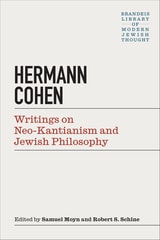
Hermann Cohen
Writings on Neo-Kantianism and Jewish PhilosophyEdited by Samuel Moyn and Robert Schine
Brandeis University Press, 2021
Hermann Cohen (1842–1918) was among the most accomplished Jewish philosophers of modern times—if not the single most significant. But his work has not yet received the attention it deserves. This newly translated collection of his writings—most of which are appearing in English for the first time—illuminates his achievements for student readers and rectifies lapses in his intellectual reception by prior generations. It presents chapters from Cohen’s Ethics of Pure Will, conflicting interpretations of Cohen by Franz Rosenzweig and Alexander Altmann, and finally the eulogy to Cohen delivered at graveside by Ernst Cassirer. Containing full annotations and selections that concentrate both on the philosophical core of Cohen’s writings and the politics of interpretation of his work at the time of his death and after, Hermann Cohen truly brings to light all of Cohen’s accomplishments.
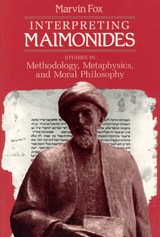
Interpreting Maimonides
Studies in Methodology, Metaphysics, and Moral PhilosophyMarvin Fox
University of Chicago Press, 1990
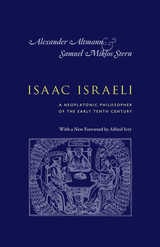
Isaac Israeli
A Neoplatonic Philosopher of the Early Tenth CenturyIsaac Israeli
University of Chicago Press, 2009
Recognized as one of the earliest Jewish neo-Platonist writers, Isaac ben Solomon Israeli (ca. 855–955) influenced Muslim, Jewish, and Christian scholars through the Middle Ages. A native of Egypt who wrote in Arabic, Israeli explored definitions of such terms as imagination, sense-perception, desire, love, creation, and “coming-to-be” in his writings.
This classic volume contains English translations of Israeli’s philosophical writings, including the Book of Definitions, the Book of Substances, and the Book on Spirit and Soul. Additionally, Isaac Israeli features a biographical sketch of the philosopher and extensive notes and comments on the texts, as well as a survey and appraisal of his philosophy. Restored to print for the first time in decades, Isaac Israeli will be essential reading for students and scholars of medieval philosophy and Jewish studies.
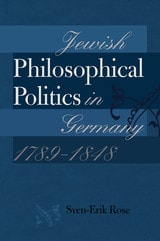
Jewish Philosophical Politics in Germany, 1789–1848
Sven-Erik Rose
Brandeis University Press, 2014
Jewish Universalisms
Mendelssohn, Cohen, and Humanity’s Highest GoodJeremy Fogel
Brandeis University Press, 2023
Any version of universalism relevant to a more attentive, pluralistic, and postcolonial outlook would balance the urgent current need for a universalistic perspective with the desire to maintain the richness of human diversity. The modern Jewish philosophers who sought to partake in the Enlightenment’s universalistic vision while maintaining their distinct identities as members of a religious minority within Europe offer insightful answers.
Jewish Universalisms analyzes how two major figures, Moses Mendelssohn and Hermann Cohen, dealt with the perceived tension between the universal values characteristic of the Enlightenment and aspects of Judaism often depicted as particularistic and parochial. Jeremy Fogel joins this lively debate in modern Jewish philosophy, offering a comparative examination of these thinkers and analyzing their worldviews from an innovative axiological perspective. Fogel writes that to gain a precise understanding of how Mendelssohn and Cohen argued for the concordance of Judaism and universalism, one must first seek out what they delineated as ultimately valuable. Then one can work out how that highest good, and the method of valuation it sustains, are universal.
Jewish and Islamic Philosophy
Crosspollinations in the Classic AgeLenn E. Goodman
Rutgers University Press, 1999
Last Works
Moses Mendelssohn. Translated by Bruce Rosenstock
University of Illinois Press, 2012
Leo Strauss and the Rediscovery of Maimonides
Kenneth Hart Green
University of Chicago Press, 2013
An invaluable companion to Green’s comprehensive collection of Strauss’s writings on Maimonides, this volume shows how Strauss confronted the commonly accepted approaches to the medieval philosopher, resulting in both a new understanding of Maimonides and a new depth and direction for his own thought. It will be welcomed by anyone engaged with the work of either philosopher.
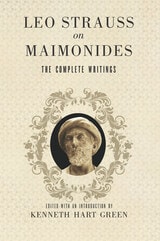
Leo Strauss on Maimonides
The Complete WritingsLeo Strauss
University of Chicago Press, 2013
With Leo Strauss on Maimonides, Kenneth Hart Green presents for the first time a comprehensive, annotated collection of Strauss’s writings on Maimonides, comprising sixteen essays, three of which appear in English for the first time. Green has also provided careful translations of materials that had originally been quoted in Hebrew, Arabic, Latin, German, and French; written an informative introduction highlighting the original contributions found in each essay; and brought references to out-of-print editions fully up to date. The result will become the standard edition of Strauss’s writings on Maimonides.
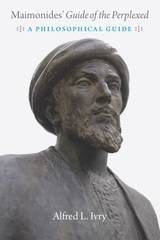
Maimonides' "Guide of the Perplexed"
A Philosophical GuideAlfred L. Ivry
University of Chicago Press, 2016
Drawing on a lifetime of study, Alfred L. Ivry has written the definitive guide to the Guide—one that makes it comprehensible and exciting to even those relatively unacquainted with Maimonides’ thought, while also offering an original and provocative interpretation that will command the interest of scholars. Ivry offers a chapter-by-chapter exposition of the widely accepted Shlomo Pines translation of the text along with a clear paraphrase that clarifies the key terms and concepts. Corresponding analyses take readers more deeply into the text, exploring the philosophical issues it raises, many dealing with metaphysics in both its ontological and epistemic aspects.
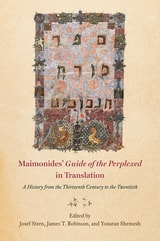
Maimonides' "Guide of the Perplexed" in Translation
A History from the Thirteenth Century to the TwentiethEdited by Josef Stern, James T. Robinson, and Yonatan Shemesh
University of Chicago Press, 2019
A collection of essays by scholars from a range of disciplines, the book unfolds in two parts. The first traces the history of the translations of the Guide, from medieval to modern renditions. The second surveys its influence in translation on Latin scholastic, early modern, and contemporary Anglo-American philosophy, as well as its impact in translation on current scholarship. Interdisciplinary in approach, this book will be essential reading for philosophers, historians, and religious studies scholars alike.
Modern French Jewish Thought
Writings on Religion and PoliticsEdited by Sarah Hammerschlag
Brandeis University Press, 2018
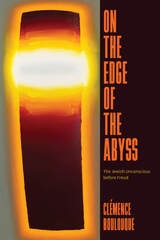
On the Edge of the Abyss
The Jewish Unconscious before FreudClémence Boulouque
University of Chicago Press, 2025
When Sigmund Freud published his theory of the unconscious, in 1899, he popularized an idea that had fascinated generations of Jewish philosophers before him. In this book, Clémence Boulouque charts the development of the pre-Freudian unconscious from subcultural inquiry to dominant discourse during the long nineteenth century. Although Freud’s scientific notion differed from Schelling’s mythical description of the abyss from which creation springs, its resonance with older ideas was celebrated as an opportunity to express specifically Jewish contributions to modernity. Indeed, Boulouque shows that the pre-Freudian unconscious emerged from conversations in Jewish mysticism about otherness and coexistence. In the hopeful years before World War I, Boulouque argues, such reflections offered the possibility of emancipation not only to Jews but to all.
Persecution and the Art of Writing
Leo Strauss
University of Chicago Press, 1988
Philosophical Witnessing
The Holocaust as PresenceBerel Lang
Brandeis University Press, 2012
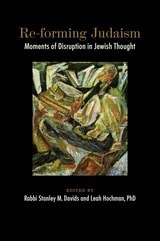
Re-forming Judaism
Moments of Disruption in Jewish ThoughtRabbi Stanley M. Davids and Leah Hochman, PhD
Central Conference of American Rabbis, 2023
Throughout Jewish history, revolutionary events and subversive ideas have burst forth, repeatedly transforming Jewish experience. Re-forming Judaism seeks to explore these ideas—and the individuals behind them—by delving into historical disruptions that led to lasting change in Jewish thought. A distinguished array of scholars take us on a journey from the disruptive prophets of ancient times, through rational, mystical, and extremist medievalists, to the impact of Haskalah and early Reform thought in modernity. Contemporary innovations such as changes in liturgy and music, feminism, and post-Holocaust theology are included, as are insights into Sephardic and North African experiences. By showing how Judaism forms—then re-forms, and re-forms again—the contributors demonstrate that tensions between continuity and change have always been part of Jewish life, helping us to both understand the past and contemplate the future.
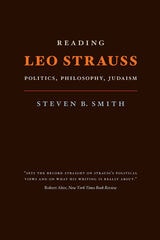
Reading Leo Strauss
Politics, Philosophy, JudaismSteven B. Smith
University of Chicago Press, 2006
Smith asserts that this philosophical skepticism defined Strauss’s thought. It was as a skeptic, Smith argues, that Strauss considered the seemingly irreconcilable conflict between reason and revelation—a conflict Strauss dubbed the “theologico-political problem.” Calling this problem “the theme of my investigations,” Strauss asked the same fundamental question throughout his life: what is the relation of the political order to revelation in general and Judaism in particular? Smith organizes his book with this question, first addressing Strauss’s views on religion and then examining his thought on philosophical and political issues.
In his investigation of these philosophical and political issues, Smith assesses Strauss’s attempt to direct the teaching of political science away from the examination of mass behavior and interest group politics and toward the study of the philosophical principles on which politics are based. With his provocative, lucid essays, Smith goes a long way toward establishing a distinctive form of Straussian liberalism.

Respecting the Wicked Child
A Philosophy of Secular Jewish Identity and EducationMitchell Silver
University of Massachusetts Press, 1998
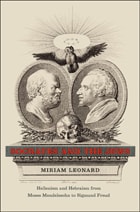
Socrates and the Jews
Hellenism and Hebraism from Moses Mendelssohn to Sigmund FreudMiriam Leonard
University of Chicago Press, 2012
"What has Athens to do with Jerusalem?” Asked by the early Christian Tertullian, the question was vigorously debated in the nineteenth century. While classics dominated the intellectual life of Europe, Christianity still prevailed and conflicts raged between the religious and the secular. Taking on the question of how the glories of the classical world could be reconciled with the Bible, Socrates and the Jews explains how Judaism played a vital role in defining modern philhellenism.
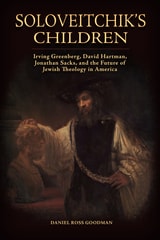
Soloveitchik's Children
Irving Greenberg, David Hartman, Jonathan Sacks, and the Future of Jewish Theology in AmericaDaniel Ross Goodman
University of Alabama Press, 2023
A revealing account of the three main disciples of Rabbi Joseph B. Soloveitchik, an essential figure in Orthodox Judaism in America
Orthodox Judaism is one of the fastest-growing religious communities in contemporary American life. Anyone who wishes to understand more about Judaism in America will need to consider the tenets and practices of Orthodox Judaism: who its adherents are, what they believe in, what motivates them, and to whom they turn for moral, intellectual, and spiritual guidance.
Among those spiritual leaders none looms larger than Rabbi Joseph B. Soloveitchik, heir to the legendary Talmudic dynasty of Brisk and a teacher and ordainer of thousands of rabbis during his time as a Talmud teacher at Yeshiva University from the Second World War until the 1980s. Soloveitchik was not only a Talmudic authority but a scholar of Western philosophy. While many books and articles have been written about Soloveitchik’s legacy and his influence on American Orthodoxy, few have looked carefully at his disciples in Torah and Talmud study, and even fewer at his disciples in Jewish thought and philosophy.
Soloveitchik’s Children: Irving Greenberg, David Hartman, Jonathan Sacks, and the Future of Jewish Theology in America is the first book to study closely three of Soloveitchik’s major disciples in Jewish thought and philosophy: Rabbis Irving (“Yitz”) Greenberg, David Hartman, and Jonathan Sacks. Daniel Ross Goodman narrates how each of these three major modern Jewish thinkers learned from and adapted Soloveitchik’s teachings in their own ways, even while advancing his philosophical and theological legacy.
The story of religious life and Judaism in contemporary America is incomplete without an understanding of how three of the most consequential Jewish thinkers of this generation adapted the teachings of one of the most consequential Jewish thinkers of the previous generation. Soloveitchik’s Children tells this gripping intellectual and religious story in a learned and engaging manner, shining a light on where Jewish religious thought in the United States currently stands—and where it may be heading in future generations.
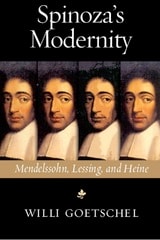
Spinoza's Modernity
Mendelssohn, Lessing, and HeineWilli Goetschel
University of Wisconsin Press, 2004
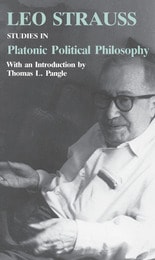
Studies in Platonic Political Philosophy
Leo Strauss
University of Chicago Press, 1983
As his choice of title indicates, the heart of Strauss's work is Platonism—a Platonism that is altogether unorthodox and highly controversial. These essays consider, among others, Heidegger, Husserl, Nietzsche, Marx, Moses Maimonides, Machiavelli, and of course Plato himself to test the Platonic understanding of the conflict between philosophy and political society. Strauss argues that an awesome spritual impoverishment has engulfed modernity because of our dimming awareness of that conflict.
Thomas Pangle's Introduction places the work within the context of the entire Straussian corpus and focuses especially on Strauss's late Socratic writings as a key to his mature thought. For those already familiar with Strauss, Pangle's essay will provoke thought and debate; for beginning readers of Strauss, it provides a fine introduction. A complete bibliography of Strauss's writings if included.
The Figural Jew
Politics and Identity in Postwar French ThoughtSarah Hammerschlag
University of Chicago Press, 2010
The rootless Jew, wandering disconnected from history, homeland, and nature, was often the target of early twentieth-century nationalist rhetoric aimed against modern culture. But following World War II, a number of prominent French philosophers recast this maligned figure in positive terms, and in so doing transformed postwar conceptions of politics and identity.
Sarah Hammerschlag explores this figure of the Jew from its prewar usage to its resuscitation by Jean-Paul Sartre, Emmanuel Levinas, Maurice Blanchot, and Jacques Derrida. Sartre and Levinas idealized the Jew’s rootlessness in order to rethink the foundations of political identity. Blanchot and Derrida, in turn, used the figure of the Jew to call into question the very nature of group identification. By chronicling this evolution in thinking, Hammerschlag ultimately reveals how the figural Jew can function as a critical mechanism that exposes the political dangers of mythic allegiance, whether couched in universalizing or particularizing terms.
Both an intellectual history and a philosophical argument, The Figural Jew will set the agenda for all further consideration of Jewish identity, modern Jewish thought, and continental philosophy.
The Guide of the Perplexed, Volume 1
Moses Maimonides
University of Chicago Press, 1963
This monument of rabbinical exegesis written at the end of the twelfth century has exerted an immense and continuing influence upon Jewish thought. Its aim is to liberate people from the tormenting perplexities arising from their understanding of the Bible according only to its literal meaning. This edition contains extensive introductions by Shlomo Pines and Leo Strauss, a leading authority on Maimonides.
The Guide of the Perplexed, Volume 2
Moses Maimonides
University of Chicago Press, 1963
This monument of rabbinical exegesis written at the end of the twelfth century has exerted an immense and continuing influence upon Jewish thought. Its aim is to liberate people from the tormenting perplexities arising from their understanding of the Bible according only to its literal meaning. This edition contains extensive introductions by Shlomo Pines and Leo Strauss, a leading authority on Maimonides.
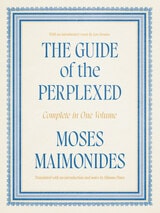
The Guide of the Perplexed
Complete in One VolumeMoses Maimonides
University of Chicago Press, 1963
The twelfth-century Judeo-Arabic text The Guide of the Perplexed is a monument of rabbinical exegesis and one of the most important works in the history of Jewish thought. Written by Moses ben Maimon,commonly known as Maimonides, the Guide aims to liberate people from the perplexities that arise from an understanding of the Bible based only on its literal meaning.
Shlomo Pines’s translation has served students and scholars for decades, and it is presented here, with Leo Strauss’s influential introduction, in one volume for the first time.
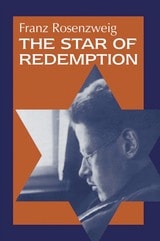
The Star of Redemption
Franz Rosenzweig; Translated by Barbara E. Galli; Foreword by Michael Oppenheim, introduction by Elliot R. Wolfson
University of Wisconsin Press, 2005
The Star of Redemption is essential reading for anyone interested in understanding religion and philosophy in the twentieth century. Fusing philosophy and theology, the book assigns both Judaism and Christianity distinct but equally important roles in the spiritual structure of the world. Franz Rosenzweig finds in both biblical religions approaches to a comprehension of reality.
The major themes and motifs of The Star—the birth, life, death, and the immortality of the soul; Eastern philosophies and Jewish mysticism; the relationship between God, world and humanity over time; and revelation as the real biblical miracle of faith and path to redemption—resonate meaningfully.