Results by title
11 books match the query 'Johnson, Mark'
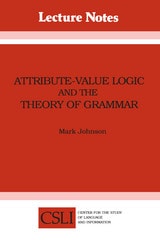
Attribute-Value Logic and the Theory of Grammar
Mark Johnson
CSLI, 1988
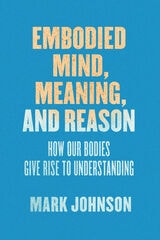
Embodied Mind, Meaning, and Reason
How Our Bodies Give Rise to UnderstandingMark Johnson
University of Chicago Press, 2017
A brief account of Johnson’s own intellectual journey, through which we track some of the most important discoveries in the field over the past forty years, sets the stage. Subsequent chapters set out Johnson’s important role in embodied cognition theory, including his cofounding (with George Lakoff) of conceptual metaphor theory and, later, their theory of bodily structures and processes that underlie all meaning, conceptualization, and reasoning. A detailed account of how meaning arises from our physical engagement with our environments provides the basis for a nondualistic, nonreductive view of mind that he sees as most congruous with the latest cognitive science. A concluding section explores the implications of our embodiment for our understanding of knowledge, reason, and truth. The resulting book will be essential for all philosophers dealing with mind, thought, and language.
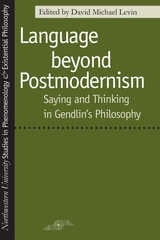
Language Beyond Postmodernism
Saying and Thinking in Gendlin PhilosophyDavid Kleinberg-Levin
Northwestern University Press, 1997
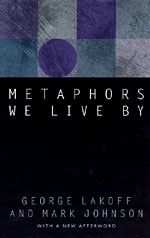
Metaphors We Live By
George Lakoff and Mark Johnson
University of Chicago Press, 1981
In this updated edition of Lakoff and Johnson's influential book, the authors supply an afterword surveying how their theory of metaphor has developed within the cognitive sciences to become central to the contemporary understanding of how we think and how we express our thoughts in language.
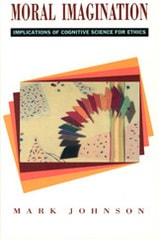
Moral Imagination
Implications of Cognitive Science for EthicsMark Johnson
University of Chicago Press, 1993
Expanding his innovative studies of human reason in Metaphors We Live By and The Body in the Mind, Johnson provides the tools for more practical, realistic, and constructive moral reflection.
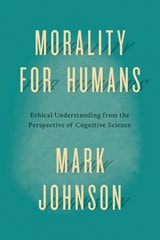
Morality for Humans
Ethical Understanding from the Perspective of Cognitive ScienceMark Johnson
University of Chicago Press, 2014
Ethical naturalism is not just a revamped form of relativism. Indeed, Johnson attempts to overcome the absolutist-versus-relativist impasse that has been one of the most intractable problems in the history of philosophy. He does so through a careful and inclusive look at the many ways we reason about right and wrong. Much of our moral thought, he shows, is automatic and intuitive, gut feelings that we follow up and attempt to justify with rational analysis and argument. However, good moral deliberation is not limited merely to intuitive judgments supported after the fact by reasoning. Johnson points out a crucial third element: we imagine how our decisions will play out, how we or the world would change with each action we might take. Plumbing this imaginative dimension of moral reasoning, he provides a psychologically sophisticated view of moral problem solving, one perfectly suited for the embodied, culturally embedded, and ever-developing human creatures that we are.

Philosophical Perspectives on Metaphor
Mark Johnson, Editor
University of Minnesota Press, 1981
Philosophical Perspectives on Metaphor was first published in 1981. Minnesota Archive Editions uses digital technology to make long-unavailable books once again accessible, and are published unaltered from the original University of Minnesota Press editions.
"We are," says Mark Johnson, "in the midst of metaphormania." The past few years have seen an explosion of interest in metaphor as a vehicle for exploring the relations between language and thought. While a number of recent books have dealt with metaphor from the standpoints of several disciplines, there is no collection that shows the best of the work that has been done in the field of philosophy. Mark Johnson has brought together essays that define the central issues of the discussion in this field.
His introductory essay offers a critical survey of historically influential treatments of figurative language (including those of Aristotle, Hobbes, Locke, Kant, and Nietzsche) and sets forth the nature of various issues that have been of interest to philosophers. Thus, it provides a context in which to understand the motivations, influences, and significance of the collected essays. An annotated bibliography serves as a catalog of all relevant literature.
Philosophical Perspectives on Metaphor provides an entry point into the philosophical exploration of metaphor for students, philosophers, linguists, psychologists, artists, critics, or anyone interested in language and its relation to understanding and experience.

Power Electronics Packaging Reliability
Mark Johnson
The Institution of Engineering and Technology, 2020
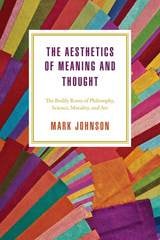
The Aesthetics of Meaning and Thought
The Bodily Roots of Philosophy, Science, Morality, and ArtMark Johnson
University of Chicago Press, 2018
This book gathers the best of philosopher Mark Johnson’s essays addressing questions of our embodiment as they deal with aesthetics—which, he argues, we need to rethink so that it takes into account the central role of body-based meaning. Viewed that way, the arts can give us profound insights into the processes of meaning making that underlie our conceptual systems and cultural practices. Johnson shows how our embodiment shapes our philosophy, science, morality, and art; what emerges is a view of humans as aesthetic, meaning-making creatures who draw on their deepest physical processes to make sense of the world around them.
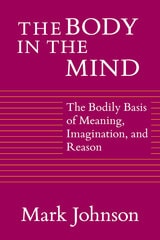
The Body in the Mind
The Bodily Basis of Meaning, Imagination, and ReasonMark Johnson
University of Chicago Press, 1990
The Meaning of the Body
Aesthetics of Human UnderstandingMark Johnson
University of Chicago Press, 2007
In The Meaning of the Body, Mark Johnson continues his pioneering work on the exciting connections between cognitive science, language, and meaning first begun in the classic Metaphors We Live By. Johnson uses recent research into infant psychology to show how the body generates meaning even before self-consciousness has fully developed. From there he turns to cognitive neuroscience to further explore the bodily origins of meaning, thought, and language and examines the many dimensions of meaning—including images, qualities, emotions, and metaphors—that are all rooted in the body’s physical encounters with the world. Drawing on the psychology of art and pragmatist philosophy, Johnson argues that all of these aspects of meaning-making are fundamentally aesthetic. He concludes that the arts are the culmination of human attempts to find meaning and that studying the aesthetic dimensions of our experience is crucial to unlocking meaning's bodily sources.