Results by title
645 books match the query 'Judaism' and 51 start with a
A Century of Jewish Life In Dixie
The Birmingham ExperienceMark H. Elovitz
University of Alabama Press, 2003
Exploring the resilience, identity, and contributions of Southern Jews in the heart of Alabama.
This is the first substantial history of the Jews in any inland town or city of the industrial South. A Century of Jewish Life in Dixie offers a vivid and deeply researched portrait of Birmingham, Alabama’s Jewish community. Mark H. Elovitz traces the community’s evolution from its immigrant roots in the late 19th century through its growth into a vibrant and influential part of Southern society. Drawing on archival records, oral histories, and cultural analysis, Elovitz explores how Southern Jews balanced tradition and assimilation, navigated racial and religious tensions, and contributed to civic and economic life in a region undergoing dramatic transformation. This book provides a rare and nuanced look at Jewish identity in the American South, making it an essential resource for scholars of Jewish studies, Southern history, and American cultural life.
A Children's Haggadah
Rabbi Howard Bogot
Central Conference of American Rabbis, 1996
A Companion to Martin Buber
Edited by Paul Mendes-Flohr
University of Chicago Press, 2025
In his 1923 essay, I and Thou, the philosopher, theologian, and activist Martin Buber introduced a philosophy of dialogue that achieved a global, interdisciplinary resonance. For Buber, dialogue was more than a conversation; dialogue discloses something essential about our orientation and our lives with one another. This companion assembles twenty-six scholars from a dozen countries to explore Buber’s international reputation and legacy in education, interfaith relations, Judaism, philosophy, politics, and psychology. The result is an essential guide to one of the most influential Jewish thinkers of the twentieth century.
A Concise Coptic-English Lexicon, Second Edition
Richard Smith
SBL Press, 1999
A History of German Jewish Bible Translation
Abigail Gillman
University of Chicago Press, 2018
This book is the first in English to offer a close analysis of German Jewish translations as part of a larger cultural project. Looking at four distinct waves of translations, Abigail Gillman juxtaposes translations within each that sought to achieve similar goals through differing means. As she details the history of successive translations, we gain new insight into the opportunities and problems the Bible posed for different generations and gain a new perspective on modern German Jewish history.
A Jewish Word or Two
Charles Reznikoff's ModernismJoel Bettridge
University of Iowa Press, 2026
The son of Jewish immigrants from Russia to New York, Charles Reznikoff found himself at the intersection of modernist innovation, ethnic otherness, and economic hardship. He both appreciated the modernists’ formal radicalism and critiqued their political failings—a task he accomplished by writing short lyric poems depicting the hardship and charm of urban life, as well as long poems presenting histories of horrific violence, from factory accidents to the Holocaust. But despite his contributions to American poetry, Reznikoff has remained a somewhat secondary figure, in part because his work—at times—is painful to read.
A Jewish Word or Two recasts Reznikoff ’s poetry as pleasurable and masterful even when disturbing. In their humor, their encounters with Jewish history, holiness, and identity, as well as their use of drama, horror, joy, and beauty, Reznikoff ’s poems help us celebrate what is simultaneously strange, surprising, lovely, and uncanny in our everyday lives.
A Kosher Christmas
'Tis the Season to be JewishJoshua Eli Plaut
Rutgers University Press, 2012
Christmas is not everybody’s favorite holiday. Historically, Jews in America, whether participating in or refraining from recognizing Christmas, have devised a multitude of unique strategies to respond to the holiday season. Their response is a mixed one: do we participate, try to ignore the holiday entirely, or create our own traditions and make the season an enjoyable time? This book, the first on the subject of Jews and Christmas in the United States, portrays how Jews are shaping the public and private character of Christmas by transforming December into a joyous holiday season belonging to all Americans.
Creative and innovative in approaching the holiday season, these responses range from composing America’s most beloved Christmas songs, transforming Hanukkah into the Jewish Christmas, creating a national Jewish tradition of patronizing Chinese restaurants and comedy shows on Christmas Eve, volunteering at shelters and soup kitchens on Christmas Day, dressing up as Santa Claus to spread good cheer, campaigning to institute Hanukkah postal stamps, and blending holiday traditions into an interfaith hybrid celebration called “Chrismukkah” or creating a secularized holiday such as Festivus.
Through these venerated traditions and alternative Christmastime rituals, Jews publicly assert and proudly proclaim their Jewish and American identities to fashion a universally shared message of joy and hope for the holiday season.
See also: http://www.akosherchristmas.org
A Land of Two Peoples
Martin Buber on Jews and ArabsMartin Buber
University of Chicago Press, 2005
Collected in ALand of Two Peoples are the private and open letters, addresses, and essays in which Buber advocated binationalism as a solution to the conflict in the Middle East. A committed Zionist, Buber steadfastly articulated the moral necessity for reconciliation and accommodation between the Arabs and Jews. From the Balfour Declaration of November 1917 to his death in 1965, he campaigned passionately for a "one state solution.
With the Middle East embroiled in religious and ethnic chaos, A Land of Two Peoples remains as relevant today as it was when it was first published more than twenty years ago. This timely reprint, which includes a new preface by Paul Mendes-Flohr, offers context and depth to current affairs and will be welcomed by those interested in Middle Eastern studies and political theory.
A Life of Meaning
Embracing Reform Judaism's Sacred PathRabbi Dana Evan Kaplan, PHD
Central Conference of American Rabbis, 2018
A Most Reliable Witness
Essays in Honor of Ross Shepard KraemerSusan Ashbrook Harvey
SBL Press, 2015
Celebrate a trailblazer in the areas of women and re
Celebrate a trailblazer in the areas of women and religion, Jews and Judaism, and earliest Christianity in the ancient Mediterranean
Ross Kraemer is Professor Emerita in the Department of Religious Studies at Brown University. This volume of essays, conceived and produced by students, colleagues, and friends bears witness to the breadth of her own scholarly interests. Contributors include Theodore A. Bergren, Debra Bucher, Lynn Cohick, Mary Rose D’Angelo, Nathaniel P. DesRosiers, Robert Doran, Jennifer Eyl, Paula Fredriksen, John G. Gager, Maxine Grossman, Kim Haines-Eitzen, Susan Ashbrook Harvey, Jordan Kraemer, Robert A. Kraft, Shira L. Lander, Amy-Jill Levine, Susan Marks, E. Ann Matter, Renee Levine Melammed, Susan Niditch, Elaine Pagels, Adele Reinhartz, Jordan Rosenblum, Sarah Schwarz, Karen B. Stern, Stanley K. Stowers, Daniel Ullucci, Arthur Urbano, Heidi Wendt, and Benjamin G. Wright.Features:
- Articles that examine both ancient and modern texts in cross-cultural and trans-historical perspective
- Twenty-eight original essays on ancient Judaism, Christianity, and women in the Greco-Roman world
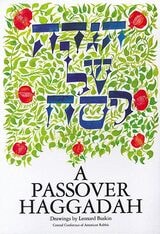
A Passover Haggadah
Rabbi Herbert Bronstein
Central Conference of American Rabbis, 0
This classic Haggadah has sold over 1 million copies since its introduction. Illustrated with twenty-three original full-color watercolors by Leonard Baskin and written in contemporary, gender-inclusive language, it contains a complete Passover home service, an extensive song section, and supplemental readings and meditations from which participants can choose during the course of the Seder. All optional selections are printed in color.
A Passover Haggadah - Russian-Hebrew Edition
Rabbi Herbert Bronstein
Central Conference of American Rabbis, 1982
A People Divided
Judaism in Contemporary AmericaJack Wertheimer
Brandeis University Press, 1997
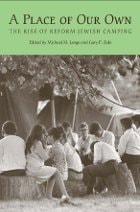
A Place of Our Own
The Rise of Reform Jewish CampingEdited by Michael M. Lorge and Gary P. Zola
University of Alabama Press, 2006
The history of educational summer camps in American Reform Judaism. Reform Judaism is not the only religious community in America to make the summer camp experience a vital part of a faith community's effort to impart its values and beliefs to its adolescents, but perhaps no group relied more on summer camp as an adjunct to home and community for this purpose. Summer camp became an important part of Reform group identity, a bulwark against the attraction of assimilation into the greater society and mere nominal Judaism.
These essays, which commemorate the fiftieth anniversary of the founding of the first Reform Jewish educational camp in the United States (Olin-Sang-Ruby Union Institute [OSRUI], in Oconomowoc, Wisconsin) cover a wide range of topics related to both the Reform Judaism movement and the development of the Reform Jewish camping system in the United States. Donald M. Splansky’s chapter on “Prayer at Reform Jewish Camps” documents changes in prayer services that took place both at OSRUI and in the Reform movement in general; Michael Zeldin’s “Making the Magic in Reform Jewish Summer Camps” describes the educational philosophies employed at many camps and analyzes their effectiveness; and Jonathan D. Sarna’s “The Crucial Decade in Jewish
A Torah Commentary for Our Times
Volume 2: Exodus and LeviticusRabbi Harvey J. Fields
Central Conference of American Rabbis, 1991
A helpful approach to the weekly parashah, juxtaposing the insights of ancient, medieval, and modern commentators (including the author). Perfect for both beginning Torah students and scholars seeking new angles on the text. The volumes are available individually or as a three-volume set, ideal for a bar or bat mitzvah or confirmation gift.
A Torah Commentary for Our Times
Volume 3: Numbers and DeuteronomyRabbi Harvey J. Fields
Central Conference of American Rabbis, 1993
A helpful approach to the weekly parashah, juxtaposing the insights of ancient, medieval, and modern commentators (including the author). Perfect for both beginning Torah students and scholars seeking new angles on the text. The volumes are available individually or as a three-volume set, ideal for a bar or bat mitzvah or confirmation gift.
A Torah Commentary for Our Times
Volume I: GenesisRabbi Harvey J. Fields
Central Conference of American Rabbis, 1990
A helpful approach to the weekly parashah, juxtaposing the insights of ancient, medieval, and modern commentators (including the author). Perfect for both beginning Torah students and scholars seeking new angles on the text. The volumes are available individually or as a three-volume set, ideal for a bar or bat mitzvah or confirmation gift.
Above All, We Are Jews
A Biography of Rabbi Alexander SchindlerMichael A. Meyer
Central Conference of American Rabbis, 2025
Abraham Geiger and the Jewish Jesus
Susannah Heschel
University of Chicago Press, 1998
Geiger, a pioneer of Reform Judaism and a founder of Jewish studies, developed a Jewish version of Christian origins. He contended that Jesus was a member of the Pharisees, a progressive and liberalizing group within first-century Judaism, and that he taught nothing new or original. This argument enraged German Protestant theologians, some of whom produced a tragic counterargument based on racial theory.
In this fascinating book, Susannah Heschel traces the genesis of Geiger's argument and examines the reaction to it within Christian theology. She concludes that Geiger initiated an intellectual revolt by the colonized against the colonizer, an attempt not to assimilate into Christianity by adopting Jesus as a Jew, but to overthrow Christian intellectual hegemony by claiming that Christianity—and all of Western civilization—was the product of Judaism.
Acting Jewish
Negotiating Ethnicity on the American Stage and ScreenHenry Bial
University of Michigan Press, 2005
Acting Jewish documents this history, looking at the work of Jewish writers, directors, and actors in the American entertainment industry with particular attention to the ways in which these artists offer behavioral models for Jewish-American audiences. The book spans the period from 1947 to the present and takes a close look at some of America's favorite plays (Death of a Salesman, Fiddler on the Roof, Angels in America), films (Gentleman's Agreement, AnnieHall), and television shows (The Goldbergs, Seinfeld), identifying a double-coding by which performers enact, and spectators read, Jewishness in contemporary performance-and, by extension, enact and read other minority identities. The book thus explores and illuminates the ever-changing relationship between Jews and mainstream American culture.
"Fascinating and original . . . Bial's command of sources is impressive, and his concept of 'double-coding' is convincing . . . the book should have no trouble finding a large audience."
-Barbara Grossman, author of Funny Woman: The Life and Times of Fanny Brice
Adam and Eve in the Armenian Tradition, Fifth through Seventeenth Centuries
Michael E. Stone
SBL Press, 2013
Adventures of Rabbah and Friends
The Talmud's Strange Tales and Their ReadersJames Adam Redfield
SBL Press, 2025
Aesthetic Theology and Its Enemies
Judaism in Christian Painting, Poetry, and PoliticsDavid Nirenberg
Brandeis University Press, 2015
Aesthetics of Renewal
Martin Buber's Early Representation of Hasidism as KulturkritikMartina Urban
University of Chicago Press, 2008
After Representation?
The Holocaust, Literature, and CultureSpargo, R. Clifton
Rutgers University Press, 2010
As experts in the study of literature and culture, the scholars in this collection examine the shifting cultural contexts for Holocaust representation and reveal how writersùwhether they write as witnesses to the Holocaust or at an imaginative distance from the Nazi genocideùarticulate the shadowy borderline between fact and fiction, between event and expression, and between the condition of life endured in atrocity and the hope of a meaningful existence. What imaginative literature brings to the study of the Holocaust is an ability to test the limits of language and its conventions. After Representation? moves beyond the suspicion of representation and explores the changing meaning of the Holocaust for different generations, audiences, and contexts.
Against the Inveterate Obduracy of the Jews
Irven M. Peter the Venerable
Catholic University of America Press, 2013
All My Mothers and Fathers
A MemoirMichael Blumenthal
West Virginia University Press, 2016
As fate would have it, his adoptive father, a German-Jewish refugee raised by a loveless and embittered stepmother after his own mother died in childbirth, has inflicted on his stepson a fate uncannily—and terrifyingly—similar to his own: Having first adopted Michael, in part, to help his dying wife, he then imposes on him the same sort of penurious and loveless stepmother whom he himself had had to survive. With these revelations, the "mysteries" that seem to have permeated Michael's childhood are laid bare, triggering a quest for belonging that will infiltrate the author's entire adult life.
Amen
Patrick J. Ryan SJ
Catholic University of America Press, 2018
Amen
Seeking Presence with Prayer, Poetry, and Mindfulness PracticeRabbi Karyn D. Kedar
Central Conference of American Rabbis, 2020
America's Spiritual Capital
Nicholas N. Capaldi
St. Augustine's Press, 2012
American Jewish Identity Politics
Deborah Dash Moore, editor
University of Michigan Press, 2009
"Displays the full range of informed, thoughtful opinion on the place of Jews in the American politics of identity."
---David A. Hollinger, Preston Hotchkis Professor of American History, University of California, Berkeley
"A fascinating anthology whose essays crystallize the most salient features of American Jewish life in the second half of the twentieth century."
---Beth S. Wenger, Katz Family Associate Professor of American Jewish History and Director of the Jewish Studies Program, University of Pennsylvania
"A wonderful collection of important essays, indispensable for understanding the searing conflicts over faith, familial, and political commitments marking American Jewry's journey through the paradoxes of the post-Holocaust era."
---Michael E. Staub, Professor of English, Baruch College, CUNY, and author of Torn at the Roots: The Crisis of Jewish Liberalism in Postwar America
"This provocative anthology offers fascinating essays on Jewish culture, politics, religion, feminism, and much more. It is a must-read for all those interested in the intersection of Jewish life and identity politics in the modern period."
---Joyce Antler, Samuel Lane Professor of American Jewish History and Culture, Brandeis University
"This collection of essays invites the reader to engage with some of the best writing and thinking about American Jewish life by some of the finest scholars in the field. Deborah Moore's introduction offers an important framework to understand not only the essays, but the academic and political contexts in which they are rooted."
---Riv-Ellen Prell, Professor and Chair, American Studies, University of Minnesota, and editor of Women Remaking American Judaism
American Jewish Thought Since 1934
Writings on Identity, Engagement, and BeliefEdited by Michael Marmur and David Ellenson
Brandeis University Press, 2020
In this volume, editors Michael Marmur and David Ellenson bring together the distinctive voices of those who have shaped the bold and shifting soundscape of American Jewish thought over the last few generations. The contributors tackle an array of topics including theological questions; loyalty and belonging; the significance of halakhic, spiritual, and ritual practice; secularization and its discontents; and the creative recasting of Jewish peoplehood. The editors are careful to point out how a plurality of approaches emerged in response to the fundamental ruptures and challenges of continuity posed by the Holocaust, the establishment of the state of Israel, and the civil rights movement in the twentieth century.
This volume also includes a wide swath of the most distinctive currents and movements over the last eighty years: post-Holocaust theology, secular forms of Jewish spirituality, ultra-orthodoxy, American neo-orthodoxy, neo-Hasidism, feminism and queer theory, diasporist critiques of Zionism, and Zionist militancy. This collection will serve as both a testament to the creativity of American Jewish thought so far, and as an inspiration for the new thinkers of its still unwritten future.
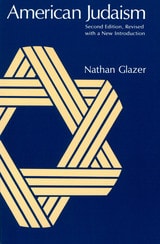
American Judaism
Nathan Glazer
University of Chicago Press, 1988
Glazer's new introduction describes the drift away from the popular equation of American Judaism with liberalism during the last two decades and considers the threat of divisiveness within American Judaism. Glazer also discusses tensions between American Judaism and Israel as a result of a revivified Orthodoxy and the disillusionment with liberalism.
"American Judaism has been arguably the best known and most used introduction to the study of the Jewish religion in the United States. . . . It is an inordinately clear-sighted work that can be read with much profit to this day."—American Jewish History (1987)
American Judaism
Nathan Glazer
University of Chicago Press, 1988
First published in 1957, Nathan Glazer's classic, historical study of Judaism in America has been described by the New York Times Book Review as "a remarkable story . . . told briefly and clearly by an objective historical mind, yet with a fine combination of sociological insight and religious sensitivity."
Glazer's new introduction describes the drift away from the popular equation of American Judaism with liberalism during the last two decades and considers the threat of divisiveness within American Judaism. Glazer also discusses tensions between American Judaism and Israel as a result of a revivified Orthodoxy and the disillusionment with liberalism.
"American Judaism has been arguably the best known and most used introduction to the study of the Jewish religion in the United States. . . . It is an inordinately clear-sighted work that can be read with much profit to this day."—American Jewish History (1987)
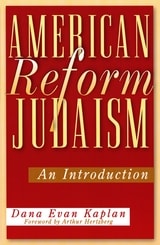
American Reform Judaism
An IntroductionDana Evan Kaplan
Rutgers University Press, 2003
The only comprehensive and up-to-date look at Reform Judaism, this book analyzes the forces currently challenging the Reform movement, now the largest Jewish denomination in the United States.
To distinguish itself from Orthodox and Conservative Judaism, the Reform movement tries to be an egalitarian, open, and innovative version of the faith true to the spirit of the tradition but nonetheless fully compatible with modern secular life. Promoting itself in this way, Reform Judaism has been tremendously successful in recruiting a variety of people—intermarried families, feminists, gays and lesbians, and interracial families among others—who resist more traditional forms of worship.
As an unintended result of this success, the movement now struggles with an identity crisis brought on by its liberal theology, which teaches that each Jew is free to practice Judaism more or less as he or she pleases. In the absence of the authority that comes from a theology based on a commanding, all-powerful God, can Reform Judaism continue to thrive? Can it be broadly inclusive and still be uniquely and authentically Jewish?
Taking this question as his point of departure, Dana Evan Kaplan provides a broad overview of the American Reform movement and its history, theology, and politics. He then takes a hard look at the challenges the movement faces as it attempts to reinvent itself in the new millennium. In so doing, Kaplan gives the reader a sense of where Reform Judaism has come from, where it stands on the major issues, and where it may be going.
Addressing the issues that have confronted the movement—including the ordination of women, acceptance of homosexuality, the problem of assimilation, the question of rabbinic officiation at intermarriages, the struggle for acceptance in Israel, and Jewish education and others—Kaplan sheds light on the connection between Reform ideology and cultural realities. He unflinchingly, yet optimistically, assesses the movement’s future and cautions that stormy weather may be ahead.
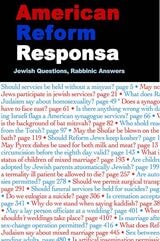
American Reform Responsa - PDF Electronic Version
Jewish Questions, Rabbinic AnswersWalter Jacob
Central Conference of American Rabbis, 1983
Originally published in 1983, this collection was edited by Rabbi Walter Jacob, then the Chair of the CCAR Responsa Committee. This collection deals with such questions as: should a remarried woman observe a deceased husband's yahrzeit? Is euthenasia ever permissible? May a shofar be sounded on Shabbat? Must an adult convert be circumcised? Should funeral services be held for suicides? May a woman wear a tallit? Responsa are rabbinic answers to actual questions of Jewish law and practice that, throughout history, have provided a guiding force in shaping Jewish life.
Americas Jews
Chaim Waxman
Temple University Press, 1983
The book is a social history and sociology of American Jewry. It provides an up-to-date analysis of the contemporary American Jewish community, an analysis that includes educational, occupational, income, and political patterns of American Jews; the American Jewish family; anti-semitism; the relationship between American Jews and Israel; and the recent immigration of Soviet, Israeli, and Iranian Jews to the USA.
In synthesizing a vast array of empirical studies, the author argues that while American Jews have been successful in their quest to integrate into the American social system, recent developments both in the American social and cultural system, at large, and within the Jewish community, in particular, indicate that this ethno-religious group is confronting the challenge to its continuity and its manifesting survivalist strengths which were not readily apparent in earlier generations.
America's Jews in Transition should interest students in a wide range of fields, among them sociology, ethnic studies, Jewish studies, American studies, and religious studies. Because of its breadth and the freshness of its material, the book should also appeal to the general reader.
An American Rabbi in Korea
A Chaplain's Journey in the Forgotten WarMilton J. Rosen, translated and edited by Stanley R. Rosen
University of Alabama Press, 2004
During the height of the Korean conflict, 1950–51, Orthodox Jewish chaplain Milton J. Rosen wrote 19 feature-length articles for Der Morgen Zhornal, a Yiddish daily in New York, documenting his wartime experiences as well as those of the servicemen under his care. An American Rabbi in Korea is an English translation of Rosen's important articles prepared by his son and annotated with background about Rosen's military service, a general introduction to the war and conflict on the Korean peninsula, and numerous maps and photographs.
Rosen was among those nearly caught in the Chinese entrapment of American and Allied forces in North Korea in late 1950, and some of his most poignant writing details the trying circumstances that faced both soldiers and civilians during that time. As chaplain, Rosen was able to offer a unique account of the American Jewish experience on the frontlines and in the United States military while also describing the impact of the American presence on Korean citizens and their culture. His interest in Korean attitudes toward Jews is also a significant theme within these articles. The sum is a readable account of war and its turmoil from an astute and compassionate observer.
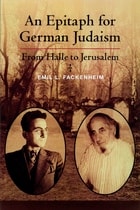
An Epitaph for German Judaism
From Halle to JerusalemEmil Fackenheim
University of Wisconsin Press, 2007
“An ‘epoch-making’ autobiography.”—Arnold Ages, Jewish Tribune

Ancient Sisterhood
The Lost Traditions of Hagar and SarahSavina J. Teubal
Ohio University Press, 1997
Ancient Sisterhood cites evidence that Hebrew women actually enjoyed the privileges and sanctity of their own religious practices. These practices, however, were gradually eroded and usurped by the establishment of patriarchal monarchies that were based on militaristic conquest and power. Teubal examines the figures of Hagar and Sarah from a feminist perspective that combines thorough scholarship with an informed and detailed understanding of the cultural and religious influences from which the mysterious biblical figure of Hagar emerged. She looks at Hagar's important role in the genesis of Hebrew culture, her role as mother of the Islamic nations, and her power as a matriarch as opposed to her apparent status as a concubine.
Teubal posits two distinct sources for the Hagar episodes: Hagar as companion to Sarah and an unknown woman whom she refers to as the desert matriarch. She explores whether Hagar was a slave to Abraham or Sarah, the differences between Hagar and the desert matriarch, and the obscurantism of these important elements in biblical texts. Teubal sheds considerable light on two central figures of these world religions and “the disassociation of woman from her own female religious experience.”
Angels, Devils
The Supernatural and Its Visual RepresentationGerhard Jaritz
Central European University Press, 2011
Animals and the Law in Antiquity
Saul M. Olyan
SBL Press, 2021
Animal law has become a topic of growing importance internationally, with animal welfare and animal rights often assuming center stage in contemporary debates about the legal status of animals. While nonspecialists routinely decontextualize ancient texts to support or deny rights to animals, experts in fields such as classics, biblical studies, Assyriology, Egyptology, rabbinics, and late antique Christianity have only just begun to engage the topic of animals and the law in their respective areas. This volume consists of original studies by scholars from a range of Mediterranean and West Asian fields on a variety of topics at the intersection of animals and the law in antiquity. Contributors include Rozenn Bailleul-LeSuer, Beth Berkowitz, Andrew McGowan, F. S. Naiden, Saul M. Olyan, Seth Richardson, Jordan D. Rosenblum, Andreas Schüle, Miira Tuominen, and Daniel Ullucci. The volume is essential reading for scholars and students of both the ancient world and contemporary law.
Anna's Shtetl
Lawrence A. Coben
University of Alabama Press, 2007
Anne Frank and Etty Hillesum
Inscribing Spirituality and Sexualityde Costa, Denise
Rutgers University Press, 1998
Studies of Nazi persecution and destruction of Jews have to date largely been based on the accounts of men. And yet gender difference in Western society is so profound that women and men seem to have divergent experiences, speak different languages, and see and hear in dissimilar ways. Denise de Costa's book explores the significance of sex and gender differences in the construction of history and society-specifically, the Nazi genocide of Jews in World War II-by focusing on the writing of two Jewish women, Anne Frank and Etty Hillesum.
De Costa argues that although both of these writers have received much attention, little has been done to understand how the significant difference occasioned by both gender and Jewishness helps to define cultural or personal identity in relation to the Holocaust. De Costa uses a variety of psychoanalytic and feminist theories to approach the writing of Frank and Hillesum. Critiquing as well as employing the concepts of Julia Kristeva, Hélène Cixous, Luce Irigaray, and Simone de Beauvoir among others, she presents a detailed and rich discussion of each writer.
De Costa approaches Anne Frank largely from a psychoanalytical perspective that emphasizes the function of writing itself in the development of self-identity. For Etty Hillesum, she is more concerned with how writing establishes a philosophy, and a faith, that can entertain and is indeed based in doubleness and paradox. Her assessment of these two writers makes a significant contribution to our understanding of the Holocaust as a cultural and historical phenomenon, of the role of writing in the production and expression of gendered identity, and of the complex relation between women, writing, and culture.
Apocalyptic Sheep and Goats in Matthew and 1 Enoch
Elekosi F. Lafitaga
SBL Press, 2022
An alternative understanding of apocalyptic eschatology in the Gospel of Matthew
Matthew’s eschatological imageries of judgment are often identified as apocalyptic and referred to as Matthew’s apocalyptic discourses. In this volume Elekosi F. Lafitaga reexamines Matthew’s vision of the sheep and goats in the judgment of the nations, which are often interpreted as metaphors for the saved and the condemned. Lafitaga views these images in the wider context of the rhetoric of apocalyptic communication stretching back to Matthew 3. This broader context reveals that the vision of Matthew 25 serves to exhort Israel in the here and now according to the torah, with salvation for Israel involving an indispensable responsibility to love and serve humanity. Central to Lafitaga’s analysis is the highly probable scenario that the material in Matthew is dependent on the Book of Dreams (1 Enoch 83–90).
Aramaic Incantation Bowls in Their Late Antique Jewish Contexts
Alexander W. Marcus
SBL Press, 2025
Armenian Apocrypha Relating to Angels and Biblical Heroes
Michael E. Stone
SBL Press, 2016
Explore how the vivid and creative Armenian spiritual tradition shaped biblical stories to serve new needs
Michael E. Stone’s latest book includes texts from Armenian manuscripts that are relevant to the development and growth of biblical themes and subjects. Most of these texts have not been published previously. Stone has collected a fascinating corpus of texts about biblical heroes, such as Joseph and Jonah, Nathan the Prophet, and Asaph the Psalmist. In addition, he has included documents illustrating particular points of the biblical story. This work reflects not just on how the Bible was interpreted in medieval times, but also how its stories and details were shaped by and served the needs of the vivid and creative Armenian spiritual tradition.
Features:
- Expanded stories from Exodus
- Introductions,translations, and notes
- Insights into the Armenian "Embroidered Bible," through which many biblical incidents were known to Armenian literature, art, and thought
Armenian Apocrypha
The Short Questionnaire from Adam to MosesMichael E. Stone
SBL Press, 2025
Ascensions on High in Jewish Mysticism
Pillars, Lines, LaddersMoshe Idel
Central European University Press, 2005
Aseneth of Egypt
The Composition of a Jewish NarrativePatricia D. Ahearne-Kroll
SBL Press, 2020
An exploration of Aseneth's beginnings
In Aseneth of Egypt: The Composition of a Jewish Narrative, Patricia D. Ahearne-Kroll challenges reliance on reconstructed texts in previous scholarship on the book of Joseph and Aseneth. After outlining the problems with previous prototypes of the Hellenistic narrative, she proposes a way to talk about the story in its initial setting without ignoring the manuscript evidence. Her thorough analysis of the evidence reveals how Joseph and Aseneth reflects the literary impulse of Greek-speaking Jewish writers to redescribe their identity in Egypt and Judean connections to the land of Egypt, while incorporating Ptolemaic strategies of legitimation of power. In the end, Ahearne-Kroll concludes that the base storyline preserved in all the copies of this story demonstrates that it was written for Jewish communities living in Hellenistic Egypt.
Features:
- A focus on Hellenistic stories of heroic ancestors
- A discussion of the possible lives of Jews in Hellenistic Egypt drawn from the narrative of Aseneth
- An examination of the complexities involved in dating the composition of literary texts