Results by title
486 books match the query 'LGBTQ+' and 36 start with a
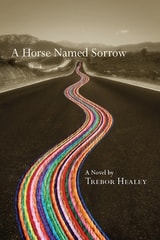
A Horse Named Sorrow
Trebor Healey
University of Wisconsin Press, 2012
Award-winning novelist Trebor Healey depicts San Francisco in the 1980s and ’90s in poetic prose that is both ribald and poignant, and a crossing into the American West that is dreamy, mythic, and visionary.
When troubled twenty-one-year-old Seamus Blake meets the strong and self-possessed Jimmy (just arrived in San Francisco by bicycle from his hometown in Buffalo, New York), he feels his life may finally be taking a turn for the better. But the ensuing romance proves short-lived as Jimmy dies of an AIDS-related illness. The grieving Seamus is obliged to keep a promise to Jimmy: “Take me back the way I came.”
And so Seamus sets out by bicycle on a picaresque journey with the ashes, hoping to bring them back to Buffalo. He meets truck drivers, waitresses, college kids, farmers, ranchers, Marines, and other travelers—each one giving him a new perspective on his own life and on Jimmy’s death. When he meets and becomes involved with a young Native American man whose mother has recently died, Seamus’s grief and his story become universal and redemptive.
A Letter to Harvey Milk
Short StoriesLesléa Newman
University of Wisconsin Press, 2004
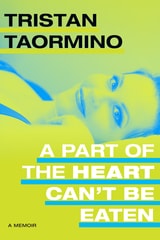
A Part of the Heart Can't Be Eaten
A MemoirTristan Taormino
Duke University Press, 2023
Tristan’s world began to fall apart when her dad was diagnosed with AIDS. After a series of devastating events, she moved to the messy, glorious world of 1990s New York City. In the midst of grief and depression, she helped change queer sexual subculture with her zine Pucker Up, her infamous The Village Voice column, and her editorship of legendary lesbian porn magazine On Our Backs. After the publication of her first book, The Ultimate Guide to Anal Sex for Women, Tristan followed her own path that marked the beginning of her work as a trailblazing feminist pornographer.
After a lifetime of outrageous adventures, Tristan reflects on the bonds, loss, and mental-health struggles that shaped her. She weaves together history from her father’s unpublished memoir, exploring the surprising ways their personal patterns converge and diverge. Bracingly emotional and erotically charged, A Part of the Heart Can’t Be Eaten reveals the transformative power of queer pleasure and defiance.
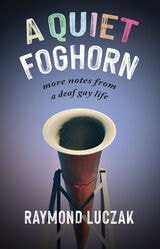
A Quiet Foghorn
More Notes from a Deaf Gay LifeRaymond Luczak
Gallaudet University Press, 2022
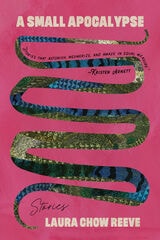
A Small Apocalypse
StoriesLaura Chow Reeve
Northwestern University Press, 2024
In her debut short-story collection A Small Apocalypse, Laura Chow Reeve examines cultural inheritance, hybridity, queerness, and the stickiness of home with an eye for both the uncanny and the realistic: human bodies become reptilian, queer ghosts haunt their friends, a young woman learns to pickle memories, and a theater floods during an apocalyptic movie marathon. The characters in A Small Apocalypse weave in and out of its fourteen stories, confronting their sense of otherness and struggling to find new ways of being and belonging. Heavily steeped in the swampy, feral heat of Florida, these stories venture beyond the problems of constructing an identity to the frontier of characters living their truth in a world that doesn’t yet have a place for them.
A Small Boy and Others
Imitation and Initiation in American Culture from Henry James to Andy WarholMichael Moon
Duke University Press, 1998
Moon illuminates the careers of James, Warhol, and others by examining the imaginative investments of their protogay childhoods in their work in ways that enable new, more complex cultural readings. He deftly engages notions of initiation and desire not within the traditional framework of “sexual orientation” but through the disorienting effects of imitation. Whether invoking the artist Joseph Cornell’s early fascination with the Great Houdini or turning his attention to James’s self-described “initiation into style” at the age of twelve—when he first encountered the homoerotic imagery in paintings by David, Géricault, and Girodet—Moon reveals how the works of these artists emerge from an engagement that is obsessive to the point of “queerness.”
Rich in historical detail and insistent in its melding of the recent with the remote, the literary with the visual, the popular with the elite, A Small Boy and Others presents a hitherto unimagined tradition of brave and outrageous queer invention. This long-awaited contribution from Moon will be welcomed by all those engaged in literary, cultural, and queer studies.
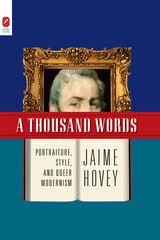
A THOUSAND WORDS
PORTRAITURE, STYLE, AND QUEER MODERNISMJaime Hovey
The Ohio State University Press, 2006
Portraiture speaks to the complex relationship between identity, sexuality, and art, and the presence of so many portraits in this era suggests that sexual, gender, and racial aspects of character, personality, and personal identity were of major concern to most modernist writers. Yet it took most of the twentieth century for critical work to appear that meaningfully explored these themes, and very little has been said about the queerness of literary portraiture. This book demonstrates that literary portraiture is enamored of its own self-consciousness, with the pleasures of looking at itself seeing itself, and that its texts circulate this pleasure between writers, narrators and other characters, and readers as a perverse aesthetics
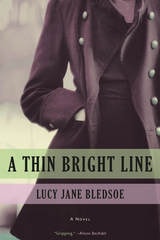
A Thin Bright Line
Lucy Jane Bledsoe
University of Wisconsin Press, 2016
Leaving behind the wreckage of a relationship, Lucybelle finds solace in working for the visionary scientist who is extracting the first-ever polar ice cores. The lucidity of ice is calming and beautiful. But the joyful pangs of a new love clash with the impossible compromises of queer life. If exposed, she could lose everything she holds dear.
Based on the hidden life of the author’s aunt and namesake, A Thin Bright Line is a love story set amid Cold War intrigue, the origins of climate research, and the nascent civil rights movement. Poignant, brilliant, and moving, it reminds us to act on what we love, not just wish for it.
"It triumphs as an intimate and humane evocation of day-to-day life under inhumane circumstances."—New York Times Book Review
“Bledsoe covers a lot of ground here, imagining her intellectual aunt’s relationship to the queer cultural transformations of the 1950s, as well as the paranoia of the Cold War era.”—San Francisco Chronicle
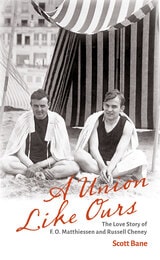
A Union Like Ours
The Love Story of F. O. Matthiessen and Russell CheneyScott Bane
University of Massachusetts Press, 2022
After a chance meeting aboard the ocean liner Paris in 1924, Harvard University scholar and activist F. O. Matthiessen and artist Russell Cheney fell in love and remained inseparable until Cheney’s death in 1945. During the intervening years, the men traveled throughout Europe and the United States, achieving great professional success while contending with serious personal challenges, including addiction, chronic disease, and severe depression.
During a hospital stay, years into their relationship, Matthiessen confessed to Cheney that “never once has the freshness of your life lost any trace of its magic for me. Every day is a new discovery of your wealth.” Situating the couple’s private correspondence alongside other sources, Scott Bane tells the remarkable story of their relationship in the context of shifting social dynamics in the United States. From the vantage point of the present day, with marriage equality enacted into law, Bane provides a window into the realities faced by same-sex couples in the early twentieth century, as they maintained relationships in the face of overt discrimination and the absence of legal protections.
A Visit to Priapus and Other Stories
Glenway Wescott; Edited and with an introduction by Jerry Rosco; Foreword by Wendy Moffat
University of Wisconsin Press, 2013
Finalist, Gay General Fiction, Lambda Literary Awards
Aberrations In Black
Toward a Queer of Color CritiqueRoderick A. Ferguson
University of Minnesota Press, 2003
A hard-hitting look at the regulation of sexual difference and its role in circumscribing African American culture
The sociology of race relations in America typically describes an intersection of poverty, race, and economic discrimination. But what is missing from the picture—sexual difference—can be as instructive as what is present. In this ambitious work, Roderick A. Ferguson reveals how the discourses of sexuality are used to articulate theories of racial difference in the field of sociology. He shows how canonical sociology—Gunnar Myrdal, Ernest Burgess, Robert Park, Daniel Patrick Moynihan, and William Julius Wilson—has measured African Americans’s unsuitability for a liberal capitalist order in terms of their adherence to the norms of a heterosexual and patriarchal nuclear family model. In short, to the extent that African Americans’s culture and behavior deviated from those norms, they would not achieve economic and racial equality.
Aberrations in Black tells the story of canonical sociology’s regulation of sexual difference as part of its general regulation of African American culture. Ferguson places this story within other stories—the narrative of capital’s emergence and development, the histories of Marxism and revolutionary nationalism, and the novels that depict the gendered and sexual idiosyncrasies of African American culture—works by Richard Wright, Ralph Ellison, James Baldwin, Audre Lorde, and Toni Morrison. In turn, this book tries to present another story—one in which people who presumably manifest the dysfunctions of capitalism are reconsidered as indictments of the norms of state, capital, and social science. Ferguson includes the first-ever discussion of a new archival discovery—a never-published chapter of Invisible Man that deals with a gay character in a way that complicates and illuminates Ellison’s project.
Unique in the way it situates critiques of race, gender, and sexuality within analyses of cultural, economic, and epistemological formations, Ferguson’s work introduces a new mode of discourse—which Ferguson calls queer of color analysis—that helps to lay bare the mutual distortions of racial, economic, and sexual portrayals within sociology.
Abuela in Shadow, Abuela in Light
Rigoberto González
University of Wisconsin Press, 2022
González travels to his abuela’s birthplace, Michoacán, Mexico, and along the way recovers his memories of a past he had tried to leave behind. A complex woman who was forced to take on maternal roles and suffered years of abuse, his grandmother simultaneously resisted traditional gender roles; she was kind yet unaffectionate, and she kept many secrets in a crowded household with little personal space. Sifting through family histories and anecdotes, González pieces together the puzzling life story of a woman who was present in her grandson’s life yet absent during his emotional journey as a young man discovering his sexuality and planning his escape from a toxic and abusive environment.
From fragments of memory and story, González ultimately creates a portrait of an unconventional yet memorable grandmother, a hard-working Indigenous Mexican woman who remained an enigma while she was alive. A grandmother, he shows, is more than what her descendants remember; she is also all that has been forgotten or never known. Through this candid exploration of his own family, González explores how we learn to remember and honor those we’ve lost.
Abundance
Sexuality’s HistoryAnjali Arondekar
Duke University Press, 2023
All There Is to Lose
Aiden Heung
Four Way Books, 2026
Marking Aiden Heung’s debut collection, All There Is to Lose is the 2024 winner of the Four Way Books Levis Prize in Poetry. The selecting judge, National Book Award Finalist Ilya Kaminsky, praises the resonant particularities and depth of feeling found in these poems, which convert “elegy [into] its driving force.” Poet and Critic Felicity Plunkett observes, “Dreams and memory move through these porous, venturesome poems. The spectral jostles with the sensual to tell ‘a story in which I could be found.’ Achily tender, they open to light, love and the jab of a joke.” Poet David Tait notes, “Unsettling and luminous, the poems preserve the memory of Village 915: its volatile seasons and hard-worn inhabitants, its headstones, spirits, and myriad forms of water. Here you’ll find not only poems of lyrical beauty, but of grim exactness.” The result is a stunning achievement of a first book, what Kaminsky identifies as an exemplar of “that ages-old mode of poetry wherein the poet uses language to break bread with the dead, to bring them back to life, if only for the moment, for a portion of the moment, an instant, before the line breaks.” Channeling the poet as medium, “I am the tension on the bow that draws the arrow,” Heung writes in “Epilogue.” “To lose myself — that is my destiny.”
All the Tiny Beauties
A NovelJenn Scott
Acre Books, 2022
All the Tiny Beauties begins with a kitchen fire that sends the reclusive Webster Jackson to the home of his new neighbor, Colleen, who discovers him on her doorstep wearing a lacy peignoir, his house in flames. Unwilling to take responsibility for the lonely eccentric, Colleen reaches out to Webb’s estranged daughter, Debra. She also helps him find a live-in companion, a young adult reeling from the loss of her childhood friend.
Moving among perspectives and generations, we see the longings and vulnerabilities that drive and impede these characters as their stories intertwine—Webb’s first love clashing with his last; Colleen embarking on a secret affair with Debra; the older Webb and his young housemate, Hannah, forming a bond over tragedy, guilt, and his passion for baking.
Confronting the many ways they’ve failed others as well as themselves, Webb, Colleen, Hannah, and Debra slowly find ways forward and ways out. While exploring the fragile nature of our connections to one another, All the Tiny Beauties asks larger questions about the constraints society imposes that warp and wound, leading us to deny those things that make us wholly ourselves.
Along the Journey River
A MysteryCarole laFavor
University of Minnesota Press, 2017
Several sacred artifacts have gone missing from the Minnesota Red Earth Reservation and the suspect list is continuously growing. While it could be the racists from the bordering town, or a young man struggling with problems at home, or the county coroner and his cronies, the need for answers and apprehending the culprit is amplified when Jed Morriseau, the Tribal Chairman, is murdered. Investigating these mysterious occurrences because of tribal traditions and the honor of her family, Renee LaRoche works to track down the people responsible. But can she maintain her intense investigation as well as her new relationship with Samantha Salisbury, the visiting women’s studies professor at the white college nearby? Renee is caught between the traditions of her tribe and efforts to help her chimook lover accept their cultural differences.
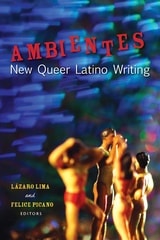
Ambientes
New Queer Latino WritingLázaro Lima and Felice Picano
University of Wisconsin Press, 2011
As the U.S. Latino population grows rapidly, and as the LGBTQ Latino community becomes more visible and a more crucial part of our literary and artistic heritage, there is an increasing demand for literature that successfully highlights these diverse lives. Edited by Lázaro Lima and Felice Picano, Ambientes is a revolutionary collection of fiction featuring stories by established authors as well as emerging voices that present a collective portrait of gay, lesbian, bisexual, and transgender experience in America today. With a preface by Picano and an introduction by Lima that sets the stage for understanding Latino literary and cultural history, this is the first anthology to cross cultural and regional borders by offering a wide variety of urban, rural, East Coast, West Coast, and midwestern perspectives on Latina and Latino queers from different walks of life. Stories range from sensual pieces to comical romances and from inner-city dramas fueled by street language to portraits of gay domesticity, making this a much-needed collection for many different kinds of readers. The stories in this collection reflect a vibrant and creative community and redefine received notions of “gay” and “lesbian.”
Finalist, Over the Rainbow selection, American Library Association
Finalist, LGBT Anthology, Lambda Literary Awards
Best Special Interest Books, selected by the American Association of School Librarians

Ambivalent Desires
Affect and Boys Love in ChinaLiang Ge
University of Michigan Press, 2027
Ambivalent Desires carefully investigates Chinese danmei creators’ and fans’ everyday affective experiences in the dynamic yet ambivalent boys love cultural ecology of China. Emerging in mainland China in the late 1990s and flourishing in the 2010s, danmei, also known as boys love fiction, is a genre that features male-male romances or erotica. This book offers a rich, empirically grounded account of danmei, examining the complex and embodied lived experiences of those producing and consuming male homoeroticism and framing ambivalence as an ongoing queer feminist project.
Proposing a novel theoretical framework of “the grammar of ambivalences,” Liang Ge seeks to understand how desires, affects, and queer feminist politics operate within and against the everyday heteropatriarchal and party-state conditions of postsocialist China. Ambivalent Desires attends simultaneously to the backward-looking normativities infused within danmei culture and the forward-facing transformative potential it generates, refusing the reductive binary of resistance versus escapism that has structured much existing scholarship.
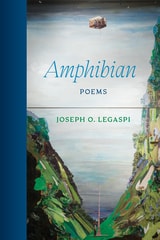
Amphibian
PoemsJoseph O. Legaspi
Northwestern University Press, 2026
Exploring queerness, belonging, and the meaning of home through the lens of a Filipino American
How does a queer brown body move through the American panorama? In Amphibian, Joseph O. Legaspi explores the metaphor of “amphibious living”—adapting, surviving, and flourishing in varying geographies—as it pertains to immigrants and to queerness. These poems draw on the natural world to illuminate personal experiences and, in turn, closely examine cultural, environmental, and societal constructs and concerns.
Legaspi searches in nature for evidence of the validity of his own existence, determined to declare his belonging. Dwelling in landscape as a guide into the interior, Amphibian journeys not only between earth, water, and air, but also into the past, cataloging an immigrant’s departures, arrivals, and returns to native soil. This moving collection is at every turn liberating, fraught, and altered.
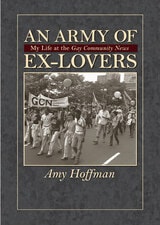
An Army of Ex-Lovers
My life at the Gay Community NewsAmy Hoffman
University of Massachusetts Press, 2007
Boston's weekly Gay Community News was “the center of the universe” during the late 1970s, writes Amy Hoffman in this memoir of gay liberation before AIDS, before gay weddings, and before The L Word. Provocative, informative, inspiring, and absurd, with a small circulation but a huge influence, Gay Community News produced a generation of leaders, writers, and friends. In addition to capturing the heady atmosphere of the times—the victories, controversies, and tragedies—Hoffman's memoir is also her personal story, written with wit and insight, of growing up in a political movement; of her deepening relationships with charismatic, talented, and sometimes utterly weird coworkers; and of trying to explain it all to her large Jewish family.
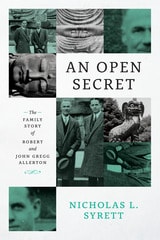
An Open Secret
The Family Story of Robert and John Gregg AllertonNicholas L. Syrett
University of Chicago Press, 2021
An Open Secret tells the striking story of these two iconoclasts, locating them among their queer contemporaries and exploring why becoming father and son made a surprising kind of sense for a twentieth-century couple who had every monetary advantage but one glaring problem: they wanted to be together publicly in a society that did not tolerate their love. Deftly exploring the nature of their design, domestic, and philanthropic projects, Nicholas L. Syrett illuminates how viewing the Allertons as both a same-sex couple and an adopted family is crucial to understanding their relationship’s profound queerness. By digging deep into the lives of two men who operated largely as ciphers in their own time, he opens up provocative new lanes to consider the diversity of kinship ties in modern US history.
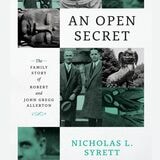
An Open Secret
The Family Story of Robert and John Gregg AllertonNicholas L. Syrett
University of Chicago Press, 2021
This is an auto-narrated audiobook edition of this book.
In 1922 Robert Allerton—described by the Chicago Tribune as the “richest bachelor in Chicago”—met a twenty-two-year-old University of Illinois architecture student named John Gregg, who was twenty-six years his junior. Virtually inseparable from then on, they began publicly referring to one another as father and son within a couple years of meeting. In 1960, after nearly four decades together, and with Robert Allerton nearing ninety, they embarked on a daringly nonconformist move: Allerton legally adopted the sixty-year-old Gregg as his son, the first such adoption of an adult in Illinois history.
An Open Secret tells the striking story of these two iconoclasts, locating them among their queer contemporaries and exploring why becoming father and son made a surprising kind of sense for a twentieth-century couple who had every monetary advantage but one glaring problem: they wanted to be together publicly in a society that did not tolerate their love. Deftly exploring the nature of their design, domestic, and philanthropic projects, Nicholas L. Syrett illuminates how viewing the Allertons as both a same-sex couple and an adopted family is crucial to understanding their relationship’s profound queerness. By digging deep into the lives of two men who operated largely as ciphers in their own time, he opens up provocative new lanes to consider the diversity of kinship ties in modern US history.
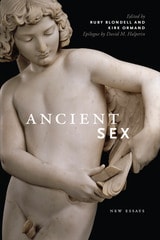
Ancient Sex
New EssaysEdited by Ruby Blondell and Kirk Ormand, epilogue by David M. Halperin
The Ohio State University Press, 2015
Rather than reopening old debates, Ancient Sex takes up Foucault’s call for discursive analysis and elucidates some of the ways that ancient Greek and Roman texts and visual arts articulate a culturally specific discourse about sexual matters. Each contributor presupposes that sexual and gendered identities are discursively produced, and teases out some of the ways that the Greeks and Romans spoke and thought about these issues. Comprising essays by emerging and established scholars, this volume emphasizes in particular: sexual discourses about women; the interaction between sexual identities and class status; gender as an unstable discursive category (even in antiquity); and the relationships between ancient and modern sexual categories.
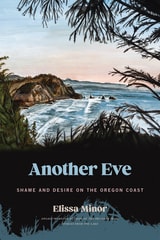
Another Eve
Shame and Desire on the Oregon CoastElissa Minor
Oregon State University Press, 2026
When she walks away from the Mormon church and a twenty-five-year marriage, Elissa Minor abandons the only life she’s ever known to embrace her identity as a queer woman. In this intimate memoir, she explores shame, desire, beauty, and acceptance. Minor realizes that her desire isn’t the problem but the solution. Finding solace outside of the church in the wilderness that surrounds her, she eventually begins to understand what it really means to be pure and worthy.
On the rugged terrain of the northern Oregon coast, Minor discovers passion and harmony in the grip of nature and in the arms of a lover who will become her wife. In the salty sea air, she learns that her own queerness—though less-charted territory—is like her love of backwoods hiking and that to accept her sexuality, she must take full pleasure in the wild that encompasses her. Poignant and powerful, Another Eve re-examines past truths and celebrates honoring oneself and living authentically. For Minor, the end of her transformation is only the beginning.
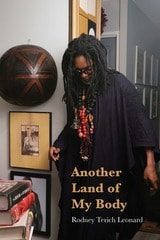
Another Land of My Body
Rodney Terich Leonard
Four Way Books, 2024
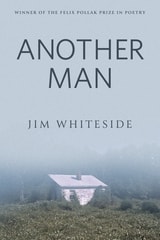
Another Man
Jim Whiteside
University of Wisconsin Press, 2026
Part reckoning with a father’s chronic illness, part coming of age in the Upper South, part meditation on the slow, painful accumulation of adulthood, Another Man considers issues of family, care, and inheritance. These powerful poems capture unexpected moments of lucidity among the desire and heartbreak of becoming oneself.
In his debut collection, Jim Whiteside astonishes with turns of phrases that pinpoint the beauty in the mundane—the “waterfalling bodies” of fish while stocking a pond—and the mundane in the tragic, as with the realization following his father’s death that “in the end so much is paperwork.” In revealing his origin story, Whiteside redefines the queer poem in a more nuanced and contemporary way, acknowledging queer life beyond conventional narratives. Filled with a zeal for life, a yearning for joy, and moments of sublime satisfaction, this collection shimmers with longing and freedom.
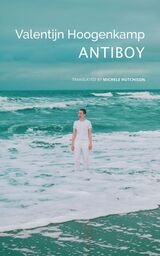
Antiboy
Valentijn Hoogenkamp
Seagull Books, 2024
When Valentijn must undergo a mastectomy because of a gene defect, he makes the decision not to have implants and adopts an in-between gender identity that feels more natural. He shaves his head and discards his wardrobe of women’s clothes, even the perfect dress his mother was so fond of. But all of this causes friction: not only are Valentijn’s doctors stumped, but friends, family, and lovers too. His trans ex helps him feel more comfortable in his new guise—not a girl, not a boy, but an antiboy—while his boyfriend draws away from the relationship. Encircled by grief and loss, Valentijn searches for the ultimate freedom to be allowed to be himself and tries to rebuild the relationships with those around him.
A refined, poetic autobiographical essay about adopting a new and truer identity, Antiboy is poignant without ever being sentimental. Valentijn finds new emotional depth and complexity in his personal relationships, providing readers with a rich and empathetic reading experience. Antiboy goes beyond the author’s own journey, becoming a nuanced exploration of human connections amid transformation.
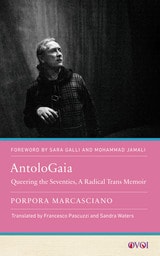
AntoloGaia
Queering the Seventies, A Radical Trans MemoirPorpora Marcasciano
Rutgers University Press, 2024
In this stirring memoir by a member of the first generation of LGBTQ+ activists in Italy, Porpora Marcasciano tells her story and shares the struggles and accomplishments of her fellow activists who achieved so much in the 1970s yet suffered devastating losses during the AIDS epidemic of the 1980s. AntoloGaia offers an insider’s look at the beginnings of the gay liberation movement in Italy and reveals how it was intimately intertwined with other forms of left-wing activism. At the same time, it powerfully conveys the queer joy of a young person from a small village first encountering the vibrant sexual minority communities of Naples, Bologna, and Rome. As Marcasciano starts to embrace her trans identity, she meets the famous anthropologist Pino Simonelli, who introduces her to Naples’s unique femminielli subculture and gives her the name Porporino, which she later shortens to Porpora. In keeping with this story of gender, sexual, and political discovery, AntoloGaia is the first piece of Italian life-writing to use gender-neutral and mixed-gender language.
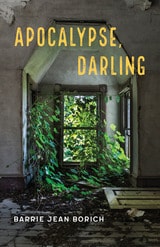
Apocalypse, Darling
Barrie Jean Borich
The Ohio State University Press, 2018
From award-winning author Barrie Jean Borich comes Apocalypse, Darling, a narrative, lyric exploration of the clash between old and new. Set in the steel mill regions of Chicago and in Northwest Indiana, the story centers on Borich’s return to a decimated landscape for a misbegotten wedding in which her spouse’s father marries his high school sweetheart. The book is a lilting journey into an ill-fated moment, where families attempt to find communion in tense gathering spaces and across their most formative disappointments. Borich tells the story of the industrial heartland that produced the steel that made American cities, but also one of the most toxic environmental sites in the world.
As concise as a poem and as sweeping as an epic novel, Apocalypse, Darling explores the intersection of American traditional and self-invented social identities and the destruction and re-greening of industrial cityscapes. Borich asks: can toxic landscapes actually be remediated and can patriarchal fathers ever really be forgiven? In a political climate where Borich is forced to daily re-enter the toxic wastelands she thought she’d long left behind, Apocalypse, Darling is an urgent collision of broken spaces, dysfunctional affections, and the reach toward familial and environmental repair.
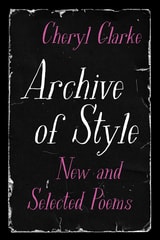
Archive of Style
New and Selected PoemsCheryl Clarke
Northwestern University Press, 2024
Award-winning poet and essayist Cheryl Clarke’s illustrious career has spanned more than four decades and culminates in Archive of Style: New and Selected Poems, a long-awaited retrospective of the indelible work of a Black feminist, community and LGBTQ activist, and educator. This collection features carefully curated poems from Narratives: Poems in the Tradition of Black Women (1982), Living as a Lesbian (1986), The Days of Good Looks: Prose and Poetry 1980-2005 (2006), By My Precise Haircut (2016), and Targets (2019). Together these works show a brilliant thinker who has profoundly impacted generations of writers and activists.
Clarke’s poetry and essays, centered around the Black, lesbian, feminist experience, have attracted an audience around the world. Her essays, “Lesbianism: an Act of Resistance” and “The Failure to Transform: Homophobia in the Black Community” revolutionized the thinking about lesbians of color and the struggle against homophobia. Her poetry and non-fiction have been reprinted in numerous anthologies and assigned in women and sexuality courses globally. Having published since 1977, Clarke and her work have become a foundational part of LGBTQ literature and activism. Archive of Style is a celebration and homage to one of American literature’s Black Women literary warriors.

Are Girls Necessary?
Lesbian Writing and Modern HistoriesJulie Abraham
University of Minnesota Press, 2008
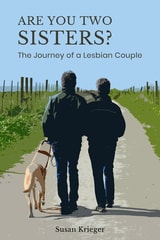
Are You Two Sisters?
The Journey of a Lesbian CoupleSusan Krieger
Temple University Press, 2022
Authored by one of the most respected figures in the field of personal ethnographic narrative, this book serves as both a memoir and a sociological study, telling the story of one lesbian couple’s lifelong journey together.
Are You Two Sisters? is Susan Krieger’s candid, revealing, and engrossing memoir about the intimacies of a lesbian couple. Krieger explores how she and her partner confront both the inner challenges of their relationship and the invisibility of lesbian identity in the larger world.
Using a lively novelistic and autoethnographic approach that toggles back and forth in time, Krieger reflects on the evolution of her forty-year relationship. She describes building a life together, from sharing pets and travels to getting married. Are You Two Sisters? addresses not only questions of gender and sexuality, but also of disability, as Krieger explores how the couple adapts to her increasing blindness.
Krieger’s title comes from a question asked by a stranger outside a remote desert bar as she and her partner traveled in the Southwest. Her apprehension about answering that question suggests how, even after the legalization of gay marriage, lesbianism often remains hidden—an observation that makes Krieger’s poignant narrative all the more moving.
Art Is Everything
A NovelYxta Maya Murray
Northwestern University Press, 2021
In her funny, idiosyncratic, and propulsive new novel, Art Is Everything, Yxta Maya Murray offers us a portrait of a Chicana artist as a woman on the margins. L.A. native Amanda Ruiz is a successful performance artist who is madly in love with her girlfriend, a wealthy and pragmatic actuary named Xōchitl. Everything seems under control: Amanda’s grumpy father is living peacefully in Koreatown; Amanda is about to enjoy a residency at the Guggenheim Museum in New York and, once she gets her NEA, she’s going to film a groundbreaking autocritical documentary in Mexico.
But then everything starts to fall apart when Xōchitl’s biological clock begins beeping, Amanda’s father dies, and she endures a sexual assault. What happens to an artist when her emotional support vanishes along with her feelings of safety and her finances? Written as a series of web posts, Instagram essays, Snapchat freakouts, rejected Yelp reviews, Facebook screeds, and SmugMug streams-of-consciousness that merge volcanic confession with eagle-eyed art criticism, Art Is Everything shows us the painful but joyous development of a mid-career artist whose world implodes just as she has a breakthrough.
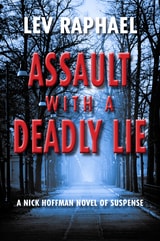
Assault with a Deadly Lie
A Nick Hoffman Novel of SuspenseLev Raphael
University of Wisconsin Press, 2014
A novel of suspense set in the academic world, Assault with a Deadly Lie probes the disturbing psychological impact of slander, harassment, stalking, police brutality, and the loss of personal safety. What will Nick do when his world threatens to collapse? How can he reestablish order in a suddenly chaotic life?
Assault with a Deadly Lie, the eighth installment of Lev Raphael's Nick Hoffman Mysteries, propels the series to a new level of danger and intrigue as Nick and Stefan are catapulted out of their tranquil existence by shocking accusations.
Finalist, Midwest Book Award for Mystery/Thriller Fiction, Midwest Independent Publishers Association
“A riveting great read for mystery/suspense fans, author Lev Raphael once again documents his impressive gifts as a storyteller, holding the reader’s rapt attention from beginning to end with unexpected plot twists and surprise twists.”—Jack Mason, Midwest Book Review
“Raphael portrays with frightening power the wrenching experience of victimization by the corporatized, PR-prioritized groves of academia, where both men teach, and by local authorities militarized into SWAT teams practicing police brutality. . . . The compelling core of this unusual novel is Raphael’s depiction of the agonizing reality of victims’ shame, in which someone ‘feels doubly exposed talking about the violation’ and so says nothing.”—Booklist
“Professor Nick Hoffman learns that even tenure can’t guarantee real security.”—Kirkus Reviews
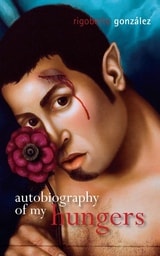
Autobiography of My Hungers
Rigoberto González
University of Wisconsin Press, 2019
Bill Whitehead Award for Lifetime Literary Achievement, Publishing Triangle
“Told in a series of revealing vignettes and poems, González’s Autobiography of my Hungers turns moments of need and want into revelations of truth and self-awareness, creating the portrait of an artist that is complex if not entirely complete.”—El Paso Times
“Through his provocative vignettes, González communicates a lifetime of struggle for affirmation and self-acceptance.”—Make/Shift
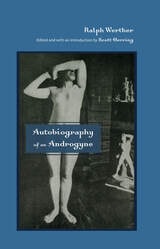
Autobiography of an Androgyne
Ralph Werther and Edited by Scott Herring
Rutgers University Press, 2008