Results by title
24 books match the query 'Later Years'
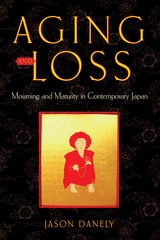
Aging and Loss
Mourning and Maturity in Contemporary JapanDanely, Jason
Rutgers University Press, 2015
Based on nearly a decade of research, Aging and Loss examines how the landscape of aging is felt, understood, and embodied by older adults themselves. In detailed portraits, anthropologist Jason Danely delves into the everyday lives of older Japanese adults as they construct narratives through acts of reminiscence, social engagement and ritual practice, and reveals the pervasive cultural aesthetic of loss and of being a burden.
Aging and Old Age
Richard A. Posner
University of Chicago Press, 1995
Aging and Old Age offers fresh insight into a wide range of social and political issues relating to the elderly, such as health care, crime, social security, and discrimination. From the dread of death to the inordinate law-abidingness of the old, from their loquacity to their penny-pinching, Posner paints a surprisingly rich, revealing, and unsentimental portrait of the millions of elderly people in the United States. He explores issues such as age discrimination in employment, creativity and leadership as functions of age, and the changing social status of the elderly. Why are old people, presumably with less to lose, more unwilling to take risks than young people? Why don't the elderly in the United States command the respect and affection they once did and still do in other countries? How does aging affect driving and criminal records? And how does aging relate to creativity across different careers?
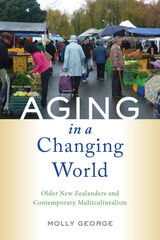
Aging in a Changing World
Older New Zealanders and Contemporary MulticulturalismMolly George
Rutgers University Press, 2022
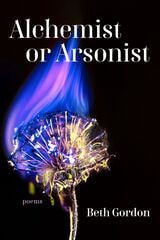
Alchemist or Arsonist
PoemsBeth Gordon
Acre Books, 2027
A feminist poetry collection re-examining the figure of the crone and upending the patriarchal expectations she embodies.
In Alchemist or Arsonist, her second full-length collection, Beth Gordon supercharges the term crone, demonstrating in image-rich poems the magical strength of older women. The Crone is frank about the realities of aging—including plucking chin hairs—yet she also surprises, warning the reader: “The tiger has always been there. . . . She is right in front of you.” Taking afternoon shots of mescal and waiting in line for Mexican street corn, she contemplates Captcha pictures, AI, and tattoos.
The book expands its concerns in several long poems and sequences, encompassing the full range of human experience. “The Secret Fate of All Life,” a series of golden shovels based on quotes from the HBO show True Detective, moves into the surreal to represent language’s failure to describe the death of an infant, and how time can be displaced by grief. Other works explore the transformation that can come from tragedy, the perils of marriage and other relationships, and the complicated conversation older and younger versions of the self would have with each other.
Gordon’s candid, wry, uncompromising voice is both refreshing and bracing, and the poems perform alchemy as they set fire to traditional expectations. With an undercurrent of violence and murder, the book reveals the ultimate consequences of patriarchy. “Alchemist or arsonist: the end is the same,” The Crone tells us. “Something becomes something else.”
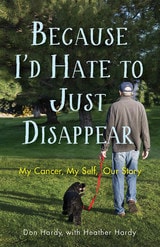
Because I'd Hate to Just Disappear
My Cancer, My Self, Our StoryDon Hardy
University of Nevada Press, 2018
Because I’d Hate to Just Disappear is a portrait of a husband and wife, Don and Heather Hardy, thrown into the physical and emotional machinery of Don being diagnosed with leukemia and going through chemotherapy and treatment over a period of close to two years.
In this thoughtful and exquisite account, Don and Heather narrate Don’s struggle in real-time. Disarmingly honest, they recount each intimate stage of a couple living through cancer together, the mental and physical struggles, the humor and visceral emotion to reveal how two very different personalities shape—and are shaped by—the experience of cancer and its treatment. Through these moments emerge a constant flow of human kindness and discovery that lifts them each day.

Burn
Sara Henning
Southern Illinois University Press, 2024
A lyrical meditation on time, survival, and merciful moments of joy
Sara Henning’s Burn draws readers deep into the moments that make us, focusing on instances of crisis and renewal to explore our relation to time and lived experience. In these poems, we follow a speaker as she works through the loss of young love, the death of her parents, marriage’s hardness and beauty, sexual assault, and the devastation of a pandemic—evolutions of trauma that fracture time and alter perception. Twinned with these extremes are shimmering manifestations of joy only an imperfect world can make possible.
Burn magnifies the way time leaves us both the victim and the victor of our realities. The blaze of her late-mother’s Tiffany lamps sends the speaker back to childhood, where she unearths mica from the schoolyard dirt. The devastation of an ecological crisis, the annihilating act of rape, and the unsolved disappearance of a caretaker all level the speaker’s world and upend her place in it, forcing her to reconstitute reality from what remains. In poems which summon the spirit of Stephen Hawking’s A Brief History of Time, this collection walks through the physics of temporality as refracted through love, loss, and grief, so we better understand its effect on our lives. Through this insight, Henning introduces a new way of being in the world.
A work of advocacy and uplift, Burn shines with the vibrant possibilities of narrative lyric poetry as it forges a path from grief to hope.
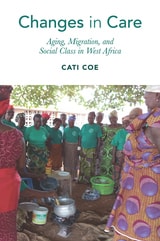
Changes in Care
Aging, Migration, and Social Class in West AfricaCati Coe
Rutgers University Press, 2022
There is a short film that accompanies the book, “Making Happiness: Older People Organize Themselves” (2020), an 11-minute film by Cati Coe. Available at: https://doi.org/doi:10.7282/t3-thke-hp15
Embracing Age
How Catholic Nuns Became Models of Aging WellAnna I. Corwin
Rutgers University Press, 2021
Embracing Age: How Catholic Nuns Became Models of Aging Well examines a community of individuals whose aging trajectories contrast mainstream American experiences. In mainstream American society, aging is presented as a “problem,” a state to be avoided as long as possible, a state that threatens one’s ability to maintain independence, autonomy, control over one’s surroundings. Aging “well” (or avoiding aging) has become a twenty-first century American preoccupation. Embracing Age provides a window into the everyday lives of American Catholic nuns who experience longevity and remarkable health and well-being at the end of life. Catholic nuns aren’t only healthier in older age, they are healthier because they practice a culture of acceptance and grace around aging. Embracing Age demonstrates how aging in the convent becomes understood by the nuns to be a natural part of the life course, not one to be feared or avoided. Anna I. Corwin shows readers how Catholic nuns create a cultural community that provides a model for how to grow old, decline, and die that is both embedded in American culture and quite distinct from other American models.
Instructor's Guide is available at no cost (https://www.rutgersuniversitypress.org/media/wysiwyg/documents/corwin_instructor_guide_final.pdf).
Open access edition funded by the National Endowment for the Humanities.
The text of this book is licensed under a Creative Commons Attribution NonCommercial-NoDerivatives 4.0 International License: https://creativecommons.org/licenses/by-nc-nd/4.0/
Download open access ebook here (https://www.rutgersuniversitypress.org/media/wysiwyg/documents/embracing_age_open_access.pdf).
Ending Ageism, or How Not to Shoot Old People
Gullette, Margaret Morganroth
Rutgers University Press, 2017
When the term “ageism” was coined in 1969, many problems of exclusion seemed resolved by government programs like Social Security and Medicare. As people live longer lives, today’s great demotions of older people cut deeper into their self-worth and human relations, beyond the reach of law or public policy. In Ending Ageism, or How Not to Shoot Old People, award-winning writer and cultural critic Margaret Morganroth Gullette confronts the offenders: the ways people aging past midlife are portrayed in the media, by adult offspring; the esthetics and politics of representation in photography, film, and theater; and the incitement to commit suicide for those with early signs of “dementia.”
In this original and important book, Gullette presents evidence of pervasive age-related assaults in contemporary societies and their chronic affects. The sudden onset of age-related shaming can occur anywhere—the shove in the street, the cold shoulder at the party, the deaf ear at the meeting, the shut-out by the personnel office or the obtuseness of a government. Turning intimate suffering into public grievances, Ending Ageism, Or How Not to Shoot Old People effectively and beautifully argues that overcoming ageism is the next imperative social movement of our time.
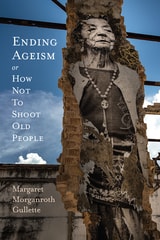
About the cover image:
This elegant, dignified figure--Leda Machado, a Cuban old enough to have seen the Revolution--once the center of a vast photo mural, is now a fragment on a ruined wall. Ageism tears down the structures that all humans need to age well; to end it, a symbol of resilience offers us all brisk blue-sky energy.
“Leda Antonia Machado” from “Wrinkles of the City, 2012.”
Piotr Trybalski / Trybalski.com. Courtesy of the artist.
A Declaration of Grievances
"A Declaration of Grievances" was written by Margaret Morganroth Gullette and is excerpted from her book Ending Ageism, or How Not to Shoot Old People (2017, Rutgers University Press). The poster was designed by Carolyn Kerchof.
- A Declaration of Grievances (in English): https://d3tto5i5w9ogdd.cloudfront.net/wp-content/uploads/2023/01/15175130/A-Declaration-of-Grievances_Eng.pdf
- A Declaration of Grievances (in Spanish): https://d3tto5i5w9ogdd.cloudfront.net/wp-content/uploads/2023/01/15175131/A-Declaration-of-Grievances_Spanish.pdf
- A Declaration of Grievances (in French): https://d3tto5i5w9ogdd.cloudfront.net/wp-content/uploads/2023/01/15175130/A-Declaration-of-Grievances_French.pdf
- A Declaration of Grievances (in German): https://d3tto5i5w9ogdd.cloudfront.net/wp-content/uploads/2023/01/15175131/A-Declaration-of-Grievances_German.pdf
Print the PDF (make sure to click "fit to page") and hang the Declaration up in your home or place of work. Please share this link with other people you know who care about the rights of older persons. Share on social media with the hashtags #ADeclarationOfGrievances and #EndingAgeismGullette.
For more information, an excerpt, links to reviews, and special offers on this book, go to: https://www.rutgersuniversitypress.org/ending-ageism
Related website: (https://www.brandeis.edu/wsrc/scholars/profiles/gullette.html)
Grandmotherhood
The Evolutionary Significance of the Second Half of Female LifeVoland, Eckart
Rutgers University Press, 2014
By the year 2030, the average life expectancy of women in industrialized countries could reach ninety—exceeding that of men by about ten years. At the present time, postmenopausal women represent more than fifteen percent of the world’s population and this figure is likely to grow.
From an evolutionary perspective, these demographic numbers pose some intriguing questions. Darwinian theory holds that a successful life is measured in terms of reproduction. How is it, then, that a woman’s lifespan can greatly exceed her childbearing and childrearing years? Is this phenomenon simply a byproduct of improved standards of living, or do older women—grandmothers in particular—play a measurable role in increasing their family members’ biological success?
Until now, these questions have not been examined in a thorough and comprehensive manner. Bringing togethertheoretical and empirical work byinternationally recognized scholars in anthropology, psychology, ethnography, and the social sciences, Grandmotherhood explores the evolutionary purpose and possibilities of female post-generative life. Students and scholars of human evolution, anthropology, and even gerontology will look to this volume as a major contribution to the current literature in evolutionary studies.
Gray Matters
Finding Meaning in the Stories of Later LifeEllyn Lem
Rutgers University Press, 2020
Finalist for the 2021 American Book Fest Best Book Awards
Aging is one of the most compelling issues today, with record numbers of seniors over sixty-five worldwide. Gray Matters: Finding Meaning in the Stories of Later Life examines a diverse array of cultural works including films, literature, and even art that represent this time of life, often made by people who are seniors themselves. These works, focusing on important topics such as housing, memory loss, and intimacy, are analyzed in dialogue with recent research to explore how “stories” illuminate the dynamics of growing old by blending fact with imagination. Gray Matters also incorporates the life experiences of seniors gathered from over two hundred in-depth surveys with a range of questions on growing old, not often included in other age studies works. Combining cultural texts, gerontology research, and observations from older adults will give all readers a fuller picture of the struggles and pleasures of aging and avoids over-simplified representations of the process as all negative or positive.
Late Stage
Theatrical Perspectives on Age and AgingEdited by Benjamin Gillespie and Cindy Rosenthal, with Elinor Fuchs
University of Michigan Press, 2026
Maturing with Moxie
A Woman’s Guide to Life after 60Jan Cannon
University Press of New England, 2018
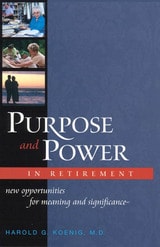
Purpose & Power In Retirement
New Opportunities for Meaning and SignificanceHarold Koenig
Templeton Press, 2003
Eighty million baby boomers are heading toward retirement. Some are retiring now, either out of choice or because they have been laid off. Others will work for a few more years until their retirement plans kick in, until they feel they can retire, or until they're forced to retire. Whatever their age at retirement, they will have better health and live longer than their parents. And each of them will face these questions:
•Do I want a reason to get up in the morning and be excited about the day ahead?•Do I still want to make a difference in the world?
They need a vision—a goal that takes into account their experience, wisdom, strengths, and limitations, and gives purpose to their lives.
Dr. Harold G. Koenig, with expertise in the fields of geriatrics, mental health, and religion, explains that the notion of retirement was in fact a marketing tool developed in the post–World War II period. Continuing today, society's image of retirement is based largely on myths, such as: things will get better when you retire—you'll be able to do everything you wanted to but couldn't when you worked. In fact, these beliefs can be harmful, leading to emotional issues, identity crises, and problems with physical health.
Citing current scientific and medical research, Koenig illustrates how having a purpose motivates and energizes people in their retirement years. He presents a step-by-step guide to identifying a goal toward which they can strive. And he shows how striving for that goal in itself brings meaning, satisfaction, and a sense of reward to retirement years.
"Finding purpose is more urgent than ever during the retirement years, when the search for purpose becomes one of the deepest of human longings," says Koenig. His Purpose and Power in Retirement is an invaluable resource for everyone heading toward retirement, and for anyone seeking meaning in life.
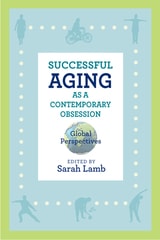
Successful Aging as a Contemporary Obsession
Global PerspectivesLamb, Sarah
Rutgers University Press, 2017
The contributors to Successful Aging as a Contemporary Obsession explore how the successful aging movement is playing out across five continents. Their chapters investigate a variety of people, including Catholic nuns in the United States; Hindu ashram dwellers; older American women seeking plastic surgery; aging African-American lesbians and gay men in the District of Columbia; Chicago home health care workers and their aging clients; Mexican men foregoing Viagra; dementia and Alzheimer sufferers in the United States and Brazil; and aging policies in Denmark, Poland, India, China, Japan, and Uganda. This book offers a fresh look at a major cultural and public health movement of our time, questioning what has become for many a taken-for-granted goal—aging in a way that almost denies aging itself.
The Essential Eldercare Handbook for Nevada
Kim Boyer
University of Nevada Press, 2014
Boyer and Shapiro provide Nevada-specific information\--medical, legal, and financial\--on the wide range of problems that arise during the elder years. Case studies show how a typical family copes with troubles such as failing health or financial cares and what options they have. This guide will help any Nevada resident plan for their own senior years and take care of aging parents, spouses, and other loved ones.
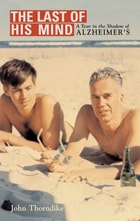
The Last of His Mind
A Year in the Shadow of Alzheimer’sJohn Thorndike
Ohio University Press, 2011
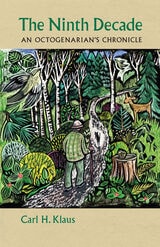
The Ninth Decade
An Octogenarian’s ChronicleKlaus, Carl H.
University of Iowa Press, 2021
The multi-year scope of his chronicle reveals the numerous physical and mental problems that arise during octogenarian life and how eighty-year-olds have dealt with those challenges. The Ninth Decade is a unique, first-hand source of information for anyone in their sixties, seventies, or eighties, as well as for persons devoted to care of the aged. Though the challenges of octogenarian life often require specialized care, The Ninth Decade also shows the pleasures of it to be so special as to have inspired Lillian Hellman’s paradoxical description of “longer life” as “the happy problem of our time.”
The Third and Only Way
Reflections on Staying AliveHelen Bevington
Duke University Press, 1996
The unique Bevington way of autobiography recreates lessons and insights of other lives, historical figures, and compelling incidents, and combines them in a narrative that follows the emotional currents of her life. Evoking a wide range of historical and literary figures, including Chekhov, Marcus Aurelius, Flannery O’Connor, Simone de Beauvoir, Thoreau, Beatrix Potter, Sappho, Yeats, Alexander the Great, Montaigne, Saint Cecilia, Virginia Woolf, Liv Ullmann, and many others, Bevington finds in these lives a path that has guided her search away from solitude. Through her reflections on the ten years that followed her son’s death, we become aware of how far she has traveled, how the search has brightened, how she has eloquently evolved into old age. In the end she is sitting, like the Buddha, under her own fig tree, waiting not for death but for further illumination.
An original contemplation of the universal dilemmas and tragedies of existence, The Third and Only Way is at once warm, funny, and inspiring—full of learning and wisdom.
There Was an Old Woman
Reflections on These Strange, Surprising, Shining YearsAndrea Carlisle
Oregon State University Press, 2023
In these personal essays, Carlisle looks for new ways to bring herself more fully to this time of life, such as daily walks with other women and connecting to the natural world that surrounds her houseboat on an Oregon river at the foot of a forest. She writes about experiences shared with many, if not most, older women: wondering at her body’s transformation, discovering new talents, caregiving, facing loss, tuning in to life patterns and drawing strength through understanding them, letting go (or not) of pieces of the past, and facing other changes large and small. Those curious about, approaching, or living in old age will find wisdom and insight in her unique perspective.
In a voice that rings with clarity, humor, humility, Carlisle shows us that Old Age is not another country where we can expect to find The Old Woman grimly waiting, but is instead an expansion of the borders in the country we’re most familiar with: ourselves.
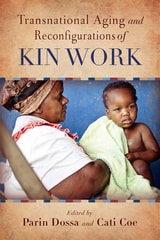
Transnational Aging and Reconfigurations of Kin Work
Dossa, Parin
Rutgers University Press, 2017
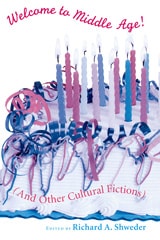
Welcome to Middle Age!
(And Other Cultural Fictions)Edited by Richard A. Shweder
University of Chicago Press, 1998
In this volume, anthropologists, behavioral scientists, and historians explore topics ranging from the Western ideology of "midlife decline" to cultural representations of mature adulthood that operate without the category of middle age. The result is a fascinating, panoramic collection that explores the myths surrounding and the representations of mature adulthood and of those years in the life span from thirty to seventy.
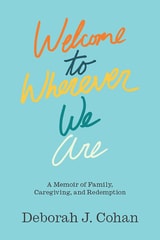
Welcome to Wherever We Are
A Memoir of Family, Caregiving, and RedemptionDeborah J. Cohan
Rutgers University Press, 2020
ESS Public Sociology Award
Recommended Book in Domestic Violence by DomesticShelters.org
How do you go about caregiving for an ill and elderly parent with a lifelong history of abuse and control, intertwined with expressions of intense love and adoration? How do you reconcile the resulting ambivalence, fear, and anger?
Welcome to Wherever We Are is a meditation on what we hold onto, what we let go of, how we remember others and ultimately how we’re remembered. Deborah Cohan shares her story of caring for her father, a man who was simultaneously loud, gentle, loving and cruel and whose brilliant career as an advertising executive included creating slogans like “Hey, how ‘bout a nice Hawaiian punch?” Wrestling with emotional extremes that characterize abusive relationships, Cohan shows how she navigated life with a man who was at once generous and affectionate, creating magical coat pockets filled with chocolate kisses when she was a little girl, yet who was also prone to searing, vicious remarks like “You’d make my life easier if you’d commit suicide.”
In this gripping memoir, Cohan tells her unique personal story while also weaving in her expertise as a sociologist and domestic abuse counselor to address broader questions related to marriage, violence, divorce, only children, intimacy and loss. A story most of us can relate to as we reckon with past and future choices against the backdrop of complicated family dynamics, Welcome to Wherever We Are is about how we might come to live our own lives better amidst unpredictable changes through grief and healing.
Questions for Discussion (https://d3tto5i5w9ogdd.cloudfront.net/wp-content/uploads/2020/05/11140346/Cohan_Discussion.docx)

Women among Women
Anthropological Perspectives on Female Age HierarchiesEdited by Jeanette Dickerson-Putman and Judith K. Brown: Foreword by Nancy Foner
University of Illinois Press, 1994