Results by title
8 books match the query 'Latin literature, Medieval and modern'
Catalogus Translationum et Commentariorum, Volume 8
Virginia Brown
Catholic University of America Press, 1960
Considered a definitive source for scholars and students, this highly acclaimed series illustrates the impact of Greek and Latin texts on the Middle Ages and Renaissance.
[more]
Catalogus Translationum et Commentariorum, Volume 9
Virginia Brown
Catholic University of America Press, 1960
Considered a definitive source for scholars and students, this highly acclaimed series illustrates the impact of Greek and Latin texts on the Middle Ages and Renaissance.
[more]
Humanism and Secularization
From Petrarch to VallaRiccardo Fubini
Duke University Press, 2003
The Renaissance movement known as humanism eventually spread from Italy through all of western Europe, transforming early modern culture in ways that are still being felt and debated. Central to these debates—and to this book—is the question of whether (and how) the humanist movement contributed to the secularization of Western cultural traditions at the end of the Middle Ages. A preeminent scholar of Italian humanism, Riccardo Fubini approaches this question in a new way—by redefining the problem of secularization more carefully to show how humanists can at once be secularizers and religious thinkers. The result is a provocative vision of the humanist movement.
Humanism and Secularization offers a nuanced account of humanists contesting medieval ideas about authority not in order to reject Christianity or even orthodoxy, but to claim for themselves the right to define what it meant to be a Christian. Fubini analyzes key texts by major humanists—isuch as Petrarch, Poggio, and Valla—from the first century of the movement. As he subtly works out these authors’ views on religion and the Church from both biographical and textual information, Fubini reveals in detail the new historical consciousness that animated the humanists in their reading of classical and patristic texts. His book as a whole shows convincingly just how radical the humanism of the first half of the fifteenth century was and how sharply it challenged well-entrenched ideas and institutions. Appearing here in English for the first time, his work provides a model set of readings of humanist texts and a critical perspective on Italian humanism that will alter and enrich discussion and understanding of the nature of the humanist movement.
Humanism and Secularization offers a nuanced account of humanists contesting medieval ideas about authority not in order to reject Christianity or even orthodoxy, but to claim for themselves the right to define what it meant to be a Christian. Fubini analyzes key texts by major humanists—isuch as Petrarch, Poggio, and Valla—from the first century of the movement. As he subtly works out these authors’ views on religion and the Church from both biographical and textual information, Fubini reveals in detail the new historical consciousness that animated the humanists in their reading of classical and patristic texts. His book as a whole shows convincingly just how radical the humanism of the first half of the fifteenth century was and how sharply it challenged well-entrenched ideas and institutions. Appearing here in English for the first time, his work provides a model set of readings of humanist texts and a critical perspective on Italian humanism that will alter and enrich discussion and understanding of the nature of the humanist movement.
[more]
Kiss My Relics
Hermaphroditic Fictions of the Middle AgesDavid Rollo
University of Chicago Press, 2011
Conservative thinkers of the early Middle Ages conceived of sensual gratification as a demonic snare contrived to debase the higher faculties of humanity, and they identified pagan writing as one of the primary conduits of decadence. Two aspects of the pagan legacy were treated with particular distrust: fiction, conceived as a devious contrivance that falsified God’s order; and rhetorical opulence, viewed as a vain extravagance. Writing that offered these dangerous allurements came to be known as “hermaphroditic” and, by the later Middle Ages, to be equated with homosexuality.
At the margins of these developments, however, some authors began to validate fiction as a medium for truth and a source of legitimate enjoyment, while others began to explore and defend the pleasures of opulent rhetoric. Here David Rollo examines two such texts—Alain de Lille’s De planctu Naturae and Guillaume de Lorris and Jean de Meun’s Roman de la Rose—arguing that their authors, in acknowledging the liberating potential of their irregular written orientations, brought about a nuanced reappraisal of homosexuality. Rollo concludes with a consideration of the influence of the latter on Chaucer’s Pardoner’s Prologue and Tale.
[more]
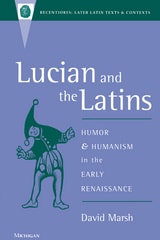
Lucian and the Latins
Humor and Humanism in the Early RenaissanceDavid Marsh
University of Michigan Press, 1998
The works of the second-century Greek satirist Lucian enjoyed a tremendous vogue in the early Renaissance. His Greek prose furnished one of the first texts in the Florentine classroom around 1400, and it aroused as much interest as Plato. At first praised as an eloquent rhetorician, Lucian was soon appreciated for his irreverent wit, which inspired new satirical and paradoxical currents in Renaissance literature.
Until now, no study has attempted to connect the Latin translators and imitators of Lucian with his wider European influence. In Lucian and the Latins, David Marsh describes how Renaissance authors rediscovered the comic writings of Lucian. He traces how Lucianic themes and structures made an essential contribution to European literature beginning with a survey of Latin translations and imitations, which gave new direction to European letters in the fifteenth and sixteenth centuries. The Lucianic dialogues of the dead and dialogues of the gods were immensely popular, despite the religious backlash of the sixteenth century. The paradoxical encomium, represented by Lucian's "The Fly" and "The Parasite," inspired so-called serious humanists like Leonardo Bruni and Guarino of Verona. Lucian's "True Story" initiated the genre of the fantastic journey, which enjoyed considerable popularity during the Renaissance age of discovery. Humanist descendants of this work include Thomas More's Utopia and much of Rabelais' Pantagruel.
Lucian and the Latins will attract readers interested in a wide variety of subjects: the classical tradition, the early Italian Renaissance, the origins of modern European literature, and the uses of humor and satire as instruments of cultural critique.
David Marsh is Professor of Italian, Rutgers University.
[more]
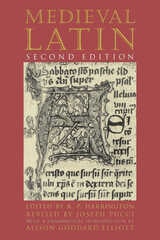
Medieval Latin
Second EditionEdited by K. P. Harrington
University of Chicago Press, 1997
K. P. Harrington's Mediaeval Latin, the standard medieval Latin anthology used in the United States since its initial publication in 1925, has now been completely revised and updated for today's students and teachers by Joseph Pucci. This new edition of the classic anthology retains its breadth of coverage, but increases its depth by adding fourteen new selections, doubling the coverage of women writers, and expanding a quarter of the original selections. The new edition also includes a substantive grammatical introduction by Alison Goddard Elliott.
To help place the selections within their wider historical, social, and political contexts, Pucci has written extensive introductory essays for each of the new edition's five parts. Headnotes to individual selections have been recast as interpretive essays, and the original bibliographic paragraphs have been expanded. Reprinted from the best modern editions, the selections have been extensively glossed with grammatical notes geared toward students of classical Latin who may be reading medieval Latin for the first time.
Includes thirty-two full-page plates (with accompanying captions) depicting medieval manuscript and book production.
[more]
Scribit Mater
Marey and the Language Arts in the Literature of Medieval EnglandGeorgiana Donavin
Catholic University of America Press, 2012
While Scribit Mater highlights different medieval English understandings of the Virgin's sapient eloquence according to class, education, and gender, it demonstrates long-standing and widespread traditions acknowledging and celebrating the Mother's verbal prowess.
[more]
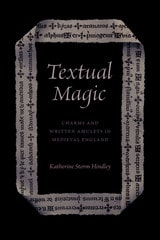
Textual Magic
Charms and Written Amulets in Medieval EnglandKatherine Storm Hindley
University of Chicago Press, 2023
An expansive consideration of charms as a deeply integrated aspect of the English Middle Ages.
Katherine Storm Hindley explores words at their most powerful: words that people expected would physically change the world. Medieval Europeans often resorted to the use of spoken or written charms to ensure health or fend off danger. Hindley draws on an unprecedented archive of more than a thousand such charms from medieval England—more than twice the number gathered, transcribed, and edited in previous studies and including many texts still unknown to specialists on this topic. Focusing on charms from 1100 to 1350 CE as well as previously unstudied texts in Latin, French, and English, Hindley addresses important questions of how people thought about language, belief, and power. She describes seven hundred years of dynamic, shifting cultural landscapes, where multiple languages, alphabets, and modes of transmission gained and lost their protective and healing power. Where previous scholarship has bemoaned a lack of continuity in the English charms, Hindley finds surprising links between languages and eras, all without losing sight of the extraordinary variety of the medieval charm tradition: a continuous, deeply rooted part of the English Middle Ages.
Katherine Storm Hindley explores words at their most powerful: words that people expected would physically change the world. Medieval Europeans often resorted to the use of spoken or written charms to ensure health or fend off danger. Hindley draws on an unprecedented archive of more than a thousand such charms from medieval England—more than twice the number gathered, transcribed, and edited in previous studies and including many texts still unknown to specialists on this topic. Focusing on charms from 1100 to 1350 CE as well as previously unstudied texts in Latin, French, and English, Hindley addresses important questions of how people thought about language, belief, and power. She describes seven hundred years of dynamic, shifting cultural landscapes, where multiple languages, alphabets, and modes of transmission gained and lost their protective and healing power. Where previous scholarship has bemoaned a lack of continuity in the English charms, Hindley finds surprising links between languages and eras, all without losing sight of the extraordinary variety of the medieval charm tradition: a continuous, deeply rooted part of the English Middle Ages.
[more]