Results by title
9 books match the query 'Latin poetry'
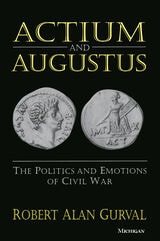
Actium and Augustus
The Politics and Emotions of Civil WarRobert Alan Gurval
University of Michigan Press, 1998
Actium and Augustus marks a turning point as well. Robert Alan Gurval's unusual approach is to examine contemporary views of the battle and its immediate political and social consequences. He starts with a consideration of the official celebration and public commemoration of the Actian victory and then moves on to other questions. What were the "Actian" monuments that Octavian erected on the battle site and later in Rome? What role did the Actian victory play in the political formation of the Principate and its public ideology? What was the response of contemporary poetry? Throughout, this volume concentrates on contemporary views of Actium and its results.
Written to include the general reader, Actium and Augustus presents a thoughtful examination of a complex period. All Greek and Latin quotations are translated, and extensive illustrations present graphic evidence about the issues Romans faced.
Robert Alan Gurval is Associate Professor of Classics, University of California, Los Angeles, and has been a recipient of the Rome Prize awarded by the American Academy in Rome.
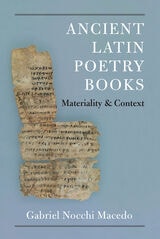
Ancient Latin Poetry Books
Materiality and ContextGabriel Nocchi Macedo
University of Michigan Press, 2021
Before the invention of printing, all forms of writing were done by hand. For a literary text to circulate among readers, and to be transmitted from one period in time to another, it had to be copied by scribes. As a result, two copies of an ancient book were different from one another, and each individual book or manuscript has its own history. The oldest of these books, those that are the closest to the time in which the texts were composed, are few, usually damaged, and have been often neglected in the scholarship. Ancient Latin Poetry Books presents a detailed study of the oldest manuscripts still extant that contain texts by Latin poets, such as Virgil, Terence, and Ovid. Analyzing their physical characteristics, their script, and the historical contexts in which they were produced and used, this volume shows how manuscripts can help us gain a better understanding of the history of texts, as well as of reading habits over the centuries. Since the manuscripts originated in various places of the Latin-speaking world, Ancient Latin Poetry Books investigates the readership and reception of Latin poetry in many different contexts, such schools in the Egyptian desert, aristocratic circles in southern Italy, and the Christian élite in late antique Rome. The research also contributes to our knowledge about the use of writing and the importance of the written text in antiquity. This is an innovative approach to the study of ancient literature, one that takes the materiality of texts into consideration.
Empire's Companion
Virgilian Epics from Colonial IberoamericaErika Valdivieso
University of Chicago Press, 2026
A study of how Latin poetry shaped colonial aspirations in sixteenth- to eighteenth-century South and Central America.
Accompanying Iberian colonizers to the Americas, Virgil’s Aeneid inspired generations of colonial elites to write their own epic poems in Latin—priming imaginations for Spanish and Portuguese rule in the Americas. In Empire’s Companion, Erika Valdivieso recovers this lost strain of poetry for classicists and early Americanists alike. Each chapter introduces readers to a new poem that adapts Virgil for a different geographic context. These epics, Valdivieso argues, show elites working to reshape the New World in their own image, drawing on Virgil to think about the conquest of Indigenous peoples, to form new ideas about the globe, and to consider the shifting power dynamics between America and Europe. A powerful corrective to prevailing ideas about the reception of Virgil in the Americas, Empire’s Companion reveals the imperial potential of the Aeneid in the hands of governing elites.
Monsters and Monstrosity in Augustan Poetry
Dunstan Lowe
University of Michigan Press, 2015
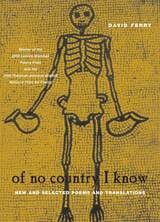
Of No Country I Know
New and Selected Poems and TranslationsDavid Ferry
University of Chicago Press, 1999
"Though Ferry is perhaps best known for his eloquent translations of Horace and Virgil, "Of No Country I Know" demonstrates that he deserves acclaim for his own poetry as well."—Carmela Ciuraru, New York Times Book Review
Perspectives of Roman Poetry
A Classics SymposiumEdited by G. Karl Galinsky
University of Texas Press, 1974
Written by leading specialists, the essays in Perspectives of Roman Poetry seek to provide a broad range of readers with a good understanding of some essential aspects of major Roman poets and poetic genres. The value of the essays is enhanced, for comparative purposes, by their extensive reference to modern authors. such as Shakespeare and Tolkien. For the modern reader, Latin quotations are accompanied by effective English translations.
The essays and their authors are as follows:
- "The Woman's Role in Latin Love Poetry," by Georg Luck
- "Autobiography and Art in Horace," by William S. Anderson
- "Some Trees in Virgil and Tolkien," by Kenneth J. Reckford
- "The Business of Roman Comedy," by Erich Segal
- "Ovid's Metamorphosis of Myth," by G. Karl Galinsky
Perspectives of Roman Poetry resulted from a symposium held at the University of Texas at Austin in 1972. These essays offer different and, in some cases, heterodox interpretations that will serve as a basis for future discussions.
Roman Poetry
From the Republic to the Silver AgeTranslated and with Introduction by Dorothea Wender
Southern Illinois University Press, 1991
Meshing her own wit, verve, and gusto with that of the Roman poets she translates, Dorothea Wender strips both the cloak of awe and the dusty mantle of boredom from the classics.
Available for the first time in paper, these English verse translations of the major classical Roman poets feature hefty selections from the savage urban satire of Juvenal, the moving philosophy of Lucretius, the elegance of Horace, the grace and humor of Catullus, the grave music of Virgil, the passion of Propertius, the sexy sophistication of Ovid, and the obscenity of Martial.
Noting Wender’s “candor,” the Classical Outlook reported that in “20th-century terms, she makes the poems lively and pertinent.”
The Boston Globe said, “The conciseness is astonishing, the information [in the introductions to each poet] provocative. The freshness of the selections should do much to augment the audience for these poets and may even inspire examination of the originals.”
The best advice came from Wender herself: “Read these good poems.”
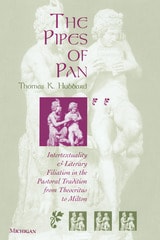
The Pipes of Pan
Intertextuality and Literary Filiation in the Pastoral Tradition from Theocritus to MiltonThomas K. Hubbard
University of Michigan Press, 1999
Pastoral poetry highlights the didactic relationship of older and younger shepherds, whether as rivals or as patron and successor. As such it is an ideal form for young poets' self-representation vis-à-vis their elders, whose work they simultaneously appropriated and transformed, even as the elder poets were represented in the new texts. This influence is reenacted in every generation: Theocritus vs. his Alexandrian forebears, Vergil vs. Theocritus, Calpurnius vs. Vergil, Nemesianus vs. Vergil and Calpurnius, Petrarch vs. Vergil, Boccaccio vs. Petrarch, Spenser vs. Vergil, along with Chaucer and Milton vs. Spenser.
The Pipes of Pan combines multiple strands of contemporary intertextual theory with reception aesthetics and Harold Bloom's theory of intersubjective conflict between generations of poets. It also provides one of the first systematic studies of intertextual and intersubjective dynamics within a whole genre.
This work will be of interest to classicists, students of literary theory, comparative literature, medieval and Renaissance literature, Italian humanism, and English literature of the sixteenth and seventeenth centuries. All texts are translated.
Thomas Hubbard is Associate Professor of Classics, University of Texas at Austin.
Vergil, Philodemus, and the Augustans
Edited by David Armstrong, Jeffrey Fish, Patricia A. Johnston, and Marilyn B. Skinner
University of Texas Press, 2003
The Epicurean teacher and poet Philodemus of Gadara (c. 110-c. 40/35 BC) exercised significant literary and philosophical influence on Roman writers of the Augustan Age, most notably the poets Vergil and Horace. Yet a modern appreciation for Philodemus' place in Roman intellectual history has had to wait on the decipherment of the charred remains of Philodemus' library, which was buried in Herculaneum by the eruption of Vesuvius in 79 AD. As improved texts and translations of Philodemus' writings have become available since the 1970s, scholars have taken a keen interest in his relations with leading Latin poets.
The essays in this book, derived from papers presented at the First International Symposium on Philodemus, Vergil, and the Augustans held in 2000, offer a new baseline for understanding the effect of Philodemus and Epicureanism on both the thought and poetic practices of Vergil, Horace, and other Augustan writers. Sixteen leading scholars trace his influence on Vergil's early writings, the Eclogues and the Georgics, and on the Aeneid, as well as on the writings of Horace and others. The volume editors also provide a substantial introduction to Philodemus' philosophical ideas for all classicists seeking a fuller understanding of this pivotal figure.