Results by title
155 books match the query 'Legislators' and 11 start with a
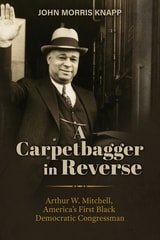
A Carpetbagger in Reverse
Arthur W. Mitchell, America's First Black Democratic CongressmanJohn Morris Knapp
University of Alabama Press, 2025
From Alabama to Congress—Arthur W. Mitchell’s fight for justice rewrote the rules of Black political power.
A Carpetbagger in Reverse offers a landmark reassessment of the life, career, and accomplishments of groundbreaking Congressman Arthur W. Mitchell, the first Black Democrat elected to Congress and the only Black member of Congress during his four terms of service from 1935 to 1943.
Born to former enslaved people in Alabama in 1883, Mitchell studied with Booker T. Washington at Tuskegee Institute and later moved to Washington DC and became a lawyer. He continued his career in Chicago, where the Great Migration had helped transform the city’s South Side into a vibrant, multiracial enclave.
As a congressman, Mitchell helped to create an enduring alliance between Black Americans and the Democratic party. Seeing his primary role as representing the South’s disempowered Black population, his belief that solutions to the region’s racial problems should arise from a new cadre of locally trained leaders brought him into frequent, vituperative conflict with the NAACP, the Republican Party, and the Black press. The first Black lawyer to argue successfully before the Supreme Court, his unanimous victory in Mitchell v. United States would have long-term consequences for the Civil Rights Movement.
A Carpetbagger in Reverse is the first publication significantly based on Mitchell’s papers, an essential and often overlooked source of insights about the development of Black political and culture life in the 1930s and 1940s.
A Great Restlessness
The Life and Politics of Dorise NielsenFaith Johnston
University of Manitoba Press, 2006
A Man for All Seasons
Monroe Sweetland and the Liberal ParadoxWilliam Robbins
Oregon State University Press, 2015
Historian William G. Robbins illuminates the wrenching transformation of American political culture in A Man for All Seasons: Monroe Sweetland and the Liberal Paradox. Racial and economic inequalities motivated much of Sweetland’s civic life, including his lifelong memberships in the American Civil Liberties Committee, the National Association for the Advancement of Colored People, the Urban League, the Japanese American Citizens League, and the Red Cross, where Sweetland worked repatriating American prisoners of war after Japan’s surrender.
Robbins’ portrait is holistic, exploring Sweetland’s socialist beginnings, inconsistencies in his politics—especially during the Cold War—and his regional legacy. He was the most important person in the resurgence of the modern, liberal Oregon Democratic Party from the late 1940s to the 1960s. He joined the National Education Association in 1964 and became the driving force behind the Bilingual Education Act of 1968 and the fight for the age-18 vote, achieved in the ratification of the 26th amendment in 1971. Monroe Sweetland was a nationally prominent figure, whose fights bequeathed to modern America important legislation that shaped its political landscape.

Accountability in State Legislatures
Steven Rogers
University of Chicago Press, 2023
A troubling portrait of democracy in US state legislatures.
State legislatures hold tremendous authority over key facets of our lives, ranging from healthcare to marriage to immigration policy. In theory, elections create incentives for state legislators to produce good policies. But do they?
Drawing on wide-ranging quantitative and qualitative evidence, Steven Rogers offers the most comprehensive assessment of this question to date, testing different potential mechanisms of accountability. His findings are sobering: almost ninety percent of American voters do not know who their state legislator is; over one-third of incumbent legislators run unchallenged in both primary and general elections; and election outcomes have little relationship with legislators’ own behavior.
Rogers’s analysis of state legislatures highlights the costs of our highly nationalized politics, challenging theories of democratic accountability and providing a troubling picture of democracy in the states.
Achieve the Honorable
A Missouri Congressman's Journey from Warm Springs to WashingtonIke Skelton
Southern Illinois University Press, 2013
During his years in the U.S. House of Representatives, Skelton became known as a bipartisan negotiator and a champion of the Armed Services. Throughout the decades, he helped steer the nation through its most dangerous challenges, from Communism to terrorism; took a leading role in the reform of the Department of Defense; dedicated himself to fulfilling the interests of his constituents; and eventually rose to become chair of the House Armed Services Committee during such pivotal events as the wars in Iraq and Afghanistan. In addition to detailing Skelton’s political career and its accompanying challenges and triumphs, Achieve the Honorable provides inside glimpses into the lives of political titans like Harry Truman, Richard Nixon, and Bill Clinton. Along the way, we are treated to Skelton’s engaging humor and shrewd insight into twentieth- and twenty-first-century U.S. politics.
Actors, Athletes, and Astronauts
Political Amateurs in the United States CongressDavid T. Canon
University of Chicago Press, 1990
Written in a lucid style accessible to the nonspecialist, David T. Canon's Actors, Athletes, and Astronauts is a definitive study of political amateurs in elections and in Congress. Canon examines the political conditions that prompt amateurs to run for office, why they win or lose, and whether elected amateurs behave differently from their experienced counterparts. Challenging previous work which presumed stable career structures and progressively ambitious candidates, his study reveals that amateurs are disproportionately elected in periods of high political opportunity, such as the 1930s for Democrats and 1980s for Republicans.
Canon's detailed findings call for significant revision of our prevailing understanding of ambition theory and disarm monolithic interpretations of political amateurs. His unique typology of amateurism differentiates among policy-oriented, "hopeless," or ambitious amateurs. The latter resemble their professional counterparts; "hopeless" amateurs are swept into office by strong partisan motivations and decision-making styles of each type vary, affecting their degree of success, but each type of amateur provides a necessary electoral balance by defeating entrenched incumbents rarely challenged by more experienced politicians.
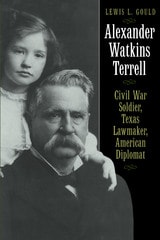
Alexander Watkins Terrell
Civil War Soldier, Texas Lawmaker, American DiplomatBy Lewis L. Gould
University of Texas Press, 2004
Alexander Terrell's career placed him at the center of some of the most pivotal events in nineteenth- and early twentieth-century history, ranging from the Civil War to Emperor Maximilian's reign over Mexico and an Armenian genocide under the Ottoman Empire. Alexander Watkins Terrell at last provides the first complete biographical portrait of this complex figure.
Born in Virginia in 1827, Terrell moved to Texas in 1852, rising to the rank of Confederate brigadier general when the Civil War erupted. Afterwards, he briefly served in Maximilian's army before returning to Texas, where he was elected to four terms in the state Senate and three terms in the House. President Grover Cleveland appointed him minister to the Ottoman Empire, dispatching him to Turkey and the Middle East for four years while the issues surrounding the existence of Christians in a Muslim empire stoked violent confrontations there. His other accomplishments included writing legislation that created the Texas Railroad Commission and what became the Permanent University Fund (the cornerstone of the University of Texas's multibillion-dollar endowment).
In this balanced exploration of Terrell's life, Gould also examines Terrell's views on race, the impact of the charges of cowardice in the Civil War that dogged him, and his spiritual searching beyond the established religions of his time. In his rich and varied life, Alexander Watkins Terrell experienced aspects of nineteenth-century Texas and American history whose effects have continued down to the present day.
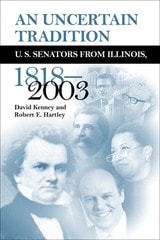
An Uncertain Tradition
David Kenney and Robert E. Hartley
Southern Illinois University Press, 2003
This sweeping survey constitutes the first comprehensive treatment of the forty-seven individuals—forty-six white males and one African American female—who have been chosen to represent Illinois in the United States Senate from 1818 to 2003. David Kenney and Robert E. Hartley underscore nearly two centuries of Illinois history with these biographical and political portraits, compiling an incomparably rich resource for students, scholars, teachers, journalists, historians, politicians, and any Illinoisan interested in the state’s heritage.
An Uncertain Tradition:U. S. Senators from Illinois, 1818–2003 is a fresh and careful study of the shifting set of political issues occurring over time and illuminated by the lives of participants in the politics of choice and service in the Senate. Kenney and Hartley plot the course of the state’s varied senatorial leadership, from the state’s founding and the appearance of political parties, through the Civil War and its aftermath, and into the diverse political climate of the twenty-first century. From the notorious to the heroic, the popular to the pioneering, the senatorial roster includes such luminaries as “The Little Giant” Stephen A. Douglas; Lyman Trumbull, who served three terms in the Civil War era; “Uncle Dick” and “Black Jack,” also known as Richard Oglesby and John A. Logan; the “Wizard of Ooze” Everett Dirksen; and modern leaders such as Adlai Stevenson III, Paul Simon, and Carol Moseley-Braun.
Kenney and Hartley offer incisive commentary on the quality of senate service in each case, as well as timeline graphs relating to the succession of individuals in each of the two sequences of service, the geographical distribution of senators within the state, and the variations in party voting for senate candidates. Rigorously documented and supremely readable, this convenient reference volume is enhanced by portraits of many of the senators.
An Uncommon Man
The Life and Times of Senator Claiborne PellG. Wayne Miller
University Press of New England, 2011
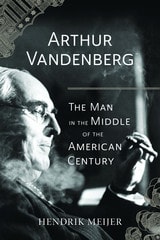
Arthur Vandenberg
The Man in the Middle of the American CenturyHendrik Meijer
University of Chicago Press, 2017
Originally the editor and publisher of the Grand Rapids Herald, Vandenberg was appointed and later elected to the Senate in 1928, where he became an outspoken opponent of the New Deal and a leader among the isolationists who resisted FDR’s efforts to aid European allies at the onset of World War II. But Vandenberg soon recognized the need for unity at the dawn of a new world order; and as a Republican leader, he worked closely with Democratic administrations to build the strong bipartisan consensus that established the Marshall Plan, the United Nations, and NATO. Vandenberg, as Meijer reveals, was instrumental in organizing Congressional support for these monumental twentieth-century foreign policy decisions.
Vandenberg’s life and career offer powerful lessons for today, and Meijer has given us a story that suggests an antidote to our current democratic challenges. After reading this poignant biography, many will ask: Where is the Vandenberg of today?
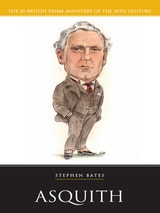
Asquith
Stephen Bates
Haus Publishing, 2006