Results by title
17 books match the query 'Leo Strauss'
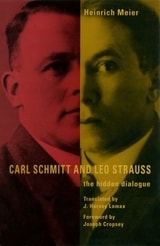
Carl Schmitt and Leo Strauss
The Hidden DialogueHeinrich Meier
University of Chicago Press, 1995
Meier contends that their exchange only ostensibly revolves around liberalism. At its heart, their “hidden dialogue” explores the fundamental conflict between political theology and political philosophy, between revelation and reasonand ultimately, the vital question of how human beings ought to live their lives.
Disturbing Revelation
Leo Strauss, Eric Voegelin, and the BibleJohn J. Ranieri
University of Missouri Press, 2009
Leo Strauss On Plato's Symposium
Leo Strauss
University of Chicago Press, 2001
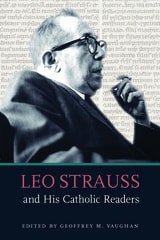
Leo Strauss and His Catholic Readers
Geoffrey M. Vaughan
Catholic University of America Press, 2018
Leo Strauss and Nietzsche
Laurence Lampert
University of Chicago Press, 1995
In Leo Strauss and Nietzsche, the eminent Nietzsche scholar Laurence Lampert offers a controversial new assessment of the Strauss-Nietzsche connection. Lampert undertakes a searching examination of the key Straussian essay, "Note on the Plan of Nietzsche's Beyond Good and Evil." He shows that this essay, written toward the end of Strauss's life and placed at the center of his final work, reveals an affinity for and debt to Nietzsche greater than Strauss's followers allow. Lampert argues that the essay comprises the most important interpretation of Nietzsche ever published, one that clarifies Nietzsche's conception of nature and of human spiritual history and demonstrates the logical relationship between the essential themes in Nietzsche's thought—the will to power and the eternal return.
Leo Strauss and the Politics of Exile
The Making of a Political PhilosopherEugene Sheppard
Brandeis University Press, 2007
Leo Strauss and the Problem of Political Philosophy
Michael P. Zuckert and Catherine H. Zuckert
University of Chicago Press, 2014
Leo Strauss and the Rediscovery of Maimonides
Kenneth Hart Green
University of Chicago Press, 2013
An invaluable companion to Green’s comprehensive collection of Strauss’s writings on Maimonides, this volume shows how Strauss confronted the commonly accepted approaches to the medieval philosopher, resulting in both a new understanding of Maimonides and a new depth and direction for his own thought. It will be welcomed by anyone engaged with the work of either philosopher.
Leo Strauss on Hegel
Leo Strauss
University of Chicago Press, 2019
Leo Strauss on Hegel reconstructs Strauss’s seminar on Hegel, supplemented by passages from an earlier version of the seminar from which only fragments of a transcript remain. Strauss focused his seminar on the lectures collected in The Philosophy of History, which he considered more accessible than Hegel’s written works. In his own lectures on Hegel, Strauss continues his project of demonstrating how modern philosophers related to ancient thought and explores the development and weaknesses of modern political theory. Strauss is especially concerned with the relationship in Hegel between empirical history and his philosophy of history, and he argues for the primacy of religion in Hegel’s understanding of history and society. In addition to a relatively complete transcript, Leo Strauss on Hegel also includes annotations, which bring context and clarity to the text.
Leo Strauss on Hobbes
Leo Strauss
University of Chicago Press, 0
Leo Strauss’s final seminar on Thomas Hobbes, representing the culmination of more than four decades of close engagement.
Leo Strauss spent more than four decades studying the work of Thomas Hobbes. In Strauss’s distinctive genealogy of political thought, Hobbes emerges as a decisive counterpoint, not only to the Ancients, but also to Strauss’s own project. Strauss saw Hobbes as both the founder of modern natural rights and the modern esoteric writer par excellence.
Strauss’s final seminar on Hobbes from 1964 is the culmination of his engagement with Hobbes’s corpus and contains the richest account of Strauss’s final insight into the nerve of Hobbes’s thought, linking human consciousness to power and passion. The seminar reflects on the tension between Hobbes’s scientific and political frameworks, Hobbes’s emphasis on rights over duties, Hobbes’s atheism, and Hobbes’s attention to causal thinking as the core capacity that sets humans apart from other animals. It also includes Strauss’s most sustained exchange with the Marxist political theorist, C. B. Macpherson. Their rival interpretations of why the state of nature takes the form of a war of all against all led Strauss to reconsider his earlier writings on Hobbes, including those parts that pertain to other thinkers, such as Aristotle, Locke, and Spinoza.
With an introductory essay by Karl Dahlquist that traces the evolution of Strauss’s thinking on Hobbes and frames Strauss’s dialogue with Macpherson, this 1964 seminar on Hobbes is a vital contribution to political thought and intellectual history.
Leo Strauss on Maimonides
The Complete WritingsLeo Strauss
University of Chicago Press, 2013
With Leo Strauss on Maimonides, Kenneth Hart Green presents for the first time a comprehensive, annotated collection of Strauss’s writings on Maimonides, comprising sixteen essays, three of which appear in English for the first time. Green has also provided careful translations of materials that had originally been quoted in Hebrew, Arabic, Latin, German, and French; written an informative introduction highlighting the original contributions found in each essay; and brought references to out-of-print editions fully up to date. The result will become the standard edition of Strauss’s writings on Maimonides.
Leo Strauss on Moses Mendelssohn
Leo Strauss
University of Chicago Press, 2012
Moses Mendelssohn (1729–86) was the leading Jewish thinker of the German Enlightenment and the founder of modern Jewish philosophy. His writings, especially his attempt during the Pantheism Controversy to defend the philosophical legacies of Spinoza and Leibniz against F. H. Jacobi’s philosophy of faith, captured the attention of a young Leo Strauss and played a critical role in the development of his thought on one of the fundamental themes of his life’s work: the conflicting demands of reason and revelation.
Leo Strauss on Moses Mendelssohn is a superbly annotated translation of ten introductions written by Strauss to a multi-volume critical edition of Mendelssohn’s work. Commissioned in Weimar Germany in the 1920s, the project was suppressed and nearly destroyed during Nazi rule and was not revived until the 1960s. In addition to Strauss’s introductions, Martin D. Yaffe has translated Strauss’s editorial remarks on each of the passages he annotates in Mendelssohn’s texts and brings those together with the introductions themselves. Yaffe has also contributed an extensive interpretive essay that both analyzes the introductions on their own terms and discusses what Strauss writes elsewhere about the broader themes broached in his Mendelssohn studies.
Strauss’s critique of Mendelssohn represents one of the largest bodies of work by the young Strauss on a single thinker to be made available in English. It illuminates not only a formerly obscure phase in the emergence of his thought but also a critical moment in the history of the German Enlightenment.
Leo Strauss on Nietzsche's "Thus Spoke Zarathustra"
Leo Strauss
University of Chicago Press, 2017
With Leo Strauss on Nietzsche’s “Thus Spoke Zarathustra,” eminent Strauss scholar Richard L. Velkley presents Strauss’s lectures on Zarathustra with superb annotations that bring context and clarity to the critical role played by Nietzsche in shaping Strauss’s thought. In addition to the broad relationship between Nietzsche and political philosophy, Strauss adeptly guides readers through Heidegger’s confrontations with Nietzsche, laying out Heidegger’s critique of Nietzsche’s “will to power” while also showing how Heidegger can be read as a foil for his own reading of Nietzsche. The lectures also shed light on the relationship between Heidegger and Strauss, as both philosophers saw Nietzsche as a central figure for understanding the crisis of philosophy and Western civilization.
Strauss’s reading of Nietzsche is one of the important—yet little appreciated—philosophical inquiries of the past century, both an original interpretation of Nietzsche’s thought and a deep engagement with the core problems that modernity posed for political philosophy. It will be welcomed by anyone interested in the work of either philosopher.
Leo Strauss on Plato’s "Protagoras"
Leo Strauss
University of Chicago Press, 2022
This book offers a transcript of Strauss’s seminar on Plato’s Protagoras taught at the University of Chicago in the spring quarter of 1965, edited and introduced by renowned scholar Robert C. Bartlett. These lectures have several important features. Unlike his published writings, they are less dense and more conversational. Additionally, while Strauss regarded himself as a Platonist and published some work on Plato, he published little on individual dialogues. In these lectures Strauss treats many of the great Platonic and Straussian themes: the difference between the Socratic political science or art and the Sophistic political science or art of Protagoras; the character and teachability of virtue, its relation to knowledge, and the relations among the virtues, courage, justice, moderation, and wisdom; the good and the pleasant; frankness and concealment; the role of myth; and the relation between freedom of thought and freedom of speech.
In these lectures, Strauss examines Protagoras and the sophists, providing a detailed discussion of Protagoras as it relates to Plato’s other dialogues and the work of modern thinkers. This book should be of special interest to students both of Plato and of Strauss.
Leo Strauss on Political Philosophy
Responding to the Challenge of Positivism and HistoricismLeo Strauss
University of Chicago Press, 2018
Leo Strauss on Political Philosophy brings together the lectures that comprise Strauss’s “Introduction to Political Philosophy.” Strauss begins by emphasizing the importance of political philosophy in determining the common good of society and critically examining the two most powerful contemporary challenges to the possibility of using political theory to learn about and develop the best political order: positivism and historicism. In seeking the common good, classical political philosophers like Plato and Aristotle did not distinguish between political philosophy and political science. Today, however, political philosophy must contend with the contemporary belief that it is impossible to know what the good society really is. Strauss emphasizes the need to study the history of political philosophy to see whether the changes in the understanding of nature and conceptions of justice that gradually led people to believe that it is not possible to determine what the best political society is are either necessary or valid. In doing so, he ranges across the entire history of political philosophy, providing a valuable, thematically coherent foundation, including explications of many canonical thinkers, such as Auguste Comte and Immanuel Kant, about whom Strauss did not write extensively in his published writings.
Leo Strauss, Max Weber, and the Scientific Study of Politics
Nasser Behnegar
University of Chicago Press, 2002
Behnegar's impressive book argues that Strauss was not against the scientific study of politics, but he did reject the idea that it could be built upon political science's unexamined assumption of the distinction between facts and values. Max Weber was, for Strauss, the most profound exponent of values relativism in social science, and Behnegar's explication artfully illuminates Strauss's critique of Weber's belief in the ultimate insolubility of all value conflicts.
Strauss's polemic against contemporary political science was meant to make clear the contradiction between its claim of value-free premises and its commitment to democratic principles. As Behnegar ultimately shows, values—the ethical component lacking in a contemporary social science—are essential to Strauss's project of constructing a genuinely scientific study of politics.
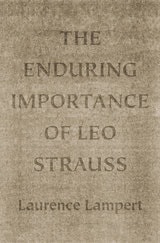
The Enduring Importance of Leo Strauss
Laurence Lampert
University of Chicago Press, 2013