Results by title
19 books match the query 'Libraries and society'

A Place at the Table
Kathleen de la Peña McCook
American Library Association, 2000
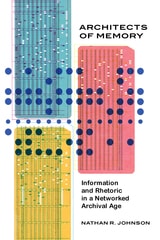
Architects of Memory
Information and Rhetoric in a Networked Archival AgeNathan R. Johnson
University of Alabama Press, 2020
Understanding the systems that shape what societies remember, archive, and forget.
We are now living in the richest age of public memory. From museums and memorials to the vast digital infrastructure of the internet, access to the past is only a click away. Even so, the methods and technologies created by scientists, espionage agencies, and information management coders and programmers have drastically delimited the ways that communities across the globe remember and forget our wealth of retrievable knowledge.
In Architects of Memory: Information and Rhetoric in a Networked Archival Age, Nathan R. Johnson charts turning points where concepts of memory became durable in new computational technologies and modern memory infrastructures took hold. He works through both familiar and esoteric memory technologies—from the card catalog to the book cart to Zatocoding and keyword indexing—as he delineates histories of librarianship and information science and provides a working vocabulary for understanding rhetoric’s role in contemporary memory practices.
This volume draws upon the twin concepts of memory infrastructure and mnemonic technê to illuminate the seemingly opaque wall of mundane algorithmic techniques that determine what is worth remembering and what should be forgotten. Each chapter highlights a conflict in the development of twentieth-century librarianship and its rapidly evolving competitor, the discipline of information science. As these two disciplines progressed, they contributed practical techniques and technologies for making sense of explosive scientific advancement in the wake of World War II. Taming postwar science became part and parcel of practices and information technologies that undergird uncountable modern communication systems, including search engines, algorithms, and databases for nearly every national clearinghouse of the twenty-first century.
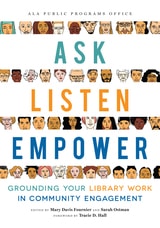
Ask, Listen, Empower
Grounding Your Library Work in Community EngagementSarah Ostman and Mary Davis Fournier
American Library Association, 2020
Foreword by Tracie D. Hall
Community engagement isn’t simply an important component of a successful library—it’s the foundation upon which every service, offering, and initiative rests. Working collaboratively with community members—be they library customers, residents, faculty, students or partner organizations— ensures that the library works, period. This important resource from ALA’s Public Programs Office (PPO) provides targeted guidance on how libraries can effectively engage with the public to address a range of issues for the betterment of their community, whether it is a city, neighborhood, campus, or something else. Featuring contributions by leaders active in library-led community engagement, it’s designed to be equally useful as a teaching text for LIS students and a go-to handbook for current programming, adult services, and outreach library staff. Balancing practical tools with case studies and stories from field, this collection explores such key topics as
- why libraries belong in the community engagement realm;
- getting the support of board and staff;
- how to understand your community;
- the ethics and challenges of engaging often unreached segments of the community;
- identifying and building engaged partnerships;
- collections and community engagement;
- engaged programming; and
- outcome measurement.
Cultural Humility
David A. Hurley, Sarah R. Kostelecky, and Lori Townsend
American Library Association, 2022
Cultural humility is emerging as a preferred approach to diversity, equity, and inclusion (DEI) efforts within librarianship. At a time when library workers are critically examining their professional practices, cultural humility offers a potentially transformative framework of compassionate accountability; it asks us to recognize the limits to our knowledge, reckon with our ongoing fallibility, educate ourselves about the power imbalances in our organizations, and commit to making change. This Special Report introduces the concept and outlines its core tenets. As relevant to those currently studying librarianship as it is to long-time professionals, and applicable across multiple settings including archives and museums, from this book readers will
- learn why cultural humility offers an ideal approach for navigating the spontaneous interpersonal interactions in libraries, whether between patrons and staff or amongst staff members themselves;
- understand how it intersects with cultural competence models and critical race theory;
- see the ways in which cultural humility’s awareness of and commitment to challenging inequitable structures of power can act as a powerful catalyst for community engagement;
- come to recognize how a culturally humble approach supports DEI work by acknowledging the need for mindfulness in day-to-day interactions;
- reflect upon cultural humility’s limitations and the criticisms that some have leveled against it; and
- take away concrete tools for undertaking and continuing such work with patience and hope.
Guide to Ethics in Acquisitions
Wyoma vanDuinkerken
American Library Association, 2015
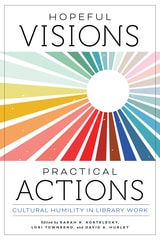
Hopeful Visions, Practical Actions
Cultural Humility in Library WorkEdited by Sarah R. Kostelecky, Lori Townsend, and David A. Hurley
American Library Association, 2023
- how Indigenous adages can be tools for reflection and guidance in developing cultural humility;
- the experiences of two Black librarians who are using cultural humility to change the profession;
- new perspectives on core concepts of customer service;
- rethinking policies and practices in libraries both large and small;
- using cultural humility in approaching collection development and creating resource guides;
- what cultural humility can look like for a tribal librarian working in a tribal college library; and
- reflecting on cultural humility itself and where it is going.
Information Services to Diverse Populations
Competent Humility for Library ProfessionalsNicole A. Cooke
American Library Association, 2026
Foreword by Cynthia Sturgis Landrum
The development of cultural competency skills and social awareness benefits LIS students, their future employers, and the library profession at large―not to mention library customers and society as a whole. Cooke's freshly updated text introduces readers to the contexts and situations that promote the development of empathy and build cultural competence. It marshals cutting edge research and relevant best practices to give readers a strong grasp of the political, social, economic, and technological divides among library patrons. It also covers outreach and library services to diverse populations, how to evaluate such services, and many other key topics. Complete with an updated syllabus, lesson plans, and exercises ready-made for course use, Cooke’s text
- demonstrates why social responsibility is a foundational value of librarianship;
- considers library services to members of marginalized racial or ethnic groups, older adults, people with mental health or physical disabilities, neurodiverse library users, refugees and immigrants, people experiencing homelessness or hunger, those growing up in or experiencing poverty, members of the LGBTQIA+ communities, and people who are incarcerated;
- features a myriad of testimonials drawn from a wide variety of settings that highlight the experiences of library and museum practitioners who are working with diverse populations;
- introduces a new model of cultural competence and cultural humility;
- authoritatively covers such essential concepts as intersectionality, privilege, marginalization, cultural competence, cultural humility, and counter-storytelling along with discussions of how they interplay in the communities that libraries serve;
- explores the impact of overwhelming whiteness of the library profession and what can be done to recruit, welcome, mentor, and retain racially and ethnically diverse library workers; and
- identifies potential employment and networking opportunities related to diversity and social justice in librarianship.
Inspired Thinking
Big Ideas to Enrich Yourself and Your CommunityDorothy Stoltz
American Library Association, 2020

Institutions of Reading
The Social Life of Libraries in the United StatesThomas Augst
University of Massachusetts Press, 2007
Tracing the evolution of the library as a modern institution from the late eighteenth century to the digital era, this book explores the diverse practices by which Americans have shared reading matter for instruction, edification, and pleasure. Writing from a rich variety of perspectives, the contributors raise important questions about the material forms and social shapes of American culture. What is a library? How have libraries fostered communities of readers and influenced the practice of reading in particular communities? How did the development of modern libraries alter the boundaries of individual and social experience, and define new kinds of public culture? To what extent have libraries served as commercial enterprises, as centers of power, and as places of empowerment for African Americans, women, and immigrants? Institutions of Reading offers at once a social history of literacy and leisure, an intellectual history of institutional and technological innovations that facilitated the mass distribution and consumption of printed books and periodicals, and a cultural history of the symbolic meanings and practical uses of reading in American life. In addition to the editors, contributors include Elizabeth Amann, Michael Baenen, James Green, Elizabeth McHenry, Barbara Mitchell, Christine Pawley, Janice Radway, James Raven, Karin Roffman, and Roy Rosenzweig.

Libraries Promoting Reflective Dialogue In A Time Of Political
Andrea Baer
Assoc of College & Research Libraries, 2019

Libraries amid Protest
Books, Organizing, and Global ActivismSherrin Frances
University of Massachusetts Press, 2020
Libraries amid Protest unpacks how these protest libraries—labor-intensive, temporary installations in parks and city squares, poorly protected from the weather, at odds with security forces—continue to arise. In telling the stories of these surprising and inspiring spaces through interviews and other research, Sherrin Frances confronts the complex history of American public libraries. She argues that protest libraries function as the spaces of opportunity and resistance promised, but not delivered, by American public libraries.
Libraries and Democracy
Nancy Kranich
American Library Association, 2001
Out Front with Stephen Abram
American Library Association, 2007
Public Libraries and Internet Service Roles
American Library Association, 2009
Resilience
Rebekkah Smith Aldrich
American Library Association, 2018
Sacred Stacks
The Higher Purpose of Libraries and LibrarianshipNancy Kalikow Maxwell
American Library Association, 2006
Sustainable Thinking
Ensuring Your Library's Future in an Uncertain WorldRebekkah Smith Aldrich
American Library Association, 2018
The Librarian Stereotype
Deconstructing Perceptions AndMiriam Rigby
Assoc of College & Research Libraries, 2014
The Transformed Library
Jeannette Woodward
American Library Association, 2013