Results by title
25 books match the query 'Literature, Experimental'
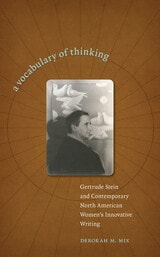
A Vocabulary of Thinking
Gertrude Stein and Contemporary North American Women's Innnovative WritingDeborah M. Mix
University of Iowa Press, 2007
Arguing that these authors have received relatively little attention because of the difficulty in categorizing them, Mix brings the writing of women of color, lesbians, and collaborative writers into the discussion of experimental writing. Thus, rather than exploring conventional lines of influence, she departs from earlier scholarship by using Stein and her work as a lens through which to read the ways these authors have renegotiated tradition, authority, and innovation.
Building on the tradition of experimental or avant-garde writing in the United States, Mix questions the politics of the canon and literary influence, offers close readings of previously neglected contemporary writers whose work doesn't fit within conventional categories, and by linking genres not typically associated with experimentalism-lyric, epic, and autobiography-challenges ongoing reevaluations of innovative writing.
Against Expression
An Anthology of Conceptual WritingCraig Dworkin and Kenneth Goldsmith
Northwestern University Press, 2011
Charles Bernstein has described conceptual poetry as "poetry pregnant with thought." Against Expression, the premier anthology of conceptual writing, presents work that is by turns thoughtful, funny, provocative, and disturbing. Dworkin and Goldsmith, two of the leading spokespersons and practitioners of conceptual writing, chart the trajectory of the conceptual aesthetic from early precursors including Samuel Beckett and Marcel Duchamp to the most prominent of today’s writers. Nearly all of the major avant-garde groups of the past century are represented here, including Dada, OuLiPo, L=A=N=G=U=A=G=E, and Flarf to name just a few, but all the writers are united in their imaginative appropriation of found and generated texts and their exploration of nonexpressive language. Against Expression is a timely collection and an invaluable resource for readers and writers alike.
American Literature and the Destruction of Knowledge
Innovative Writing in the Age of EpistemologyRonald E. Martin
Duke University Press, 1991
The works of Melville, Emerson, Whitman, and Dickinson, followed by Crane, Frost, Pound, Stein, Hemingway, Dos Passos, Aiken, Stevens, and Williams, are examined as part of a cultural current that casts doubt on the possibility of knowledge itself. The destruction of concepts, of literary and linguistic forms, was for these writers a precondition for liberating the imagination to gain more access to the self and the real world. As part of the exploration of this cultural context, literary and philosophical realisms are examined together, allowing a comparison of their somewhat different objectives, as well as their common epistemological predicament.
Beyond Human
Vital Materialisms in the Andean Avant-GardesDaly, Tara
Bucknell University Press, 2019
Published by Bucknell University Press. Distributed worldwide by Rutgers University Press.
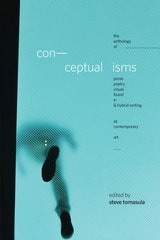
Conceptualisms
The Anthology of Prose, Poetry, Visual, Found, E- & Hybrid Writing as Contemporary ArtEdited by Steve Tomasula
University of Alabama Press, 2022
A wide-ranging anthology of experimental writing—prose, poetry, and hybrid—from its most significant practitioners and innovators
A variety of names have been used to describe fiction, poetry, and hybrid writing that explore new forms and challenges mainstream traditions. Those phrases include experimental, conceptual, avant-garde, hybrid, surfiction, fusion, radical, slip-stream, avant-pop, postmodern, self-conscious, innovative, L=A=N=G=U=A=G=E writing, alternative, and anti- or new literature. Conceptualisms: The Anthology of Prose, Poetry, Visual, Found, E- & Hybrid Writing as Contemporary Art is the first major anthology of writing that offers readers an overview of this other tradition as it lives in the early decades of the 21st century.
Featuring over 100 pieces from more than 90 authors, this anthology offers a plethora of aesthetics and approaches to a wide variety subjects. Editor Steve Tomasula has gathered poems, prose, and hybrid pieces that all challenge our understanding of what literature means. Intended as a collection of the most exciting and bold literary work being made today, Tomasula has put a spotlight on the many possibilities available to writers and readers wishing for a glimpse of literature’s future.
Readers will recognize authors who have shaped contemporary writing, as among them Lydia Davis, Charles Bernstein, Jonathan Safran Foer, Shelley Jackson, Nathaniel Mackey, David Foster Wallace, and Claudia Rankine. Even seasoned readers will find authors, and responses to the canon, not yet encountered. Conceptualisms is a book of ideas for writers, teachers and scholars, as well as readers who wonder how many ways literature can live.
The text features headnotes to chapters on themes such as sound writing, electronic literature, found text, and other forms, offering accessible introductions for readers new to this work. An online companion presents statements about the work and biographies of the authors in addition to audio, video, and electronic writing that can’t be presented in print. Visit www.conceptualisms.info to read more.
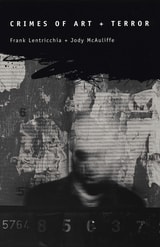
Crimes of Art and Terror
Frank Lentricchia and Jody McAuliffe
University of Chicago Press, 2003
Crimes of Art and Terror reveals how the desire beneath many romantic literary visions is that of a terrifying awakening that would undo the West's economic and cultural order. This is also the desire, of course, of what is called terrorism. As the authority of writers and artists recedes, it is criminals and terrorists, Lentricchia and McAuliffe suggest, who inherit this romantic, destructive tradition. Moving freely between the realms of high and popular culture, and fictional and actual criminals, the authors describe a web of impulses that catches an unnerving spirit.
Lentricchia and McAuliffe's unorthodox approach pairs Dostoevsky's Crime and Punishment with Martin Scorsese's King of Comedy and connects the real-life Unabomber to the surrealist Joseph Cornell and to the hero of Bret Easton Ellis's bestselling novel American Psycho. They evoke a desperate culture of art through thematic dialogues among authors and filmmakers as varied as Don DeLillo, Joseph Conrad, Francis Ford Coppola, Jean Genet, Frederick Douglass, Hermann Melville, and J. M. Synge, among others. And they conclude provocatively with an imagined conversation between Heinrich von Kleist and Mohamed Atta. The result is a brilliant and unflinching reckoning with the perilous proximity of the impulse to create transgressive art and the impulse to commit violence.
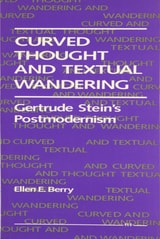
Curved Thought and Textual Wandering
Gertrude Stein's PostmodernismEllen E. Berry
University of Michigan Press, 1992
Daniil Kharms
Writing and the EventBy Branislav Jakovljevic
Northwestern University Press, 2009
The book follows Kharms’s development as a creative thinker, inquiring into the nature of Kharmsian nonsense, the ontological status of the OBERIU object, writing as performance, Kharms’s gestural language, his "language machines," and his ideas of order, number, infinity, and chance. Reading every paper trace (as well as extant memories) of Kharms’s activities as part of a large project of world creation, Branislav Jakovljevic situates him in a twentieth-century effort—exemplified by Kafka, Beckett, Artaud, Malevich, and Khelbnikov, among others—to go beyond an interpretation of meaning circumscribed by rational and logical thought. Examining texts that could conceivably be called "literary" as well as sketches, diagrams, hieroglyphs, photographs, and unclassifiable others, Jakovljevic’s study is the first to provide a properly broad perspective on this creative thinker’s farranging, far-reaching, and finally comprehensive achievement.
Emancipating Pragmatism
Emerson, Jazz, and Experimental WritingMichael Magee
University of Alabama Press, 2004
A radical rereading of Emerson that posits African- American culture, literature, and jazz as the very continuation and embodiment of pragmatic thought and democratic tradition
Emancipating Pragmatism is a radical rereading of Emerson that posits African- American culture, literature, and jazz as the embodiment of pragmatic thought and democratic tradition. It traces Emerson's philosophical legacy through the 19th and 20th centuries to discover how Emersonian thought continues to inform issues of race, aesthetics, and poetic discourse.
Emerson’s pragmatism derives from his abolitionism, Michael Magee argues, and any pragmatic thought that aspires toward democracy cannot ignore and must reckon with its racial roots. Magee looks at the ties between pragmatism and African-American culture as they manifest themselves in key texts and movements, such as William Carlos Williams’s poetry; Ralph Ellison’s discourse in Invisible Man and Juneteenth and his essays on jazz; the poetic works of Robert Creeley, Amiri Baraka, and Frank O'Hara; as well as the “new jazz” being forged at clubs like The Five Spot in New York.
Ultimately, Magee calls into question traditional maps of pragmatist lineage and ties pragmatism to the avant-garde American tradition.
Imagine the Sound
Experimental African American Literature after Civil RightsCarter Mathes
University of Minnesota Press, 2014
The post–Civil Rights era was marked by an explosion of black political thought and aesthetics. Reflecting a shifting horizon of expectations around race relations, the unconventional sounds of free jazz coupled with experimental literary creation nuanced the push toward racial equality and enriched the possibilities for aesthetic innovation within the Black Arts Movement. In Imagine the Sound, Carter Mathes demonstrates how African American writers used sound to further artistic resistance within a rapidly transforming political and racial landscape.
While many have noted the oral and musical qualities of African American poetry from the post–Civil Rights period, Mathes points out how the political implications of dissonance, vibration, and resonance produced in essays, short stories, and novels animated the ongoing struggle for equality. Situating literary works by Henry Dumas, Larry Neal, and Toni Cade Bambara in relation to the expansive ideas of sound proposed by free jazz musicians such as Marion Brown and Sun Ra, not only does this book illustrate how the presence of sound can be heard and read as political, but it recuperates critically neglected, yet important, writers and musicians. Ultimately, Mathes details how attempts to capture and render sound through the medium of writing enable writers to envision alternate realities and resistance outside of the linear frameworks offered by the Civil Rights and Black Power movements.
In precise and elegant prose, Mathes shows how in conceptualizing sound, African American writers opened up the political imaginations of their readers. By exploring this intellectual convergence of literary artistry, experimental music, and sound theory, Imagine the Sound reveals how taking up radically new forms of expression allows us to speak to the complexities of race and political resistance.
Interruptions
The Fragmentary Aesthetic in Modern LiteratureGerald L. Bruns
University of Alabama Press, 2018
A history of fragmentary—or interrupted—writing in avant-garde poetry and prose by a renowned literary critic.
In Interruptions: The Fragmentary Aesthetic in Modern Literature, Gerald L. Bruns explores the effects of parataxis, or fragmentary writing as a device in modern literature. Bruns focuses on texts that refuse to follow the traditional logic of sequential narrative. He explores numerous examples of self-interrupting composition, starting with Friedrich Schlegel's inaugural theory and practice of the fragment as an assertion of the autonomy of words, and their freedom from rule-governed hierarchies.
Bruns opens the book with a short history of the fragment as a distinctive feature of literary modernism in works from Gertrude Stein to Paul Celan to present-day authors. The study progresses to the later work of Maurice Blanchot and Samuel Beckett, and argues, controversially, that Blanchot's writings on the fragment during the 1950s and early 1960s helped to inspire Beckett’s turn toward paratactic prose.
The study also extends to works of poetry, examining the radically paratactic arrangements of two contemporary British poets, J. H. Prynne and John Wilkinson, focusing chiefly on their most recent, and arguably most abstruse, works. Bruns also offers a close study of the poetry and poetics of Charles Bernstein.
Interruptions concludes with two chapters about James Joyce. First, Bruns tackles the language of Finnegans Wake, namely the break-up of words themselves, its reassembly into puns, neologisms, nonsense, and even random strings of letters. Second, Bruns highlights the experience of mirrors in Joyce’s fiction, particularly in Dubliners, Portrait of the Artist as a Young Man, and Ulysses, where mirrored reflections invariably serve as interruptions, discontinuities, or metaphorical displacements and proliferations of self-identity.
OBERIU
An Anthology of Russian AbsurdismEugene Ostashevsky
Northwestern University Press, 2006
Some called it the last of the Russian avant-garde, and others called it the first (and last) instance of Absurdism in Russia. Though difficulty to pigeon-hole, OBERIU and the pleasures of its poetry and prose are, with this volume, at long last fully open to English-speaking readers. Skillfully translated to preserve the weird charm of the originals, these poems and prose pieces display all the hilarity and tragedy, the illogical action and puppetlike violence and eroticism, and the hallucinatory intensity that brought down the wrath of the Soviet censors. Today they offer an uncanny reflection of the distorted reality they reject.
Paper Electronic Literature
An Archaeology of Born-Digital MaterialsRichard Hughes Gibson
University of Massachusetts Press, 2021
Paper Electronic Literature attests that digital literature's old media elements have much to teach us about the cultural and physical conditions in which we compute; the creativity that new media artists have shown in their dealings with old media; and the distinctively electronic issues that confront digital artists. Moving between avant-garde works and popular ones, fiction writing and poetry generation, Richard Hughes Gibson reveals the diverse ways in which paper has served as a component within electronic literature, particularly in facilitating interactive experiences for users. This important study develops a new critical paradigm for appreciating the multifaceted material innovation that has long marked digital literature.
Slapstick Modernism
Chaplin to Kerouac to Iggy PopWilliam Solomon
University of Illinois Press, 2018
William Solomon charts the origins and evolution of what he calls slapstick modernism--a merging of artistic experimentation with the socially disruptive lunacy made by the likes of Charlie Chaplin. Romping through texts, films, and theory, Solomon embarks on an intellectual odyssey from the high modernism of Dos Passos and Williams to the late modernism of the Beats and Burroughs before a head-on crash into the raw power of punk rock. Throughout, he shows the links between the experimental writers and silent screen performers of the early century, and explores the potent cultural undertaking that drew inspiration from anarchical comedy after World War II.
Technomodern Poetics
The American Literary Avant-Garde at the Start of the Information AgeTodd F. Tietchen
University of Iowa Press, 2018
After the second World War, the term “technology” came to signify both the anxieties of possible annihilation in a rapidly changing world and the exhilaration of accelerating cultural change. Technomodern Poetics examines how some of the most well-known writers of the era described the tensions between technical, literary, and media cultures at the dawn of the Digital Age. Poets and writers such as Allen Ginsberg, Charles Olson, Jack Kerouac, and Frank O’Hara, among others, anthologized in Donald Allen’s iconic The New American Poetry, 1945–1960, provided a canon of work that has proven increasingly relevant to our technological present. Elaborating on the theories of contemporaneous technologists such as Norbert Wiener, Claude Shannon, J. C. R. Licklider, and a host of noteworthy others, these artists express the anxieties and avant-garde impulses they wrestled with as they came to terms with a complex array of issues raised by the dawning of the nuclear age, computer-based automation, and the expansive reach of electronic media. As author Todd Tietchen reveals, even as these writers were generating novel forms and concerns, they often continued to question whether such technological changes were inherently progressive or destructive.
With an undeniable timeliness, Tietchen’s book is sure to appeal to courses in modern English literature and American studies, as well as among fans of Beat writers and early Cold War culture.
The Afric-American Picture Gallery
William J. Wilson's Speculative Museum of Black ArtBritt Rusert
Duke University Press, 2026
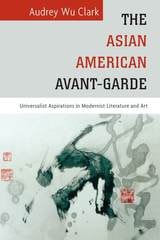
The Asian American Avant-Garde
Universalist Aspirations in Modernist Literature and ArtAudrey Wu Clark
Temple University Press, 2015
The Asian American Avant-Garde is the first book-length study that conceptualizes a long-neglected canon of early Asian American literature and art. Audrey Wu Clark traces a genealogy of counter-universalism in short fiction, poetry, novels, and art produced by writers and artists of Asian descent who were responding to their contemporary period of Asian exclusion in the United States, between the years 1882 and 1945.
Believing in the promise of an inclusive America, these avant-gardists critiqued racism as well as institutionalized art. Clark examines racial outsiders including Isamu Noguchi, Dong Kingman and Yun Gee to show how they engaged with modernist ideas, particularly cubism. She draws comparisons between writers such as Sui Sin Far and Carlos Bulosan with modernist luminaries like Stein, Eliot, Pound, and Proust.
Acknowledging the anachronism of the term “Asian American” with respect to these avant-gardists, Clark attempts to reconstruct it. The Asian American Avant-Garde explores the ways in which these artists and writers responded to their racialization and the Orientalism that took place in modernist writing.
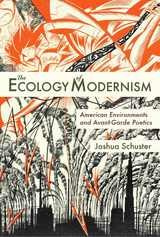
The Ecology of Modernism
American Environments and Avant-Garde PoeticsJoshua Schuster
University of Alabama Press, 2015
In his opening passage, Schuster boldly invokes lines from Walt Whitman’s “Crossing Brooklyn Ferry,” which echo as a paean to pollution: “Burn high your fires, foundry chimneys! cast black shadows at nightfall!” Schuster labels this theme “regeneration through pollution” and demonstrates how this motif recurs in modernist compositions. This tolerance for, if not actual exultation of, the by-products of industrialization hindered modernist American artists, writers, and musicians from embracing environmentalist agendas.
Schuster provides specific case studies focusing on Marianne Moore and her connection of fables with animal rights; Gertrude Stein and concepts of nature in her avant-garde poetics; early blues music and poetry and the issue of how environmental disasters (floods, droughts, pestilence) affected black farmers and artists in the American South; and John Cage, who extends the modernist avant-garde project formally but critiques it at the same time for failing to engage with ecology. A fascinating afterword about the role of oil in modernist literary production rounds out this work.
Schuster masterfully shines a light on the modernist interval between the writings of bucolic and nature-extolling Romantics and the emergence of a self-conscious green movement in the 1960s. This rewarding work shows that the reticence of modernist poets in the face of resource depletion, pollution, animal rights, and other ecological traumas is highly significant.
The Editor Function
Literary Publishing in Postwar AmericaAbram Foley
University of Minnesota Press, 2021
Offering the everyday tasks of literary editors as inspired sources of postwar literary history
Michel Foucault famously theorized “the author function” in his 1969 essay “What Is an Author?” proposing that the existence of the author limits textual meaning. Abram Foley shows a similar critique at work in the labor of several postwar editors who sought to question and undo the corporate “editorial/industrial complex.” Marking an end to the powerful trope of the editor as gatekeeper, The Editor Function demonstrates how practices of editing and publishing constitute their own kinds of thought, calling on us to rethink what we read and how.
The Editor Function follows avant-garde American literary editors and the publishing practices they developed to compete against the postwar corporate consolidation of the publishing industry. Foley studies editing and publishing through archival readings and small press and literary journal publishing lists as unique sites for literary inquiry. Pairing histories and analyses of well- and lesser-known figures and publishing formations, from Cid Corman’s Origin and Nathaniel Mackey’s Hambone to Dalkey Archive Press and Semiotext(e), Foley offers the first in-depth engagement with major publishing initiatives in the postwar United States.
The Editor Function proposes that from the seemingly mundane tasks of these editors—routine editorial correspondence, line editing, list formation—emerge visions of new, better worlds and new textual and conceptual spaces for collective action.
The Historicity of Experience
Modernity, the Avant-Garde, and the EventKrysztof Ziarek
Northwestern University Press, 2001
The four poets Ziarek considers—Gertrude Stein, Velimir Khlebnikov, Miron Biaoszewski, and Susan Howe—demonstrate the broad reach of and variety of forms taken by the avant-garde revision of experience and aesthetics. Moreover, this quartet illustrates how the main operative concepts and strategies of the avant-garde underpinned the practices of canonical writers. A profound philosophical meditation on language, modernity, and the everyday, The Historicity of Experience offers a fundamental reconceptualization of the avant-garde in relation to experience.
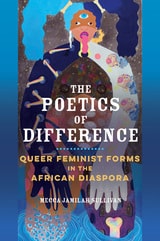
The Poetics of Difference
Queer Feminist Forms in the African DiasporaMecca Jamilah Sullivan
University of Illinois Press, 2021
From Audre Lorde, Ntozake Shange, and Bessie Head, to Zanele Muholi, Suzan-Lori Parks, and Missy Elliott, Black women writers and artists across the African Diaspora have developed nuanced and complex creative forms. Mecca Jamilah Sullivan ventures into the unexplored spaces of black women’s queer creative theorizing to learn its languages and read the textures of its forms. Moving beyond fixed notions, Sullivan points to a space of queer imagination where black women invent new languages, spaces, and genres to speak the many names of difference. Black women’s literary cultures have long theorized the complexities surrounding nation and class, the indeterminacy of gender and race, and the multiple meanings of sexuality. Yet their ideas and work remain obscure in the face of indifference from Western scholarship.
Innovative and timely, The Poetics of Difference illuminates understudied queer contours of black women’s writing.

The Senses of Nonsense
Alison Rieke
University of Iowa Press, 1992
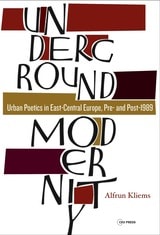
Underground Modernity
Urban Poetics in East-Central Europe, Pre- and Post-1989Alfrun Kliems
Central European University Press, 2021
The literary scholar Alfrun Kliems explores the aesthetic strategies of Eastern European underground literature, art, film and music in the decades before and after the fall of communism, ranging from the ‘father’ of Prague Underground, Egon Bondy, to the neo-Dada Club of Polish Losers in Berlin.
The works she considers are "underground" in the sense that they were produced illegally, or were received as subversive after the regimes had fallen. Her study challenges common notions of ‘Underground’ as an umbrella term for nonconformism. Rather, it depicts it as a sociopoetic reflection of modernity, intimately linked to urban settings, with tropes and aesthetic procedures related to Surrealism, Dadaism, Expressionism, and, above all, pop and counterculture.
The author discusses these commonalities and distinctions in Czech, Polish, Slovak, Ukrainian, Russian, and German authors, musicians, and filmmakers. She identifies intertextual relations across languages and generations, and situates her findings in a transatlantic context (including the Beat Generation, Susan Sontag, Neil Young) and the historical framework of Romanticism and modernity (including Baudelaire and Brecht).
Despite this wide brief, the book never loses sight of its core message: Underground is no arbitrary expression of discontent, but rather the result of a fundamental conflict at the socio-philosophical roots of modernity.
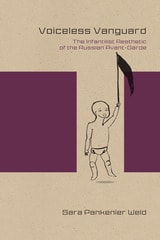
Voiceless Vanguard
The Infantilist Aesthetic of the Russian Avant-GardeSara Pankenier Weld
Northwestern University Press, 2014
Voiceless Vanguard: The Infantilist Aesthetic of the Russian Avant-Garde offers a new approach to the Russian avant-garde. It argues that central writers, artists, and theorists of the avant-garde self-consciously used an infantile aesthetic, as inspired by children’s art, language, perspective, and logic, to accomplish the artistic renewal they were seeking in literature, theory, and art. It treats the influence of children’s drawings on the Neo-Primitivist art of Mikhail Larionov, the role of children’s language in the Cubo-Futurist poetics of Aleksei Kruchenykh, the role of the naive perspective in the Formalist theory of Viktor Shklovsky, and the place of children’s logic and lore in Daniil Kharms’s absurdist writings for children and adults. This interdisciplinary and cultural study not only illuminates a rich period in Russian culture but also offers implications for modernism in a wider Western context, where similar principles apply.

Writing in the Feminine
Feminism and Experimental Writing in QuebecKaren Gould
Southern Illinois University Press, 1990
Here is a celebration and an analysis of four Québécois feminist rebels whose self-conscious revolt against language has put them at the forefront of experimental writing in Quebec. These women—Nicole Brossard, Madeleine Gagnon, Louky Bersianik, and France Theoret—are attempting to explode male-dominated language and to construct a new language and literature of women.
In this first major study of their work in English, Karen Gould examines in depth these women’s literary visions and the new ways in which they communicate those visions. Gould broadens her book’s appeal by showing how these four women’s works, in modern forms of experimental literature, are shaped not only by Quebec feminism, politics, and culture but by American and French influences as well.