Results by title
9 books match the query 'Local color in literature'
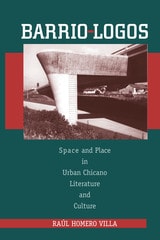
Barrio-Logos
Space and Place in Urban Chicano Literature and CultureBy Raúl Homero Villa
University of Texas Press, 2000
Struggles over space and resistance to geographic displacement gave birth to much of Chicano history and culture. In this pathfinding book, Raúl Villa explores how California Chicano/a activists, journalists, writers, artists, and musicians have used expressive culture to oppose the community-destroying forces of urban renewal programs and massive freeway development and to create and defend a sense of Chicano place-identity.
Villa opens with a historical overview that shows how Chicano communities and culture have grown in response to conflicts over space ever since the United States' annexation of Mexican territory in the 1840s. Then, turning to the work of contemporary members of the Chicano intelligentsia such as Helena Maria Viramontes, Ron Arias, and Lorna Dee Cervantes, Villa demonstrates how their expressive practices re-imagine and re-create the dominant urban space as a community enabling place. In doing so, he illuminates the endless interplay in which cultural texts and practices are shaped by and act upon their social and political contexts.
Coloring Locals
Racial Formation in Katie Chopin's "Youth's Companion" StoriesBonnie James Shaker
University of Iowa Press, 2003
Chopin's canonical status as a feminist rebel and reformer conflicts with the fact that one of her most supportive publishers throughout her life was the Youth's Companion, a juvenile periodical whose thoroughly orthodox “family values” contributed to its success as the longest-running and, at one time, most widely circulating periodical in nineteenth-century America. Not surprisingly, Chopin’s Youth’s Companion stories differ from her canonical texts in that they embrace and advance ideals of orthodox white femininity and masculinity. Rather than viewing these two representations as being at odds with each other, Bonnie Shaker asserts that Chopin's endorsement of conventional gender norms is done in the service of a second political agenda beyond her feminism, one that can help the reader appreciate nuances of identity construction previously misunderstood or overlooked in the body of her work.
Latin American Literature at the Millennium
Local Lives, Global SpacesCecily Raynor
Bucknell University Press, 2021
Place in American Fiction
Excursions and ExplorationsEdited by H.L. Weatherby & George Core
University of Missouri Press, 2004
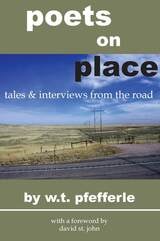
Poets On Place
W. T. Pfefferle
Utah State University Press, 2005
Out to see America and satisfy his travel bug, W. T. Pfefferle resigned from his position as director of the writing program at Johns Hopkins University and hit the road to interview sixty-two poets about the significance of place in their work. The lively conversations that resulted may surprise with the potential meanings of a seemingly simple concept. This gathering of voices and ideas is illustrated with photo and word portraits from the road and represented with suitable poems.
The poets are James Harms, David Citino, Martha Collins, Linda Gregerson, Richard Tillinghast, Orlando Ricardo Menes, Mark Strand, Karen Volkman, Lisa Samuels, Marvin Bell, Michael Dennis Browne, David Allan Evans, David Romtvedt, Sandra Alcosser, Robert Wrigley, Nance Van Winckel, Christopher Howell, Mark Halperin, Jana Harris, Sam Hamill, Barbara Drake, Floyd Skloot, Ralph Angel, Carol Muske-Dukes, David St. John, Sharon Bryan, Donald Revell, Claudia Keelan, Alberto Rios, Richard Shelton, Jane Miller, William Wenthe, Naomi Shihab Nye, Peter Cooley, Miller Williams, Beth Ann Fennelly, Natasha Trethewey, Denise Duhamel, Campbell McGrath, Terrance Hayes, Alan Shapiro, Nikki Giovanni, Charles Wright, Rita Dove, Henry Taylor, Dave Smith, Nicole Cooley, David Lehman, Lucie Brock-Broido, Michael S. Harper, C. D. Wright, Mark Wunderlich, James Cummins, Frederick Smock, Mark Jarman, Carl Phillips, Scott Cairns, Elizabeth Dodd, Jonathan Holden, Bin Ramke, Kenneth Brewer, and Paisley Rekdal.
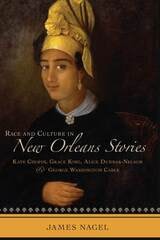
Race and Culture in New Orleans Stories
Kate Chopin, Grace King, Alice Dunbar-Nelson, and George Washington CableJames Nagel
University of Alabama Press, 2013
Race and Culture in New Orleans Stories is a study of four volumes of interrelated short stories set in New Orleans and the surrounding Louisiana bayous: Kate Chopin’s Bayou Folk; George Washington Cable’s Old Creole Days; Grace King’s Balcony Stories; and Alice Dunbar-Nelson’s The Goodness of St. Rocque and Other Stories. James Nagel argues that the conflicts and themes in these stories cannot be understood without a knowledge of the unique historical context of the founding of Louisiana, its four decades of rule by the Spanish, the Louisiana Purchase and the resulting cultural transformations across the region, Napoleonic law, the Code Noir, the plaçage tradition, the immigration of various ethnic and natural groups into the city, and the effects of the Civil War and Reconstruction. All of these historical factors energize and enrich the fiction of this important region.
The literary context of these volumes is also central to understanding their place in literary history. They are short-story cycles—collections of short fiction that contain unifying settings, recurring characters or character types, and central themes and motifs. They are also examples of the “local color” tradition in fiction, a movement that has been much misunderstood. Nagel maintains that regional literature was meant to be the highest form of American writing, not the lowest, and its objective was to capture the locations, folkways, values, dialects, conflicts, and ways of life in the various regions of the country in order to show that the lives of common citizens were sufficiently important to be the subject of serious literature.
Finally, Nagel shows that New Orleans provided a profoundly rich and complex setting for the literary exploration of some of the most crucial social problems in America, including racial stratification, social caste, economic exploitation, and gender roles, all of which were undergoing rapid transformation at the end of the nineteenth century and the beginning of the twentieth.
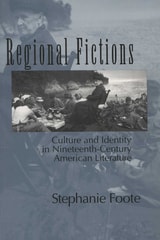
Regional Fictions
Culture and Identity in Nineteenth-Century American LiteratureStephanie Foote
University of Wisconsin Press, 2001
Out of many, one—e pluribus unum—is the motto of the American nation, and it sums up neatly the paradox that Stephanie Foote so deftly identifies in Regional Fictions. Regionalism, the genre that ostensibly challenges or offers an alternative to nationalism, in fact characterizes and perhaps even defines the American sense of nationhood.
In particular, Foote argues that the colorful local characters, dialects, and accents that marked regionalist novels and short stories of the late nineteenth century were key to the genre’s conversion of seemingly dangerous political differences—such as those posed by disaffected Midwestern farmers or recalcitrant foreign nationals—into appealing cultural differences. She asserts that many of the most treasured beliefs about the value of local identities still held in the United States today are traceable to the discourses of this regional fiction, and she illustrates her contentions with insightful examinations of the work of Sarah Orne Jewett, Hamlin Garland, Gertrude Atherton, George Washington Cable, Jacob Riis, and others. Broadening the definitions of regional writing and its imaginative territory, Regional Fictions moves beyond literary criticism to comment on the ideology of national, local, ethnic, and racial identity.

Resisting Regionalism
Gender And Naturalism In American Fiction, 1885-1915Donna Campbell
Ohio University Press, 1997
When James Lane Allen defined the “Feminine Principle” and the “Masculine Principle” in American fiction for the Atlantic Monthly in 1897, he in effect described local color fiction and naturalism, two branches of realism often regarded as bearing little relationship to each other. In this award-winning study of both movements, Resisting Regionalism explores the effect the cultural dominance of women’s local color fiction in the 1890’s had on young male naturalist writers, who rebelled against the local colorists and their “teacup tragedies.”
An immensely popular genre, local color fiction reached its peak in the 1880s in such literary journals as Harper’s Monthly, Scribner’s, the Atlantic Monthly, and the Century. These short stories exhibited local “characters,” depicted marginal groups and vanishing folkways, and addressed issues of absence, loss, limitation, and the past. Despite such prickly themes, according to Donna Campbell, local color fiction “fulfilled some specific needs of the public – for nostalgia, for a retreat into mildly exotic locales, for a semblance of order preserved in ritual.”
By the turn of the century, however, local color fiction was fading from the scene, supplanted by writers of adventure fiction and historical romances, with whom local colorists increasingly merged, and opposed by the naturalists. In examining this historic shift, Resisting Regionalism shows that far from being distanced from local color fiction, nationalism emerged in part as a dissenting response to its popularity and to the era’s concerns about the dominance of feminine influence in American literature. The new generation of authors, including Crane, Norris, London, Frederic, Wharton, resisted the cultural myths and narrative strategies common to local colorists Sarah Orne Jewett, Rose Terry Cooke, Mary E. Wilkins Freeman, and Constance Fenimore Woolson. Yet, as Campbell underscores in her analysis of Stephan Crane’s The Monster, the naturalists could, and did, integrate local color conventions with the grotesque and horrifying to powerful effect.
In clear, accessible prose, Resisting Regionalism provides fresh readings of naturalistic works in the context of the dispute between local color and naturalism. In the process, this book shows the debt naturalism owes to local color fiction and illuminates a neglected but significant literary era.

The Genius of Place
The Geographic Imagination in the Early RepublicChristopher C. Apap
University of New Hampshire Press, 2019
The Genius of Place examines how, after the War of 1812, concerns about the scale of the nation resulted in a fundamental reorientation of American identity away from the Atlantic or global ties that held sway in the early republic and toward more localized forms of identification. Instead of addressing the sweep of the nation, American authors, artists, geographers, and politicians shifted from the larger reach of the globe to the more manageable scope of the local and sectional. Paradoxically, that local representation became the primary mode through which early Americans construed their emerging national identity. This newfound cultural obsession with locality impacted the literary consolidation and representation of key American imagined places—New England, the plantation, the West—in the decades between 1816 and 1836.
Apap's examination of the intersections between local and national representations and exploration of the myths of space and place that shaped U.S. identity through the nineteenth century will appeal to a broad, interdisciplinary readership.