Results by title
23 books match the query 'Logic, Symbolic and mathematical'
A Paradigm for Program Semantics
Chris Brink and Ingrid Rewitsky
CSLI, 2001
Foundations and Methods from Mathematics to Neuroscience
Essays Inspired by Patrick SuppesEdited by Colleen E Crangle, Adolfo García de la Sienra, and Helen E. Longino
CSLI, 2014
Introduction Wittgensteins Tractatus
G.E.M. Anscombe
St. Augustine's Press, 2000
Language and Grammar
Studies in Mathematical Linguistics and Natural LanguageEdited by Claudia Casadio, Philip Scott, and Robert Seely
CSLI, 2004
Lectures on Linear Logic
A. S. Troelstra
CSLI, 1992
Logic Colloquium '92
Edited by Lázló Csirmaz, Dov M. Gabbay, and Maarten de Rijke
CSLI, 1995
Logic and Automata
History and PerspectivesEdited by Jörg Flum, Erich Grädel, and Thomas Wilke
Amsterdam University Press, 2008
Logic and Visual Information
Eric M. Hammer
CSLI, 1995
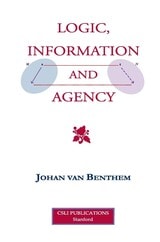
Logic, Information and Agency
Johan van Benthem
CSLI, 2025
Everything we do is driven by information, but the dynamic process of acquiring information and adjusting our views based on it has seldom been put at the center place in logic, and there are few textbooks introducing readers to this line of work. The present book introduces the reader to major logical techniques for studying information dynamics and interaction between agents, based on a variety of intuitive scenarios as well as recent research. Readers will learn styles of modeling, as well as the basic features of the new logical systems emanating from this line of work. All the separate strands in the book are brought together in a comprehensive study of information flow and action in games, forming a logic-based complement to standard perspectives in game theory.
Logic, Langage and Computation, Volume 2
Edited by Lawrence S. Moss, Jonathan Ginzburg, and Maarten de Rijke
CSLI, 1999
Logic, Language and Computation
Edited by Jerry Seligman and Dag Westerståhl
CSLI, 1996
Logic, Language and Computation, Volume 3
Edited by Patrick Blackburn, Nick Braisby, Lawrence Cavedon, and Atsushi Shimoji
CSLI, 2001
The book contains contributions to a general theory of information, while also tackling specific problems from artificial intelligence, formal semantics, cognitive psychology, and the philosophy of mind. There is focus on the dynamics of information flow, and also a consideration of static approaches to information content; both quantitative and qualitative approaches are represented.
Mathematical Reasoning with Diagrams
Mateja Jamnik
CSLI, 2001
Mathematical Structures in Languages
Edward Keenan and Larry Moss
CSLI, 2015
Notebooks, 1914-1916
Ludwig Wittgenstein
University of Chicago Press, 1984
"When the first edition of this collection of remarks appeared in 1961 we were provided with a glimpse of the workings of Wittgenstein's mind during the period when the seminal ideas of the Tractatus Logico-Philosophicus were being worked out. This second edition provided the occasion to be struck anew by the breadth, rigor, and above all the restlessness of that mind."—T. Michael McNulty, S. J., The Modern Schoolman
Philosophical Remarks
Ludwig Wittgenstein
University of Chicago Press, 1980
"[Philosophical Remarks] contains the seeds of Wittgenstein's later philosophy of mind and of mathematics. Principally, he here discusses the role of indispensable in language, criticizing Russell's The Analysis of Mind. He modifies the Tractatus's picture theory of meaning by stressing that the connection between the proposition and reality is not found in the picture itself. He analyzes generality in and out of mathematics, and the notions of proof and experiment. He formulates a pain/private-language argument and discusses both behaviorism and the verifiability principle. The work is difficult but important, and it belongs in every philosophy collection."—Robert Hoffman, Philosophy
"Any serious student of Wittgenstein's work will want to study his Philosophical Remarks as a transitional book between his two great masterpieces. The Remarks is thus indispensible for anyone who seeks a complete understanding of Wittgenstein's philosophy."—Leonard Linsky, American Philosophical Association
Studies in Weak Arithmetics, Volume 1
Edited by Patrick Cégielski
CSLI, 2009
The field of weak arithmetics is an application of logical methods to number theory that was developed by mathematicians, philosophers, and theoretical computer scientists. In this volume, after a general presentation of weak arithmetics, the following topics are studied: the properties of integers of a real closed field equipped with exponentiation; conservation results for the induction schema restricted to first-order formulas with a finite number of alternations of quantifiers; a survey on a class of tools called pebble games; the fact that the reals e and pi have approximations expressed by first-order formulas using bounded quantifiers; properties of infinite pictures depending on the universe of sets used; a language that simulates in a sufficiently nice manner all algorithms of a certain restricted class; the logical complexity of the axiom of infinity in some variants of set theory without the axiom of foundation; and the complexity to determine whether a trace is included in another one.
Studies in Weak Arithmetics, Volume 2
Edited by Patrick Cégielski, Charalampos Cornaros, and Costas Dimitracopoulos
CSLI, 2013
Studies in Weak Arithmetics, Volume 3
Edited by Patrick Cegielski, Ali Enayat, and Roman Kossak
CSLI, 2013
The Best of All Possible Worlds
Mathematics and DestinyIvar Ekeland
University of Chicago Press, 2006
Optimists believe this is the best of all possible worlds. And pessimists fear that might really be the case. But what is the best of all possible worlds? How do we define it? Is it the world that operates the most efficiently? Or the one in which most people are comfortable and content? Questions such as these have preoccupied philosophers and theologians for ages, but there was a time, during the seventeenth and eighteenth centuries, when scientists and mathematicians felt they could provide the answer.
This book is their story. Ivar Ekeland here takes the reader on a journey through scientific attempts to envision the best of all possible worlds. He begins with the French physicist Maupertuis, whose least action principle asserted that everything in nature occurs in the way that requires the least possible action. This idea, Ekeland shows, was a pivotal breakthrough in mathematics, because it was the first expression of the concept of optimization, or the creation of systems that are the most efficient or functional. Although the least action principle was later elaborated on and overshadowed by the theories of Leonhard Euler and Gottfried Leibniz, the concept of optimization that emerged from it is an important one that touches virtually every scientific discipline today.
Tracing the profound impact of optimization and the unexpected ways in which it has influenced the study of mathematics, biology, economics, and even politics, Ekeland reveals throughout how the idea of optimization has driven some of our greatest intellectual breakthroughs. The result is a dazzling display of erudition—one that will be essential reading for popular-science buffs and historians of science alike.
Transcendence and Wittgenstein's Tractatus
Michael P. Hodges
Temple University Press, 1990
Although Wittgenstein claimed that his first book, the Tractatus Logico-Philosophicus, was essentially an ethical work, it has been viewed insistently as a purely logical one. His later work, Philosophical Investigations, is generally seen as presenting totally different ideas from his earlier writings. In this book, Michael Hodges shows how Wittgenstein’s later work emerged from his earlier Tractatus, and he unifies the early philosophy, both its well-known logical aspects and the lesser known ethical dimensions, in terms of the notion of transcendence.
Hodges studies the Tractatus in light of Wittgenstein’s own claim that the Philosophical Investigations can only be understood when read against the background of the Tractatus. At the heart of an understanding of the earlier work is the idea of transcendence which structures both Wittgenstein’s logical and ethical insights. Seen in terms of this notion, the rigorous unity of Wittgenstein’s early thinking becomes apparent and the gestalt shift to the later philosophy comes clearly into focus.
Universal Logic
Ross Brady
CSLI, 2001
Wittgenstein's Tractatus
An IntroductionH. O. Mounce
University of Chicago Press, 1981