Results by title
8 books match the query 'Low - Wage Work'
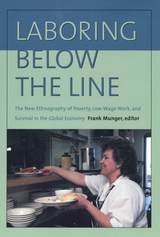
Laboring Below the Line
The New Ethnography of Poverty, Low-Wage Work, and Survival in the Global EconomyFrank Munger
Russell Sage Foundation, 2002
As the distribution of wealth between rich and poor in the United States grew more and more unequal over the past twenty years, this economic gap assumed a life of its own in the popular culture. The news and entertainment media increasingly portrayed the lives of the poor with such stereotypes as the lazy welfare mother and the thuggish teen, offering Americans few ways to learn how the "other half" really lives. Laboring Below the Line works to bridge this gap by synthesizing a wide range of qualitative scholarship on the working poor. The result is a coherent, nuanced portrait of how life is lived below the poverty line, and a compelling analysis of the systemic forces in which poverty is embedded, and through which it is perpetuated. Laboring Below the Line explores the role of interpretive research in understanding the causes and effects of poverty. Drawing on perspectives of the working poor, welfare recipients, and marginally employed men and women, the contributors—an interdisciplinary roster of ethnographers, oral historians, qualitative sociologists, and narrative analysts—dissect the life circumstances that affect the personal outlook, ability to work, and expectations for the future of these people. For example, Carol Stack views the work aspirations of an Oakland teenager for whom a job is important, even though it strains her academic performance. And Ruth Buchanan looks at low-wage telemarketing workers who are attempting to move up the economic ladder while balancing family, education, and other important commitments. What emerges is a compelling picture of low-wage workers—one that illustrates the precarious circumstances of individuals struggling with the economic conditions and institutions that surround them Each chapter also explores the capacity for economic survival from a different angle, with ancillary commentary complementing the ethnographies with perspectives from other fields of study, such as economics. At this moment of governmental retrenchment, ethnography's complex, nonstereotypical portraits of individual people fighting against poverty are especially important. Laboring Below the Line reveals the ambiguities of real lives, the potential for individuals to change in unexpected ways, and the even greater intricacy of the collective life of a community.
[more]
Low-Wage Work in Denmark
Niels Westergaard-Nielsen
Russell Sage Foundation, 2008
The Danish economy offers a dose of American labor market flexibility inside a European welfare state. The Danish government allows employers a relatively high level of freedom to dismiss workers, but also provides generous unemployment insurance. Widespread union coverage and an active system of collective bargaining help regulate working conditions in the absence of strong government regulation. Denmark's rate of low-wage work—8.5 percent—is the lowest of the five countries under analysis. In Low-Wage Work in Denmark, a team of Danish researchers combines comprehensive national registry data with detailed case studies of five industries to explore why low-end jobs are so different in Denmark. Some jobs that are low-paying in the United States, including hotel maids and meat processors, though still demanding, are much more highly compensated in Denmark. And Danes, unlike American workers, do not stay in low-wage jobs for long. Many go on to higher paying jobs, while a significant minority ends up relying temporarily on income support and benefits sustained by one of the highest tax rates in the world. Low-Wage Work in Denmark provides an insightful look at the particularities of the Danish labor market and the lessons it holds for both the United States and the rest of Europe. A Volume in the Russell Sage Foundation Case Studies of Job Quality in Advanced Economies
[more]

Low-Wage Work in France
Eve Caroli
Russell Sage Foundation, 2008
In France, low wages have historically inspired tremendous political controversy. The social and political issues at stake center on integrating the working class into society and maintaining the stability of the republican regime. A variety of federal policies—including high minimum wages and strong employee protection—serve to ensure that the low-wage workforce stays relatively small. Low-Wage Work in France examines both the benefits and drawbacks of this politically inspired system of worker protection. France's high minimum wage, which is indexed not only to inflation but also to the average increase in employee wages, plays a critical role in limiting the development of low-paid work. Social welfare benefits and a mandatory thirty-five hour work week also make life easier for low-wage workers. Strong employee protection is a central characteristic of the French model, but high levels of protection for employees may also be one of the causes of France's chronically high rate of unemployment. The threat of long-term unemployment may, in turn, contribute to a persistent sense of insecurity among French workers. Low-Wage Work in France provides a lucid analysis of how a highly regulated labor market shapes the experiences of workers—for better and for worse. A Volume in the Russell Sage Foundation Case Studies of Job Quality in Advanced Economies
[more]
Low-Wage Work in Germany
Gerhard Bosch
Russell Sage Foundation, 2008
In recent years, the German government has intentionally expanded the low-wage work sector in an effort to reduce exceptionally high levels of unemployment. As a result, the share of the German workforce employed in low-paying jobs now rivals that of the United States. Low Wage Work in Germany examines both the federal policies and changing economic conditions that have driven this increase in low-wage work. The new "mini-job" reflects the federal government's attempt to make certain low-paying jobs attractive to both employers and employees. Employers pay a low flat rate for benefits, and employees, who work a limited number of hours per week, are exempt from social security and tax contributions. Other factors, including slow economic growth, a declining collective bargaining system, and the influx of foreign workers, also contribute to the growing incidence of low-wage work. Yet while both Germany and the United States have large shares of low-wage workers, German workers receive health insurance, four weeks of paid vacation, and generous old age support—benefits most low-wage workers in the United States can only dream of. The German experience offers an important opportunity to explore difficult trade-offs between unemployment and low-wage work. A Volume in the Russell Sage Foundation Case Studies of Job Quality in Advanced Economies
[more]
Low-Wage Work in the Netherlands
Weimer Salverda
Russell Sage Foundation, 2008
The Dutch economy has often been heralded for accomplishing solid employment growth within a generous welfare system. In recent years, the Netherlands has seen a rise in low-wage work and has maintained one of the lowest unemployment rates in the European Union. Low-Wage Work in the Netherlands narrows in on the causes and consequences of this new development. The authors find that the increase in low-wage work can be partly attributed to a steep rise in the number of part-time jobs and non-standard work contracts—46 percent of Dutch workers hold part-time jobs. The decline in full-time work has challenged historically powerful Dutch unions and has led to a slow but steady dismantling of many social insurance programs from 1979 onward. At the same time, there are hopeful lessons to be gleaned from the Dutch model: low-wage workers benefit from a well-developed system of income transfers, and many move on to higher paying jobs. Low-Wage Work in the Netherlands paints a nuanced picture of the Dutch economy by analyzing institutions that both support and challenge its low-wage workforce. A Volume in the Russell Sage Foundation Case Studies of Job Quality in Advanced Economies
[more]

Low-Wage Work in the United Kingdom
Caroline LLoyd
Russell Sage Foundation, 2008
The United Kingdom's labor market policies place it in a kind of institutional middle ground between the United States and continental Europe. Low pay grew sharply between the late 1970s and the mid-1990s, in large part due to the decline of unions and collective bargaining and the removal of protections for the low paid. The changes instituted by Tony Blair's New Labour government since 1997, including the introduction of the National Minimum Wage, halted the growth in low pay but have not reversed it. Low-Wage Work in the United Kingdom explains why the current level of low-paying work remains one of the highest in Europe. The authors argue that the failure to deal with low pay reflects a policy approach which stressed reducing poverty, but also centers on the importance of moving people off benefits and into work, even at low wages. The U.K. government has introduced a version of the U.S. welfare to work policies and continues to stress the importance of a highly flexible and competitive labor market. A central policy theme has been that education and training can empower people to both enter work and to move into better paying jobs. The case study research reveals the endemic nature of low paid work and the difficulties workers face in escaping from the bottom end of the jobs ladder. However, compared to the United States, low paid workers in the United Kingdom do benefit from in-work social security benefits, targeted predominately at those with children, and entitlements to non-pay benefits such as annual leave, maternity and sick pay, and crucially, access to state-funded health care. Low-Wage Work in the United Kingdom skillfully illustrates the way that the interactions between government policies, labor market institutions, and the economy have ensured that low pay remains a persistent problem within the United Kingdom. A Volume in the Russell Sage Foundation Case Studies of Job Quality in Advanced Economies
[more]
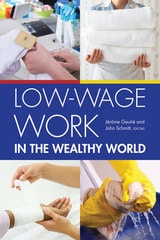
Low-Wage Work in the Wealthy World
Jerome Gautie
Russell Sage Foundation, 2010
As global flows of goods, capital, information, and people accelerate competitive pressure on businesses throughout the industrialized world, firms have responded by reorganizing work in a variety of efforts to improve efficiency and cut costs. In the United States, where minimum wages are low, unions are weak, and immigrants are numerous, this has often lead to declining wages, increased job insecurity, and deteriorating working conditions for workers with little bargaining power in the lower tiers of the labor market. Low-Wage Work in the Wealthy World builds on an earlier Russell Sage Foundation study (Low-Wage America) to compare the plight of low-wage workers in the United States to five European countries—Denmark, France, Germany, the Netherlands, and the United Kingdom—where wage supports, worker protections, and social benefits have generally been stronger. By examining low-wage jobs in systematic case studies across five industries, this groundbreaking international study goes well beyond standard statistics to reveal national differences in the quality of low-wage work and the well being of low-wage workers. The United States has a high percentage of low-wage workers—nearly three times more than Denmark and twice more than France. Since the early 1990s, however, the United Kingdom, the Netherlands, and Germany have all seen substantial increases in low-wage jobs. While these jobs often entail much the same drudgery in Europe and the United States, quality of life for low-wage workers varies substantially across countries. The authors focus their analysis on the "inclusiveness" of each country's industrial relations system, including national collective bargaining agreements and minimum-wage laws, and the generosity of social benefits such as health insurance, pensions, family leave, and paid vacation time—which together sustain a significantly higher quality of life for low-wage workers in some countries. Investigating conditions in retail sales, hospitals, food processing, hotels, and call centers, the book's industry case studies shed new light on how national institutions influence the way employers organize work and shape the quality of low-wage jobs. A telling example: in the United States and several European nations, wages and working conditions of front-line workers in meat processing plants are deteriorating as large retailers put severe pressure on prices, and firms respond by employing low-wage immigrant labor. But in Denmark, where unions are strong, and, to a lesser extent, in France, where the statutory minimum wage is high, the low-wage path is blocked, and firms have opted instead to invest more heavily in automation to raise productivity, improve product quality, and sustain higher wages. However, as Low-Wage Work in the Wealthy World also shows, the European nations' higher level of inclusiveness is increasingly at risk. "Exit options," both formal and informal, have emerged to give employers ways around national wage supports and collectively bargained agreements. For some jobs, such as room cleaners in hotels, stronger labor relations systems in Europe have not had much impact on the quality of work. Low-Wage Work in the Wealthy World offers an analysis of low-wage work in Europe and the United States based on concrete, detailed, and systematic contrasts. Its revealing case studies not only provide a human context but also vividly remind us that the quality and incidence of low-wage work is more a matter of national choice than economic necessity and that government policies and business practices have inevitable consequences for the quality of workers' lives. A Volume in the Russell Sage Foundation Case Studies of Job Quality in Advanced Economies
[more]
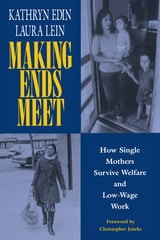
Making Ends Meet
How Single Mothers Survive Welfare and Low-Wage WorkKathryn Edin
Russell Sage Foundation, 1997
Welfare mothers are popularly viewed as passively dependent on their checks and averse to work. Reformers across the political spectrum advocate moving these women off the welfare rolls and into the labor force as the solution to their problems. Making Ends Meet offers dramatic evidence toward a different conclusion: In the present labor market, unskilled single mothers who hold jobs are frequently worse off than those on welfare, and neither welfare nor low-wage employment alone will support a family at subsistence levels. Kathryn Edin and Laura Lein interviewed nearly four hundred welfare and low-income single mothers from cities in Massachusetts, Texas, Illinois, and South Carolina over a six year period. They learned the reality of these mothers' struggles to provide for their families: where their money comes from, what they spend it on, how they cope with their children's needs, and what hardships they suffer. Edin and Lein's careful budgetary analyses reveal that even a full range of welfare benefits—AFDC payments, food stamps, Medicaid, and housing subsidies—typically meet only three-fifths of a family's needs, and that funds for adequate food, clothing and other necessities are often lacking. Leaving welfare for work offers little hope for improvement, and in many cases threatens even greater hardship. Jobs for unskilled and semi-skilled women provide meager salaries, irregular or uncertain hours, frequent layoffs, and no promise of advancement. Mothers who work not only assume extra child care, medical, and transportation expenses but are also deprived of many of the housing and educational subsidies available to those on welfare. Regardless of whether they are on welfare or employed, virtually all these single mothers need to supplement their income with menial, off-the-books work and intermittent contributions from family, live-in boyfriends, their children's fathers, and local charities. In doing so, they pay a heavy price. Welfare mothers must work covertly to avoid losing benefits, while working mothers are forced to sacrifice even more time with their children. Making Ends Meet demonstrates compellingly why the choice between welfare and work is more complex and risky than is commonly recognized by politicians, the media, or the public. Almost all the welfare-reliant women interviewed by Edin and Lein made repeated efforts to leave welfare for work, only to be forced to return when they lost their jobs, a child became ill, or they could not cover their bills with their wages. Mothers who managed more stable employment usually benefited from a variety of mitigating circumstances such as having a relative willing to watch their children for free, regular child support payments, or very low housing, medical, or commuting costs. With first hand accounts and detailed financial data, Making Ends Meet tells the real story of the challenges, hardships, and survival strategies of America's poorest families. If this country's efforts to improve the self-sufficiency of female-headed families is to succeed, reformers will need to move beyond the myths of welfare dependency and deal with the hard realities of an unrewarding American labor market, the lack of affordable health insurance and child care for single mothers who work, and the true cost of subsistence living. Making Ends Meet is a realistic look at a world that so many would change and so few understand.
[more]