Results by title
17 books match the query 'Lyric poetry'
A Symposion of Praise
Horace Returns to Lyric in Odes IVTimothy Johnson
University of Wisconsin Press, 2007
Johnson shows the Horatian panegyrist is more than a dependent poet representing only the desires of his patrons. The poet forges the panegyric agenda, setting out the character of the praise (its mode, lyric, and content both positive and negative), and calls together a community to join in the creation and adaptation of Roman identities and civic ideologies. With this insightful reading, A Symposion of Praise will be of interest to historians of the Augustan period and its literature, and to scholars interested in the dynamics between personal expression and political power.
Amphion
Lyre, Poetry, and Politics in ModernityLeah Middlebrook
University of Chicago Press, 2024
Amphion is the figure in Greek mythology who played so skillfully on a lyre that stones moved of their own accord to build walls for Thebes. While Amphion still presides over music and architecture, he was once fundamental to the concept of lyric poetry. Amphion figured the human power to inspire action, creating and undoing polities by means of language. In contrast to the individual inspiration we associate with the better-known Orpheus, Amphion represents the relentless, often violent, play of harmony and disorder in human social life.
In this wide-ranging study, Leah Middlebrook introduces readers to Amphion-inspired poetics and lyrics and traces the tradition of the Amphionic from the Renaissance through modernist and postmodern poetry and translation from the Hispanic, Anglophone, French, Italian, and ancient Roman worlds. Amphion makes a significant contribution to scholarship on the connection between poetry and politics and the history of the lyric, offering an account well-suited to our times.
Bonfire of Roadmaps
By Joe Ely
University of Texas Press, 2007
Since he first hitched a ride out of Lubbock, Texas, at the age of sixteen, singer-songwriter and Flatlanders band member Joe Ely has been a road warrior, traveling highways and back roads across America and Europe, playing music for "2 hours of ecstasy" out of "22 hours of misery." To stay sane on the road, Ely keeps a journal, penning verses that sometimes morph into songs, and other times remain "snapshots of what was flying by, just out of reach, so to savor at a later date when the wheels stop rolling, and the gears quit grinding, and the engines shut down."
In Bonfire of Roadmaps, Ely takes readers on the road with him. Using verse passages from his road journals and his own drawings, Ely authentically re-creates the experience of a musician's life on tour, from the hard goodbyes at home, to the long hours on the road, to the exhilaration of a great live show, to the exhaustion after weeks of touring. Ely's road trips begin as he rides the rails to Manhattan in 1972 and continue up through recent concert tours with fellow Flatlanders Jimmie Dale Gilmore and Butch Hancock.
While acknowledging that "it is not the nature of a gypsy to look in the rearview mirror," Joe Ely nevertheless offers his many fans a revelatory look back over the roads he's traveled and the wisdom he's won from his experiences. And for "those who want to venture beyond the horizon just to see what is there... to those, I hope these accounts will give a glint of inspiration..."
Continental England
Form, Translation, and Chaucer in the Hundred Years’ WarElizaveta Strakhov
The Ohio State University Press, 2022
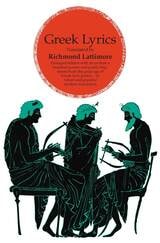
Greek Lyrics, Second Edition
More than a Hundred Poems and Poetic Fragments from the Great Age of Greek Lyric PoetryRichmond Lattimore
University of Chicago Press, 1960
In this second edition of Greek Lyrics, translator and editor Richmond Lattimore brings together a vast assortment of seventh-and sixth-century Greek lyric, elegiac, and iambic poetry. For the Greekless student or curious scholar, these translations showcase the diversity of poetic subjects in classical antiquity, which range from love poems to medical inscriptions and drinking songs. Gracefully and robustly translated by a number of top-tier translators, this volume includes poets such as Archílochus, Callínus, Semónides of Amórgos, Hippónax, Tyrtaéus, Mimnérmus, Solon, Phocýlides, Xenóphanes, Theógnis, Terpánder, Alcman, Stesíchorus, íbycus, Sappho, Alcaéus, Anácreon, Hýbrias, Praxílla, Corínna, Simónides of Ceos, Pindar, and Bacchýlides.

Land and Sea
The Lyric Poetry of Philip FreneauRichard C. Vitzthum
University of Minnesota Press, 1978
Land and Sea was first published in 1978. Minnesota Archive Editions uses digital technology to make long-unavailable books once again accessible, and are published unaltered from the original University of Minnesota Press editions.
Although Philip Freneau is best known as the poet of the American Revolution, half his poems had nothing to do with the war, Professor Vitzthum points out, and this, the first systematic, in-depth study of Freneau's lyric poetry, provides a fresh perspective on the poet's non-political work. Demonstrating that there is a heretofore unrecognized pattern of land-sea imagery and symbolism in Freneau's best work. Professor Vitzthum traces changes reflected in this imagery to developments in the poet's thought, which in turn related to major intellectual and literary trends in revolutionary and early republican America. An introductory chapter assesses twentieth century biographical and critical estimates of Freneau, outlines the key themes in his work, and links his thirty-year career as sailor and ship captain to his creation of a covert, symbolistic poetic method. The following five chapters chronologically discuss Freneau's non-political poems from 1772 through 1815. Professor Vitzthum concludes that Freneau was not the derivative and unsuccessful artist he is currently thought to have been but, rather, one of America's genuinely important poets.
Lyric Interventions
Feminism, Experimental Poetry, DiscourseLinda A. Kinnahan
University of Iowa Press, 1998
Lyric Interventions explores linguistically innovative poetry by contemporary women in North America and Britain whose experiments give rise to fresh feminist readings of the lyric subject. The works discussed by Linda Kinnahan explore the lyric subject in relation to the social: an “I” as a product of social discourse and as a conduit for change.
Contributing to discussions of language-oriented poetries through its focus on women writers and feminist perspectives, this study of lyric experimentation brings attention to the cultural contexts of nation, gender, and race as they significantly shift the terms by which the “experimental” is produced, defined, and understood.
This study focuses upon lyric intervention in distinct but related spheres as they link public and ideological norms of identity. Firstly, lyric innovations with visual and spatial realms of cultural practice and meaning, particularly as they naturalize ideologies of gender and race in North America and the post-colonial legacies of the Caribbean, are investigated in the works of Barbara Guest, Kathleen Fraser, Erica Hunt, and M. Nourbese Philip. Secondly, experimental engagements with nationalist rhetorics of identity, marking the works of Carol Ann Duffy, Denise Riley, Wendy Mulford, and Geraldine Monk, are explored in relation to contemporary evocations of “self” in Britain. And thirdly, in discussions of all of the poets, but particularly accenuated in regard to Guest, Fraser, Riley, Mulford, and Monk, formal experimentation with the lyric “I” is considered through gendered encounters with critical and avant-garde discourses of poetics.
This fresh, energetic study will be of great interest to literary critics and womens studies scholars, as well as poets on both sides of the Atlantic.
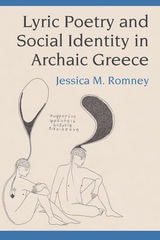
Lyric Poetry and Social Identity in Archaic Greece
Jessica M. Romney
University of Michigan Press, 2020
All non-English text and quotes are translated, with the original languages given alongside the translation or in the endnotes.
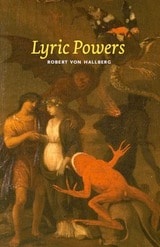
Lyric Powers
Robert von Hallberg
University of Chicago Press, 2008
To explain why a reader might prefer one kind of poem to another, von Hallberg analyzes—beyond the political and intellectual significance of poems—the musicality of both lyric poetry and popular song, including that of Tin Pan Alley and doo-wop. He shows that poets have distinctive intellectual resources—not just rhetorical resources—for examining their subjects, and that the power of poetic language to generalize, not particularize, is what justly deserves a critic’s attention.
The first book in more than a decade from this respected critic, Lyric Powers will be celebrated as a genuine event by readers of poetry and literary criticism.
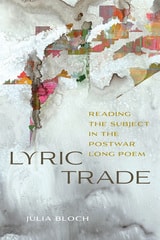
Lyric Trade
Reading the Subject in the Postwar Long PoemJulia Bloch
University of Iowa Press, 2024
Engaging with poets such as Gwendolyn Brooks, H.D., Lorine Niedecker, Alice Notley, and Myung Mi Kim, this book asks: What does lyric mean, and why should it matter to poets and readers? Lyric Trade argues that lyric in the postwar long poem not only registers the ideological contradictions of modernism’s insistence on new forms, but that it also maps spaces for formal reimaginings of the subject.
Poetry and the Fate of the Senses
Susan Stewart
University of Chicago Press, 2001
Herself an acclaimed poet, Stewart not only brings the intelligence of a critic to the question of poetry, but the insight of a practitioner as well. Her new study draws on reading from the ancient Greeks to the postmoderns to explain how poetry creates meanings between persons. Poetry and the Fate of the Senses includes close discussions of poems by Stevens, Hopkins, Keats, Hardy, Bishop, and Traherne, of the sense of vertigo in Baroque and Romantic works, and of the rich tradition of nocturnes in visual, musical, and verbal art. Ultimately, Stewart explores the pivotal role of poetry in contemporary culture. She argues that poetry can counter the denigration of the senses and can expand our imagination of the range of human expression.
Poetry and the Fate of the Senses won the 2004 Truman Capote Award for Literary Criticism in Memory of Newton Arvin, administered for the Truman Capote Estate by the University of Iowa Writers' Workshop. It also won the Phi Beta Kappa Society's 2002 Christian Gauss Award for Literary Criticism.
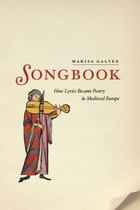
Songbook
How Lyrics Became Poetry in Medieval EuropeMarisa Galvez
University of Chicago Press, 2012
Today we usually think of a book of poems as composed by a poet, rather than assembled or adapted by a network of poets and readers. But the earliest European vernacular poetries challenge these assumptions. Medieval songbooks remind us how lyric poetry was once communally produced and received—a collaboration of artists, performers, live audiences, and readers stretching across languages and societies.
The only comparative study of its kind, Songbook treats what poetry was before the emergence of the modern category “poetry”: that is, how vernacular songbooks of the thirteenth to fifteenth centuries shaped our modern understanding of poetry by establishing expectations of what is a poem, what is a poet, and what is lyric poetry itself. Marisa Galvez analyzes the seminal songbooks representing the vernacular traditions of Occitan, Middle High German, and Castilian, and tracks the process by which the songbook emerged from the original performance contexts of oral publication, into a medium for preservation, and, finally, into an established literary object. Galvez reveals that songbooks—in ways that resonate with our modern practice of curated archives and playlists—contain lyric, music, images, and other nonlyric texts selected and ordered to reflect the local values and preferences of their readers. At a time when medievalists are reassessing the historical foundations of their field and especially the national literary canons established in the nineteenth century, a new examination of the songbook’s role in several vernacular traditions is more relevant than ever.
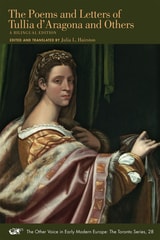
The Poems and Letters of Tullia d'Aragona and Others
A Bilingual EditionTullia d'Aragona and Others, Edited by Julia L. Hairston, Translated by Julia L. Hairston
Iter Press, 2014
Hairston has constructed a full personal, cultural and literary biography for d’Aragona, using newly discovered letters, archival material of other kinds, and contemporary theory about gender in women’s writing. Footnotes establish the intricacy of Tullia’s intellectual networks and her courting of intellectuals in rhyme. Hairston includes poems written to d’Aragona, including Girolamo Muzio’s long pastoral, Tirrhenia. She addresses with tact the question of how sexual Tullia’s relationships were with her various interlocutors. At times, as she says, one just can’t know, but that the issue is much less important than the poems themselves. I agree wholeheartedly. This is the editor Tullia has been waiting for: an indefatigable researcher, a creative biographer, and a precise and appreciative literary critic.
—Ann Rosalind Jones
Esther Cloudman Dunn Professor of Comparative Literature, Smith College
The figure of Tullia d’Aragona has long fascinated readers as the prototype of the “honest courtesan”, a woman who successfully exploited her physical and intellectual charms to win the adoration and respect of the Italian cultural elite. With Julia Hairston’s richly annotated edition of her collected verse, the product of more than a decade of scholarship, d’Aragona finally comes into focus also as poet. She emerges in this volume as one of the most distinctive protagonists in a key transitional moment in Italian literary history, when the aristocratic tradition of Petrarchist lyric began to be reshaped and democratized by its encounter with print.
—Virginia Cox
Professor of Italian, New York University
The Poetics of Epiphany in the Spanish Lyric of Today
Judith Nantell
Bucknell University Press, 2020
Published by Bucknell University Press. Distributed worldwide by Rutgers University Press.
The Poetics of Repetition in English and Chinese Lyric Poetry
Cecile Chu-chin Sun
University of Chicago Press, 2010
For more than half a century, Chinese-Western comparative literature has been recognized as a formal academic discipline, but critics and scholars in the field have done little to develop a viable, common basis for comparison between these disparate literatures. In this pioneering book, Cecile Chu-chin Sun establishes repetition as the ideal perspective from which to compare the poetry and poetics from these two traditions.
Sun contends that repetition is at the heart of all that defines the lyric as a unique art form and, by closely examining its use in Chinese and Western poetry, she demonstrates howone can identify important points of convergence and divergence. Through a representative sampling of poems from both traditions, she illustrates how the irreducible generic nature of the lyric transcends linguistic and cultural barriers but also reveals the fundamental distinctions between the traditions. Most crucially, she dissects the two radically different conceptualizations of reality—mimesis and xing—that serve as underlying principles for the poetic practices of each tradition.
Skillfully integrating theory and practice, The Poetics of Repetition in English and Chinese Lyric Poetryprovides a much-needed model for future study of Chinese and English poetry as well as lucid, succinct interpretations of individual poems.
The Power of Genre
Adena Rosmarin
University of Minnesota Press, 1986
The Power of Genre was first published in 1986. Minnesota Archive Editions uses digital technology to make long-unavailable books once again accessible, and are published unaltered from the original University of Minnesota Press editions.
The Power of Genre is a radical and systematic rethinking of the relationship between literary genre and critical explanation. Adene Rosmarin shows how traditional theories of genre—whether called "historical," "intrinsic," or "theoretical"—are necessarily undone by their attempts to define genre representationally. Rather, Rosmarin argues, the opening premise of critical argument is always critical purpose or, as E. H. Gombrich has said, function, and the genre or "form" follows the reform. The goal is a relational model that works.
Rosemarin analyzes existing theories of genre — those of Hirsch, Crane, Frye, Todorov, Jauss, and Rader are given particular attention—before proposing her own. These analyses uncover the illogic that plagues even sophisticated attempts to treat genre as a preexistent entity. Rosmarin shows how defining genre pragmatically – as explicitly chosen or devised to serve explicitly critical purposes – solves this problem: a pragmatic theory of genre builds analysis of its metaphors and motives into its program, thereby eliminating theory's traditional need to deny the invented and rhetorical nature of its schemes. A pragmatic theory, however, must be tested not only by its internal cohesion but also by its power to enable practice, and Rosmarin chooses the dramatic monologue, an infamously problematic genre, and its recent relative, the mask lyric, as testing grounds. Both genres—variously exemplified by poems of Browning, Thennyson, Eliot, and Pound—are ex post facto critical constructs that, when defined as such, make closely reasoned sense not only of particular poems but also of their perplexed interpretive histories. Moreover, both genres dwell on the historicity, textuality, and redemptive imperfection of the speaking self. This generic obsession ties the poems to their reception and, finally, to the openended, processes of hermeneutic question-and-answer stressed in Rosmarin's framing theory.
Vise and Shadow
Essays on the Lyric Imagination, Poetry, Art, and CulturePeter Balakian
University of Chicago Press, 2015
Vise and Shadow draws into conversation such disparate figures as W. B. Yeats, Hart Crane, Joan Didion, Primo Levi, Robert Rauschenberg, Bob Dylan, Elia Kazan, and Arshile Gorky, revealing how the lyric imagination of these artists grips experience, "shadows history," and "casts its own type of illumination," creating one of the deepest kinds of human knowledge and sober truth. In these elegantly written essays, Balakian offers a fresh way to think about the power of poetry, art, and the lyrical imagination as well as history, trauma, and memory.