Results by title
8 books match the query 'Magick Studies'
Between the Living and the Dead
A Perspective on Witches and Seers in the Early Modern AgeÉva Pócs
Central European University Press, 1998
Glamorous Sorcery
Magic and Literacy in the High Middle AgesDavid Rollo
University of Minnesota Press, 2000
In Darkness and Secrecy
The Anthropology of Assault Sorcery and Witchcraft in AmazoniaNeil L. Whitehead and Robin Wright, eds.
Duke University Press, 2004
These essays, by leading anthropologists of South American shamanism, consider assault sorcery as it is practiced in parts of Brazil, Guyana, Venezuela, and Peru. They analyze the social and political dynamics of witchcraft and sorcery and their relation to cosmology, mythology, ritual, and other forms of symbolic violence and aggression in each society studied. They also discuss the relations of witchcraft and sorcery to interethnic contact and the ways that shamanic power may be co-opted by the state. In Darkness and Secrecy includes reflections on the ethical and practical implications of ethnographic investigation of violent cultural practices.
Contributors. Dominique Buchillet, Carlos Fausto, Michael Heckenberger, Elsje Lagrou, E. Jean Langdon, George Mentore, Donald Pollock, Fernando Santos-Granero, Pamela J. Stewart, Andrew Strathern, Márnio Teixeira-Pinto, Silvia Vidal, Neil L. Whitehead, Johannes Wilbert, Robin Wright
Monks and Magic
Revisiting a Classic Study of Religious Ceremonies in ThailandBarend Jan Terwiel
National University of Singapore Press, 2012
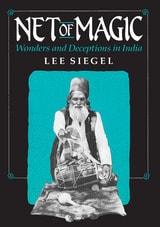
Net of Magic
Wonders and Deceptions in IndiaLee Siegel
University of Chicago Press, 1991
Siegel's journeys take him from ancient Sanskrit texts to the slums of New Delhi to find remnants of a remarkable magical tradition. In the squalid settlement of Shadipur, he is initiated into a band of Muslim street conjurers and performs as their shill while they tutor him in their con and craft. Siegel also becomes acquainted with Hindu theatrical magicians, who claim descent from court illusionists and now dress as maharajahs to perform a repertoire of tricks full of poignant kitsch and glitz.
Masterfully using a panoply of narrative sleights to recreate the magical world of India, Net of Magic intersperses travelogue, history, ethnography, and fiction. Siegel's vivid, often comic tale is crowded with shills and stooges, tourists and pickpockets, snake charmers and fakirs. Among the cast of characters are Naseeb, a poor Muslim street magician who guides Siegel into the closed circle of itinerant performers; the Industrial Magician, paid by a bank, who convinces his audience to buy traveler's checks by making twenty-rupee notes disappear; the Government Magician, who does a trick with condoms to encourage family planning; P. C. Sorcar, Jr., the most celebrated Indian stage magician; and the fictive Professor M. T. Bannerji, the world's greatest magician, who assumes various guises over a millennium of Indian history and finally arrives in the conjuring capital of the world—Las Vegas.
Like Indra's net—the web of illusion in which Indian performers ensnare their audience—Net of Magic captures the reader in a seductive portrayal of a world where deception is celebrated and lies are transformed into compelling and universal truths.
The Greek Magical Papyri in Translation, Including the Demotic Spells, Volume 1
TextsEdited by Hans Dieter Betz
University of Chicago Press, 1992
"The Greek magical papyri" is a collection of magical spells and formulas, hymns, and rituals from Greco-Roman Egypt, dating from the second century B.C. to the fifth century A.D. Containing a fresh translation of the Greek papyri, as well as Coptic and Demotic texts, this new translation has been brought up to date and is now the most comprehensive collection of this literature, and the first ever in English.
The Greek Magical Papyri in Transition is an invaluable resource for scholars in a wide variety of fields, from the history of religions to the classical languages and literatures, and it will fascinate those with a general interest in the occult and the history of magic.
Witchcraft Dialogues
Anthropological and Philosophical ExchangesGeorge Clement Bond
Ohio University Press, 2001
While many Africanist scholars shun the analysis of witchcraft as an appropriate domain of investigation, the experiences, thoughts, activities, and powers that witchcraft encompasses have become increasingly the source of interest and debate. Concepts of witchcraft and the phenomena to which they are applied express something fundamental to the human condition and have their equation in the logic of other human practices such as racism and its various crafts. Thus, the focus on witchcraft is not just a concern with the occult, but a manifestation of the convergence of interest in mediating and transcending disciplinary domains.
The contributors to this volume embrace the challenge of exploring witchcraft as a mode of experiencing and explaining human circumstances as well as confronting the limitations of their own intellectual traditions and paradigms. The range of their explorations takes us in new directions, making use not only of their academic training but also of their personal experiences, to reframe the conceptual terrain of the occult and the epistemological orientations of their various academic fields of inquiry.
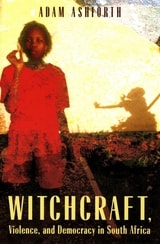
Witchcraft, Violence, and Democracy in South Africa
Adam Ashforth
University of Chicago Press, 2004
In Witchcraft, Violence, and Democracy in South Africa, Adam Ashforth examines how people in Soweto and other parts of post-apartheid South Africa manage their fear of 'evil forces' such as witchcraft. Ashforth examines the dynamics of insecurity in the everyday life of Soweto at the turn of the twenty-first century. He develops a new framework for understanding occult violence as a form of spiritual insecurity and documents new patterns of interpretation attributing agency to evil forces. Finally, he analyzes the response of post-apartheid governments to issues of spiritual insecurity and suggests how these matters pose severe long-term challenges to the legitimacy of the democratic state.