Results by title
13 books match the query 'Maimonides, Moses'
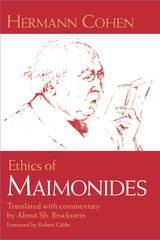
Ethics of Maimonides
Hermann Cohen, Translated by Almut Sh. Bruckstein
University of Wisconsin Press, 2004
Hermann Cohen’s essay on Maimonides’ ethics is one of the most fundamental texts of twentieth-century Jewish philosophy, correlating Platonic, prophetic, Maimonidean, and Kantian traditions. Almut Sh. Bruckstein provides the first English translation and her own extensive commentary on this landmark 1908 work, which inspired readings of medieval and rabbinic sources by Leo Strauss, Franz Rosenzweig, and Emmanuel Levinas.
Cohen rejects the notion that we should try to understand texts of the past solely in the context of their own historical era. Subverting the historical order, he interprets the ethical meanings of texts in the light of a future yet to be realized. He commits the entire Jewish tradition to a universal socialism prophetically inspired by ideals of humanity, peace, and universal justice.
Through her own probing commentary on Cohen’s text, like the margin notes of a medieval treatise, Bruckstein performs the hermeneutical act that lies at the core of Cohen’s argument: she reads Jewish sources from a perspective that recognizes the interpretive act of commentary itself.
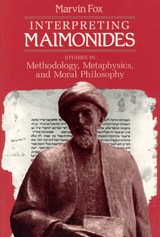
Interpreting Maimonides
Studies in Methodology, Metaphysics, and Moral PhilosophyMarvin Fox
University of Chicago Press, 1990
Leo Strauss and the Rediscovery of Maimonides
Kenneth Hart Green
University of Chicago Press, 2013
An invaluable companion to Green’s comprehensive collection of Strauss’s writings on Maimonides, this volume shows how Strauss confronted the commonly accepted approaches to the medieval philosopher, resulting in both a new understanding of Maimonides and a new depth and direction for his own thought. It will be welcomed by anyone engaged with the work of either philosopher.
Leo Strauss on Maimonides
The Complete WritingsLeo Strauss
University of Chicago Press, 2013
With Leo Strauss on Maimonides, Kenneth Hart Green presents for the first time a comprehensive, annotated collection of Strauss’s writings on Maimonides, comprising sixteen essays, three of which appear in English for the first time. Green has also provided careful translations of materials that had originally been quoted in Hebrew, Arabic, Latin, German, and French; written an informative introduction highlighting the original contributions found in each essay; and brought references to out-of-print editions fully up to date. The result will become the standard edition of Strauss’s writings on Maimonides.

Maimonides and Spinoza
Their Conflicting Views of Human NatureJoshua Parens
University of Chicago Press, 2012
Until the last century, it was generally agreed that Maimonides was a great defender of Judaism, and Spinoza—as an Enlightenment advocate for secularization—among its key opponents. However, a new scholarly consensus has recently emerged that the teachings of the two philosophers were in fact much closer than was previously thought. In his perceptive new book, Joshua Parens sets out to challenge the now predominant view of Maimonides as a protomodern forerunner to Spinoza—and to show that a chief reason to read Maimonides is in fact to gain distance from our progressively secularized worldview.
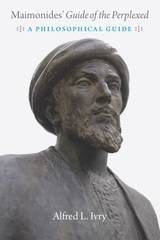
Maimonides' "Guide of the Perplexed"
A Philosophical GuideAlfred L. Ivry
University of Chicago Press, 2016
Drawing on a lifetime of study, Alfred L. Ivry has written the definitive guide to the Guide—one that makes it comprehensible and exciting to even those relatively unacquainted with Maimonides’ thought, while also offering an original and provocative interpretation that will command the interest of scholars. Ivry offers a chapter-by-chapter exposition of the widely accepted Shlomo Pines translation of the text along with a clear paraphrase that clarifies the key terms and concepts. Corresponding analyses take readers more deeply into the text, exploring the philosophical issues it raises, many dealing with metaphysics in both its ontological and epistemic aspects.

Maimonides' Empire of Light
Popular Enlightenment in an Age of BeliefRalph Lerner
University of Chicago Press, 2000
Lerner describes the brilliant and sometimes wily ways in which Maimonides sought to break through the despair and superstition that gripped the Jewish people's minds, without sacrificing the dignity and core of his message. These writings—presented here in uncommonly accurate, mostly new translations—also reveal that Maimonides was willing to risk the scorn of his contemporaries to enlighten both his own and future generations. By addressing the writings of Maimonides' disciples, including Shem Tov ben Joseph Ibn Falaquera in the mid-thirteenth century and Joseph Albo in the fifteenth century, Lerner shows how this technique was passed on.
In striking contrast to the Enlightenment of the eighteenth century, Maimonides' enlightenment is premised on the inequality of understandings and other differences between the elite and the common people. Instead of scorning the past, Lerner shows, Maimonides' enlightenment invests it with a new and ennobling dignity. A valuable reference for students of political philosophy and Jewish studies, Lerner's elegantly written book also brings to life the richness and relevance of medieval Jewish thought for all those interested in the Jewish tradition.

Maimonides' Ethics
The Encounter of Philosophic and Religious MoralityRaymond L. Weiss
University of Chicago Press, 1991
The gulf between classical philosophy and the Torah made the task of Maimonides extraordinarily difficult. Weiss shows that Maimonides subtly preserves the tension between those traditions while producing a practical accommodation between them. To explain how Maimonides was able to accomplish this twofold goal, Weiss takes seriously the multilevel character of Maimonides' works. Weiss interprets Maimonides as a heterodox thinker who, with utter integrity, faces the Law's encounter with philosophy and gives both the Torah and philosophy their due.
Maimonides' "Guide of the Perplexed" in Translation
A History from the Thirteenth Century to the TwentiethEdited by Josef Stern, James T. Robinson, and Yonatan Shemesh
University of Chicago Press, 2019
A collection of essays by scholars from a range of disciplines, the book unfolds in two parts. The first traces the history of the translations of the Guide, from medieval to modern renditions. The second surveys its influence in translation on Latin scholastic, early modern, and contemporary Anglo-American philosophy, as well as its impact in translation on current scholarship. Interdisciplinary in approach, this book will be essential reading for philosophers, historians, and religious studies scholars alike.

Persecution and the Art of Writing
Leo Strauss
University of Chicago Press, 1988
The Guide of the Perplexed, Volume 1
Moses Maimonides
University of Chicago Press, 1963
This monument of rabbinical exegesis written at the end of the twelfth century has exerted an immense and continuing influence upon Jewish thought. Its aim is to liberate people from the tormenting perplexities arising from their understanding of the Bible according only to its literal meaning. This edition contains extensive introductions by Shlomo Pines and Leo Strauss, a leading authority on Maimonides.
The Guide of the Perplexed, Volume 2
Moses Maimonides
University of Chicago Press, 1963
This monument of rabbinical exegesis written at the end of the twelfth century has exerted an immense and continuing influence upon Jewish thought. Its aim is to liberate people from the tormenting perplexities arising from their understanding of the Bible according only to its literal meaning. This edition contains extensive introductions by Shlomo Pines and Leo Strauss, a leading authority on Maimonides.
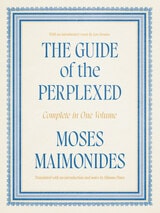
The Guide of the Perplexed
Complete in One VolumeMoses Maimonides
University of Chicago Press, 1963
The twelfth-century Judeo-Arabic text The Guide of the Perplexed is a monument of rabbinical exegesis and one of the most important works in the history of Jewish thought. Written by Moses ben Maimon,commonly known as Maimonides, the Guide aims to liberate people from the perplexities that arise from an understanding of the Bible based only on its literal meaning.
Shlomo Pines’s translation has served students and scholars for decades, and it is presented here, with Leo Strauss’s influential introduction, in one volume for the first time.