Results by title
8 books match the query 'Mann, Thomas'

DR. FAUSTUS
ARCHETYPAL SUBTEXT AT THE MILLENNIUMPETER WERRES
West Virginia University Press, 1999
[more]
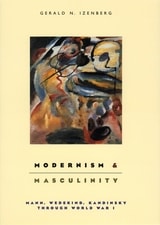
Modernism and Masculinity
Mann, Wedekind, Kandinsky through World War IGerald Izenberg
University of Chicago Press, 2000
Modernism and Masculinity argues that a crisis of masculinity among European writers and artists played a key role in the modernist revolution. Gerald Izenberg revises the notion that the feminine provided a premodern refuge for artists critical of individualism and materialism. Industrialization and the growing power of the market inspired novelist Thomas Mann, playwright Frank Wedelind, and painter Wassily Kandinsky to feel the problematic character of their own masculinity. As a result, these artists each came to identify creativity, transcendence, and freedom with the feminine.
But their critique of masculinity created enormous challenges: How could they appropriate a feminine aesthetic while retaining their own masculine idenitites? How did appropiating the feminine affect their personal relationships or their political views? Modernism and Masculinity seeks to answer these questions. In this absorbing combination of biography and formal critique, Izenberg reconsiders the works of Mann, Wedekind, Kandinsky and semonstrates how the cirses of masculinity they endure are found not just within the images and forms of their art, but in the distinct and very personal impulses that inspired it.
But their critique of masculinity created enormous challenges: How could they appropriate a feminine aesthetic while retaining their own masculine idenitites? How did appropiating the feminine affect their personal relationships or their political views? Modernism and Masculinity seeks to answer these questions. In this absorbing combination of biography and formal critique, Izenberg reconsiders the works of Mann, Wedekind, Kandinsky and semonstrates how the cirses of masculinity they endure are found not just within the images and forms of their art, but in the distinct and very personal impulses that inspired it.
[more]
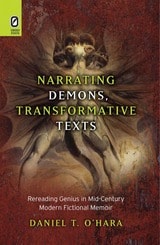
Narrating Demons, Transformative Texts
Rereading Genius in Mid-Century Modern Fictional MemoirDaniel T. O’Hara
The Ohio State University Press, 2012
Narrating Demons, Transformative Texts: Rereading Genius in Mid-Century Modern Fictional Memoir, by Daniel T. O’Hara, acknowledges that the modern conception of literary genius is probably most lucidly expressed in the criticism of Lionel Trilling. But O’Hara also demonstrates that certain important and widely read mid-century modern fictional memoirs subversively return to an earlier conception that emphasizes the demonic nature of genius, a conception that is associated with the occult and the visionary and embraces the vision of evil articulated in earlier literature. O’Hara argues that Thomas Mann’s Doctor Faustus (1947), Vladimir Nabokov’s Lolita (1955), and William Burroughs’s Naked Lunch (1959) all demonstrate an imagining of genius in art and in life that stands in stark and total opposition to the emerging post–World War II age of conformity. These influential works show that genius is inherently a dangerous reality, albeit a creative one. Despite its most transcendent appearances, the full immanence of this conception of demonic genius condemns the modern world to a Last Judgment that is every bit as severe as any envisioned in the Western religious traditions.
[more]
Proust, Mann, Joyce in the Modernist Context, Second Edition
Gerald Gillespie
Catholic University of America Press, 2010
The original version of Proust, Mann, Joyce in the Modernist Context strove to show how a kindred encyclopedic drive and sacramental sense informed their responses to the epochal trauma, yielding three distinct and monumental visions of the human estate by the 1920s.
[more]
Textual Awareness
A Genetic Study of Late Manuscripts by Joyce, Proust, and MannDirk Van Hulle
University of Michigan Press, 2004
Aware of the act of writing as a temporal process, many modernist authors preserved numerous manuscripts of their works, which themselves thematized time. Textual Awareness analyzes the writing processes in James Joyce's Finnegans Wake, Marcel Proust's À la recherche du temps perdu, and Thomas Mann's Doktor Faustus and relates these to Anglo-American, French, and German theories of text. By relating theory to practice, this comparative study reveals the links between literary and textual criticism.
A key issue in both textual criticism and the so-called crisis of the novel is the tension between the finished and the unfinished. After a theoretical examination of the relationship between genetic and textual criticism, Dirk Van Hulle uses the three case studies to show how?at each stage in the writing process?the text still had the potential of becoming something entirely different; how and why these geneses proceeded the way they did; how Joyce, Proust, and Mann allowed contingencies to shape their work; how these authors recycled the words of their critics in order to inoculate their works against them; how they shaped an intertextual dimension through the processing of source texts and reading notes; and how text continually generated more text.
Van Hulle's exploration of process sheds new light on the remarkable fact that so many modernist authors protected their manuscripts, implying both the authors' urge to grasp everything and their awareness of the dangers of their encyclopedic projects. Textual Awareness offers new insights into the artificiality of the artifact?the novel?that are relevant to the study of literary modernism in general and the study of James Joyce, Marcel Proust, and Thomas Mann in particular.
Dirk Van Hulle is Assistant Professor of English and German Literature, University of Antwerp.
[more]
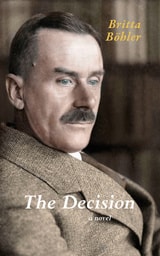
The Decision
Britta Böhler
Haus Publishing, 2015
This intriguing novel follows German author Thomas Mann during three crucial days in 1936. Away in Switzerland and fearing arrest by the Nazis upon his return to Germany, Mann must choose whether to travel back to Munich. He decides to release an open letter to the regime in a Swiss newspaper but is then tortured by doubt: his Jewish publisher in Germany will be furious with the unwelcome attention Mann’s letter is sure to bring, and by choosing exile, isn’t the writer abandoning his loyal readers back home? Will the Nazis burn his books? Will they confiscate his diaries, which include intimate, homoerotic confessions?
Britta Böhler shows us one of the twentieth century’s greatest writers as a family man, a father, a writer, and a man with moral doubts. We see a human soul trapped in a historical setting that forces him to make a seemingly impossible choice. A convincing depiction of a dilemma addressed only sparsely in Mann’s own writings, The Decision eloquently explores the all-too-human price of confronting totalitarianism.
Britta Böhler shows us one of the twentieth century’s greatest writers as a family man, a father, a writer, and a man with moral doubts. We see a human soul trapped in a historical setting that forces him to make a seemingly impossible choice. A convincing depiction of a dilemma addressed only sparsely in Mann’s own writings, The Decision eloquently explores the all-too-human price of confronting totalitarianism.
[more]
Thomas Mann's Artist-Heroes
Jeffrey Meyers
Northwestern University Press, 2014
Jeffrey Meyers has written acclaimed biographies of many of the most influential authors of the twentieth century, but none has affected him as deeply as Thomas Mann. From his first youthful encounter with Death in Venice, Meyers has cultivated a lifetime obsession with Mann’s elegant style, penetrating irony, and insight into the life of the artist. Thomas Mann’s Artist-Heroes follows Mann’s own obsession with the artistic life through his characters: from the fiction of Gustav von Aschenbach in Death in Venice and the music of Adrian Leverkühn in Doctor Faustus, to Tonio Kröger’s life as a writer, to the artistically minded patient Hans Castorp in The Magic Mountain, and finally to Mann’s time in America and later memoirs by his family. Mann probes deeper than perhaps any other author into questions of how an artist is formed, why he must defy conventional society, and how suffering and disease affect his work. Admirers of Thomas Mann and of Jeffrey Meyers’s biographies will find in this remarkable book the best introduction to one of the greatest writers of the modern age.
[more]
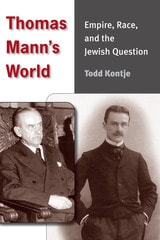
Thomas Mann's World
Empire, Race, and the Jewish QuestionTodd Kontje
University of Michigan Press, 2011
Thomas Mann's World: Empire, Race, and the Jewish Question offers a comprehensive reevaluation of one of Germany’s most celebrated literary giants by situating his life and fiction squarely within the Age of Empire. Rather than viewing Mann strictly as an idealized, cosmopolitan voice of tolerance or dismissing him entirely as a clandestine anti-Semite, Kontje presents a nuanced portrait of a deeply "worldly" author whose personal prejudices and anxieties reflected the global realities of imperial conquest, nationalism, and conflict. By tracing the evolution of Mann's work—including Buddenbrooks, The Magic Mountain, and Joseph and his Brothers—the book examines how Mann’s representations of Jews and foreign others intersected with a persistent, lifelong fascination with racial difference and his own complex identity. Ultimately, this essential text provides literary scholars with a critical framework for understanding how Mann’s highly autobiographical fiction captured not just the internal spirit of the German nation, but the broader geopolitical tensions of a rapidly globalizing world.
[more]