Results by title

12 books match the query 'Manpower policy'
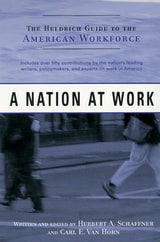
cover of A Nation at Work: The Heldrich Guide to the American Workforce

A Nation at Work

The Heldrich Guide to the American Workforce

Van Horn, Carl E

Rutgers University Press, 2003

In the United States work underlies our very concept of who we are. Changes in society and technology have influenced how and where we work, and transformations within the workplace in turn have altered our society.

A Nation at Work addresses the fundamental economic, demographic, policy, and business facts about how the workforce and workplace are changing in the early twenty-first century. Illustrated with over thirty-five graphs, Part I covers essential topics about the American workforce and workers. Part II gathers essays and speeches from the nation's outstanding journalists and workplace analysts. The book incorporates facts and data, including invaluable tables and listings for useful Internet sites, books, and organizations.

Comprehensive in scope, A Nation at Work will help readers reach a better understanding about their own work and the world of work around them.

[more]
cover of Beyond the Iron Rice Bowl: Regimes of Production and Industrial Relations in China

Beyond the Iron Rice Bowl

Regimes of Production and Industrial Relations in China

Boy Lüthje, Siqi Luo, and Hao Zhang

Campus Verlag, 2013
A unique account of labor relations in the modern Chinese economy, Beyond the Iron Rice Bowl brings together more than thirty in-depth case studies of key multinational, Chinese, and overseas Chinese enterprises in the automotive, electronic, and garment industries. Analyzing the regimes of production and their segmentations in the context of global and national production networks, the authors discuss Chinese and international industrial relations theory and labor sociology and explore the perspectives of collective bargaining, trade union reform, and democratic workplace representation in China. 
[more]
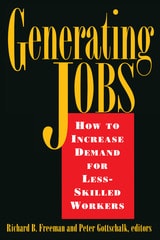
cover of Generating Jobs: How to Increase Demand for Less-Skilled Workers

Generating Jobs

How to Increase Demand for Less-Skilled Workers

Richard B. Freeman

Russell Sage Foundation, 1998
The American economy is in danger of leaving its low-skilled workers behind. In the last two decades, the wages and employment levels of the least educated and experienced workers have fallen disastrously. Where willing workers once found ready employment at reasonable wages, our computerized, service-oriented economy demands workers who can read and write, master technology, deal with customers, and much else. Improved education and training will alleviate this problem in the long run, but educating the new workforce will take a substantial national investment over many years. In the meantime, we face increasingly acute questions about how to include low-skill workers in today's economy. Generating Jobs takes a hard look at these questions, and asks whether anything can be done to improve the lot of low-skilled workers by intervening in the labor market on their behalf. These micro demand-side policies seek to improve wages and employment levels—either by lowering the costs of hiring low-skilled workers through employer subsidies, or by raising wage levels, benefit levels, or hours of employment, or by providing employment via government jobs. Although these policies are not currently popular in the U.S., they have long been used in many countries. Generating Jobs provides a clear-eyed assessment of this history, and asks if any of these policies might be applicable to the current problems of low-skilled workers in the United States. The results are surprising. Several recently touted panaceas turn out to be costly and ineffective in the American labor market. Enterprise zones, for instance, are an expensive way of moving jobs into areas of high unemployment, costing as much as $60,000 per job. Similarly, job-sharing, which has had uneven success in Europe, turns out to be ill-suited to conditions in the U.S., where wages are relatively low and workers need to work long hours to maintain income. On the other hand, a number of older, less flashy policies turn out to have real, if modest, benefits. Wage subsidies have increased employment among qualifying workers, and public employment policies can increase the number of workers from targeted groups working during the program. While acknowledging that many solutions are counterproductive, this definitive review of active labor market policies shows that many programs can offer real help. More than any rhetoric, Generating Jobs is the best guide to future action and a serious response to those who claim that nothing can be done.
[more]
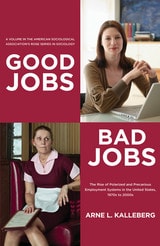
cover of Good Jobs, Bad Jobs: The Rise of Polarized and Precarious Employment Systems in the United States, 1970s-2000s

Good Jobs, Bad Jobs

The Rise of Polarized and Precarious Employment Systems in the United States, 1970s-2000s

Arne L. Kalleberg

Russell Sage Foundation, 2011

The economic boom of the 1990s veiled a grim reality: in addition to the growing gap between rich and poor, the gap between good and bad quality jobs was also expanding. The postwar prosperity of the mid-twentieth century had enabled millions of American workers to join the middle class, but as author Arne L. Kalleberg shows, by the 1970s this upward movement had slowed, in part due to the steady disappearance of secure, well-paying industrial jobs. Ever since, precarious employment has been on the rise—paying low wages, offering few benefits, and with virtually no long-term security. Today, the polarization between workers with higher skill levels and those with low skills and low wages is more entrenched than ever. Good Jobs, Bad Jobs traces this trend to large-scale transformations in the American labor market and the changing demographics of low-wage workers. Kalleberg draws on nearly four decades of survey data, as well as his own research, to evaluate trends in U.S. job quality and suggest ways to improve American labor market practices and social policies. Good Jobs, Bad Jobs provides an insightful analysis of how and why precarious employment is gaining ground in the labor market and the role these developments have played in the decline of the middle class. Kalleberg shows that by the 1970s, government deregulation, global competition, and the rise of the service sector gained traction, while institutional protections for workers—such as unions and minimum-wage legislation—weakened. Together, these forces marked the end of postwar security for American workers. The composition of the labor force also changed significantly; the number of dual-earner families increased, as did the share of the workforce comprised of women, non-white, and immigrant workers. Of these groups, blacks, Latinos, and immigrants remain concentrated in the most precarious and low-quality jobs, with educational attainment being the leading indicator of who will earn the highest wages and experience the most job security and highest levels of autonomy and control over their jobs and schedules. Kalleberg demonstrates, however, that building a better safety net—increasing government responsibility for worker health care and retirement, as well as strengthening unions—can go a long way toward redressing the effects of today’s volatile labor market. There is every reason to expect that the growth of precarious jobs—which already make up a significant share of the American job market—will continue. Good Jobs, Bad Jobs deftly shows that the decline in U.S. job quality is not the result of fluctuations in the business cycle, but rather the result of economic restructuring and the disappearance of institutional protections for workers. Only government, employers and labor working together on long-term strategies—including an expanded safety net, strengthened legal protections, and better training opportunities—can help reverse this trend. A Volume in the American Sociological Association’s Rose Series in Sociology.
[more]
cover of Human Capital: A Theoretical and Empirical Analysis, with Special Reference to Education, 3rd Edition

Human Capital

A Theoretical and Empirical Analysis, with Special Reference to Education, 3rd Edition

Gary S. Becker

University of Chicago Press, 1993

WINNER OF THE NOBEL PRIZE!
 
Human Capital is Gary ecker's classic study of how investment in an individual's education and training is similar to business investments in equipment. Recipient of the 1992 Nobel Prize in Economic Science, Gary S. Becker is a pioneer of applying economic analysis to human behavior in such areas as discrimination, marriage, family relations, and education. Becker's research on human capital was considered by the Nobel committee to be his most noteworthy contribution to economics.

This expanded edition includes four new chapters, covering recent ideas about human capital, fertility and economic growth, the division of labor, economic considerations within the family, and inequality in earnings.
[more]
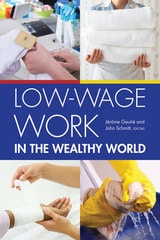
cover of Low-Wage Work in the Wealthy World

Low-Wage Work in the Wealthy World

Jerome Gautie

Russell Sage Foundation, 2010
As global flows of goods, capital, information, and people accelerate competitive pressure on businesses throughout the industrialized world, firms have responded by reorganizing work in a variety of efforts to improve efficiency and cut costs. In the United States, where minimum wages are low, unions are weak, and immigrants are numerous, this has often lead to declining wages, increased job insecurity, and deteriorating working conditions for workers with little bargaining power in the lower tiers of the labor market. Low-Wage Work in the Wealthy World builds on an earlier Russell Sage Foundation study (Low-Wage America) to compare the plight of low-wage workers in the United States to five European countries—Denmark, France, Germany, the Netherlands, and the United Kingdom—where wage supports, worker protections, and social benefits have generally been stronger. By examining low-wage jobs in systematic case studies across five industries, this groundbreaking international study goes well beyond standard statistics to reveal national differences in the quality of low-wage work and the well being of low-wage workers. The United States has a high percentage of low-wage workers—nearly three times more than Denmark and twice more than France. Since the early 1990s, however, the United Kingdom, the Netherlands, and Germany have all seen substantial increases in low-wage jobs. While these jobs often entail much the same drudgery in Europe and the United States, quality of life for low-wage workers varies substantially across countries. The authors focus their analysis on the "inclusiveness" of each country's industrial relations system, including national collective bargaining agreements and minimum-wage laws, and the generosity of social benefits such as health insurance, pensions, family leave, and paid vacation time—which together sustain a significantly higher quality of life for low-wage workers in some countries. Investigating conditions in retail sales, hospitals, food processing, hotels, and call centers, the book's industry case studies shed new light on how national institutions influence the way employers organize work and shape the quality of low-wage jobs. A telling example: in the United States and several European nations, wages and working conditions of front-line workers in meat processing plants are deteriorating as large retailers put severe pressure on prices, and firms respond by employing low-wage immigrant labor. But in Denmark, where unions are strong, and, to a lesser extent, in France, where the statutory minimum wage is high, the low-wage path is blocked, and firms have opted instead to invest more heavily in automation to raise productivity, improve product quality, and sustain higher wages. However, as Low-Wage Work in the Wealthy World also shows, the European nations' higher level of inclusiveness is increasingly at risk. "Exit options," both formal and informal, have emerged to give employers ways around national wage supports and collectively bargained agreements. For some jobs, such as room cleaners in hotels, stronger labor relations systems in Europe have not had much impact on the quality of work. Low-Wage Work in the Wealthy World offers an analysis of low-wage work in Europe and the United States based on concrete, detailed, and systematic contrasts. Its revealing case studies not only provide a human context but also vividly remind us that the quality and incidence of low-wage work is more a matter of national choice than economic necessity and that government policies and business practices have inevitable consequences for the quality of workers' lives. A Volume in the Russell Sage Foundation Case Studies of Job Quality in Advanced Economies
[more]
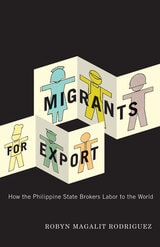
cover of Migrants for Export: How the Philippine State Brokers Labor to the World

Migrants for Export

How the Philippine State Brokers Labor to the World

Robyn Magalit Rodriguez

University of Minnesota Press, 2010
Migrant workers from the Philippines are ubiquitous to global capitalism, with nearly 10 percent of the population employed in almost two hundred countries. In a visit to the United States in 2003, Philippine president Gloria Macapagal Arroyo even referred to herself as not only the head of state but also “the CEO of a global Philippine enterprise of eight million Filipinos who live and work abroad.”
 
Robyn Magalit Rodriguez investigates how and why the Philippine government transformed itself into what she calls a labor brokerage state, which actively prepares, mobilizes, and regulates its citizens for migrant work abroad. Filipino men and women fill a range of jobs around the globe, including domestic work, construction, and engineering, and they have even worked in the Middle East to support U.S. military operations. At the same time, the state redefines nationalism to normalize its citizens to migration while fostering their ties to the Philippines. Those who leave the country to work and send their wages to their families at home are treated as new national heroes.
 
Drawing on ethnographic research of the Philippine government’s migration bureaucracy, interviews, and archival work, Rodriguez presents a new analysis of neoliberal globalization and its consequences for nation-state formation.
[more]
cover of Reforming the Welfare State: Recovery and Beyond in Sweden

Reforming the Welfare State

Recovery and Beyond in Sweden

Edited by Richard B. Freeman, Birgitta Swedenborg, and Robert H. Topel

University of Chicago Press, 2010

Over the course of the twentieth century, Sweden carried out one of the most ambitious experiments by a capitalist market economy in developing a large and active welfare state. Sweden's generous social programs and the economic equality they fostered became an example for other countries to emulate. Of late, Sweden has also been much discussed as a model of how to deal with financial and economic crisis, due to the country's recovery from a banking crisis in the mid-1990s. At that time economists heatedly debated whether the welfare state caused Sweden's crisis and should be reformed—a debate with clear parallels to current concerns over capitalism. 
Bringing together leading economists, Reforming the Welfare State examines Sweden's policies in response to the mid-1990s crisis and the implications for the subsequent recovery. Among the issues investigated are the way changes in the labor market, tax and benefit policies, local government policy, industrial structure, and international trade affected Sweden's recovery. The way that Sweden addressed its economic challenges provides valuable insight into the viability of large welfare states, and more broadly, into the way modern economies deal with crisis.
[more]
cover of Shaping the Future of Power: Knowledge Production and Network-Building in China-Africa Relations

Shaping the Future of Power

Knowledge Production and Network-Building in China-Africa Relations

Lina Benabdallah

University of Michigan Press, 2020

China’s rise to power is one of the biggest questions in International Relations theory (IRT) and foreign policy circles. Although power has been a core concept of IRT for a long time, the faces and mechanisms of power as it relates to Chinese foreign policymaking has changed the contours of that debate. The rise of China and other powers across the global political arena sparks a new visibility for different kinds of encounters between states, particularly between China and other Global South states. These encounters are more visible to IR scholars because of the increasing influence that rising powers have in the international system. This book shows that foreign policy encounters between rising powers and Global South states do not necessarily exhibit the same logics, behaviors, or investment strategies of Euro-American hegemons. Instead, they have distinctive features that require new theoretical frameworks for analysis. Shaping the Future of Power probes the types of power mechanisms that build, diffuse, and project China’s power in Africa. One must take into account the processes of knowledge production, social capital formation, and skills transfers that Chinese foreign policy directs toward African states to fully understand China’s power-building mechanisms. The relational power framework requires these elements to capture both the material aspects and ideational people-centered aspects to power. By examining China’s investments in human resource development programs for Africa, the book reveals a vital, yet undertheorized, aspect of China’s foreign policy making.
[more]
cover of Studies of Labor Market Intermediation

Studies of Labor Market Intermediation

Edited by David H. Autor

University of Chicago Press, 2009

From the traditional craft hiring hall to the Web site Monster.com, a multitude of institutions exist to facilitate the matching of workers with firms. The diversity of such Labor Market Intermediaries (LMIs) encompasses criminal records providers, public employment offices, labor unions, temporary help agencies, and centralized medical residency matches. Studies of Labor Market Intermediation analyzes how these third-party actors intercede where workers and firms meet, thereby aiding, impeding, and, in some cases, exploiting the matching process.

By building a conceptual foundation for analyzing the roles that these understudied economic actors serve in the labor market, this volume develops both a qualitative and quantitative sense of their significance to market operation and worker welfare. Cross-national in scope, Studies of Labor Market Intermediation is distinctive in coalescing research on a set of market institutions that are typically treated as isolated entities, thus setting a research agenda for analyzing the changing shape of employment in an era of rapid globalization and technological change.
[more]
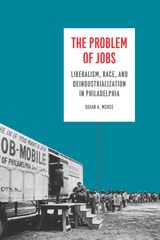
cover of The Problem of Jobs: Liberalism, Race, and Deindustrialization in Philadelphia

The Problem of Jobs

Liberalism, Race, and Deindustrialization in Philadelphia

Guian A. McKee

University of Chicago Press, 2008

Contesting claims that postwar American liberalism retreated from fights against unemployment and economic inequality, The Problem of Jobs reveals that such efforts did not collapse after the New Deal but instead began to flourish at the local, rather than the national, level.

With a focus on Philadelphia, this volume illuminates the central role of these local political and policy struggles in shaping the fortunes of city and citizen alike. In the process, it tells the remarkable story of how Philadelphia’s policymakers and community activists energetically worked to challenge deindustrialization through an innovative series of job retention initiatives, training programs, inner-city business development projects, and early affirmative action programs. Without ignoring the failure of Philadelphians to combat institutionalized racism, Guian McKee's account of their surprising success draws a portrait of American liberalism that evinces a potency not usually associated with the postwar era. Ultimately interpreting economic decline as an arena for intervention rather than a historical inevitability, The Problem of Jobs serves as a timely reminder of policy’s potential to combat injustice.
 
[more]
cover of Unsocial Europe: Social Protection Or Flexploitation?

Unsocial Europe

Social Protection Or Flexploitation?

Anne Gray

Pluto Press, 2004

[more]