Results by title
16 books match the query 'Marxist criticism'
Calibrations
Reading For The SocialAto Quayson
University of Minnesota Press, 2003
Proposes an entirely new socially and politically conscious way of reading
Ato Quayson explores a practice of reading that oscillates rapidly between domains—the literary-aesthetic, the social, the cultural, and the political—in order to uncover the mutually illuminating nature of these domains. He does this not to assert the often repeated postmodernist view that there is nothing outside the text, but to outline a method of reading he calls calibrations: a form of close reading of literature with what lies beyond it as a way of understanding structures of transformation, process, and contradiction that inform both literature and society.
Quayson surveys a wide array of texts—ranging from Bob Marley lyrics, Toni Morrison’s work, Walter Benjamin’s Theses on the Philosophy of History, and Althusser’s reflections on political economy—and treats a broad range of themes: the comparative structures of alienation in literature and anthropology, cultural heroism as a trope in African society and politics, literary tragedy as a template for reading the life and activism of Ken Saro-Wiwa, trauma and the status of citizenship in post-apartheid South Africa, representations of physical disability, and the clash between enchanted and disenchanted time in postcolonial texts.
Dialectical Imaginaries
Materialist Approaches to U.S. Latino/a Literature in the Age of NeoliberalismMarcial González and Carlos Gallego, editors
University of Michigan Press, 2018
Fredric Jameson and Film Theory
Marxism, Allegory, and Geopolitics in World CinemaKeith B. Wagner
Rutgers University Press, 2022

Fredric Jameson
The Project of Dialectical CriticismRobert T. Tally
Pluto Press, 2014
Fredric Jameson is the most important Marxist critic in the world today. While consistently operating at the cutting edge of literary and cultural studies, Jameson has remained committed to seemingly old-fashioned philosophical discourses, most notably dialectical criticism and utopian thought.
In Fredric Jameson: The Project of Dialectical Criticism, Robert Tally surveys Jameson’s entire oeuvre, from his early studies of Sartre and formal criticism through his engagements with postmodernism and globalisation to his recent readings of Hegel, Marx and the valences of the dialectic.
The book is both a comprehensive critical guide to Jameson’s theoretical project and itself a convincing argument for the power of dialectical criticism to understand the world today.
Lesbian Rule
Cultural Criticism and the Value of DesireAmy Villarejo
Duke University Press, 2003
Integrating cinema studies, queer and feminist theory, and cultural studies, Villarejo illuminates the contexts within which the lesbian is rendered visible. Toward that end, she analyzes key portrayals of lesbians in public culture, particularly in documentary film. She considers a range of films—from documentaries about Cuba and lesbian pulp fiction to Exile Shanghai and The Brandon Teena Story—and, in doing so, brings to light a nuanced economy of value and desire.
Marxism and the Interpretation of Culture
Edited by Cary Nelson and Lawrence Grossberg
University of Illinois Press, 1988
Marxist Literary Criticism Today
Barbara Foley
Pluto Press, 2019
Periodizing Jameson
Dialectics, the University, and the Desire for NarrativePhillip E. Wegner
Northwestern University Press, 2014
For a half century, the American intellectual Fredric Jameson has been a driving force in literary and cultural theory. In Periodizing Jameson, Phillip E. Wegner builds upon Jameson’s unique dialectical method to demonstrate the value of Jameson’s tools—periodization, the fourfold hermeneutic, and the Greimasian semiotic square, among others—and to develop virtuoso readings of Jameson’s own work and the history of the contemporary American university in which it unfolds.
Wegner shows how Jameson’s work intervenes in particular social, cultural, and political situations, using his scholarship both to develop original explorations of nineteenth-century fiction, popular films, and other promiment theorists, and to examine the changing fortunes of theory itself. In this way, Periodizing Jameson casts new light on the potential of and challenges to humanist intellectual work in the present.
Postmodernism and Politics
Jonathon Arac
University of Minnesota Press, 1986
In eight essays, the contributors reach out to explore cinema and photography, psychology and ethics, social theory and economic reform. Taken together, the essays provide fresh perspectives on the problem of representation in many areas, from the constitution of the individual subject, through the status of the image, to the formation and transmission of social and moral knowledge.
The contributors: Paul A. Bove, Mary Louise Pratt, Dana Polan, Andrew Parker, Rainer Nagele, John Higgins, Cornel West, and Bruce Robbins.
Psychoanalytic Mediations between Marxist and Postcolonial Reading of the Bible
Tat-siong Benny Liew
SBL Press, 2016
The first sustained conversation between Marxism, postcolonialism, and psychoanalysis in biblical studies
This volume pursues critical readings of the Bible that put psychoanalysis into conversation with Marxist and postcolonial criticism. In these essays psychoanalysis provides a way to mediate between Marxism's materialist groundings and postcolonialism's resistance against empire. The essays in the volume illuminate the way empire has shaped the biblical text by looking at the biblical texts' silences, ruptures, oversights, over-emphases, and inexplicable elements. These details are read as symptoms of a set of oppressive material relations that shaped and continue to haunt the text in the ascendancy of the text in the name of the West.
Features:
- Essays and responses from multiple perspectives and geographical locations, including Africa, Australia, Oceania, Latin America, and North America
- Psychoanalysis that considers how the traumas of colonialism manifest both materially and psychically
- Close readings of biblical texts

Roy Pascal and Georg Lukács
Towards a Re-Evaluation of the History of Marxist Literary Criticism in Britain?Helmut Peitsch
University of London Press, 2018
The Future of Totality
Fredric Jameson and the Prospects of Critical TheoryNicholas Brown, Maria Elisa Cevasco, Fabio Akcelrud Durão, and Robert T. Tally Jr., editors
Duke University Press, 2026
The Jamesonian Unconscious
The Aesthetics of Marxist TheoryClint Burnham
Duke University Press, 1995
In an unusual biographical move, Burnham negotiates Jameson’s major works—including Marxism and Form, The Political Unconscious, and Postmodernism, or, The Cultural Logic of Late Capitalism—by way of his own working-class, queer-ish, Gen-X background and sensibility. Thus Burnham’s study draws upon an immense range of references familiar to the MTV generation, including Reservoir Dogs, theorists Slavoj Zizek and Pierre Bourdieu, The Satanic Verses, Language poetry, the collapse of state communism in Eastern Europe, and the indie band Killdozer. In the process, Burnham addresses such Jamesonian questions as how to imagine the future, the role of utopianism in capitalist culture, and the continuing relevance of Marxist theory.
Through its redefinition of Jameson’s work and compelling reading of the political present, The Jamesonian Unconscious defines the leading edge of Marxist theory. Written in a style by turns conversational, playful, and academic, this book will appeal to students and scholars of Marxism, critical theory, aesthetics, narratology, and cultural studies, as well as the wide circle of readers who have felt and understood Jameson’s influence.
The New Hegemony in Literary Studies
Contradictions in TheoryTony Hilfer
Northwestern University Press, 2003
The problem Hilfer identifies is one of logical consistency, but also of moral and psychological implications, and it can be found operating across the whole spectrum of literary Theory. It is, however, as this book makes blindingly clear, not immune from scrutiny. With quiet erudition and consistent incisiveness, Hilfer shows how the various methods, while ostensibly at odds, actually fit together, all sharing the same peculiar structure and logic, and all wearing an identical set of ideological blinders. He offers examples of theorists-and assumptions-hard at work on particular texts, and again and again (often letting these theorists refute themselves) pinpoints the blindspots that have become endemic in the practice of Theory.
Written with great care and a deep commitment to the value and integrity of literary criticism and theory, this tonic work stands as a corrective to the misuse of theory, and a bracing reminder of how a critical approach works when it is well and judiciously applied.
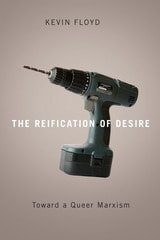
The Reification of Desire
Toward a Queer MarxismKevin Floyd
University of Minnesota Press, 2009
Kevin Floyd brings queer critique to bear on the Marxian categories of reification and totality and considers the dialectic that frames the work of Georg Lukács, Herbert Marcuse, and Fredric Jameson. Reading the work of these theorists together with influential queer work by such figures as Michel Foucault and Judith Butler, and alongside reconsiderations of such texts as The Sun Also Rises and Midnight Cowboy, Floyd reformulates these two central categories that have been inseparable from a key strand of Marxist thought and have marked both its explanatory power and its limitations. Floyd theorizes a dissociation of sexuality from gender at the beginning of the twentieth century in terms of reification to claim that this dissociation is one aspect of a larger dynamic of social reification enforced by capitalism.
Developing a queer examination of reification and totality, Kevin Floyd ultimately argues that the insights of queer theory require a fundamental rethinking of both.

Universal Abandon
The Politics of PostmodernismAndrew Ross, Editor
University of Minnesota Press, 1989
Universal Abandon was first published in 1989. Minnesota Archive Editions uses digital technology to make long-unavailable books once again accessible, and are published unaltered from the original University of Minnesota Press editions.
In recent years, the debate about postmodernism has become a full-blown, global discussion about the nature and future of society: it has challenged and redefined the cultural and sexual politics of the last two decades, and is increasingly shaping tomorrow's agenda. Postmodernist culture is a medium in which we all live, no matter how unevenly its effects are felt across the jagged spectrum of color, gender, class, sexual, orientation, region, and nationality. But it is also a culture that proclaims its abandonment of the universalist foundations of Enlightenment thought in the West. At a time when interests can no longer be universalized, the question arises: Whose interests are served by this "universal abandon"?
Universal Abandon is the first volume in a new series entitled Cultural Politics, edited by the Social Text collective. This collection tackles a wider range of cultural and political issues than are usually addressed in the debates about postmodernism—color, ethnicity, and neocolonialism; feminism and sexual difference; popular culture and the question of everyday life—as well as some political and philosophical matters that have long been central to the Western tradition. Together, the contributors provide no consensus about the politics of postmodernism; they insist, rather, that "universal abandon?" remain a question and not an answer.
The contributors: Anders Stephanson, Chantal Mouffe, Stanley Aronowitz, Ernesto Laclau, Nancy Fraser, Linda Nicholson, Meaghan Morris, Paul Smith, Laura Kipnis, Lawrence Grossberg, Abigail Solomon-Godeau, George Yudice, Jacqueline Rose, and Hal Foster.
Andrew Ross teaches English at Princeton University and is the author of The Failure of Modernism.