Results by title
6 books match the query 'Mass society'
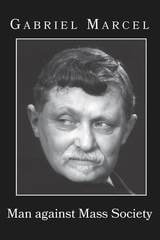
Man against Mass Society
Gabriel Marcel
St. Augustine's Press, 2008
The central theme of this important book is that we are paying the price of an arrogance that refuses to recognize mystery. The author invites the reader to enter into the argument that he holds with himself on a great number of problems. Written in the early 1950s, Marcel’s discussion of these topics are remarkably contemporary, e.g.:
* Our crisis is a metaphysical, not merely social, one.
* What a man is depends partly on what he thinks he is, and a materialistic philosophy turns men into things.
* Can a man be free except in a free country?
* Stoicism is no longer a workable philosophy because today pressure can be put on the mind as well as on the body.
* Technical progress is not evil in itself, but a technique is a means that, regarded as an end, can become either an idol or an excuse for self-idolatry. State control of scientific research, leading to a concentration on new means of destruction, is a calamity.
* Fanaticism is an opinion that refuses to argue, and so the fanatic is an enemy of truth.
* The kind of unification that science is bringing about today is really an ironing out of differences, but the only valuable kind of unity is one that implies a respect for differences.
* We must beware of thinking in terms of great numbers and so blinding ourselves to the reality of individual suffering. Our philosophical approach to being is made possible only by our practical approach to our neighbor.
* We must encourage the spirit of fraternity and distrust the kind of egalitarianism that is based on envy and resentment.
* No man however humble should feel that he cannot spread the light among his friends. No easy solution is offered, but the author conveys his own faith that ultimately love and intelligence will triumph.

Small Town in Mass Society
Class, Power, and Religion in a Rural Community (rev. ed.)Arthur J. Vidich and Joseph BensmanForeword by Michael W. Hughey
University of Illinois Press, 2000
Through a close study of "Springdale, New York," Arthur J. Vidich and Joseph Bensman depict the small town as continuously and increasingly drawn into the central institutions and processes of the total society. Vidich and Bensman based their conclusions on extensive interviews with and close observation of the inhabitants of one community. The original publication of the book caused a sharp response among the town's citizens who felt their trust had been violated and their town misrepresented.
The present volume includes the editorials and correspondence evoked by that controversy, the authors' articles describing their methodology, a new foreword by Michael W. Hughey, and a new afterword in which Arthur J. Vidich recounts the creation and history of the book.
Stateville
The Penitentiary in Mass SocietyJames B. Jacobs
University of Chicago Press, 1978
Jacobs applies Edward Shils's interpretation of the dynamics of mass society in order to explain the dramatic events of the past quarter century that have permanently altered Stateville's structure. With the extension of civil rights to previously marginal groups such as racial minorities, the poor, and, ultimately, the incarcerated, prisons have moved from society's periphery toward its center. Accordingly Stateville's control mechanisms became less authoritarian and more legalistic and bureaucratic. As prisoners' rights increased, the preogatives of the staff were sharply curtailed. By the early 1970s the administration proved incapable of dealing with politicized gangs, proliferating interest groups, unionized guards, and interventionist courts.
In addition to extensive archival research, Jacobs spent many months freely interacting with the prisoners, guards, and administrators at Stateville. His lucid presentation of Stateville's troubled history will provide fascinating reading for a wide audience of concerned readers.
". . . [an] impressive study of a complex social system."—Isidore Silver, Library Journal
The Mana of Mass Society
William Mazzarella
University of Chicago Press, 2017
We often invoke the “magic” of mass media to describe seductive advertising or charismatic politicians. In The Mana of Mass Society, William Mazzarella asks what happens to social theory if we take that idea seriously. How would it change our understanding of publicity, propaganda, love, and power?
Mazzarella reconsiders the concept of “mana,” which served in early anthropology as a troubled bridge between “primitive” ritual and the fascination of mass media. Thinking about mana, Mazzarella shows, means rethinking some of our most fundamental questions: What powers authority? What in us responds to it? Is the mana that animates an Aboriginal ritual the same as the mana that energizes a revolutionary crowd, a consumer public, or an art encounter? At the intersection of anthropology and critical theory, The Mana of Mass Society brings recent conversations around affect, sovereignty, and emergence into creative contact with classic debates on religion, charisma, ideology, and aesthetics.
The Nationalization of the Masses
Political Symbolism and Mass Movements in Germany from the Napoleonic Wars Through the Third ReichGeorge L. Mosse
University of Wisconsin Press, 2023
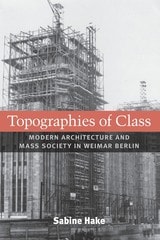
Topographies of Class
Modern Architecture and Mass Society in Weimar BerlinSabine Hake
University of Michigan Press, 2010
In Topographies of Class, Sabine Hake explores why Weimar Berlin has had such a powerful hold on the urban imagination. Approaching Weimar architectural culture from the perspective of mass discourse and class analysis, Hake examines the way in which architectural projects; debates; and representations in literature, photography, and film played a key role in establishing the terms under which contemporaries made sense of the rise of white-collar society.
Focusing on the so-called stabilization period, Topographies of Class maps out complex relationships between modern architecture and mass society, from Martin Wagner's planning initiatives and Erich Mendelsohn's functionalist buildings, to the most famous Berlin texts of the period, Alfred Döblin's city novel Berlin Alexanderplatz (1929) and Walter Ruttmann's city film Berlin, Symphony of the Big City (1927). Hake draws on critical, philosophical, literary, photographic, and filmic texts to reconstruct the urban imagination at a key point in the history of German modernity, making this the first study---in English or German---to take an interdisciplinary approach to the rich architectural culture of Weimar Berlin.
Sabine Hake is Professor and Texas Chair of German Literature and Culture at the University of Texas at Austin. She is the author of numerous books, including German National Cinema and Popular Cinema of the Third Reich.
Cover art: Construction of the Karstadt Department Store at Hermannplatz, Berlin-Neukölln. Courtesy Bildarchiv Preeussischer Kulturbesitz / Art Resource, NY