Results by title
8 books match the query 'Maya art'
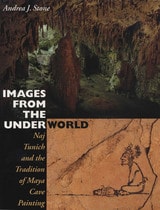
Images from the Underworld
Naj Tunich and the Tradition of Maya Cave PaintingBy Andrea J. Stone
University of Texas Press, 1995
In 1979, a Kekchi Maya Indian accidentally discovered the entrance to Naj Tunich, a deep cave in the Maya Mountains of El Peten, Guatemala. One of the world's few deep caves that contain rock art, Naj Tunich features figural images and hieroglyphic inscriptions that have helped to revolutionize our understanding of ancient Maya art and ritual.
In this book, Andrea Stone takes a comprehensive look at Maya cave painting from Preconquest times to the Colonial period. After surveying Mesoamerican cave and rock painting sites and discussing all twenty-five known painted caves in the Maya area, she focuses extensively on Naj Tunich. Her text analyzes the images and inscriptions, while photographs and line drawings provide a complete visual catalog of the cave art, some of which has been subsequently destroyed by vandals.
This important new body of images and texts enlarges our understanding of the Maya view of sacred landscape and the role of caves in ritual. It will be important reading for all students of the Maya, as well as for others interested in cave art and in human relationships with the natural environment.
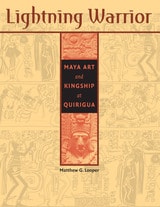
Lightning Warrior
Maya Art and Kingship at QuiriguaBy Matthew G. Looper
University of Texas Press, 2003
The ancient Maya city of Quirigua occupied a crossroads between Copan in the southeastern Maya highlands and the major centers of the Peten heartland. Though always a relatively small city, Quirigua stands out because of its public monuments, which were some of the greatest achievements of Classic Maya civilization. Impressive not only for their colossal size, high sculptural quality, and eloquent hieroglyphic texts, the sculptures of Quirigua are also one of the few complete, in situ series of Maya monuments anywhere, which makes them a crucial source of information about ancient Maya spirituality and political practice within a specific historical context.
Using epigraphic, iconographic, and stylistic analyses, this study explores the integrated political-religious meanings of Quirigua's monumental sculptures during the eighth-century A.D. reign of the city's most famous ruler, K'ak' Tiliw. In particular, Matthew Looper focuses on the role of stelae and other sculpture in representing the persona of the ruler not only as a political authority but also as a manifestation of various supernatural entities with whom he was associated through ritual performance. By tracing this sculptural program from its Early Classic beginnings through the reigns of K'ak' Tiliw and his successors, and also by linking it to practices at Copan, Looper offers important new insights into the politico-religious history of Quirigua and its ties to other Classic Maya centers, the role of kingship in Maya society, and the development of Maya art.
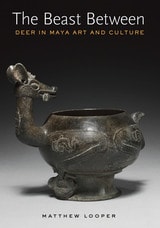
The Beast Between
Deer in Maya Art and CultureBy Matthew Looper
University of Texas Press, 2019
The first book to focus on the multifaceted images of deer and hunting in ancient Maya art, from the award-winning author of To Be Like Gods: Dance in Ancient Maya Civilization.
Winner, CHOICE Outstanding Academic Title, 2019
The white-tailed deer had a prominent status in Maya civilization: it was the most important wild-animal food source at many inland Maya sites and also functioned as a major ceremonial symbol. Offering an in-depth semantic analysis of this imagery, The Beast Between considers iconography, hieroglyphic texts, mythological discourses, and ritual narratives to translate the significance and meaning of the vibrant metaphors expressed in a variety of artifacts depicting deer and hunting.
Charting the importance of deer as a key component of the Maya diet, especially for elites, and analyzing the coupling of deer and maize in the Maya worldview, The Beast Between reveals a close and long-term interdependence between the Maya and these animals. Not only are deer depicted naturalistically in hunting and ritual scenes, but also they are assigned human attributes. This rich imagery reflects the many ways in which deer hunting was linked to status, sexuality, and war as part of a deeper process to ensure the regeneration of both agriculture and ancestry. Drawing on methodologies of art history, archaeology, and ethnology, this illuminating work is poised to become a key resource for multiple fields.
The Maya Art of Speaking Writing
Remediating Indigenous Orality in the Digital AgeTiffany D. Creegan Miller
University of Arizona Press, 2022
Based on nearly a decade of fieldwork in the Guatemalan highlands, Tiffany D. Creegan Miller discusses images that are sonic, pictorial, gestural, and alphabetic. She reveals various forms of creativity and agency that are woven through a rich media landscape in Indigenous Guatemala, as well as Maya diasporas in Mexico and the United States. Miller discusses how technologies of inscription and their mediations are shaped by human editors, translators, communities, and audiences, as well as by voices from the natural world.
These texts push back not just on linear and compartmentalized Western notions of media but also on the idea of the singular author, creator, scholar, or artist removed from their environment. The persistence of orality and the interweaving of media forms combine to offer a challenge to audiences to participate in decolonial actions through language preservation.
The Maya Art of Speaking Writing calls for centering Indigenous epistemologies by doing research in and through Indigenous languages as we engage in debates surrounding Indigenous literatures, anthropology, decoloniality, media studies, orality, and the digital humanities.
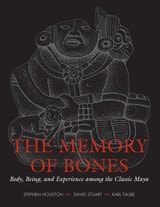
The Memory of Bones
Body, Being, and Experience among the Classic MayaBy Stephen Houston, David Stuart, and Karl Taube
University of Texas Press, 2006
All of human experience flows from bodies that feel, express emotion, and think about what such experiences mean. But is it possible for us, embodied as we are in a particular time and place, to know how people of long ago thought about the body and its experiences? In this groundbreaking book, three leading experts on the Classic Maya (ca. AD 250 to 850) marshal a vast array of evidence from Maya iconography and hieroglyphic writing, as well as archaeological findings, to argue that the Classic Maya developed a coherent approach to the human body that we can recover and understand today.
The authors open with a cartography of the Maya body, its parts and their meanings, as depicted in imagery and texts. They go on to explore such issues as how the body was replicated in portraiture; how it experienced the world through ingestion, the senses, and the emotions; how the body experienced war and sacrifice and the pain and sexuality that were intimately bound up in these domains; how words, often heaven-sent, could be embodied; and how bodies could be blurred through spirit possession.
From these investigations, the authors convincingly demonstrate that the Maya conceptualized the body in varying roles, as a metaphor of time, as a gendered, sexualized being, in distinct stages of life, as an instrument of honor and dishonor, as a vehicle for communication and consumption, as an exemplification of beauty and ugliness, and as a dancer and song-maker. Their findings open a new avenue for empathetically understanding the ancient Maya as living human beings who experienced the world as we do, through the body.
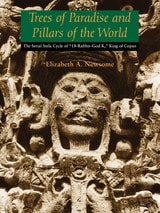
Trees of Paradise and Pillars of the World
The Serial Stelae Cycle of "18-Rabbit–God K," King of CopanBy Elizabeth A. Newsome
University of Texas Press, 2001
Assemblies of rectangular stone pillars, or stelae, fill the plazas and courts of ancient Maya cities throughout the lowlands of southern Mexico, Guatemala, Belize, and western Honduras. Mute testimony to state rituals that linked the king's power to rule with the rhythms and renewal of time, the stelae document the ritual acts of rulers who sacrificed, danced, and experienced visionary ecstasy in connection with celebrations marking the end of major calendrical cycles. The kings' portraits are carved in relief on the main surfaces of the stones, deifying them as incarnations of the mythical trees of life.
Based on a thorough analysis of the imagery and inscriptions of seven stelae erected in the Great Plaza at Copan, Honduras, by the Classic Period ruler "18-Rabbit-God K," this ambitious study argues that stelae were erected not only to support a ruler's temporal claims to power but more importantly to express the fundamental connection in Maya worldview between rulership and the cosmology inherent in their vision of cyclical time. After an overview of the archaeology and history of Copan and the reign and monuments of "18-Rabbit-God K," Elizabeth Newsome interprets the iconography and inscriptions on the stelae, illustrating the way they fulfilled a coordinated vision of the king's ceremonial role in Copan's period-ending rites. She also links their imagery to key Maya concepts about the origin of the universe, expressed in the cosmologies and mythic lore of ancient and living Maya peoples.
Unseen Art
Making, Vision, and Power in Ancient MesoamericaClaudia Brittenham
University of Texas Press, 2023
In Unseen Art, Claudia Brittenham unravels one of the most puzzling phenomena in Mesoamerican art history: why many of the objects that we view in museums today were once so difficult to see. She examines the importance that ancient Mesoamerican people assigned to the process of making and enlivening the things we now call art, as well as Mesoamerican understandings of sight as an especially godlike and elite power, in order to trace a gradual evolution in the uses of secrecy and concealment, from a communal practice that fostered social memory to a tool of imperial power.
Addressing some of the most charismatic of all Mesoamerican sculptures, such as Olmec buried offerings, Maya lintels, and carvings on the undersides of Aztec sculptures, Brittenham shows that the creation of unseen art has important implications both for understanding status in ancient Mesoamerica and for analyzing art in the present. Spanning nearly three thousand years of the Indigenous art of Mexico, Guatemala, Honduras, and Belize, Unseen Art connects the dots between vision, power, and inequality, providing a critical perspective on our own way of looking.
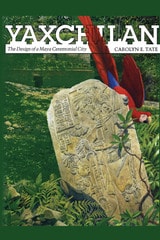
Yaxchilan
The Design of a Maya Ceremonial CityBy Carolyn E. Tate
University of Texas Press, 1991
As archaeologists peel away the jungle covering that has both obscured and preserved the ancient Maya cities of Mexico and Central America, other scholars have only a limited time to study and understand the sites before the jungle, weather, and human encroachment efface them again, perhaps forever. This urgency underlies Yaxchilan: The Design of a Maya Ceremonial City, Carolyn Tate's comprehensive catalog and analysis of all the city's extant buildings and sculptures.
During a year of field work, Tate fully documented the appearance of the site as of 1987. For each sculpture and building, she records its discovery, present location, condition, measurements, and astronomical orientation and reconstructs its Long Counts and Julian dates from Calendar Rounds. Line drawings and photographs provide a visual document of the art and architecture of Yaxchilan.
More than mere documentation, however, the book explores the phenomenon of art within Maya society. Tate establishes a general framework of cultural practices, spiritual beliefs, and knowledge likely to have been shared by eighth-century Maya people. The process of making public art is considered in relation to other modes of aesthetic expression, such as oral tradition and ritual. This kind of analysis is new in Maya studies and offers fresh insight into the function of these magnificent cities and the powerful role public art and architecture play in establishing cultural norms, in education in a semiliterate society, and in developing the personal and community identities of individuals.
Several chapters cover the specifics of art and iconography at Yaxchilan as a basis for examining the creation of the city in the Late Classic period. Individual sculptures are attributed to the hands of single artists and workshops, thus aiding in dating several of the monuments. The significance of headdresses, backracks, and other costume elements seen on monuments is tied to specific rituals and fashions, and influence from other sites is traced. These analyses lead to a history of the design of the city under the reigns of Shield Jaguar (A.D. 681-741) and Bird Jaguar IV (A.D. 752-772).
In Tate's view, Yaxchilan and other Maya cities were designed as both a theater for ritual activities and a nexus of public art and social structures that were crucial in defining the self within Maya society.