Results by title
3 books match the query 'Medical History & Records'
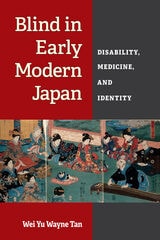
Blind in Early Modern Japan
Disability, Medicine, and IdentityWei Yu Wayne Tan
University of Michigan Press, 2022
While the loss of sight—whether in early modern Japan or now—may be understood as a disability, blind people in the Tokugawa period (1600–1868) could thrive because of disability. The blind of the era were prominent across a wide range of professions, and through a strong guild structure were able to exert contractual monopolies over certain trades. Blind in Early Modern Japan illustrates the breadth and depth of those occupations, the power and respect that accrued to the guild members, and the lasting legacy of the Tokugawa guilds into the current moment.The book illustrates why disability must be assessed within a particular society’s social, political, and medical context, and also the importance of bringing medical history into conversation with cultural history. A Euro-American-centric disability studies perspective that focuses on disability and oppression, the author contends, risks overlooking the unique situation in a non-Western society like Japan in which disability was constructed to enhance blind people’s power. He explores what it meant to be blind in Japan at that time, and what it says about current frameworks for understanding disability.
[more]
NURSING AND THE PRIVILEGE OF PRESCRIPTION
1893-2000Arlene W. Keeling
The Ohio State University Press, 2007
[more]
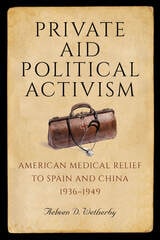
Private Aid, Political Activism
American Medical Relief to Spain and China, 1936–1949Aelwen D. Wetherby
University of Missouri Press, 2017
This book explores American medical relief to Spain and China in the 1930s and 1940s as responses to the Spanish Civil War and the Second Sino-Japanese War. Although serving vastly different peoples in strikingly distant landscapes, the three aid organizations focused on here illustrate a transition in how Americans responded to foreign conflict and how humanitarian aid was used as a political tool. The story of these small and relatively unknown organizations can help refine historical understanding of the development of humanitarianism and the evolution of global citizenship in the twentieth century.
[more]