Results by title
11 books match the query 'Medical Law & Legislation'
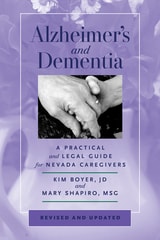
Alzheimer's and Dementia
A Practical and Legal Guide for Nevada Caregivers, Revised and UpdatedKim Boyer
University of Nevada Press, 2025
The book, specific to Nevada, covers state laws including Medicaid planning, asset protection, guardianship, probate, advance directives, and patient rights. It also addresses estate and financial planning, and provides a detailed list of resources available to assist caregivers. Written by an elder law attorney and a gerontologist, Alzheimer’s and Dementiaoffers insights from two professionals who provide practical solutions to common obstacles faced by caregivers, helping them support the needs and overcome the challenges facing those coping with these diseases.
Boyer and Shapiro coauthored The Essential Eldercare Handbook for Nevada also available from the University of Nevada Press.
Alzheimer’s and Dementia
A Practical and Legal Guide for Nevada CaregiversKim Boyer
University of Nevada Press, 2012
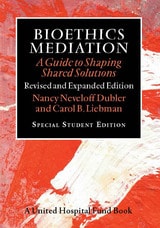
Bioethics Mediation
A Guide to Shaping Shared Solutions, Revised and Expanded EditionNancy Neveloff Dubler
Vanderbilt University Press, 2011
Conflicts come in different guises, and the key to successful resolution is early identification and intervention. Every bioethics mediator needs to be prepared with skills to listen, "level the playing field," identify individual interests, explore options, and help craft a "principled resolution" -- a consensus that identifies a plan aligned with accepted ethical principles, legal stipulations, and moral rules and that charts a clear course of future intervention.
The organization of the book makes it ideal for teaching or as a handbook for the practitioner. It includes actual cases, modified to protect the privacy of patients, providers, and institutions; detailed case analyses; tools for step-by-step mediation; techniques for the mediator; sample chart notes; and a set of actual role plays with expert mediator and bioethics commentaries. The role plays include:
- discharge planning for a dying patient
- an at-risk pregnancy
- HIV and postsurgical complications in the ICU
- treatment for a dying adolescent
- dialysis and multiple systems failure
Expanded by two-thirds from the 2004 edition, the new edition features two new role plays, a new chapter on how to write chart notes, and a discussion of new understandings of the role of the clinical ethics consultant.

Bioethics in the Courts
Analyszing the Bioethical Jurisprudence of International and National CourtsJudit Sandor
Central European University Press, 2027

Children and Drug Safety
Balancing Risk and Protection in Twentieth-Century AmericaConnolly, Cynthia A
Rutgers University Press, 2018
Children and Drug Safety traces the development, use, and marketing of drugs for children in the twentieth century, a history that sits at the interface of the state, business, health care providers, parents, and children. This book illuminates the historical dimension of a clinical and policy issue with great contemporary significance—many of the drugs administered to children today have never been tested for safety and efficacy in the pediatric population.
Each chapter of Children and Drug Safety engages with major turning points in pediatric drug development; themes of children’s risk, rights, protection and the evolving context of childhood; child-rearing; and family life in ways freighted with nuances of race, class, and gender. Cynthia A. Connolly charts the numerous attempts by Congress, the Food and Drug Administration, the American Academy of Pediatrics, and leading pediatric pharmacologists, scientists, clinicians, and parents to address a situation that all found untenable.
Open access edition funded by the National Endowment for the Humanities.
The text of this book is licensed under a Creative Commons Attribution NonCommercial-NoDerivatives 4.0 International License: https://creativecommons.org/licenses/by-nc-nd/4.0/
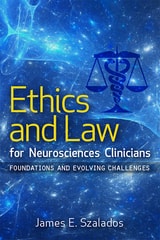
Ethics and Law for Neurosciences Clinicians
Foundations and Evolving ChallengesJames E. Szalados
Rutgers University Press, 2019

Life-Altering
Abortion Stories from the MidwestAngie Leventis Lourgos
University of Missouri Press, 2023
Based on her coverage of reproductive rights for the Chicago Tribune, veteran journalist Angie Leventis Lourgos explores these personal accounts to delve into the most nuanced aspects of abortion, from life-threatening cases to terminations later in gestation to restrictions for minors. The reporting spans the time before Roe and continues through the first year after the landmark Supreme Court case’s stunning reversal, which spurred some of the most stringent abortion laws of the past half-century—as well as new and innovative means of access.
From interviews Lourgos conducted with women across the Midwest, Life-Altering examines different facets of abortion from the perspectives of those who ended their pregnancies, illustrating how court cases, state legislation, and religious beliefs can affect the lives and reproductive choices of ordinary people. By looking at myriad factors that influence the decision whether or not to abort a pregnancy— be they socio-economic, religious, legal, or medical—the accounts collected in this volume challenge the conventional labels of “pro-life” and “pro-choice .”
Speaking for the Dying
Life-and-Death Decisions in Intensive CareSusan P. Shapiro
University of Chicago Press, 2019
Speaking for the Dying tells their story, drawing on daily observations over more than two years in two intensive care units in a diverse urban hospital. From bedsides, hallways, and conference rooms, you will hear, in their own words, how physicians really talk to families and how they respond. You will see how decision makers are selected, the interventions they weigh in on, the information they seek and evaluate, the values and memories they draw on, the criteria they weigh, the outcomes they choose, the conflicts they become embroiled in, and the challenges they face. Observations also provide insight into why some decision makers authorize one aggressive intervention after the next while others do not—even on behalf of patients with similar problems and prospects. And they expose the limited role of advance directives in structuring the process decision makers follow or the outcomes that result.
Research has consistently found that choosing life or death for another is one of the most difficult decisions anyone can face, sometimes haunting families for decades. This book shines a bright light on a role few of us will escape and offers steps that patients and loved ones, health care providers, lawyers, and policymakers could undertake before it is too late.
TennCare, One State's Experiment with Medicaid Expansion
Christina Juris Bennett
Vanderbilt University Press, 2014
While many states cut back on their Medicaid enrollments from 1993 to 2001, TennCare grew from 750,000 to 1.47 million enrollees. The state was less successful in controlling costs, however. Each major stakeholder group (the state, the managed care organizations, the providers, and the enrollees and their advocates) pushed back against parts of the state's strategy that adversely affected their interests, and they eventually dismantled the mechanisms of cost constraint.
The author lays out the four stakeholder perspectives for each period in the history of TennCare and provides a link to difficult-to-access primary documents.
The Medical Malpractice Myth
Tom Baker
University of Chicago Press, 2005
This, according to Tom Baker, is the myth of medical malpractice, and as a reality check he offers The Medical Malpractice Myth, a stunning dismantling of this familiar, but inaccurate, picture of the health care industry. Are there too many medical malpractice suits? No, according to Baker; there is actually a great deal more medical malpractice, with only a fraction of the cases ever seeing the inside of a courtroom. Is too much litigation to blame for the malpractice insurance crisis? No, for that we can look to financial trends and competitive behavior in the insurance industry. Are these lawsuits frivolous? Very rarely. Point by point, Baker—a leading authority on insurance and law—pulls together the research that demolishes the myths that have taken hold about medical malpractice and suggests a series of legal reforms that would help doctors manage malpractice insurance while also improving patient safety and medical accountability.
President Bush has made medical malpractice reform a priority in his last term in office, but if history is any indication, legislative reform would only worsen the situation and perpetuate the gross misunderstanding of it. The debate surely will be transformed by The Medical Malpractice Myth, a book aimed squarely at general readers but with radical conclusions that speak to the highest level of domestic policymaking.
Why Surgeons Struggle with Work-Hour Reforms
James E. Coverdill
Vanderbilt University Press, 2021
Why Surgeons Struggle with Work-Hour Reforms focuses on general surgeons, a historically long-hour specialty, who fiercely opposed the reforms and are among the least compliant. Why do surgeons struggle with the reforms? Why do they continue to work long hours and view the act of doing so as reasonable if not quintessentially professional? Although the analysis is situated in the growing scientific literature on the consequences of fatigue, the authors do not adjudicate between the claims of surgeons and reform advocates about the effects of long work hours on patient or provider safety. Rather, the aim is to explore and explain how aspects of the occupational culture of surgeons and the social organization of surgical training and practice interlock to impede the reforms.