Results by title

8 books match the query 'Reagan'
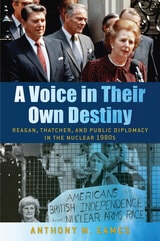
cover of A Voice in Their Own Destiny: Reagan, Thatcher, and Public Diplomacy in the Nuclear 1980s

A Voice in Their Own Destiny

Reagan, Thatcher, and Public Diplomacy in the Nuclear 1980s

Anthony M. Eames

University of Massachusetts Press, 2023

On June 8, 1982, Ronald Reagan delivered a historic address to the British Parliament, promising that the United States would give people around the world “a voice in their own destiny” in the struggle against Soviet totalitarianism. While British Prime Minister Margaret Thatcher celebrated Reagan’s visit and thanked him for putting “freedom on the offensive,” over 100,000 Britons marched from Hyde Park to Trafalgar Square to protest his arrival and call for nuclear disarmament. Reagan’s homecoming was equally eventful, with 1,000,000 protesters marking his return with a rally for nuclear disarmament in Central Park—the largest protest in American history up to that point.

Employing a wide range of previously unexamined primary sources, Anthony M. Eames demonstrates how the Reagan and Thatcher administrations used innovations in public diplomacy to build back support for their foreign policy agendas at a moment of widespread popular dissent. A Voice in Their Own Destiny traces how competition between the governments of Reagan and Thatcher, the Anglo-American antinuclear movement, and the Soviet peace offensive sparked a revolution in public diplomacy.
[more]
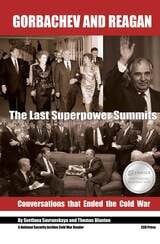
cover of Gorbachev and Reagan: The Last Superpower Summits. Conversations that Ended the Cold War

Gorbachev and Reagan

The Last Superpower Summits. Conversations that Ended the Cold War

The National Security Archive Savranskaya

Central European University Press, 2020
This book is the culmination of twenty years of research in which the editors gathered thousands of pages documenting the most important conversations of the late Cold War. Every word Ronald Reagan and Mikhail Gorbachev said to each other in their five superpower summits from 1985 to 1988 is included in this volume. The editors argue in their contextual essays and detailed notes that these summits fueled a learning process on both sides of the Cold War. Their anthology provides insight into the nuanced shifts of monumentally important discussions, showing how Moscow’s sense of threat was eased and how a hawkish Reagan softened his tone in negotiations during his second presidential term. Documents from foreign ministers Eduard Shevardnadze and George Shultz offer a particularly intriguing look into the handful of conversations that ended almost half a century of conflict. These verbatim transcripts, until now top secret, are combined with fascinating photos and crucial information from declassified preparatory and after-action documents from both the Americans and Soviets, obtained in the US through the Freedom of Information Act and in Russia from the Gorbachev Foundation, the State Archive of the Russian Federation in Moscow, and from the personal files of Anatoly Chernyaev, Gorbachev’s foreign policy adviser.
[more]
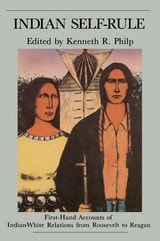
cover of Indian Self Rule: First-Hand Accounts of Indian-White Relations from Roosevelt to Reagan

Indian Self Rule

First-Hand Accounts of Indian-White Relations from Roosevelt to Reagan

edited by Kenneth R. Philp

Utah State University Press, 1995
Now back in print, this important collection of first-hand accounts from individuals who had leading roles in Indian-white relations is a necessary reference for anyone interested in the modern Indian experience. Reviewing fifty years of Indian history since the Indian Reorganization Act was passed during FDR's New Deal administration, the contributors include Indian leaders and activists from a wide cross-section of America's varied native communities.
[more]
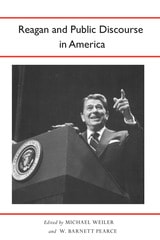
cover of Reagan and Public Discourse in America

Reagan and Public Discourse in America

Michael Weiler

University of Alabama Press, 1992

A critical assessment of the impact of the administration of President Ronald Reagan on public discourse in the United States

The authors show that more than any president since John F. Kennedy, Reagan’s influence flowed from his rhetorical practices. And he is remembered as having reversed certain trends and cast the U.S. on a new course. The contributors to this insightful collection of essays show that Reagan’s rhetorical tactics were matters of primary concern to his administration’s chief political strategists.
[more]
cover of The Last Superpower Summits: Reagan, Gorbachev and Bush. Conversations that Ended the Cold War.

The Last Superpower Summits

Reagan, Gorbachev and Bush. Conversations that Ended the Cold War.

The National Security Archive Savranskaya

Central European University Press, 2017
This book publishes for the first time in print every word the American and Soviet leaders – Ronald Reagan, Mikhail Gorbachev, and George H.W. Bush – said to each other in their superpower summits from 1985 to 1991. Obtained by the authors through the Freedom of Information Act in the U.S., from the Gorbachev Foundation and the State Archive of the Russian Federation in Moscow, and from the personal donation of Anatoly Chernyaev, these previously Top Secret verbatim transcripts combine with key declassified preparatory and after-action documents from both sides to create a unique interactive documentary record of these historic highest-level talks – the conversations that ended the Cold War. The summits fueled a process of learning on both sides, as the authors argue in contextual essays on each summit and detailed headnotes on each document. Geneva 1985 and Reykjavik 1986 reduced Moscow's sense of threat and unleashed Reagan's inner abolitionist. Malta 1989 and Washington 1990 helped dampen any superpower sparks that might have flown in a time of revolutionary change in Eastern Europe, set off by Gorbachev and by Eastern Europeans (Solidarity, dissidents, reform Communists). The high level and scope of the dialogue between these world leaders was unprecedented, and is likely never to be repeated.
[more]
cover of The Other Arab-Israeli Conflict: Making America's Middle East Policy, from Truman to Reagan

The Other Arab-Israeli Conflict

Making America's Middle East Policy, from Truman to Reagan

Steven L. Spiegel

University of Chicago Press, 1985
The Other Arab-Israeli Conflict illuminates the controversial course of America's Middle East relations from the birth of Israel to the Reagan administration. Skillfully separating actual policymaking from the myths that have come to surround it, Spiegel challenges the belief that American policy in the Middle East is primarily a relation to events in that region or is motivated by bureaucratic constraints or the pressures of domestic politics. On the contrary, he finds that the ideas and skills of the president and his advisors are critical to the determination of American policy. This volume received the 1986 National Jewish Book Award.
[more]
cover of We Begin Bombing in Five Minutes: Late Cold War Culture in the Age of Reagan

We Begin Bombing in Five Minutes

Late Cold War Culture in the Age of Reagan

Andrew Hunt

University of Massachusetts Press, 2021

In the moments before his weekly radio address hit the airwaves in 1984, Ronald Reagan made an off-the-record joke: "I've signed legislation that will outlaw Russia forever. We begin bombing in five minutes." As reports of the stunt leaked to the press, many Americans did not find themselves laughing along with the president. Long a fervent warrior against what he termed the "Evil Empire," by the mid-1980s, Reagan confronted growing domestic opposition to his revival of the Cold War. While numerous histories of the era have glorified the "Decade of Greed," historian Andrew Hunt instead explores the period's robust political and cultural dissent.

We Begin Bombing in Five Minutes focuses on a striking array of protest movements that took up issues such as the nuclear arms race, U.S. intervention in Central America, and American investments in South Africa. Hunt's new history of the eighties investigates how film, television, and other facets of popular culture critiqued Washington's Cold War policies and reveals that activists and cultural rebels alike posed a more meaningful challenge to the Cold War's excesses than their predecessors in the McCarthy era.
[more]
cover of When Democrats Won the Heartland: Progressive Populism in the Age of Reagan, 1978-1992

When Democrats Won the Heartland

Progressive Populism in the Age of Reagan, 1978-1992

Cory Haala

University of Illinois Press, 2026

In the 1980s, the Midwestern economic collapse caused by the farm crisis and deindustrialization inspired the region’s liberal politicians to call on progressive populist traditions to rebuild local, state, and national Democratic parties. Cory Haala looks at the Midwest’s central role in asserting an updated populism wielded by grassroots activists, politicians, and a wide-ranging coalition of voters to counter Reagan-era conservativism.

This left-oriented movement resurrected the imagery and policies of twentieth-century radical parties like the Minnesota Farmer-Labor Party and Robert La Follette’s Wisconsin Idea. Delving into progressive populist ideas and tactics, Haala illuminates the work of the activists and politicians who led protests, founded a congressional caucus, and backed presidential campaigns that sought to advance their cause. Haala’s account moves from Iron Range union halls to Iowa farmhouses to South Dakota reservations to revise views of Democratic Party history, the Midwest’s political culture, and populism’s role in US politics.

A counter to established political narratives, When Democrats Won the Heartland takes readers into the history of an unexpected political moment.
[more]